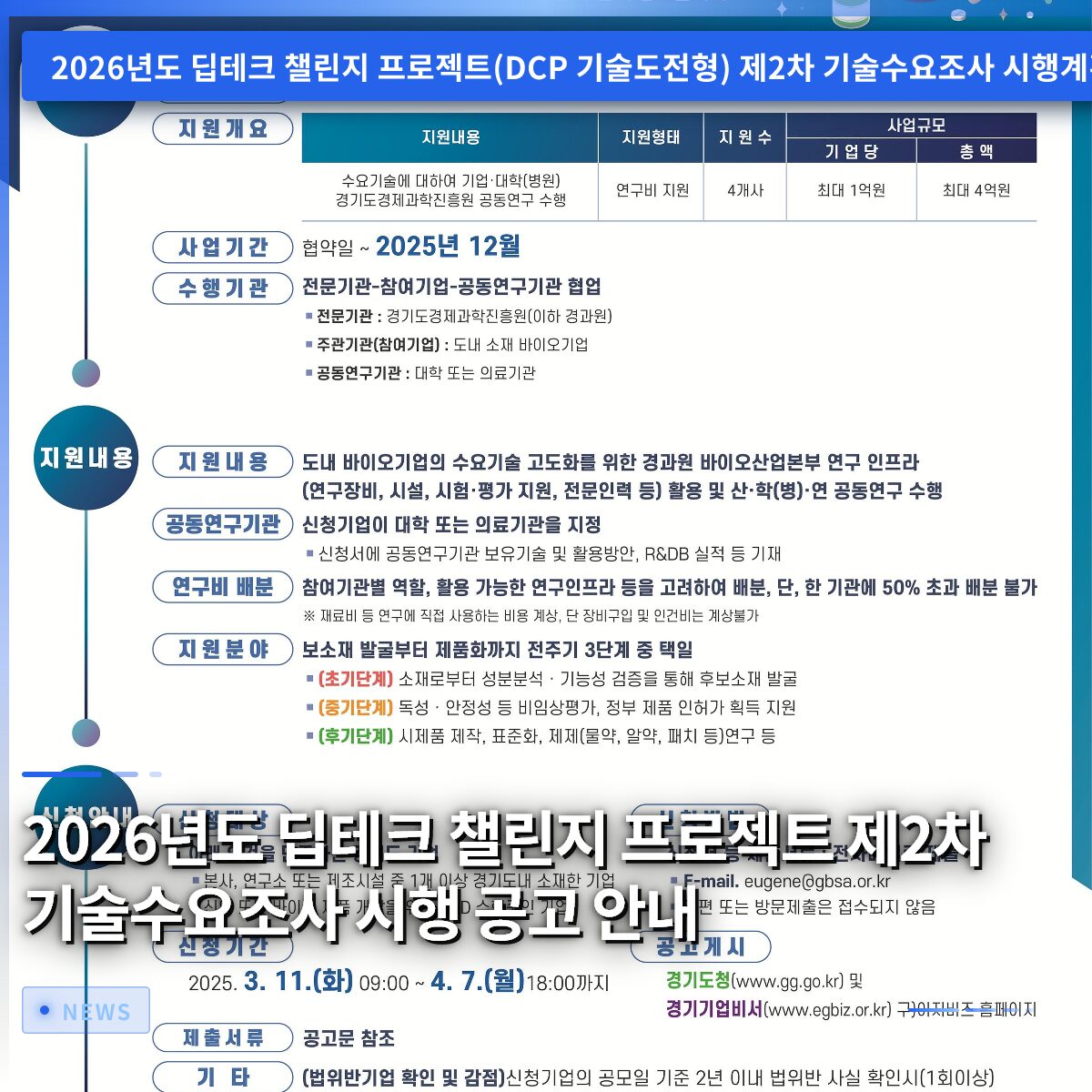
The implementation plan for the 2nd Technology Demand Survey of the 2026 Deep Tech Challenge Project (Technology Challenge Type) has been officially announced. This survey is a crucial procedure designed to reflect the voices from the field, enabling innovative companies in South Korea to lead future technologies. Many researchers and business leaders are moving swiftly to find new growth drivers. For instance, companies with exceptional technological capabilities in fields such as artificial intelligence and advanced biotechnology are using this opportunity to grasp the direction of government support programs. Therefore, any entity with innovative ideas in related fields should carefully review the schedule for this demand survey without missing it. In this article, we will clearly summarize the detailed schedule, participation methods, and key precautions of the announcement.
=
Notice on the Implementation of the 2nd Technology Demand Survey for the 2026 Deep Tech Challenge Project
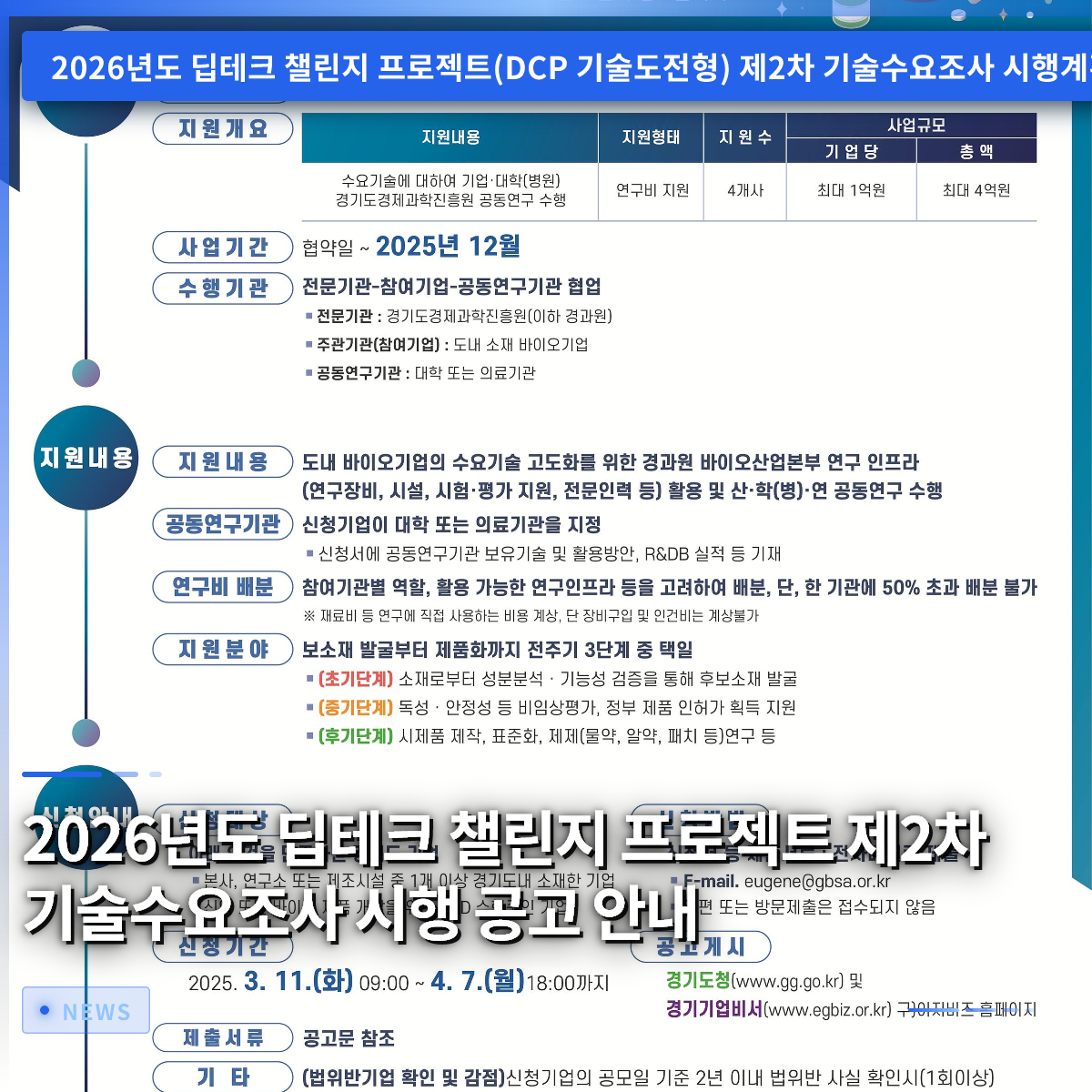
1. Understanding the Project Overview and Objectives

The Deep Tech Challenge Project announced this time is a core initiative at the national level aimed at discovering future growth engines and fostering innovative technologies. Moving beyond conventional support methods, it presents clear challenge tasks and encourages innovative approaches to solving them. True to its name as a “Technology Challenge Type” project, it focuses on high-difficulty tasks that, despite the risk of failure, would have a massive impact if successful. Many experts conducting research in the field expect this approach to lead to the acquisition of true source technologies. For example, research in materials science that may take years to commercialize but could shake the global market upon success falls into this category.
To accurately understand the intent of such a project, one must be able to judge whether the content proposed by our organization aligns with the government’s direction. It is essential to critically evaluate whether our current capabilities meet the project’s requirements, rather than applying unconditionally. The responsible department is demonstrating its will to lay a solid foundation for South Korea to gain an advantage in the future technology hegemony competition through this process. It serves as an opportunity to consider what preparations our company should make to respond to the changes in the coming future society. One must remember that thorough preliminary research is the first step toward successful participation.
It is essential to accurately grasp the fundamental purpose of this project, which aims to acquire high-difficulty source technologies.
2. Checking the Application Period and Key Schedule
The 2nd Technology Demand Survey is scheduled to run from September 28, 2026, to November 13, 2026. Although this period of about a month and a half may seem ample, one must start moving immediately to prepare a substantive proposal. It is more common than one might think for critical omissions to occur when documents are submitted in a rush near the deadline due to poor schedule management. In fact, a small business that participated in a similar project last year shared a close call where they nearly missed the submission due to a server overload right before the deadline. Therefore, the safest method is to prepare and register all documents well in advance of the deadline.
The announcement number is No. 2026-569, and related detailed documents and attachments can be downloaded directly from the Ministry of SMEs and Startups website. It is necessary to mark the schedule prominently on a calendar and develop the habit of checking the specific tasks to be completed at each stage in detail. The responsible department is repeatedly emphasizing that applications are only accepted within the designated deadline, and no exceptions will be made. It is advisable to designate a key person in charge and establish a system to check progress daily, even amidst a busy schedule. The more time and care taken in preparation, the higher the chances of selection.
Strictly adhere to the submission deadline of November 13, 2026, and prepare with ample time to spare.
3. How to Participate in the Technology Demand Survey

The Technology Demand Survey proposal must be written according to the designated format, clearly demonstrating the necessity and distinctiveness of the technology. It should not merely list ideas but logically prove specific feasibility and economic impact. For example, it is highly effective to present numerical data showing how much cost can be saved compared to existing processes if the technology is introduced. During the writing process, rather than filling the text with technical jargon, one needs the sense to structure it with sentences that are easy for anyone to understand and persuasive.
Applications are processed online through the official website, and documents other than the designated format may be excluded from review. Before submission, one must repeatedly check that all items are filled in without omission and that there are no errors in the attached supporting materials. It is also a good method to show the draft to colleagues or external experts for objective feedback. This is because logical flaws may be discovered from another person’s perspective, allowing for corrections before the deadline. One must maintain focus until the end to ensure that the carefully prepared proposal leaves a deep impression on the review committee.
A proposal that logically includes the distinctiveness and feasibility of the technology must be submitted online according to the designated format.
4. Eligibility and Qualification Requirements

This Technology Challenge Type project has widely opened its doors to small and medium-sized enterprises (SMEs), research institutions, and others equipped with innovative technological capabilities. However, to prevent indiscriminate applications, a basic verification process for execution capabilities is required. The scale of the research personnel and R&D performance over the past few years are used as key review indicators. For example, companies that hold numerous patents in related fields or have commercialization track records can occupy a much more advantageous position.
If there are any ambiguous parts regarding whether you meet the qualification requirements, it is wise to contact the responsible department listed in the announcement in advance. To avoid the unfair situation of being judged ineligible later, a procedure to confirm clearly in advance is absolutely necessary. In the case of participating in a consortium form, the division of roles between the lead institution and participating institutions must be clearly stated. Demonstrating that the strengths of each entity can create a synergistic effect is the key to selection. Carefully verify that you fully meet the qualification conditions and prepare strategic support.
You must fully meet the qualification requirements by proving clear R&D performance and execution capabilities.
5. Strategies for a Successful Proposal

To achieve good results in government support projects, an eye for reading trends and a thorough differentiation strategy are essential. One must consider what true challenge this Deep Tech Challenge Project pursues and find our own unique weapon. It is difficult to capture the attention of reviewers with ordinary topics that everyone is doing, so originality is very important. For example, convergence technologies that can solve environmental issues or energy shortages, which are cited as social challenges, can be a good example.
Additionally, to improve the quality of the proposal, it must be backed by thorough market analysis and competitor trend research. Presenting a concrete roadmap for how the technology development will lead to commercialization after completion determines the success or failure of the application. Rather than vague expectations, one should cite objective data and expert opinions to enhance the credibility of the argument. These efforts will ultimately lead to the fruit of final selection. Let us now sharpen our own powerful weapon to survive in fierce competition.
It is important to formulate a differentiated proposal strategy equipped with originality and a specific commercialization roadmap.
6. Future Prospects and Preparations

The 2026 Deep Tech Challenge Project will be a significant turning point that changes the landscape of South Korea’s future industries. The valuable opinions submitted in this 2nd Technology Demand Survey will be directly reflected in the formulation of future government R&D policies. Therefore, even if you do not directly perform the tasks, it is a very beneficial opportunity to grasp the overall flow of our industry. Only companies that proactively respond to the coming wave of change will seize market leadership.
Even at this very moment, numerous innovative entities are submitting their challenges after meticulous preparation. We hope that you, our readers, will actively utilize this opportunity to widely showcase the technological potential you possess. Small interest and thorough preparation will gather to become a great step that elevates your business to the next level. We sincerely support you in completing the documents step by step by the deadline of November 13, 2026, for a good result. We look forward to your bold challenge toward the future bearing successful fruit.
This should be taken as an opportunity to seize leadership in future industries through thorough preliminary preparation and bold challenges.
Frequently Asked Questions
=