If you consistently contribute 300,000 KRW to your pension savings account every month, you can claim up to 3.6 million KRW as a tax deduction during your year-end tax settlement, resulting in a substantial refund. Many employees often emphasize the importance of maxing out their account contribution limits every year to secure a generous “13th month salary” during the year-end tax settlement season. In fact, the tax deduction benefits are so attractive that prioritizing long-term savings and tax efficiency over immediate cash flow has become a smart choice. As of 2026, the annual tax deduction limit for pension savings is 6 million KRW, which can be expanded to a maximum of 9 million KRW when combined with an Individual Retirement Pension (IRP) account. In this article, we will detail the precise structure of the tax deduction for pension savings accounts, efficient asset management methods, and common pitfalls to avoid.
=
Pension Savings Account Tax Deduction Limits and Essential Tax-Saving Strategies for 2026: A Complete Guide
1. Calculating the Refund Amount for Monthly Contributions of 300,000 KRW

If you diligently contribute 300,000 KRW to your pension savings account every month for a year, your total annual contribution will be exactly 3.6 million KRW. For employees with a total annual income of 55 million KRW or less, a tax deduction rate of 16.5% is applied, allowing you to receive a refund of approximately 590,000 KRW during your year-end tax settlement. Even if your total annual income exceeds 55 million KRW, a deduction rate of 13.2% is applied, resulting in tax savings of approximately 470,000 KRW. This is equivalent to securing a guaranteed return that far exceeds typical bank deposit interest rates. Mr. Kim, an employee, started a pension savings account last year with some skepticism, but after checking his year-end tax settlement refund, he realized the true value of the system and increased his monthly contributions. Thus, what may seem like a modest monthly contribution accumulates to become a powerful tool for maximizing your year-end tax refund.
A monthly contribution of 300,000 KRW results in an annual deductible amount of 3.6 million KRW, offering a tax deduction benefit of 13.2% to 16.5% depending on your income bracket.
2. 2026 Tax Deduction Limits and How to Maximize the Increased Cap

As of 2026, the annual tax deduction limit for a standalone pension savings account is set at a maximum of 6 million KRW. By additionally utilizing an Individual Retirement Pension (IRP) account for contributions, you can significantly increase the total deduction limit to a maximum of 9 million KRW. To maximize your tax refund during the year-end settlement, the most standard approach is to contribute 6 million KRW to your pension savings account and an additional 3 million KRW to your IRP account. Mr. Lee, an employee, initially found it burdensome to max out the limits, but by splitting his bonus payments into smaller contributions, he has successfully filled the 9 million KRW limit every year. However, you must be careful not to neglect the management of products within your accounts while focusing on meeting contribution limits, as this can lead to lower returns. By making a thorough plan to allocate your annual contributions, you can fully enjoy the tax benefits without straining your finances.
The tax deduction limit is 6 million KRW for a standalone pension savings account, but it increases to a maximum of 9 million KRW when combined with an Individual Retirement Pension (IRP) account.
3. Asset Management and Product Selection Tips Within the Account
A pension savings account is not merely a savings product for depositing cash; it is a comprehensive asset management space where you can invest in various funds and Exchange-Traded Funds (ETFs) through securities firms. Capital gains generated from buying and selling products within the account are not taxed immediately; instead, taxation is deferred until you receive your pension, a benefit known as tax deferral. Mr. Park, an employee, once impulsively invested in various appealing products, resulting in dozens of funds and ETFs in his account that became unmanageable. Following expert advice, he aggressively streamlined his portfolio by removing duplicate products and focusing on core assets, which made managing returns and monitoring the account much easier. Note that some tax-benefited products opened at bank branches may be excluded from separate periodic reviews, so you should carefully check the specific characteristics of your financial institution. Freely rebalancing assets within the account to maximize the effect of compound interest is the key to long-term investment success.
Tax deferral benefits apply when trading products within a pension account, and it is advantageous to streamline operations by organizing duplicate products.
4. Planning Pension Receipt Age and Duration, and the Secrets of Tax Rates
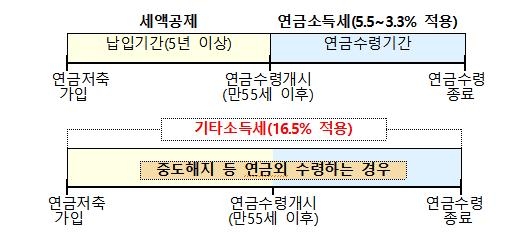
To actually receive the assets accumulated in your pension savings account and Individual Retirement Pension, you must meet specific requirements. Basically, you must be at least 55 years old, and a minimum of 5 years must have passed since the initial account opening to receive funds in the form of a pension. The tax rate applied when receiving the pension is structured to decrease as you age, which is highly reasonable. Specifically, including local income tax, a pension income tax rate of 5.5% is applied from age 55 to 69. As you age, the rate drops to 4.4% for those between 70 and 79, and for those aged 80 and above, a low rate of only 3.3% is applied. By receiving your pension in installments at a low tax rate after your retirement income stops, you can minimize your tax burden while securing a stable cash flow.
You can receive your pension if you are at least 55 years old and have held the account for 5 years; the applicable tax rate decreases as you get older.
5. Warning: The Tax Bomb of Early Termination
Because pension savings accounts offer strong tax deduction benefits, strict penalties are applied if you terminate the account early or receive funds in a form other than a pension, so caution is required. If you terminate the account midway due to an urgent need for cash, you will be subject to a heavy tax of 16.5% as miscellaneous income tax on both the previously deducted taxes and the investment returns. Mr. Jung, an employee, regretted his decision to close his pension savings account, which he had diligently funded for several years, due to an urgent need for wedding funds, as he faced an unexpected tax bomb. Therefore, if you inevitably need funds before retirement, it is much wiser to utilize partial withdrawal systems while maintaining the account or to explore collateral loans offered by financial institutions rather than terminating the account unconditionally. Since this is long-term funding for your old age, it is wise to set your contribution amount within the range of your surplus funds so that you are not swayed by short-term funding needs.
In the case of early termination, a 16.5% miscellaneous income tax is applied to the tax deduction benefits received and the returns, so special caution is required.
6. Practical Final Strategies for Successful Retirement Preparation
As we have seen, the pension savings account is one of the best financial tools for employees in South Korea to legally secure the most certain tax-saving effects. By making consistent monthly contributions to secure year-end tax refunds, and by enjoying the benefits of tax deferral and low-rate taxation to grow your retirement assets, your post-retirement life will be much more secure. No matter how the financial environment changes, the fundamental structure of the state-guaranteed tax-saving account is unlikely to be easily shaken, so it is advantageous to join early and leverage the power of time. Today, check your annual income and current contribution amount, and if you have not reached the limit, exercise the initiative to fill the gap before the year ends. This small attention and action will be the most certain first step toward completing a prosperous and comfortable financial future.
You should join a pension savings account early and make consistent contributions to secure both the compound interest effect of time and maximum tax-saving benefits.
Frequently Asked Questions
=