If you find yourself facing a situation where you have to pay additional taxes rather than receiving a refund during the year-end tax settlement season, it is time to seriously consider opening a personal pension savings account. Mr. Kim, an office worker, was shocked when he checked the year-end tax settlement simplification service last year. While his colleagues were receiving refunds of several hundred thousand won, he had to pay extra taxes. It turned out that his colleagues had been consistently utilizing pension savings accounts for years, effectively taking advantage of valuable tax deduction benefits. One of the most reliable ways to reduce your tax burden and build a solid future asset base is to join a personal pension savings plan. In this article, we will step-by-step explore the basic concepts of personal pension savings, tax deduction limits, and practical wealth management strategies in an easy-to-understand manner.
=
Personal Pension Savings: Tax Deduction Limits and Secrets to Maximizing Year-End Tax Refunds
1. What is Personal Pension Savings?
Personal pension savings is a representative savings product that offers tax benefits to help individuals prepare for their retirement and secure a comfortable post-retirement life. It has a very low barrier to entry, as anyone can join regardless of income status, including employed workers, housewives without income, and university students. In the past, savings-type insurance through banks or insurance companies was the norm, but recently, there is a growing preference for pension savings funds, which allow individuals to directly choose their investment products. Since this is a financial product for growing assets over the long term, it should be approached with funds intended for long-term holding rather than money needed for short-term expenses.
Looking around, many people feel overwhelmed by the prospect of life after retirement. However, setting up this account in advance can provide significant psychological peace of mind. The process of consistently contributing a fixed amount each month to grow your assets helps build excellent savings habits. In particular, if you start preparing early in your career, you can maximize the effect of compound interest, leading to a substantial difference in the future. Therefore, even if you don’t have a large sum of money right now, opening an account with a small, manageable amount is a wise first step.
Personal pension savings is a retirement preparation account available to everyone, offering the essential financial benefits of long-term asset formation and tax incentives.
2. Differences Between Pension Savings Funds and Pension Savings Insurance
Many people are confused about which product format to choose when signing up with a bank, securities firm, or insurance company. Pension savings insurance is a suitable choice for those who prefer to save a fixed amount monthly at a guaranteed interest rate for stability. On the other hand, pension savings funds involve direct investment in equity assets or exchange-traded funds (ETFs) through a securities account to pursue higher returns. Recently, the number of investors choosing securities firm pension savings funds has overwhelmingly increased, as they aim to defend against inflation and aggressively grow their assets.
In the case of Mr. Park, an office worker, he initially started with a safe insurance product similar to a deposit but transferred his contract to a securities firm a few years ago after realizing the importance of long-term investment. Using a securities account allows you to select various domestic and international ETFs according to your preference, offering the advantage of flexible response to market conditions. Of course, it is not entirely free from the risk of principal loss, but for younger generations with decades left until retirement, combining investments is far more advantageous. You should carefully consider your investment style and risk tolerance to determine the method that best suits you.
Choose insurance if you want principal protection, or choose funds from a securities firm if you are pursuing aggressive returns.
3. Complete Guide to Tax Deduction Limits and Benefits
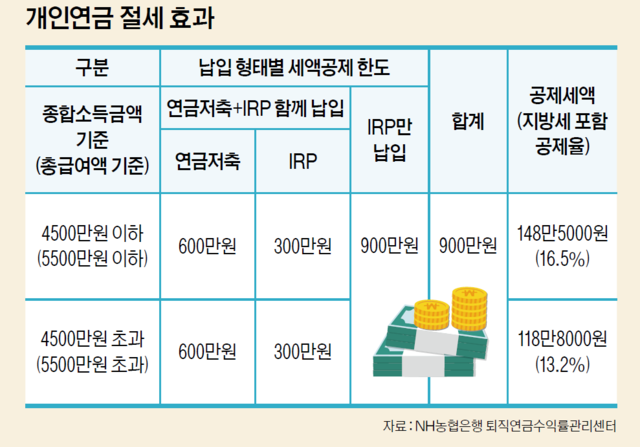
To address the issue of poverty in old age, the government provides generous tax deduction benefits on contributions to pension accounts. When combining pension savings accounts and individual retirement pensions (IRP), the annual contribution limit eligible for tax deductions is up to 9 million won. If you fill only the pension savings account, you can receive tax deduction benefits on contributions up to 6 million won annually, resulting in a significant tax-saving effect. The tax deduction rate varies from 13.2% to a maximum of 16.5% depending on your annual total income, which affects the refund amount.
For example, if an office worker with total income below a certain threshold contributes the maximum 6 million won to a pension savings account, they can receive a substantial tax refund of 990,000 won during the year-end tax settlement. Since a significant portion of the taxes paid annually is returned in cash, this is considered one of the best wealth management tools among office workers. If you want to fully utilize the 9 million won limit, you can contribute 6 million won to a pension savings account and an additional 3 million won to an IRP. Simply understanding and implementing this tax-saving formula can help protect the wallets of office workers.
You can contribute up to 6 million won annually to pension savings, or up to 9 million won when combined with retirement pensions, to receive tax deductions of up to 16.5%.
4. Practical Strategies to Maximize Year-End Tax Refunds
If you want to smile every year during the year-end tax settlement, often called the “13th month’s salary,” you need to strategically readjust your fixed monthly expenses and savings plans. When wondering how to use bonuses or emergency funds saved during holidays, it is wiser to use them as additional contributions to this account rather than for consumption. A popular method is to set up automatic transfers for a fixed amount monthly and then fill the remaining amount up to the deduction limit in one go as the year-end approaches. This reduces the burden of locking up a large sum of money at once while ensuring a definite reward in the form of a year-end tax refund.
In fact, Mr. Choi, an office worker, calculates his surplus funds every year and fills in the missing contribution amount to renew his maximum refund amount annually. Although he initially felt burdened by the monthly outflow, he realized that the refund amount offered returns incomparable to bank deposit interest rates. Instead of feeling anxious about stories of others making big money in stocks or real estate, the basics of wealth management involve securing certain tax-saving benefits first. You will experience the powerful magic where small habit changes accumulate to create an asset difference of several million won after a few years.
By using bonuses or surplus funds to fill in missing contributions at year-end, you can secure the maximum refund amount with certainty every year.
5. Precautions and Countermeasures for Early Termination
Since personal pension savings is a long-term product, early termination during the subscription period can result in significant disadvantages. If you have to terminate the account early due to a sudden need for a large sum of money, you must return all tax deduction benefits received so far in the form of other income tax. This painful situation, where money saved frugally through tax benefits is lost to taxes in one go, requires caution when signing up. Therefore, you should not put funds needed within the next few years, such as wedding funds or home purchase funds, into this account; instead, use regular deposits or other accounts.
If you must withdraw funds for unavoidable reasons, it is more advantageous to utilize the account transfer system between financial institutions or look into partial withdrawal systems rather than terminating the account. There are also exception clauses allowing withdrawal at a lower tax rate if the situation falls under legally defined unavoidable circumstances, so you should not simply terminate the account first. Since this is a long-term race, using the contribution suspension system to pause contributions when you need a breather is also a wise method. It is most important to start with a realistic amount you can afford and see it through to the end.
Early termination may result in the recoupment of all tax deductions received, so avoid using short-term funds and only contribute amounts you can maintain until the end.
6. Mindset and Action for a Successful Retirement
Life after retirement is longer and more significant than many think, and the only sturdy support to sustain you then is the pension assets you have prepared yourself. It is difficult to enjoy a comfortable retirement relying solely on the National Pension guaranteed by the state, so additional preparation through personal pension savings is essential. You need the action to open an account and set up automatic transfers, even for small amounts, by turning on a securities or bank app today. Start this most certain and safe investment for your future self now and aim for an economically free retirement.
Many people know the importance of retirement preparation intellectually but keep postponing action due to immediate realities. However, as time passes, the magic of compound interest diminishes, and opportunities to receive tax benefits naturally disappear. As many successful investors around us emphasize, the perfect timing is right now, this very moment. Small actions will accumulate to become a sturdy fence for your distant future, so we recommend taking a step forward immediately.
Postponing retirement preparation leads to losses, so open an account today and start with small amounts to prepare for a secure future.
Frequently Asked Questions
=