Pension savings insurance remains an attractive option for those looking to prepare stable funds for retirement, but caution is required, as enrolling without proper consideration can lead to significant losses. Recently, commercial banks and insurance companies have been aggressively promoting enrollment by highlighting guaranteed interest rates. However, if the product does not align with your investment style and retirement timeline, you are likely to face difficulties. Last year, Mr. Kim, an office worker, enrolled in pension savings insurance solely for the year-end tax deduction benefits. A few years later, when he urgently needed cash, he canceled the policy and ended up facing a massive tax bill. In this article, we will thoroughly examine the precise structure and pros and cons of pension savings insurance, as well as the differences between it and other retirement preparation products. This will help you carefully evaluate whether this product is right for you and make a wise decision. Let us break down the hidden truths of complex financial products in an easy-to-understand manner.
=
Pros, Cons, and Return Analysis: What You Must Know Before Enrolling in a Pension Savings Insurance
1. The Appeal of Guaranteed Interest Rates and Tax Deduction Benefits
Pension savings insurance is a representative product that allows you to fully utilize the year-end tax deduction benefits provided by the government while earning stable interest without the risk of losing your principal. Since tax deductions can be claimed within a certain limit of the annual maximum contribution, it is often considered an essential item for office workers during the annual year-end tax settlement season. As recent market conditions have become unstable, products offering guaranteed interest rates, primarily from major insurance companies, are once again gaining attention. A major advantage is that, compared to simply depositing money in a bank, you can enjoy long-term tax savings while securing a definite interest rate. In particular, investors tired of stock market volatility are turning to this product as a means to prepare for retirement step by step while ensuring their principal is protected.
However, relying solely on these immediate benefits can lead to trouble, so you must carefully examine the overall structure. Receiving a tax deduction means that you will have to pay pension income tax when you receive the pension later, so it should be understood as a tax deferral effect. While saving on taxes in the present is certainly attractive, you must keep in mind that the actual amount received after retirement may be less than expected. Instead of impulsively enrolling based on recommendations from acquaintances or statements from bank employees, it is essential to thoroughly calculate your income level and future cash flow. Above all, it is crucial to ask yourself whether you have the financial capacity to make consistent contributions over a long period.
Pension savings insurance has powerful tools in the form of guaranteed interest rates and tax deductions, but you must first check your ability to maintain the policy long-term.
2. Fatal Drawbacks: Early Cancellation Risks and Low Returns

The biggest drawback of pension savings insurance is that if you cancel the policy within the first few years of enrollment, you will suffer significant principal losses and be subject to miscellaneous income tax. Many people naively think they can cancel the policy and use the money whenever they need a lump sum, but in reality, they receive a refund far less than the principal they contributed. Due to the nature of insurance companies, a large portion of business expenses and sales commissions is deducted at the beginning of the contract. Therefore, if you cancel the policy after a few years of contributions, the refund rate is extremely low. It is not uncommon to hear regretful stories from people who enrolled in insurance when they were just starting their careers without knowing better, only to cancel it after three years and recover less than half of their principal.
Furthermore, considering recent inflation rates, the low returns of pension savings insurance can be a fatal weakness as a retirement preparation tool. Statistics from the last few years show that the return gap between insurance company products and investment-type products centered on funds or exchange-traded funds (ETFs) has widened significantly. While there is stability in the guarantee of principal and interest, there is a persistent risk that your purchasing power in retirement will decrease because the returns fail to keep up with inflation. Therefore, you should not take lightly the warning that chasing stability alone could lead to poverty after retirement. No matter how conservative your investment style is, you must secure a minimum path for asset growth that can defend against inflation.
Early cancellation can result in severe principal loss and a tax burden, while low returns fail to keep up with inflation.
3. Comparing Decisive Differences with Pension Savings Funds

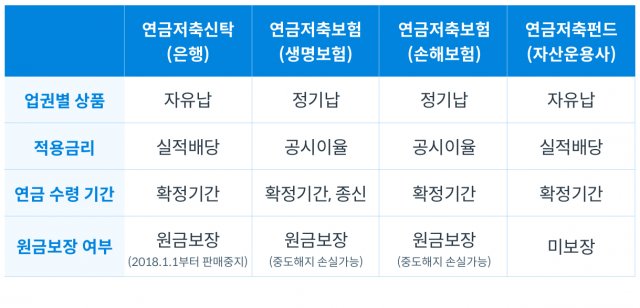
Although they share the same name “pension savings,” products sold by insurance companies and securities firms differ vastly in their asset management methods, like heaven and earth. Products managed by securities firms allow you to directly invest in equity ETFs or various funds within the account to pursue high returns, whereas insurance products operate with a fixed interest rate. In your younger years, it is advantageous to aggressively grow your assets by increasing the proportion of equity assets, but insurance products make it difficult to fully enjoy this compound interest effect. In fact, when comparing the long-term returns of the two products, a huge gap emerges. Consequently, it is widely believed that investment-type accounts are far more favorable for young people who have a long way to go until retirement compared to insurance products.
However, it is not possible to definitively state that investment-type products from securities firms are always better, as everyone’s tolerance for risk differs. If watching the stock index fluctuate daily makes your heart race and keeps you awake at night, an insurance product where interest accumulates steadily might be better for your mental health. The important thing is not to blindly follow what others say is good, but to choose based on your age, financial situation, and investment philosophy. If you are regretting an insurance policy you have already enrolled in, consider switching to an equivalent account at another financial institution rather than canceling it outright. Only by accurately understanding and comparing the pros and cons of each product can you build the only shield against retirement bankruptcy.
Pension savings insurance focuses on stable interest rates, while securities firm products aim for high returns through direct investment, so the choice depends on your investment style.
4. Smart Switching Using the Account Transfer System
If you are regretting your enrolled pension savings insurance due to low returns or excessive business expenses, you should utilize the system that allows you to transfer to another financial institution without canceling the policy. Many consumers, when they want to change products, simply cancel and withdraw their money, but this results in a massive tax and fee burden, which must be avoided at all costs. According to the Income Tax Act, transfers between accounts that meet certain conditions are not considered withdrawals, so you can change institutions while maintaining your existing tax deduction benefits. For example, it is possible to transfer assets from Insurance Company A to an investment-type account at Securities Firm B and switch to investing in various ETFs.
When using this account transfer system, you must carefully consider any cancellation deductions from the existing product or additional fees that may arise. You should meticulously review, through consultation with a counter staff member or expert, whether it is beneficial to move now or if it is better to keep the current policy for a while longer. There are occasional cases where people move impulsively and end up at a loss, so it is wise to contact the financial institution you wish to transfer to directly and get an accurate estimate of the expected amount. It is entirely your responsibility to manage your valuable retirement funds so they do not leak away through unnecessary fees. If you neglect this out of laziness, it will be too late to regret it in 10 or 20 years, so you should check the status of your account immediately.
Instead of early cancellation, utilizing the account transfer system allows you to switch to a more favorable product while maintaining tax benefits.
5. Comparative Analysis with Other Retirement Preparation Products
To design a perfect retirement, you must accurately understand the differences between pension savings insurance and various other financial products, such as Individual Retirement Pensions (IRP) and General Individual Asset Management Accounts (ISA). An IRP allows you to manage your severance pay together with additional contributions to increase the tax deduction limit, but it is operated conservatively due to restrictions on the investment ratio of equity assets. On the other hand, an ISA does not offer tax deductions but allows you to enjoy both tax-exempt and separately taxed benefits simultaneously, making it much more suitable for medium-term funding. Since the purpose and benefits of each product vary greatly, it is important to build a diverse portfolio tailored to your age group and retirement timeline.
A good strategy is to utilize flexible medium-term accounts in your early career and then combine them with pension accounts to fill the tax deduction limit as your income significantly increases. All-in investing in a single product is extremely vulnerable to economic changes and is absolutely not recommended. Experts recommend appropriately allocating between insurance for stable cash flow and investment-type products for aggressive asset growth. You should realistically calculate the amount you can consistently pay out of your income each month and start retirement preparation within a manageable range to prevent giving up midway. Retirement preparation is like a marathon across a plain, not a short-distance sprint, so you must maintain a long breath.
You must find the optimal combination for yourself by comparing with other tax-saving products such as IRPs and ISAs.
6. Final Recommendations for a Successful Retirement
Pension savings insurance is a product with clearly distinct pros and cons, so you should approach it based on cool-headed analysis rather than blind expectations to avoid regret. If you are a conservative investor who desires stable principal and interest guarantees and cannot tolerate any risk from the stock market, this product can be an excellent alternative. However, if you want to overcome inflation and achieve greater asset growth, you should actively consider investment-type products from securities firms or account transfers. Today, take out your insurance policy, carefully examine the contribution period and expected refund rate, and consult with an expert to restructure your portfolio.
Life after retirement is longer than you might think, and an unprepared retirement can plunge us into a deep quagmire. The small difference in attention and effort you put in now will be the most important key to determining a comfortable and abundant retirement later. You need the wisdom to face your asset status and retirement timeline directly, walking steadily without being swayed by others’ words. I sincerely hope that this article serves as an opportunity for you to open your pension account, which you may have forgotten about, and to formulate a wise retirement strategy before it is too late.
Stop blind enrollment or neglect, and prepare for a stable retirement through a cool-headed check tailored to your style.
Frequently Asked Questions
=