Forecasts suggest that the combined Q3 operating profit of Samsung Electronics and SK Hynix, collectively referred to as “Samsung-Hynix,” will approach 180 trillion won, drawing significant market attention. According to data from financial information provider FnGuide, Samsung Electronics’ revenue is expected to exceed 199 trillion won, with operating profit surpassing 105 trillion won over the past month, while SK Hynix is also recording solid results. These two companies have become the massive pillars of the South Korean economy, to the point that comedian Nam Chang-hee jokingly warned Yoo Jae-suk on a terrestrial variety show not to touch “Samsung-Hynix.” Seeing acquaintances losing sleep over stock investments, many are curious whether this strong performance will lead to a stock price rebound. In this article, we will carefully examine recent earnings forecasts, stock price trends, and the on-the-ground atmosphere surrounding Samsung-Hynix.
=
Samsung and SK Hynix Q3 Operating Profit Nears 180 Trillion Won: Stock Price Outlook and AI Semiconductor Performance Analysis
1. Background of Strong Performance
The background behind such dazzling results from Samsung Electronics and SK Hynix is undoubtedly the surge in memory semiconductor demand driven by expanded investments in AI infrastructure. In the past, smartphone and personal computer sales determined performance, but now large-scale data centers and AI training servers are leading the market. According to securities reports, the prevailing analysis is that these two companies have positioned themselves as core assets of the AI era, going beyond being mere memory component suppliers. In fact, when discussing this with colleagues, many are amazed by the unimaginable scale of profits the companies are generating. Opinions vary among experts on how long this super-boom will last. Compared to past semiconductor supercycles, the view is dominant that this upward trend, riding on the massive structural change of AI, will not easily reverse. However, some cautious voices argue that the possibility of oversupply or a slowdown in investment pace in downstream industries cannot be ruled out. It is rare to open economic news in the morning without seeing headlines about Samsung-Hynix’s performance.
The near-180 trillion won Q3 operating profit of Samsung-Hynix is driven by the surge in AI infrastructure demand.
2. Stock Price and Market Reaction
Despite expectations of record-high earnings, actual stock price movements have not risen as smoothly as investors hope, causing frustration for many. In stock communities and stock discussion rooms, posts complaining about being tired of “hope torture” while shouting for “300,000 won Samsung” or “3 million won Hynix” are lined up. Mr. Park, an office worker who invested in leverage products that track the stock price return of a single stock at double the rate, expressed his frustration, stating that he suffered principal losses while the index stagnated. It is a common sight to see individual investors sighing, asking why the stock price is in this state despite record-high earnings. The supply-demand gap among foreign investors and institutions, along with macroeconomic uncertainty, are cited as major factors holding back the stock price. In particular, fluctuations in indicators representing overall market volatility have also put the brakes on a stable upward trend centered on large-cap stocks. However, every time talk of share buybacks or large-scale shareholder return policies emerges, the stock price shows strong downside rigidity and attempts a rebound. Investors who believe in the company’s intrinsic value and performance and patiently endure are viewing the current stagnation as an opportunity from a long-term perspective.
Despite record-high earnings, the stock price remains in a box range, continuing the “hope torture” for investors.
3. Atmosphere According to Current Employees
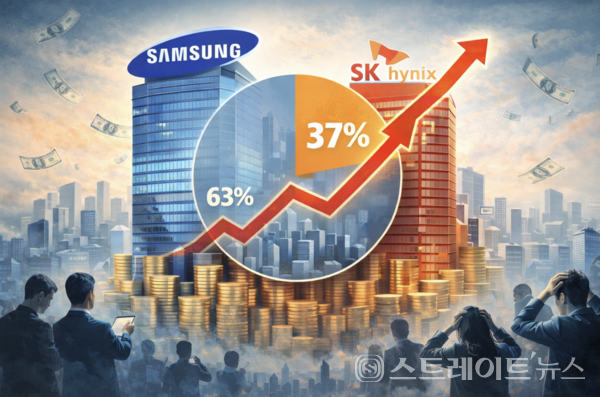
An analysis of big data from anonymous office worker communities like Blind reveals interesting evaluations from current employees of Samsung Electronics and SK Hynix. While both are representative semiconductor powerhouses in South Korea, the talent they prefer and the traits recognized as “working well” within the organization differ subtly. Samsung Electronics is said to value talent that smoothly coordinates systems within a massive organization and collaborates persistently, while SK Hynix prefers a breakthrough-oriented personality that plays decisive moves in fast-paced leadership battles. A friend who is a researcher at a large corporation, met in the cafeteria during lunch, joked that no matter how much money the company makes, the shoulders of those working in the field remain heavy. In reality, while the internal atmosphere is busy with the Q3 earnings supercycle, it is also lively with expectations for performance bonuses. To maintain leadership in next-generation High Bandwidth Memory (HBM), R&D department employees are fighting for their lives, guarding the lab day and night. As the hiring season for new graduates approaches, what the real specs and character traits companies are looking for have become a hot topic among job seekers. It is said that current employees give the highest scores not to flashy specs, but to the perseverance and communication skills needed to withstand immediate deployment in practical work.
Samsung Electronics and SK Hynix are moving busily, seeking differentiated talent according to their organizations amidst record-high earnings.
4. Next-Generation Technology Competition
As the era of AI agents fully begins, the global semiconductor industry is watching whether Samsung-Hynix can grasp the final hegemony of the memory market. In particular, SK Hynix, which has taken the lead in the HBM market, is making a full-scale effort to maintain its leadership in next-generation products. Samsung Electronics is also launching a fierce pursuit based on its massive production capacity and capital power, keenly watching for an opportunity to counterattack. As the technology gap narrows, the quarterly market share indicators to be released in the future will become important leading indicators that will determine the landscape for the next few years. Securities analysts unanimously state that the technological competitiveness of the two companies has long since gone beyond simple memory performance. How well the GPU and memory are organically combined to maximize AI computing speed has emerged as a core competitiveness. Browsing the latest economic magazines at a bookstore on the weekend, one can feel that the tension on the ground is at its peak, compounded by inter-country competition for semiconductor supply chain stability. Since the stock price’s fate can dramatically diverge depending on the speed of technology development, the sense of responsibility among engineers is becoming heavier day by day.
The competition between the two companies to preempt next-generation memory technology, a core asset of the AI era, is fierce.
5. Share Buybacks and Supply-Demand Issues
The most noteworthy aspect of the recent Samsung-Hynix stock price trend is large-scale share buybacks and the supply-demand trends of foreign investors. The stock price has reacted sensitively and fluctuated whenever foreign net buying flows in or large-scale trading through specific channels is detected. Carefully examining the reports uploaded to the Financial Supervisory Service’s electronic disclosure system allows for a comprehensive understanding of the company’s efforts to enhance shareholder value and market reactions. A senior colleague who makes a living from stock investment advised without holding back that reading the supply-demand direction of foreigners and institutions is most important in a large-cap stock market. While indicators representing index volatility find stability, the movements of other corporations and pension funds are also playing a role as a sturdy prop supporting the lower bound of the stock price. During the share buyback program, it served as a defensive wall filling the supply-demand gap in the overall stock market and preventing a sharp drop in stock price. For individual investors, reading these subtle changes in supply and demand is greatly helpful in formulating short-term response strategies. Wisdom is needed to look not only at the grand economic discourses in the news but also at the real-time changing trading volume and supply-demand indicators.
Large-scale share buybacks and foreign supply-demand trends are core variables supporting the lower bound of Samsung-Hynix’s stock price.
6. Future Outlook and Response
In conclusion, Samsung-Hynix is navigating the massive waves of the AI era based on the strong fundamental of record-high earnings. Rather than impulsively selling out of fatigue from short-term stock price stagnation and “hope torture,” one should focus on the company’s intrinsic value and medium-to-long-term growth potential. Experts advise looking at the market with a steady breath, stating that the time when performance translates into actual stock price increases will eventually come. For individual investors, it is wise to establish one’s own investment criteria and respond calmly without being swayed by surrounding rumors. Please keep a close eye on the upcoming confirmed Q3 earnings and next-generation memory market share indicators, and prepare your next investment strategy step by step.
One should calmly formulate an investment strategy, trusting Samsung-Hynix’s solid performance and medium-to-long-term growth potential.
Frequently Asked Questions
=