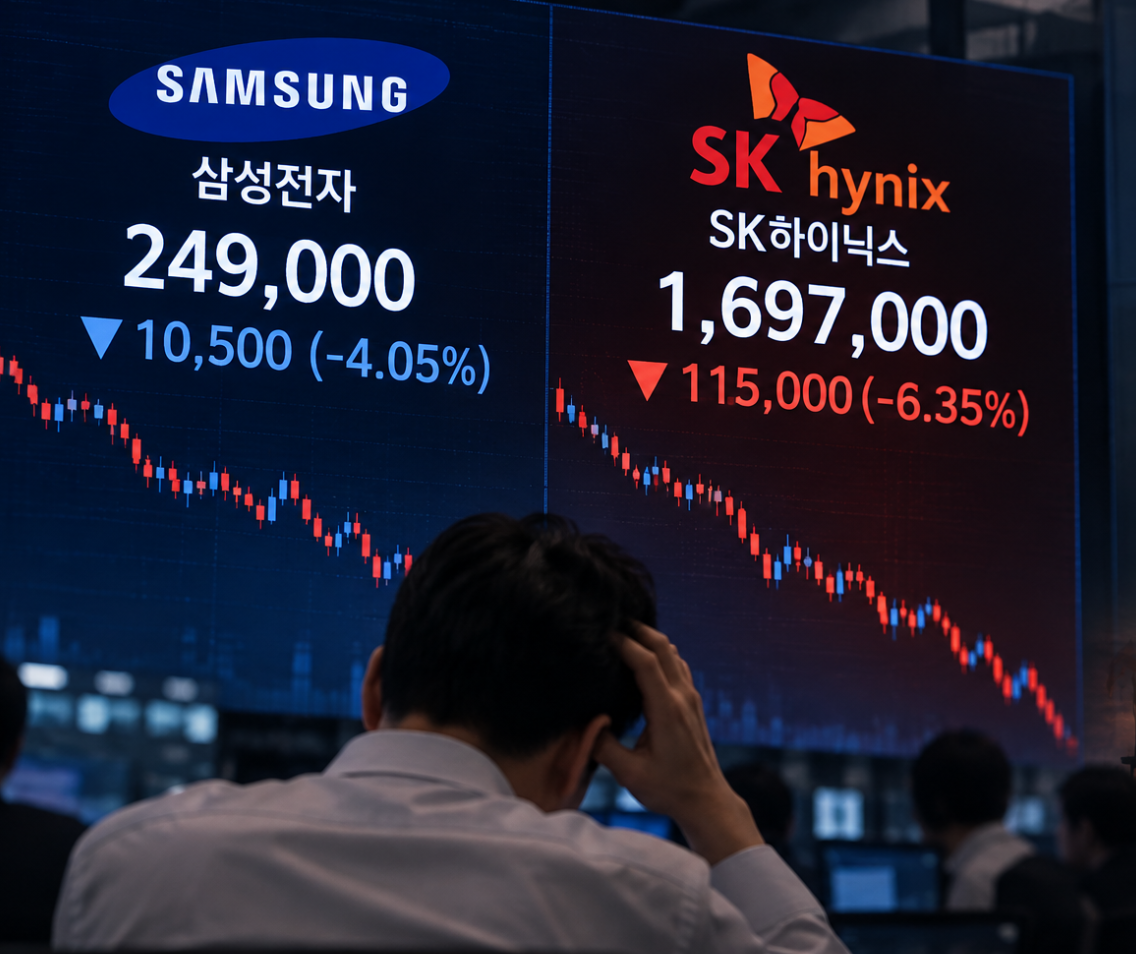
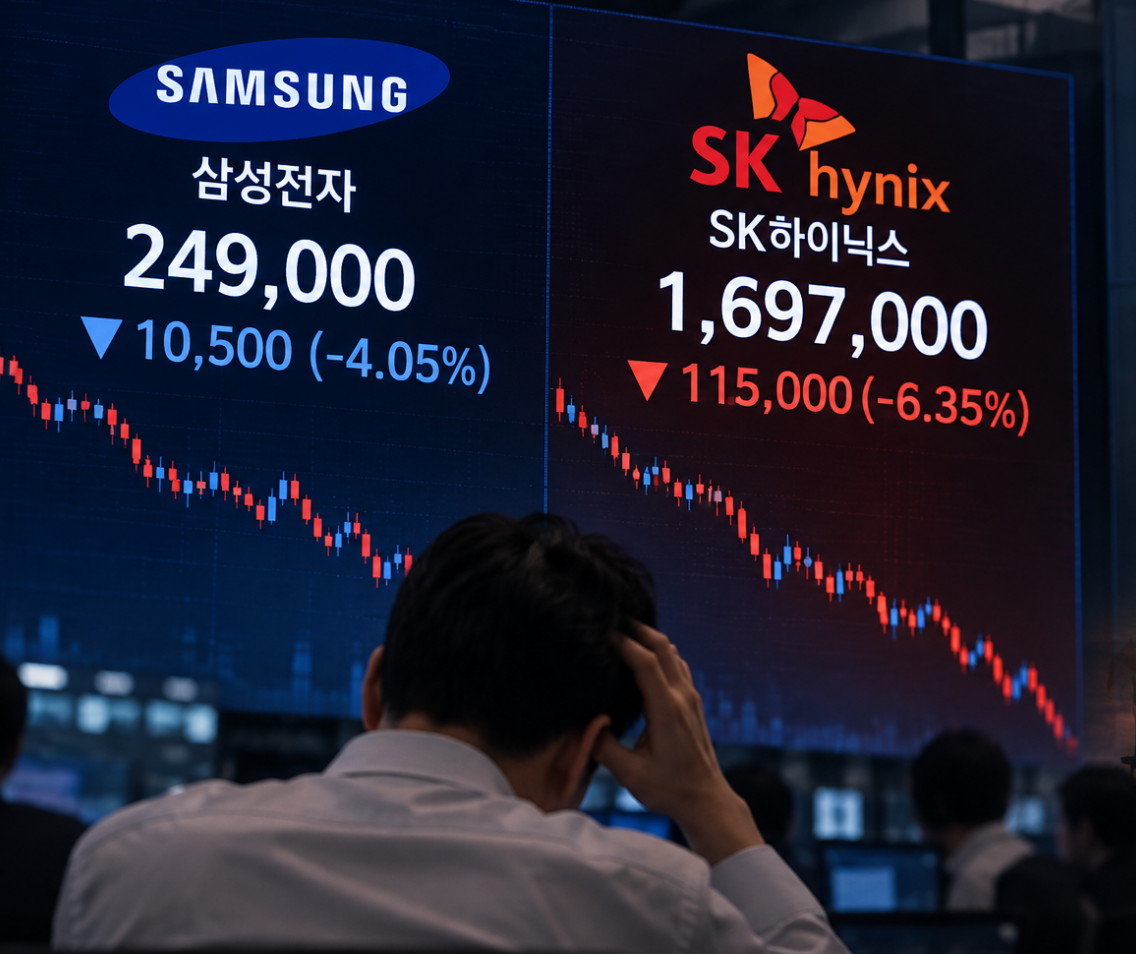
Samsung Electronics and SK Hynix, the pillars of the domestic stock market, faced a shock as both the 250,000 won and 1.7 million won price levels simultaneously collapsed. This downturn was driven by a dual blow: the cooling of the artificial intelligence investment boom and geopolitical risks in the Middle East. Recently, as leaders of major tech companies, including the CEO of OpenAI, have voiced the need to moderate the pace of AI development, investor sentiment has frozen rapidly. Compounding this, concerns over armed conflicts and disruptions in oil transportation in the Middle East have caused the entire market to be hit by a fierce selling bomb. Foreign investors net sold trillions of won worth of these two stocks in a single day, dragging the index down sharply. This external uncertainty is likely to act as a heavy burden on the domestic stock market for the time being. In this article, we will analyze the specific causes of this stock price crash and the future direction of the market from multiple perspectives.
=
Samsung Electronics and SK Hynix Shares Plunge as AI Slowdown Calls and Middle East Tensions Collide
1. The Rise of AI Slowdown Theories and Market Shock
1. The Rise of AI Slowdown Theories and Market Shock
The call for slowing down AI development, initiated by the CEOs of major tech companies, has firmly held back the leading semiconductor stocks. Concerns have spread that the unconditional expansion of AI investment, which has driven the market for a long time, may be put on the brakes. In fact, CEOs’ remarks suggesting that the pace of related technology development should be moderated have caused no small amount of confusion among investors. As the core driving force behind the recent stock price surge wavered, market participants rushed to take profits. This psychological shift immediately translated into massive selling pressure, driving stock prices down. Experts assess that the AI industry is not entering a phase of declining growth but rather a period of consolidation. However, due to the steep rise in prices recently, the market has shown a clear tendency to react overly sensitively to even minor concerns. Investors’ fear has grown that if future performance does not support the valuation, further stock price adjustments may occur. The stock market always hates uncertainty the most, and this slowdown theory has maximized that uncertainty. This is why it is crucial to closely monitor how the actual investment scale of tech companies will change going forward.
💡 Key Point The emergence of AI investment slowdown theories has put the brakes on the upward trend of leading semiconductor stocks.
2. Middle East Geopolitical Crisis and Oil Price Pressure
2. Middle East Geopolitical Crisis and Oil Price Pressure
Another massive negative factor weighing on the market alongside AI concerns is the armed conflict in the Middle East and energy security instability. Recently, attacks on Saudi Arabian pipeline facilities disrupted operations, bringing concerns over oil supply shortages to the surface. As diplomatic dialogue between Middle Eastern nations failed and geopolitical tensions reached their peak, the commodity market swung wildly. Consequently, West Texas Intermediate (WTI) crude oil prices easily broke through $100 per barrel, reigniting inflationary pressures. The surge in energy prices leads to higher manufacturing costs, which can directly hit corporate profitability. Markets with high external dependence, like the domestic stock market, are structurally very vulnerable to such commodity price fluctuations. Rising oil prices increase overall production costs and dampen consumer sentiment, acting as a fatal negative factor for the stock market. Moreover, geopolitical risks are unpredictable in terms of when and where they might escalate, making them a primary driver of investor anxiety. In fact, foreign investors moved massive amounts of capital from the domestic stock market to safe-haven assets on this day to avoid risk. Unless oil prices stabilize, the downward pressure on the stock market brought by Middle East instability is expected to continue for the time being.
💡 Key Point Geopolitical instability in the Middle East and concerns over oil transportation disruptions have fueled rising oil prices, worsening investor sentiment.
3. Foreign Selling Bomb and the Collapse of “Sam-Hynix”
3. Foreign Selling Bomb and the Collapse of “Sam-Hynix”
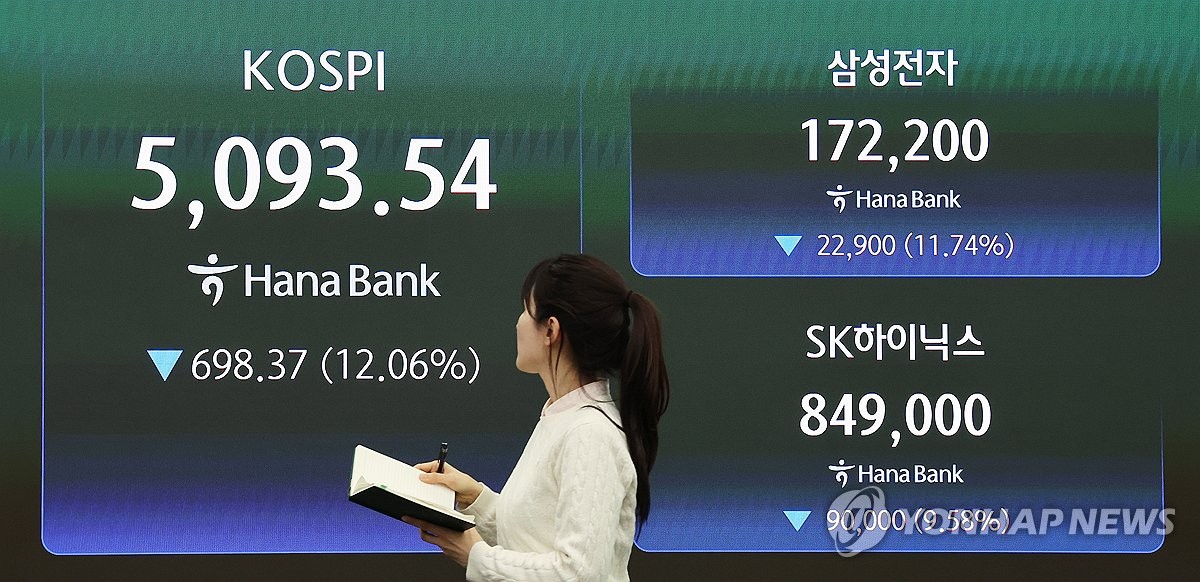
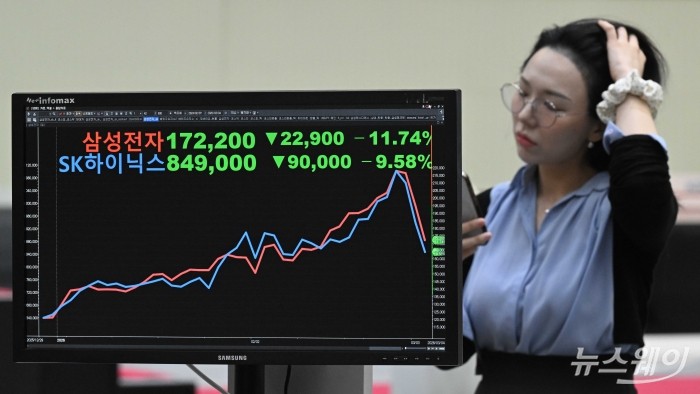
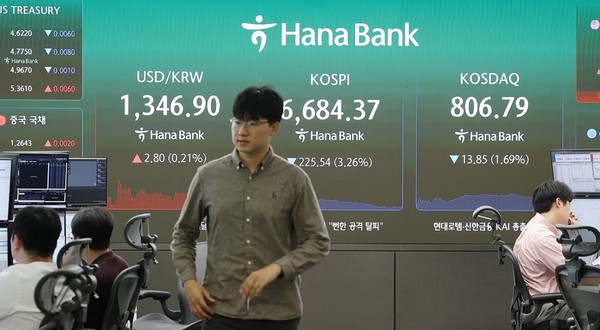
As foreign investors continued their indiscriminate selling offensive, the defense lines of Samsung Electronics and SK Hynix collapsed helplessly. Samsung Electronics saw its stock price pushed down by more than 4% in a single day, losing the 250,000 won mark and falling to the mid-240,000 won range. SK Hynix’s decline was even deeper, plunging by more than 6% and failing to hold the 1.7 million won line, closing in the high 1.6 million won range. The shock was significant, with foreign net selling of these two stocks alone exceeding 4 trillion won. With top market-cap stocks collapsing all at once, the entire KOSPI index fell below the 6,600 mark. Individual investors, stunned by the sudden crash, attempted to buy at low prices but were powerless to prevent the decline. The securities industry reports that foreigners are concentrating their selling on Korean semiconductor stocks as they adjust their global asset allocation strategies. With exchange rate volatility also increasing, foreigners have even greater incentives to dispose of domestic stocks to prevent exchange losses. While there is no fatal flaw in the fundamentals of the two companies, supply-demand imbalance has triggered the stock price crash. This large-scale outflow clearly reveals the fragile supply-demand structure of the domestic stock market.
💡 Key Point Foreign investors unleashed a massive selling bomb, breaking through the key price levels of Samsung Electronics and SK Hynix.
4. Ripple Effects on the Domestic Market and KOSPI Decline
4. Ripple Effects on the Domestic Market and KOSPI Decline
The simultaneous plunge of the leading stocks did not remain an issue limited to just those two companies; it plunged the entire domestic KOSPI market into a deep quagmire. Centered on the electrical and electronics sector, the index’s decline widened, and the majority of stocks closed in the red. As the leading stocks lost their momentum, investors found themselves stranded without a clear safe haven. Program selling was also triggered, and the index’s decline did not ease easily until the end of the trading session. It was a day that clearly demonstrated how much the instability of the two semiconductor giants, which hold an overwhelming market cap weight, drags down the entire index. Experts advise that index volatility is bound to expand for the time being, necessitating a conservative approach. Concerns about forced liquidations of leveraged investments (debt-investing) are also rising. Since external negatives have overlapped with a weakened market resilience, it may take considerable time to seek a rebound. Both institutional and individual investors are focused on defensive portfolio restructuring while watching the market’s direction. For the KOSPI to regain its former vitality, stability in global markets and a reversal in foreign supply-demand are essential.
💡 Key Point The fall of the leading stocks triggered a sharp decline in the overall KOSPI index, pouring cold water on the entire market.
5. Expert Diagnosis and Conditions for Future Market Rebound
5. Expert Diagnosis and Conditions for Future Market Rebound
Market experts analyze that the current stock price decline is less of a structural long-term depression and more of a temporary shock caused by a pile-up of negative factors. Stock market experts, including researcher Lee Sang-hyun, unanimously agree that the trend of international oil prices is the most critical variable determining future market stability. They argue that the stock market can only catch its breath once oil prices stabilize and the armed conflict in the Middle East subsides. Additionally, regarding AI investment, excessive concerns must be proven unfounded through actual corporate earnings reports. The diagnosis is that the market is likely to return to a phase where performance proves everything. For investors, wisdom is needed to calmly examine a company’s essential competitiveness and performance rather than selling out of fear. Since the demand base of the semiconductor industry has not completely collapsed, a strategy of holding based on faith in fundamentals may also be valid. However, rather than reacting emotionally to short-term stock price fluctuations, it is advisable to carefully examine macroeconomic indicators such as exchange rates and commodity prices. As the market atmosphere can reverse at any time, more investors are approaching the market from a perspective of staged buying. This crash should be used as an opportunity to review one’s investment portfolio and diversify risk.
💡 Key Point Experts emphasize that oil price stability and the calming of Middle East tensions are the most important prerequisites for a future stock price rebound.
6. Investor Response Strategies and Future Outlook
6. Investor Response Strategies and Future Outlook
Surviving in a stock market battered by a storm requires a cool-headed response strategy that is not swayed by emotions more than ever. One of the actions to avoid most is blindly chasing the sell-off just because stock prices have dropped significantly in the short term. Investors should check the ratio of safe assets to risky assets in their portfolio and demonstrate flexibility by adjusting proportions if necessary. In particular, for the semiconductor sector, stock prices may regain momentum as the earnings season approaches, depending on whether performance improves. Caution is required to confirm the market bottom by checking changes in macro indicators daily. The stock market always brings both crisis and opportunity, and this decline could be a new entry opportunity for some. There is no need to fall into excessive pessimism, as the long-term growth direction of the AI industry remains valid. However, since a volatile market is likely to continue for the time being, it is safe to maintain a certain level of cash holdings. Investors should focus on corporate performance and global economic trends rather than being swayed by news and rumors. We encourage you to calmly observe the market flow and make wise investment decisions.
💡 Key Point In highly volatile markets, cool-headed asset allocation and a focus on corporate performance are key to successful investing.
Frequently Asked Questions
What is the decisive reason for the sharp drop in Samsung Electronics and SK Hynix shares?
Investor sentiment worsened due to the overlap of AI development slowdown calls from major tech CEOs and geopolitical risks from the Middle East.
How much did foreign investors sell?
Foreign investors net sold over 3 trillion won in Samsung Electronics and over 1 trillion won in SK Hynix in a single day, dragging down the stock prices.
What is the most important indicator to watch for a future stock price rebound?
The stability of international oil prices and changes in the Middle East situation are cited as the most critical prerequisites for future stock market stability.
What is the correct strategy for individual investors in the current market conditions?
Investors should refrain from emotional selling, examine macroeconomic indicators such as exchange rates and commodities, and approach the market conservatively with a focus on corporate performance and fundamentals.