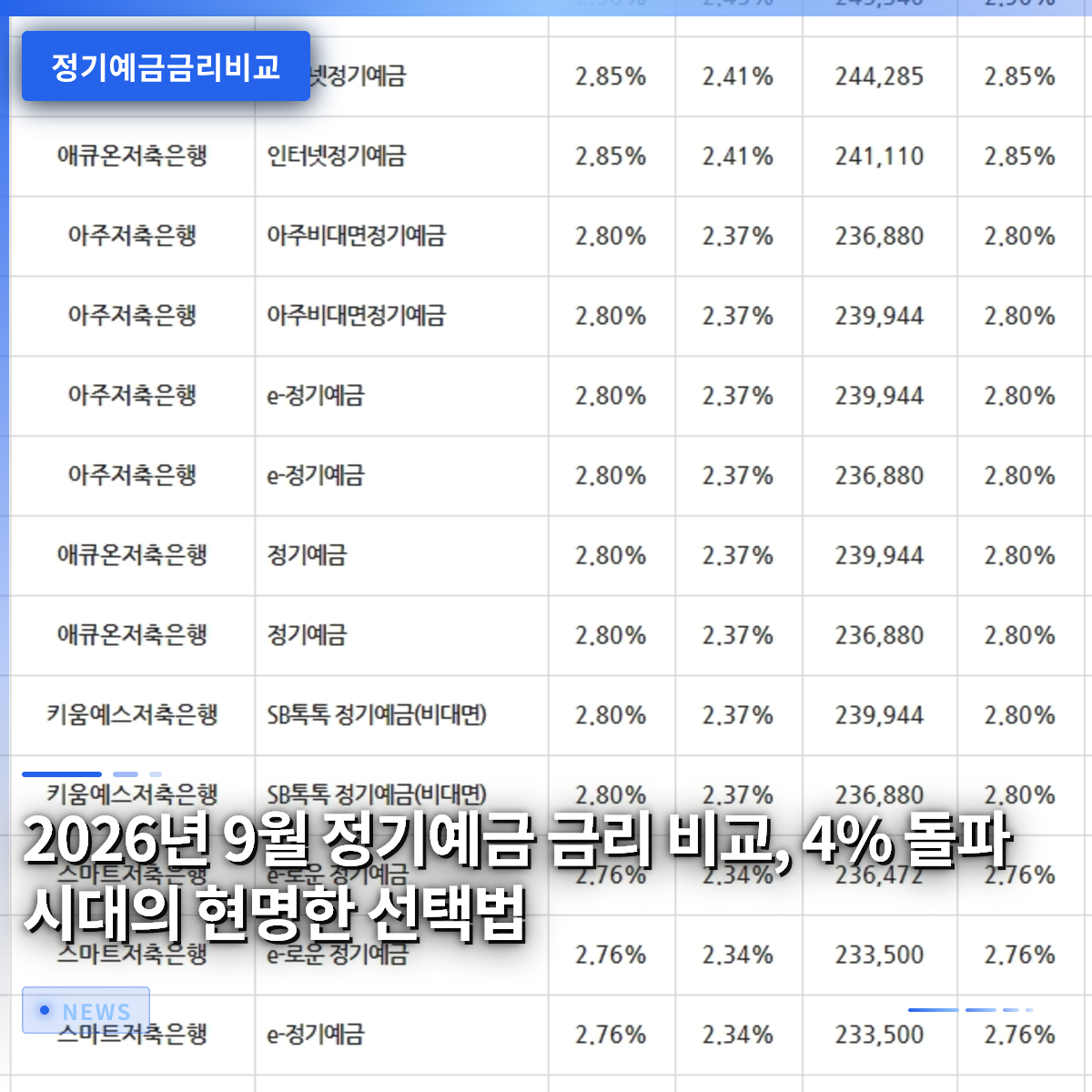
If you feel that the interest on your current fixed deposits isn’t making a noticeable difference, you need to acknowledge the reality that 1-year maturity rates have surpassed the 4% mark as of September 2026. Recently, major commercial banks, including Woori Bank, have raised corporate deposit rates above 4%, prompting them to increase rates for individual products by a small to moderate margin to keep pace. The old habit of thinking, “A 1 million won difference is no big deal,” no longer holds true. Today, a 1 percentage point difference in interest rates on deposits of several million won can translate to an amount equivalent to years of living expenses. Particularly, as banks scramble to secure funds ahead of the fourth quarter, when large-scale corporate deposits are set to mature, consumers are entering a period where strong negotiation power and product selection skills are essential. In this article, we will meticulously examine the actual interest rate comparisons among commercial banks as of September 2026, along with hidden fees and conditions, to ensure you are not caught off guard by simply chasing high numbers.
=
September 2026 Fixed Deposit Interest Rate Comparison: How to Make Smart Choices in the Era of 4%+ Rates
1. Why Did the 4% High-Interest Era Sudden Begin in September 2026?
This interest rate hike is not merely due to inflation but is a structural change caused by a sharp increase in banks’ funding costs. With large corporate fixed deposits held by major conglomerates maturing en masse around the end of Q3 and the beginning of Q4, banks find themselves in a situation where they must offer relatively high interest rates to individual customers to retain funds. In the past, banks attempted to substitute this with issuing bank bonds or other market funding, but recent rises in market rates have made these funding costs burdensome, intensifying direct competition for deposits. Specifically, as the maturity dates of deposits from leading semiconductor companies overlap, raising concerns about fluctuations in total bank deposits, each bank is proactively raising rates to prevent capital outflows. This structure ultimately benefits ordinary depositors like us, making it crucial to understand how urgently banks need funds right now.
2. Actual Comparison of 1-Year Fixed Deposit Rates by Commercial Bank

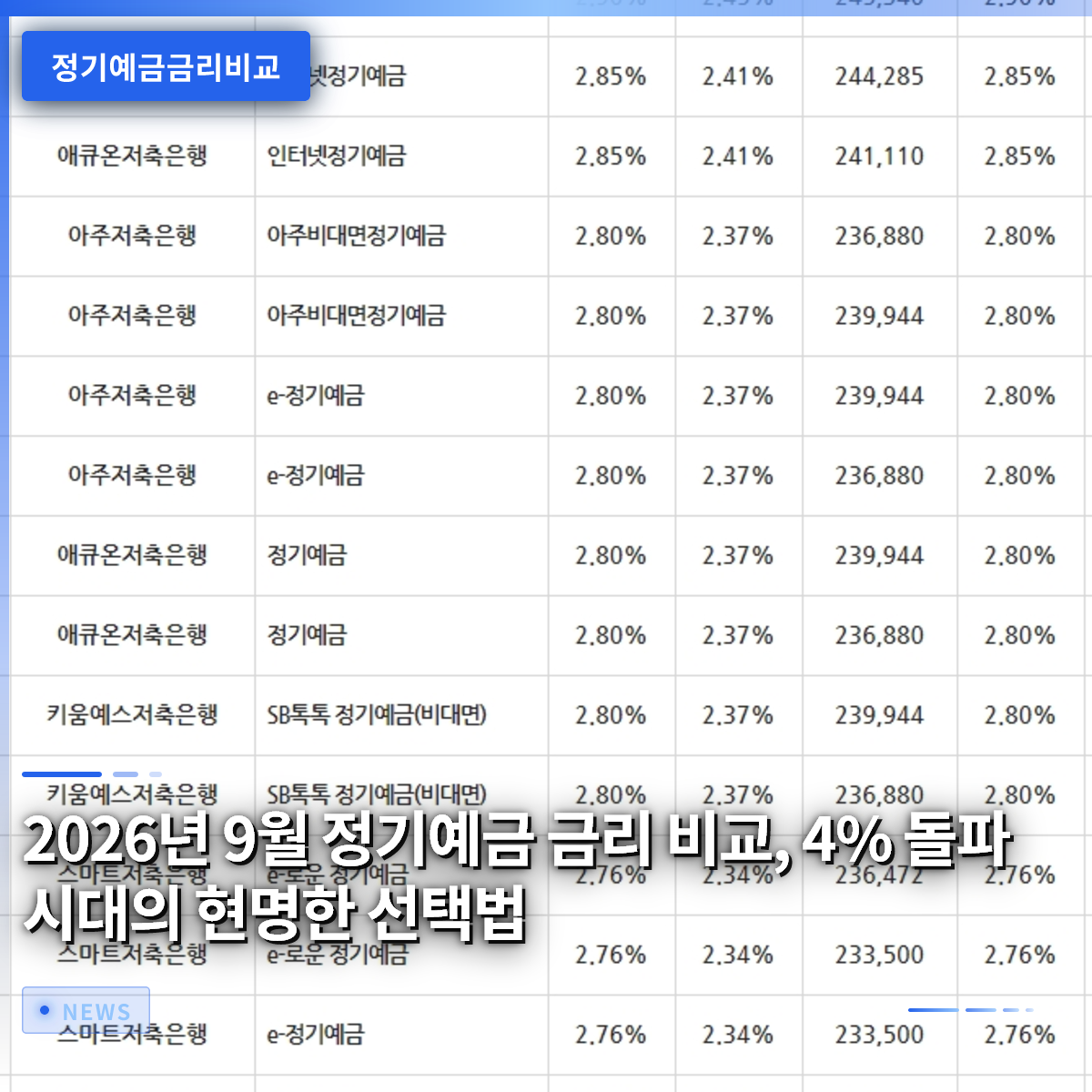
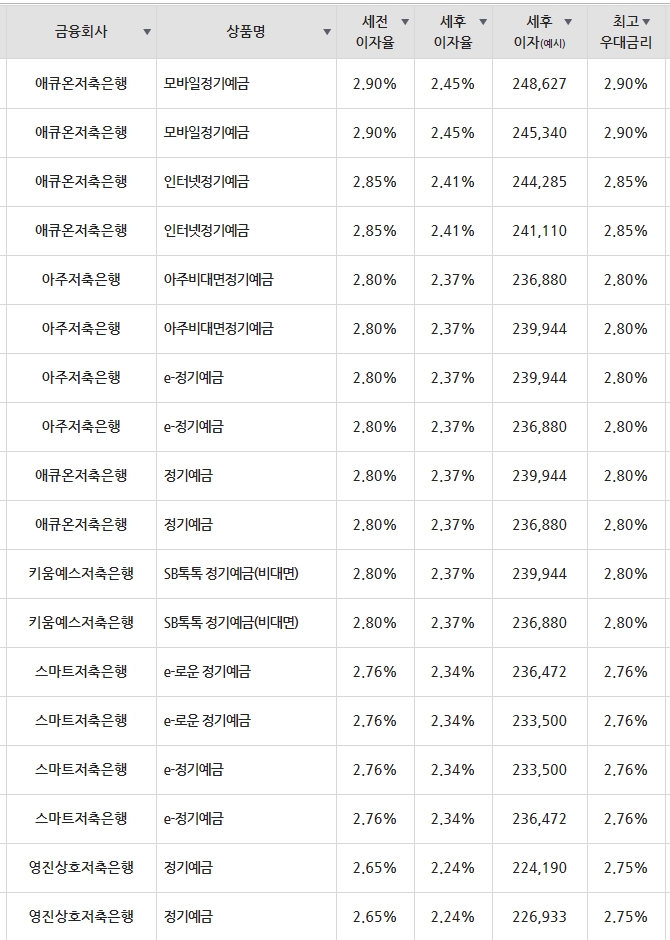
As of September 2026, with Woori Bank’s corporate fixed deposit rate reported at 4.09%, the interest rate gap between corporate and individual products is noticeably narrowing. However, 1-year maturity rates still vary between 3.8% and 4.2% across different banks, so you should not blindly trust promotions claiming to offer the “highest rate.” For instance, if you deposit 50 million won for one year, the difference in interest income between a 3.8% rate and a 4.2% rate is nearly 200,000 won, which constitutes a tangible difference in living standards. Additionally, while some internet-only banks or regional banks are temporarily offering higher rates, you must carefully verify specific conditions such as early withdrawal fees and principal protection limits. Even for products with the same name, the applicable rate often depends on the date of opening, the region, and the deposit channel, so it is essential to develop the habit of directly comparing publicly disclosed rates from multiple banks.
As of September 2026, 1-year fixed deposit rates range from 3.8% to 4.2%, and this gap results in an interest difference of over 200,000 won for a 50 million won deposit.
3. Hidden Costs and Conditions: What Matters More Than the Interest Rate
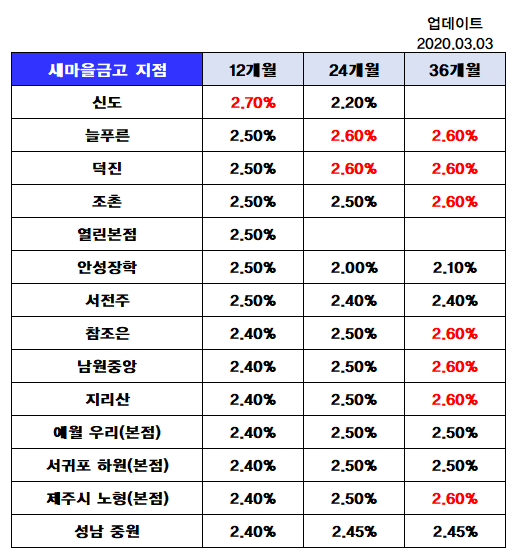
Products that appear to offer high interest rates on the surface often contain many traps that require detailed investigation, particularly regarding exclusions from tax-free benefits or complex tax treatment. For example, specific corporate-linked deposits or point-accumulation type deposits may have lower effective interest rates, so you should not just calculate cash benefits but also convert point values for comparison. Furthermore, if the auto-renewal function is set as the default, there is a risk that your deposit will automatically extend at a lower rate when market conditions change, so caution is advised. Remember that the deposit insurance limit is set at 100 million won, but interest is not included in this limit; therefore, you should diversify deposits to keep the principal under 100 million won to maximize safety. No matter how high the interest rate is, penalties for early withdrawal can halve your actual returns, so if you need frequent liquidity, withdrawal conditions should take precedence over yield.
You must always verify hidden clauses that affect actual returns, such as early withdrawal conditions, auto-renewal settings, and diversification of deposit insurance limits, rather than just looking at the surface interest rate.
4. Case Study: A Smart Diversification Strategy for Large Depositors
Mr. Kim, an office worker holding 150 million won, did not put all his money into a single bank. Instead, he split it, placing 100 million won in a fixed deposit at Bank A and 50 million won in an internet-only deposit at Bank B. Although Bank A’s rate was 4.0%, he chose it despite the inconvenience of visiting the branch to ensure his large remaining balance was protected. Meanwhile, he maximized part of his returns through Bank B’s 4.15% rate. As a result, Mr. Kim secured approximately 75,000 won in actual interest that he might have lost had he chosen just one bank, an amount sufficient to cover holiday gift expenses. As his case shows, if your capital exceeds 100 million won, diversifying to stay within deposit insurance limits is essential. The process of comparing interest rate differences across banks when splitting deposits becomes part of asset management itself. Even for the same 100 million won, the interest received varies depending on which bank and which product you choose, so a systematic approach is necessary.
For assets exceeding 100 million won, it is effective to diversify across banks considering deposit insurance limits and compare interest rate differences to maximize total returns.
5. Fact Check on Interest Rate Volatility Ahead of Q4
In Q4, large-scale corporate deposit maturities are concentrated, so the possibility of short-term interest rate increases cannot be ruled out. Therefore, rather than rushing to deposit money in mid-September, it may be wiser to wait and see how final rates are set in early October. However, if you get trapped in the expectation that rates will keep rising, you will sacrifice the compound interest effect on your principal and pay the price of a longer holding period. If you need funds immediately, depositing at the current 4%+ rates is also a way to reduce opportunity costs. Ultimately, the answer lies in finding a balance between the sustainability of high rates and immediate returns, based on your own fund usage schedule. Instead of relying solely on news from acquaintances or media, you must judge whether the funds are absolutely necessary for your financial plan.
While there is a possibility of further rate increases due to concentrated corporate deposit maturities in Q4, immediately depositing at current high rates aligned with your personal fund needs is also a rational choice.
6. Preparation and Action Guide Until the Next Interest Rate Cycle
Even if you don’t deposit money immediately, bookmark the interest rate disclosures on each bank’s official app or website. Interest rates often change on the fourth Thursday of every month, so marking this date on your calendar will help you deposit at a favorable time. Additionally, preferential interest rates may be applied on top of the base rate depending on your credit information or deposit type, so be sure to inquire with staff about additional benefits before opening an account. Starting in 2026, interest rate directions may shift rapidly due to changes in inflation expectations, so it is advisable to develop the habit of reviewing your portfolio quarterly. Finally, train yourself to discern whether this September rate hike is a one-time event or an inflation-response rate that will continue for the next few years. As these insights accumulate, you will gain the power to actively control your wealth management strategy rather than simply complaining about low interest rates.
Key Takeaway: September 2026 marks the beginning of a new interest rate gradient based on 4%, making deposit diversification and careful condition verification essential.
Actively respond to the uncertain interest rate environment in the second half of 2026 and beyond by checking rate change dates, verifying preferential rates, and maintaining the habit of quarterly portfolio reviews.
Frequently Asked Questions
=