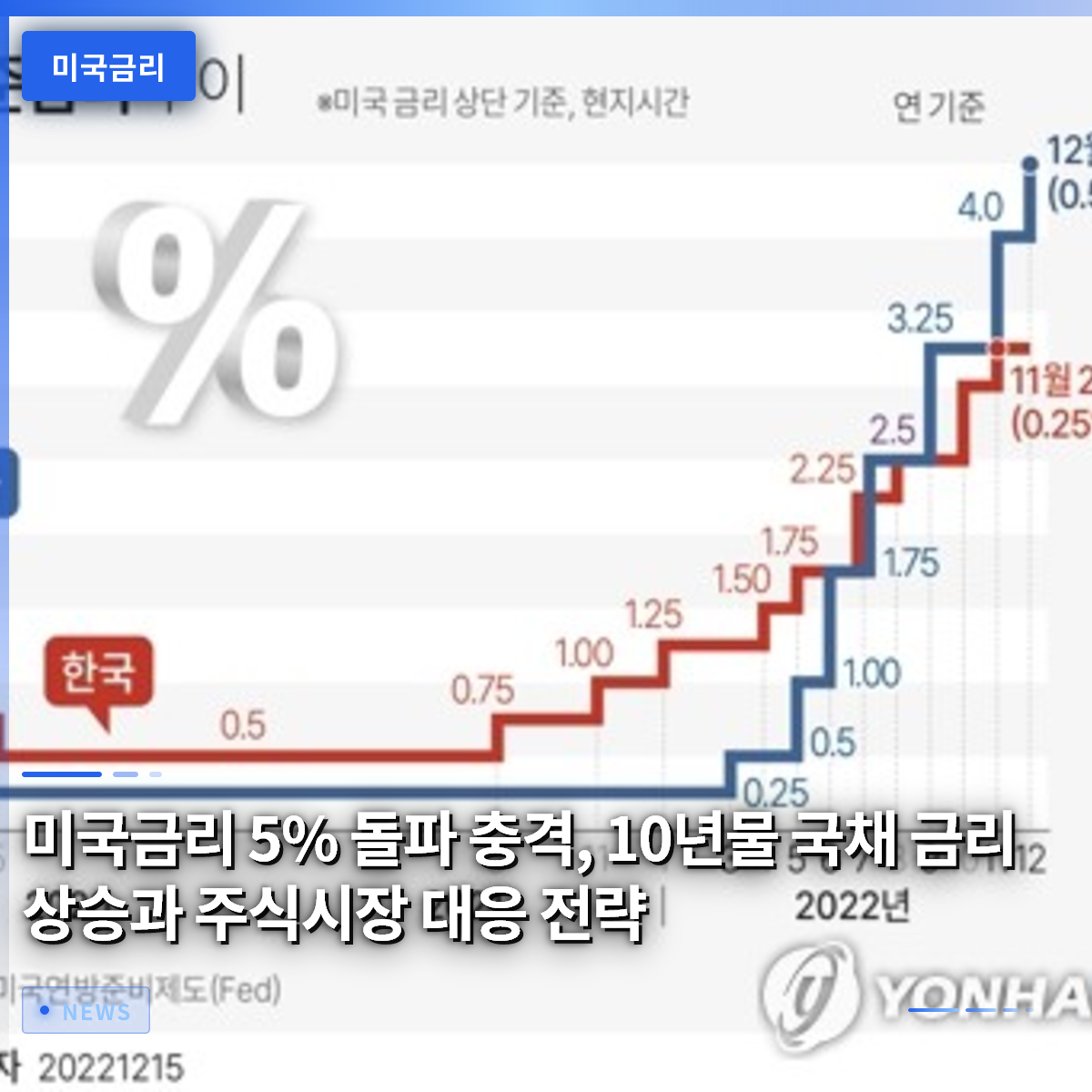
With the US 10-year Treasury yield easily surpassing 5% to hit its highest level since 2007, it is absolutely urgent to face reality with a cool head and swiftly restructure our portfolios to protect our assets. The long-term yield, which spiked to 5.13% during trading last night, is acting as a massive tsunami that shakes up global financial capital flows, going beyond a mere numerical change. As economic indicators prove more resilient than expected and the Federal Reserve signals further tightening, market participants’ anxiety has reached its peak. Mr. Kim, an office worker invested in the stock market, lets out a deep sigh, saying that his head aches just from rising deposit rates, and he is losing sleep due to the combination of loan interest and stock market declines. In this article, we will examine the exact causes of the surging US interest rates and carefully outline specific investment solutions for surviving in a volatile market.
=
Shock as US Interest Rates Breach 5%: Rising 10-Year Treasury Yields and Stock Market Response Strategies
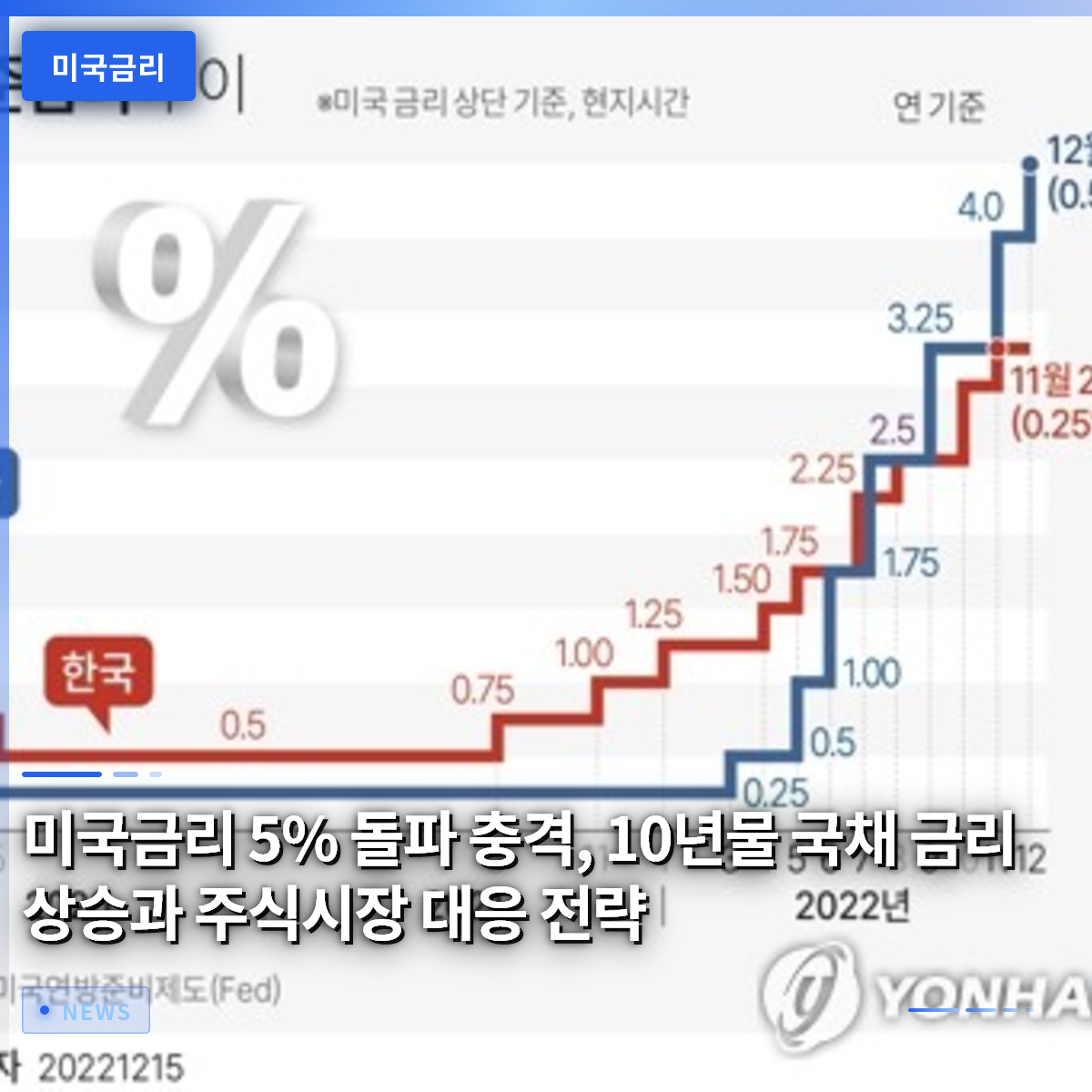
1. The Dawn of the 5% Era for US 10-Year Treasury Yields
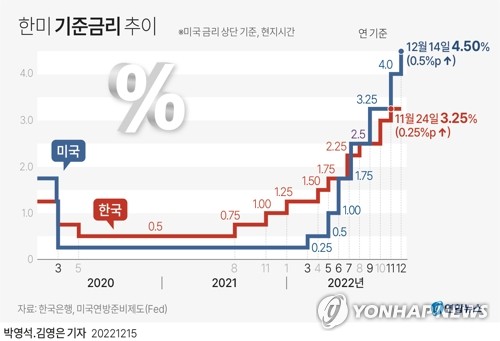
The US 10-year Treasury yield has breached the 5.1% mark for the first time since July 2007, sending a strong shockwave through the global financial markets. Among market participants, concerns about the impact on the broader asset market are snowballing as the previously unthinkable barrier of the 5% range has actually crumbled. Mr. Park, an investor who checks his securities account every morning, expresses his bewilderment at seeing his stock holdings continue to shrink, admitting he did not expect interest rates to rise so sharply. This phenomenon should be interpreted not as a one-off incident, but as the starting gun for a global rise in funding costs.
Soaring Treasury yields mean that the interest the government must pay to borrow money has become more expensive, which in turn triggers a chain reaction of surging interest rates across the board. Numerous borrowers with mortgage loans are drastically cutting their daily consumption as their principal and interest repayment burdens snowball. Companies also have to endure much higher interest costs when raising funds from banks or issuing corporate bonds, causing them to hesitate on new investments and hiring. Ultimately, this provides the fundamental cause for a cold wind blowing across the real economy, demanding rigorous risk management from investors.
The US 10-year Treasury yield has exceeded 5.1%, driving up overall funding costs in the market.
2. Strong Economic Indicators and Pressure for Further Fed Hikes
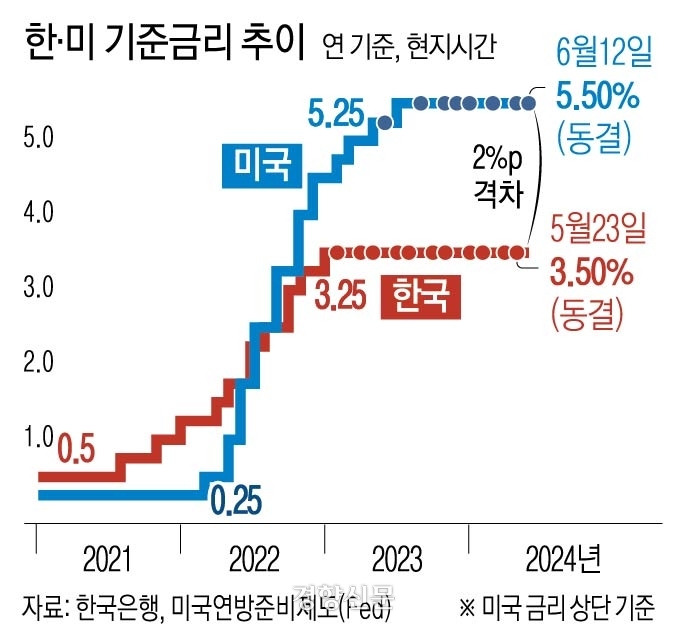
A series of indicators showing that the US economy is maintaining much stronger resilience than expected is deepening the dilemma for monetary authorities. Key economic indicators recently released, including preliminary Purchasing Managers’ Index (PMI) figures, have proven that the inflation the Federal Reserve has been desperate to lower still has a tenacious life. Since prices are not coming down easily, voices are gaining momentum that the central bank should not lower the benchmark rate for the time being, but rather consider further hikes. Mr. Lee, a self-employed cafe owner in Seoul, laments that he is struggling to breathe because raw material prices show no sign of falling while interest rates remain high.
The market is already pricing in a high probability of additional rate hikes for the remainder of the year, tightening its nerves. Heads of monetary authorities, who prioritize price stability, have unleashed hawkish remarks warning of a prolonged tightening cycle, regardless of market expectations. For investors, it is time to completely discard the previous hope that rates have peaked and will now fall, and to adapt to the new environment. This is precisely why a strong economy can paradoxically be poison for the stock market, and blind optimism is strictly forbidden.
Persistent economic indicators and the Fed’s signals for further hikes are fueling concerns about a prolonged period of high interest rates.
3. Chain Reactions of Global Bond Market Instability and Geopolitical Risks
Not only in the US, but also in Europe, Asia, and other major countries worldwide, government bond yields are drawing steep upward curves, suffering from simultaneous instability. Long-term funding costs for major advanced economies like the UK and France are hitting record highs, turning on warning lights for the fiscal soundness of each government. The situation where raw material import costs surge and oil prices fluctuate due to geopolitical instability in the Middle East is rendering central banks’ efforts to manage inflation futile. Mr. Choi, an office worker, expresses his anxiety, saying he worries about his bank balance every time he hears news about other countries’ bond yields spiking.
This global interest rate frenzy ultimately delivers a massive shock to the foreign exchange market, becoming the decisive trigger for emerging market funds to drain out to the US like a receding tide. Foreign investors are ruthlessly reducing their exposure to risky assets, including the domestic stock market, as they move funds into safe-haven US Treasuries. As funds outflow, the value of the won plunges and import prices soar again, creating a vicious cycle that causes consumer prices for ordinary people to spiral out of control. As long as geopolitical uncertainties remain unresolved, this phenomenon of global interest rate convergence is not expected to subside easily for the time being.
The simultaneous rise in global bond yields, coupled with Middle East instability, is shaking the entire domestic and international financial markets.
4. Unavoidable Blow to the Stock Market and Growth Tech Stocks
As Treasury yields enter the range above 5%, growth tech stocks, which thrive on future value, are taking a direct hit and facing a barrage of selling. Since the discount rate used to convert a company’s future profits into present value increases, the appeal of tech stock prices inevitably drops significantly. Mr. Jung, an office worker who has invested a significant portion of his assets in AI-related stocks, laments that he feels his heart sink every time he sees the blue numbers in his account. The reason experts emphasize a company’s ability to generate immediate cash over its growth speed is precisely due to this cold mathematical formula.
Of course, some semiconductor-related stocks are performing well based on solid results, but they act as a massive pressure factor blocking the upward movement of the overall index. The fact that major indices like the Dow Jones and Nasdaq are repeatedly mixed and performing a roller-coaster ride without a clear direction is also due to this interest rate burden. Traditional value stocks or bank stocks that pay high dividends are holding up relatively well, but individuals with growth-stock-centric portfolios are left helpless. It must be remembered that stocks without supporting results may be completely eliminated from accounts during this interest rate frenzy.
High Treasury yields lead to higher discount rates, rapidly eroding the valuations of future growth stocks.
5. Practical Portfolio Response Strategies for Individual Investors
To survive in the current market where volatility has reached its peak, one must immediately liquidate excessive leverage and restructure asset allocation weights. It is essential to secure a certain portion of total assets in cash to watch for upcoming opportunities and to maintain an attitude that does not get swept away by the market’s optimistic outlook. A strategy of diversifying investments into safe assets like bonds or high-dividend stocks through monthly systematic investing is shining brighter than ever. Mr. Kang, a veteran investor with long experience in stocks, advises that now is not the time to aggressively chase returns, but the time to protect principal and take a breather.
Rather than forcibly increasing the weight of growth stocks, wisdom is needed to focus on sectors expected to benefit from rate cuts or large-cap stocks with solid results. Additionally, one must stay alert to major economic events such as the upcoming Personal Consumption Expenditures (PCE) price index release and flexibly respond to market volatility. Stepping back to observe market trends rather than impulsively pressing the buy/sell button is the most certain shield to protect your account. Do not forget that principled investing shines brightest when anxiety is high, and please review your investment style.
You must defend against the risks of a volatile market by increasing cash holdings and adhering to principled diversification.
6. Future Outlook and a Wise Approach to Asset Management
The financial market is highly likely to continue an extreme roller-coaster ride depending on the pace of inflation slowdown and the direction of the Federal Reserve’s monetary policy. Since it is structurally difficult for interest rates to fall sharply in the short term, structural adaptation to a high-interest-rate environment is required of all economic agents. Rather than investing based on vague expectations, wisdom is needed to look ahead based on cold data and objective indicators. Remember that protecting assets is the path to the greatest returns, and please maintain the resolve not to be swayed by emotions.
As we have seen today, the rise in US interest rates is not a simple numerical change but a massive trend that alters our daily lives and the entire economic ecosystem. Do not dismiss government policy announcements or global news as someone else’s business; recognize them as issues directly connected to your wallet and always be prepared. Since new opportunities always hide within crises, if you do not stop studying and continue to build your skills, you can successfully break through this market environment. I sincerely wish you successful asset management and encourage you to be a wise investor who flexibly adapts to changing market conditions.
Flexible response to a prolonged high-interest-rate environment and continuous learning are the only way to protect assets.
Frequently Asked Questions
=