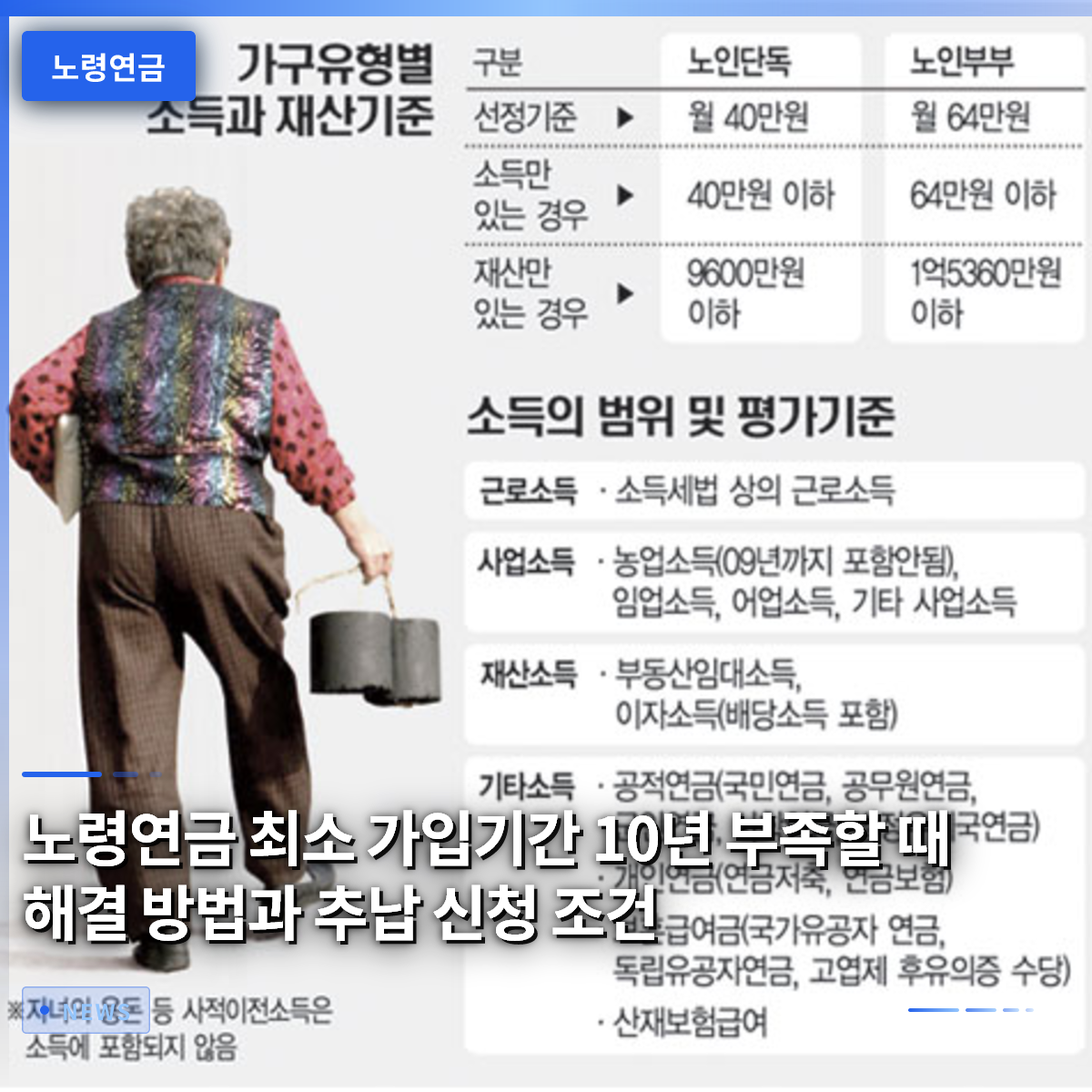
To receive the National Pension old-age pension, you must meet the minimum enrollment period of 10 years; otherwise, you may only be eligible for a lump-sum payment. It is common to see cases where individuals on the verge of retirement are in a panic because they have only completed 119 months of enrollment. You do not need to give up just because your enrollment period is insufficient. By utilizing the additional payment system, which allows you to make up for periods in which you did not pay premiums in the past, you can dramatically secure your eligibility for benefits. In this article, we will take a detailed look at methods to extend your old-age pension enrollment period and the specific application conditions. We encourage readers to carefully review their enrollment records and prepare wisely for their retirement.
=
Solutions and Additional Payment Application Conditions When Falling Short of the 10-Year Minimum Enrollment Period for Old-Age Pensions
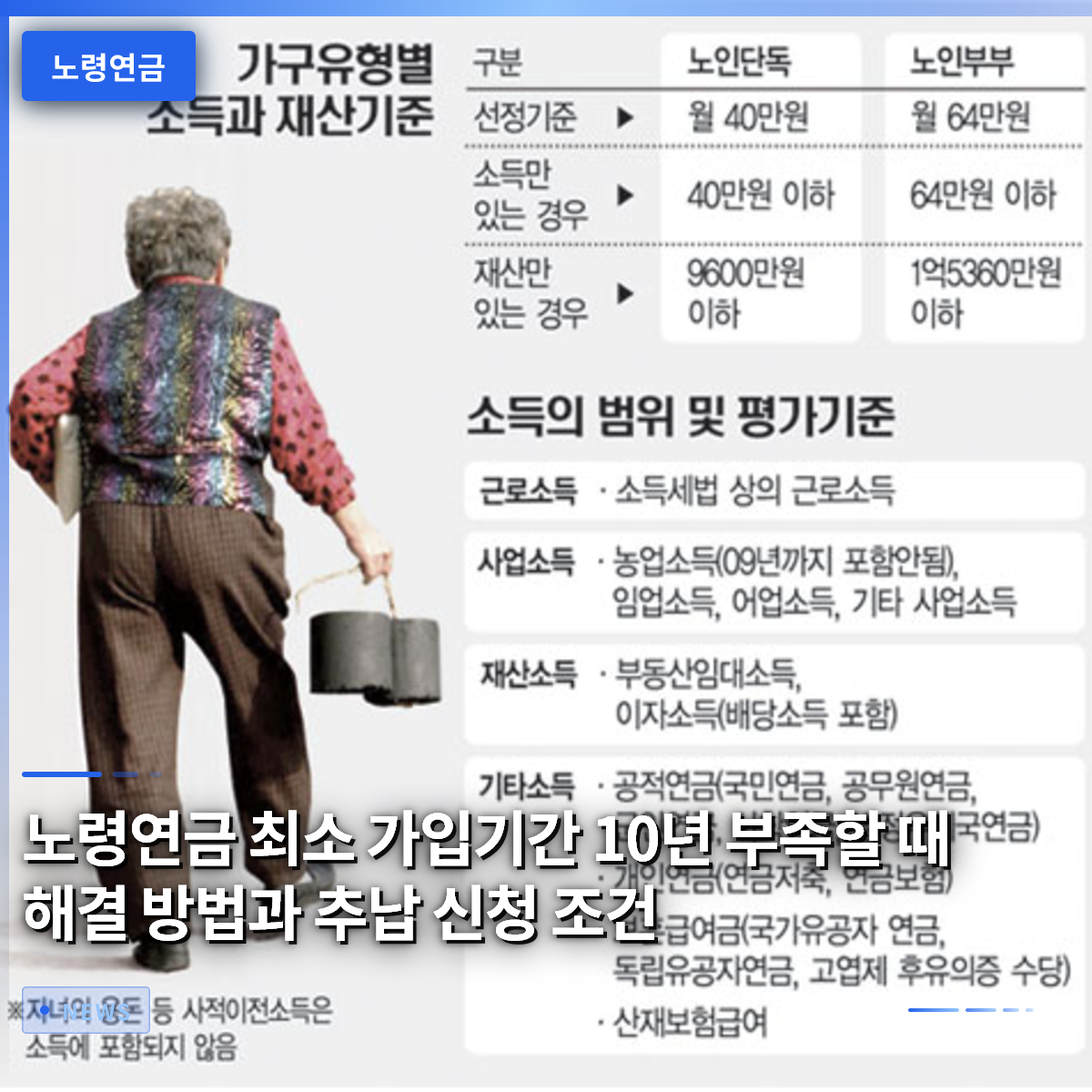
1. Eligibility for Old-Age Pensions and the Importance of the 10-Year Minimum Enrollment Period

To receive the National Pension old-age pension stably every month, you must complete a minimum enrollment period of exactly 120 months. If you reach the age of 60 with only 119 months of enrollment, you will face the situation of being unable to receive a lifelong monthly pension. Many people realize this fact too late and rush to the National Pension Service in a state of panic. Unfortunately, being short by just one month means losing the right to receive a steady monthly pension. In such cases, you can resolve the issue by utilizing past periods of payment exemption or career interruptions. Securing eligibility for benefits is not just a financial benefit but the strongest shield for protecting your livelihood in old age. Therefore, it is crucial to check your enrollment history in advance and identify any missing periods. As a real-life example, Mr. Kim, who lives in Seoul, discovered that his enrollment period was only 9 years as he approached retirement. He nearly ended up receiving a return lump sum for the premiums he had paid and walking away. However, after hearing advice from those around him and checking the missing period, he decided to take proactive action. Ultimately, he paid additional premiums for the required period and successfully made the list of old-age pension recipients. As shown, a small difference in attention and action can completely change life after retirement. We encourage readers to check their enrollment records today.
Since old-age pensions can only be received for life if the minimum 120-month period is met, you should check your enrollment records in advance.
2. Strategies for Extending Your Enrollment Period Using the Additional Payment System

The National Pension additional payment system is a useful scheme that allows you to pay premiums later for periods in which you previously applied for payment exemption due to lack of income. Because it secures the right to receive a monthly pension for life, even if it requires a lump sum of money upfront, it has become a popular retirement planning tool among people in their 40s and 50s. For example, if you have periods where you did not pay premiums while working as a full-time housewife, you can apply for additional payments to have those periods recognized as part of your enrollment period. However, since there is a maximum period for which additional payments can be made, you must carefully consider your own situation. With recent signs of premium rate increases, the rush to apply for additional payments in advance has become even more intense. Wise retirement planners are rushing to complete their applications before system changes to secure stable benefit rights. Mr. Lee, who lives in Gyeonggi Province, experienced a pension gap after leaving his company and living as a full-time housewife for a long time. As he aged and his retirement approached, he suffered from extreme anxiety about not meeting the eligibility requirements. Then, he happened to learn about the additional payment system and paid the premiums he had missed in a lump sum to fill the missing period. As a result, he was able to breathe a sigh of relief while receiving his old-age pension, which is regularly deposited into his account. Thus, additional payment is not just an expense but an excellent investment that secures a reliable cash flow in old age. However, rather than making excessive financial commitments, a strategic approach tailored to your economic situation is necessary.
The additional payment system is an effective method for securing old-age pension eligibility by paying premiums for past periods of payment exemption.
3. Comparative Analysis of the Pros and Cons of Early Old-Age Pensions and Deferred Pensions

People whose income has stopped and who urgently need living expenses often consider the early old-age pension, which can be received up to 5 years earlier than the standard age. A fatal drawback of the early old-age pension is that the pension amount is reduced by a certain percentage for each year the receipt is brought forward. Since the amount is reduced by 6% for each year it is received early, bringing it forward by the full 5 years significantly reduces the original amount. Conversely, if you continue economic activities after retirement or have sufficient assets, you can choose the deferred pension, which is received later. Since the deferred pension increases by a certain percentage for each year it is postponed, it maximizes the amount received for life. Therefore, you must carefully weigh the two systems based on your health status and current economic independence. Mr. Park, who lives in Busan, found himself in a difficult situation after retirement with no proper income to cover living expenses. Ultimately, he decided to apply for the early old-age pension, accepting the reduction to cover his living costs with a slightly smaller monthly amount. On the other hand, his friend, Mr. Choi, decided to defer his pension for 5 years because he had rental income after retirement. A few years later, the pension amount Mr. Choi would receive was incomparably larger than Mr. Park’s reduced amount. Thus, the choices of these two individuals led their post-retirement quality of life in completely different directions. It is wise to first review your bank balance and spending plans rather than blindly following what others are doing.
The early old-age pension is a system where you receive benefits earlier while accepting a reduction, whereas the deferred pension allows you to receive more by delaying receipt.
4. Decisive Reasons to Choose a Pension Over a Return Lump Sum
If you reach the age of 60 without completing the 10-year enrollment period and cannot make additional payments, you will receive a return lump sum. This structure returns the premiums you have paid, plus a modest interest, in a single lump sum, offering the advantage of immediate cash. However, in an era of rapidly rising prices, it is easy for a lump sum to run out quickly if spent. In contrast, the old-age pension is paid for life, reflecting inflation rates, making it the best weapon against longevity risk. Therefore, even if it requires some effort, it is far more advantageous to reject the lump sum and enter the status of a pension recipient through voluntary enrollment or additional payments. This is why many experts strongly warn against receiving a lump sum in retirement fund management. Mr. Jeong, who lives in Incheon, received a notice from the National Pension Service regarding a return lump sum in the year he turned 60 due to insufficient enrollment period. When he realized he would receive several million won at once, he wavered and tried to settle with the lump sum. However, after being persuaded by his family and consulting with an expert, he chose voluntary enrollment to fill the remaining period instead of taking the lump sum. By paying premiums monthly, he eventually succeeded in meeting the minimum enrollment period. Now, thanks to the pension that comes in steadily every month, he has been able to alleviate the major anxiety of his retirement life. You must not make the mistake of being blinded by immediate cash and giving up the massive asset of a lifelong pension.
While a return lump sum provides immediate cash, choosing the old-age pension is advantageous for long-term retirement security.
5. Introduction of the Automatic Payment Service and Changes in the Pension Receipt Environment
Recently, the National Pension system has been steadily evolving in a direction that greatly enhances the convenience of recipients. In particular, a service has been introduced where payments begin automatically when the recipient reaches the eligible age, without the need to submit complex documents or apply directly. As a result, it is expected that regrettable cases of missing the application deadline and failing to receive the pension on time will decrease significantly. However, since this does not apply uniformly to all recipients, you must carefully check if you are included in the target group. For the elderly who are not familiar with digital devices or administrative procedures, this is welcome news like rain in a drought. Simply keeping up with changing systems is an excellent way to protect your valuable rights. Mr. Kang, who lives in Gwangju, had reached the pension receipt age but had been delaying his application due to physical discomfort and the hassle of complex procedures. Then, through the newly introduced automatic payment service, he experienced having his pension deposited directly into his account without any complicated procedures. Thanks to the helpful guidance of the National Pension Service staff and the automated system, he was spared the trouble. Mr. Kang actively shared this system with his friends, praising its convenience. Thus, the National Pension system continues to develop to increase the convenience of the public. We must not miss these changes and actively utilize them to fully enjoy the benefits.
The introduction of the automatic payment service has simplified the application process, greatly improving convenience for eligible recipients.
6. Practical Strategies for Pension Enrollees for Successful Retirement Planning
To complete a stable retirement, you must immediately open your National Pension enrollment records and check for any deficiencies. As retirement approaches, the range of choices narrows, so it is essential to prepare in advance from your 40s and 50s. You must actively utilize useful tools such as the additional payment system and voluntary enrollment to ensure you meet the 10-year minimum enrollment period. Do not be swayed by hearsay; make judgments based on official materials from the National Pension Service and expert advice. The old-age pension deposited into your account every month is a sturdy support for life after retirement and the most reliable retirement security asset. We encourage you, who are reading this article today, to take the first step in checking your pension assets without delay. Mr. Oh, who lives in Daejeon, is enjoying a leisurely life after retirement because he has consistently managed his pension since his younger days. He emphasizes to those around him that retirement preparation is never someone else’s business but starts with one’s own active interest. If you have missing periods, you should look into additional payments now and plan to secure the necessary funds. Creating a stable cash flow, like receiving rent for life, depends solely on your decision. Start acting now so that you can welcome your approaching retirement with a confident smile instead of fear. Wise retirement planning is the ultimate secret to making the rest of your life shine most beautifully.
Thorough preliminary checks and active securing of the enrollment period determine successful receipt of retirement pensions.
Frequently Asked Questions
=