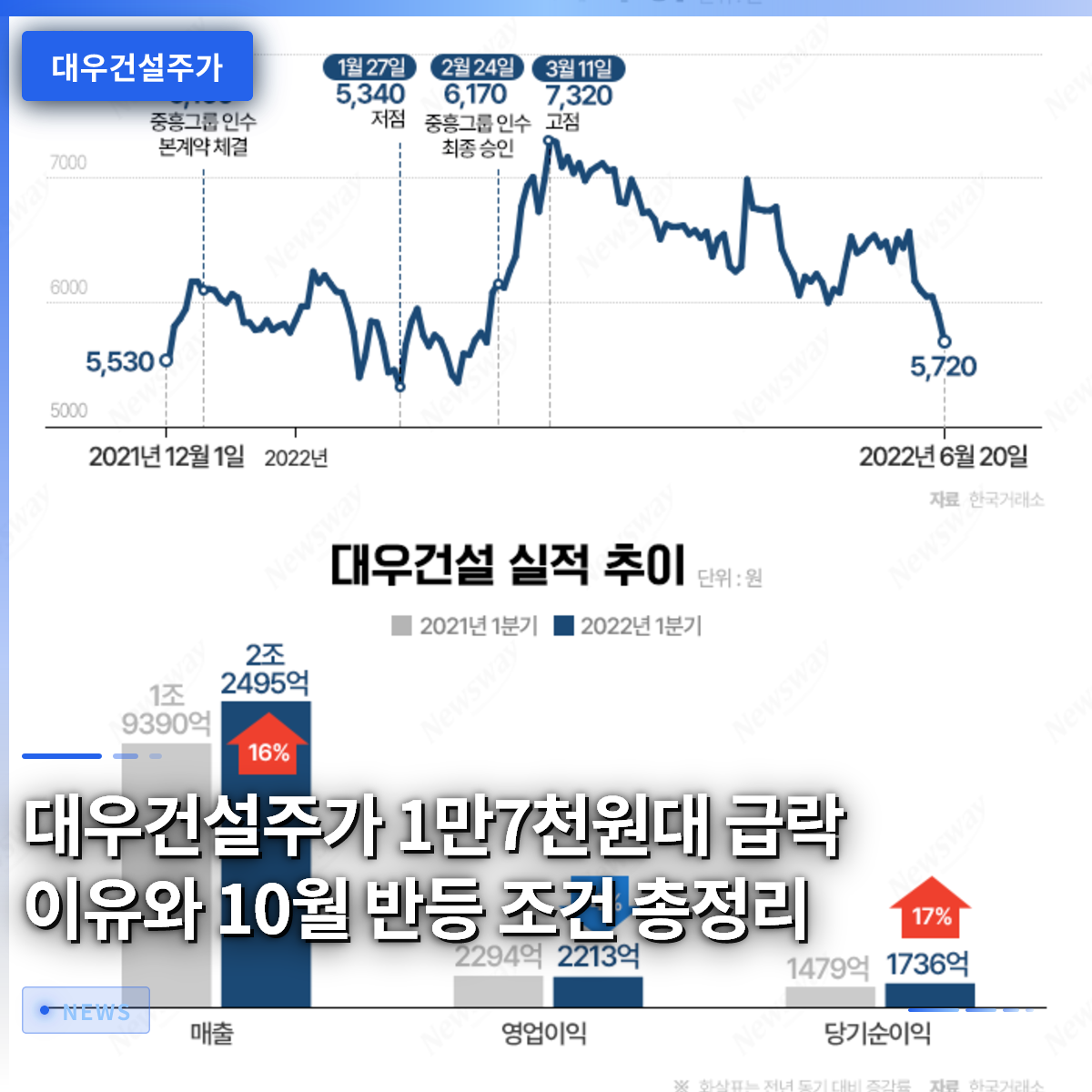
Daewoo E&C stock recently closed at 17,440 KRW after a sharp decline of over 7% during recent trading sessions, raising concerns among many investors. Despite the overall upward trend of the KOSPI index, construction-related stocks struggled, presenting a stark contrast. At one point during the session, the price dropped to 17,300 KRW, prompting growing questions about whether the current price represents the bottom. Behind this sharp drop lies a supply-demand structure where institutional and foreign investors dumped shares, while individual investors moved to buy at low prices. In this article, we will thoroughly examine the true causes of the plunge and the conditions necessary for a potential rebound in the coming October. For those who have long been interested in the construction sector and this specific company, this analysis will be a significant aid in making investment decisions.
=
Why Daewoo E&C Stock Plunged to the 17,000 Won Range and Conditions for an October Rebound: A Complete Summary
1. The Reality of the Sharp Decline and Supply-Demand Analysis
Daewoo E&C stock recorded a steep decline of over 7% in recent trading, catching many investors off guard. This movement was in direct contrast to the KOSPI index, which rose by nearly 1% and showed a relatively positive trend. Although the stock ranked among the top by trading volume, its downward direction highlighted the intensity of the selling pressure. In particular, both institutional and foreign investors recorded net selling positions, dumping shares and serving as the direct trigger for the price drop. The impact was so tangible that a friend of mine called yesterday, shocked by his stock balance, to complain about why only his stocks were falling so sharply. While the overall market sentiment was not bad, construction-related stocks were thoroughly ignored as supply and demand concentrated on specific sectors.
Individual investors took advantage of the sharp drop to aggressively buy, attempting to purchase at the bottom. Exchange statistics show that individuals bought Daewoo E&C shares in large quantities, second only to Samsung Electronics, hoping to catch the bottom. However, with major supply-demand players like institutions and foreign investors turning their backs simultaneously, individual buying power was insufficient to halt the decline. This supply-demand imbalance is the primary factor preventing the stock from rebounding easily, keeping it stagnant. In the stock market, supply and demand equate to power; as long as foreigners and institutions continue to sell, it is difficult to gauge the bottom. The true signal of the bottom will be when institutions and foreigners stop selling and shift back to a buying perspective.
Simultaneous selling by institutions and foreigners triggered the sharp drop, while individual investors engaged in large-scale low-price buying.
2. Impact of Earnings Concerns and Construction Industry Slump
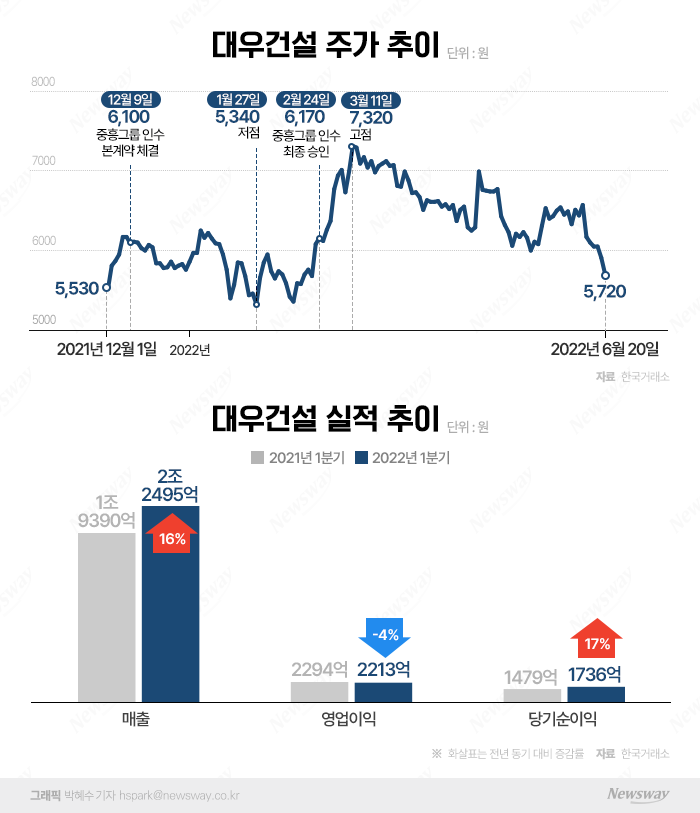
Another fundamental factor weighing on Daewoo E&C stock is the recently reported poor performance and the general slump in the construction industry. Recent financial indicators show operating losses and net losses for the period, resulting in a scorecard that fell short of market expectations. The Return on Equity (ROE), which indicates corporate profitability, also recorded a negative figure, heightening market concerns about financial soundness. The prolonged downturn in the construction cycle has also dampened vitality in new orders and the housing market, negatively impacting the stock price. Even when speaking with local real estate agents, the consensus is that cash flow is severely constricted on the ground, and even major construction companies cannot feel safe.
This weakening of fundamentals has led to a vicious cycle where investor sentiment freezes, further fueling the stock price decline. A stock price unsupported by solid earnings is inevitably vulnerable to external shocks and can be significantly shaken by minor negative news. While the securities industry places hope in the company’s high-difficulty plant construction capabilities and the potential for overseas nuclear power orders, this is not enough to offset short-term earnings weakness. Ultimately, market participants are reacting more sensitively to the immediate deficit results and industry sluggishness than to any rosy future prospects. To dispel these earnings concerns, the company must demonstrate concrete results, such as a series of visible new orders or improved cost ratios.
The combination of poor earnings and a general slump in the construction industry has suppressed investor sentiment, increasing downward pressure on the stock price.
3. Significance of the 17,000 Won Price Range and Support Lines
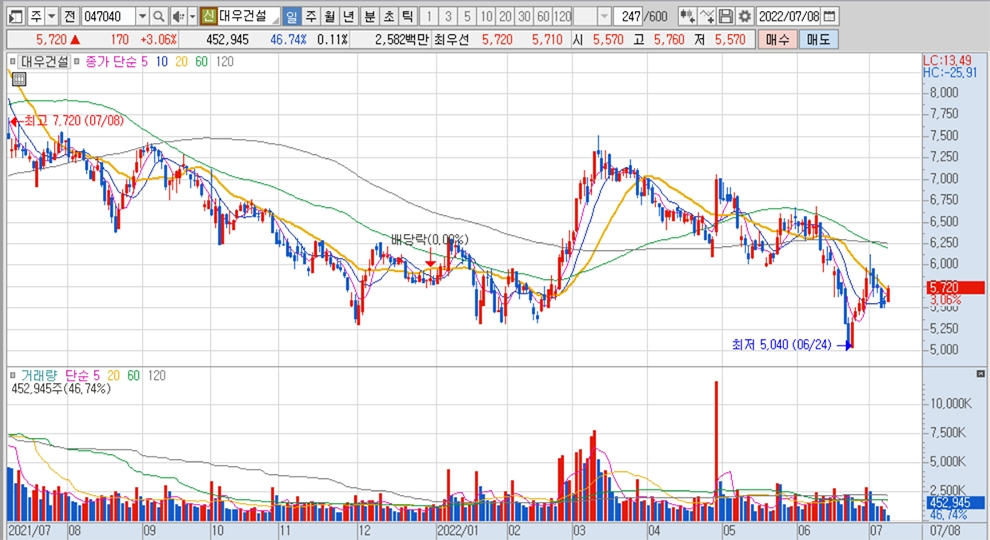
With Daewoo E&C stock falling to the 17,440 KRW level, attention is turning to whether this price range represents a technical bottom. Although the stock price, which had dipped to 17,300 KRW intraday, managed to narrow the decline somewhat, it remains in an unstable state. Chart analysis shows that the current zone aligns with past major support lines, playing a crucial role as a technical defense line. If this 17,000 KRW line also breaks, fear of further declines could grow, risking a flood of sell orders. Veteran investors are deeply contemplating whether to start split buying at this price level or wait longer.
Rushing in blindly to catch a falling knife is risky; wisdom requires observing changes in trading volume. Only when trading volume gradually decreases and the stock price stops falling to move sideways can it be interpreted as a signal of incoming buying pressure. Conversely, if heavy trading volume accompanies downward candles, it is evidence that the bottom has not yet been established, requiring a cautious approach. Currently, opinions are sharply divided between those who see high value in the bottom and those who view it as a falling knife. Therefore, it is essential to adjust positions according to one’s investment style and avoid the mistake of investing all assets at once.
The 17,000 KRW range is a technically significant support line and a critical point determining whether further declines will occur.
4. Momentum from Overseas Nuclear Power and Plant Orders
The most powerful weapon to drive a medium-to-long-term rebound in Daewoo E&C stock is undoubtedly its competitiveness in overseas nuclear power generation and high-difficulty plant orders. Demand for large-scale nuclear power construction in the global market is steadily increasing, and the company traditionally boasts unparalleled construction track records in the plant sector. Indeed, securities reports and market analysis materials frequently cite the possibility of participating in overseas nuclear power projects as a key basis for raising target prices. Visible results are also emerging from overseas development projects, including in Vietnam, leading to assessments that long-term growth drivers remain valid. If you check stock discussion boards on your phone during your commute, you will see a stream of posts desperately hoping for news of a jackpot overseas order.
However, there is a limitation to this major order momentum: a time lag exists before it can immediately defend against short-term earnings weakness and stock price declines. Even if an order contract is signed, it takes considerable time for it to be reflected in actual revenue and profit, meaning the impact on the stock price may be delayed. Nevertheless, as the company is classified as a nuclear power-related stock, it holds the potential for a sharp rebound at any time if news of policy benefits or large overseas contracts emerges. From an investor’s perspective, rather than reacting emotionally to short-term price fluctuations, it is crucial to check whether the company’s essential order pipeline is operating normally. Ultimately, major overseas order news will be the most certain key to securing downside resilience and establishing a foundation for a rebound.
Order momentum in the overseas nuclear power and high-difficulty plant sectors is the core driver for a long-term rebound.
5. Essential Conditions for an October Stock Price Rebound
For Daewoo E&C stock to ride a full-fledged rebound trend in October, several clear market conditions must be met. The first condition is the calming of the prolonged net-selling trend by institutions and foreigners and its shift to net buying. Only when the main supply-demand players return can an environment be created for the stock price to draw a stable upward curve. The second condition is additional real estate measures or policy support from the government that can heighten expectations for a soft landing of the construction economy. If the industry itself does not recover, individual corporate efforts alone will have limited impact on stock price growth.
The third condition is transparent communication from the company to reduce financial risks and instill trust in the market regarding future earnings improvement. Demonstrating the resolution of uncertainties ahead of the earnings announcement season would greatly help thaw frozen investor sentiment. In fact, there are precedents where other major construction stocks that faced sharp declines last month quickly recovered their footing as institutional buying flowed in. We often see acquaintances who panic-sold at the bottom, only to kick themselves in regret after seeing a sharp rebound. In October, it is most important to carefully assess whether these negative factors have already been priced in and respond with a cool-headed attitude.
For an October rebound, improved supply-demand from institutions and foreigners and the resolution of earnings uncertainty must precede.
6. Successful Investment Strategies and Future Outlook
Investors in Daewoo E&C stock should wisely analyze the current volatile market conditions and approach with a split-buying strategy. It is absolutely forbidden to be swayed by emotions and make reckless chase-sells or borrow money to invest just because the stock price has dropped sharply in the short term. A strategy of carefully monitoring the chart to see if the 17,000 KRW price line holds and gradually increasing positions is much safer. The key to navigating this difficulty is to stick to your own clear investment principles without being shaken by what others say on stock message boards. Having seen countless people suffer losses by investing based on hearsay, thorough information verification is essential.
In the remaining second half of the year, news of overseas nuclear power orders and the possibility of earnings improvement will be the decisive landmarks determining the stock price’s direction. While the current stock price decline may be painful, wisdom is needed to believe in the company’s essential competitiveness and its position in the global plant market and wait patiently. We look forward to a rebound scenario in October where supply-demand turns positive, recovering the previous decline. Since all investment responsibility lies with the individual, please refer to the provided information but make final decisions cautiously. Do not forget that successful investment is always completed through a balance of thorough analysis and patience.
One should refrain from emotional responses and approach from a long-term perspective through thorough split buying and supply-demand monitoring.
Frequently Asked Questions
=