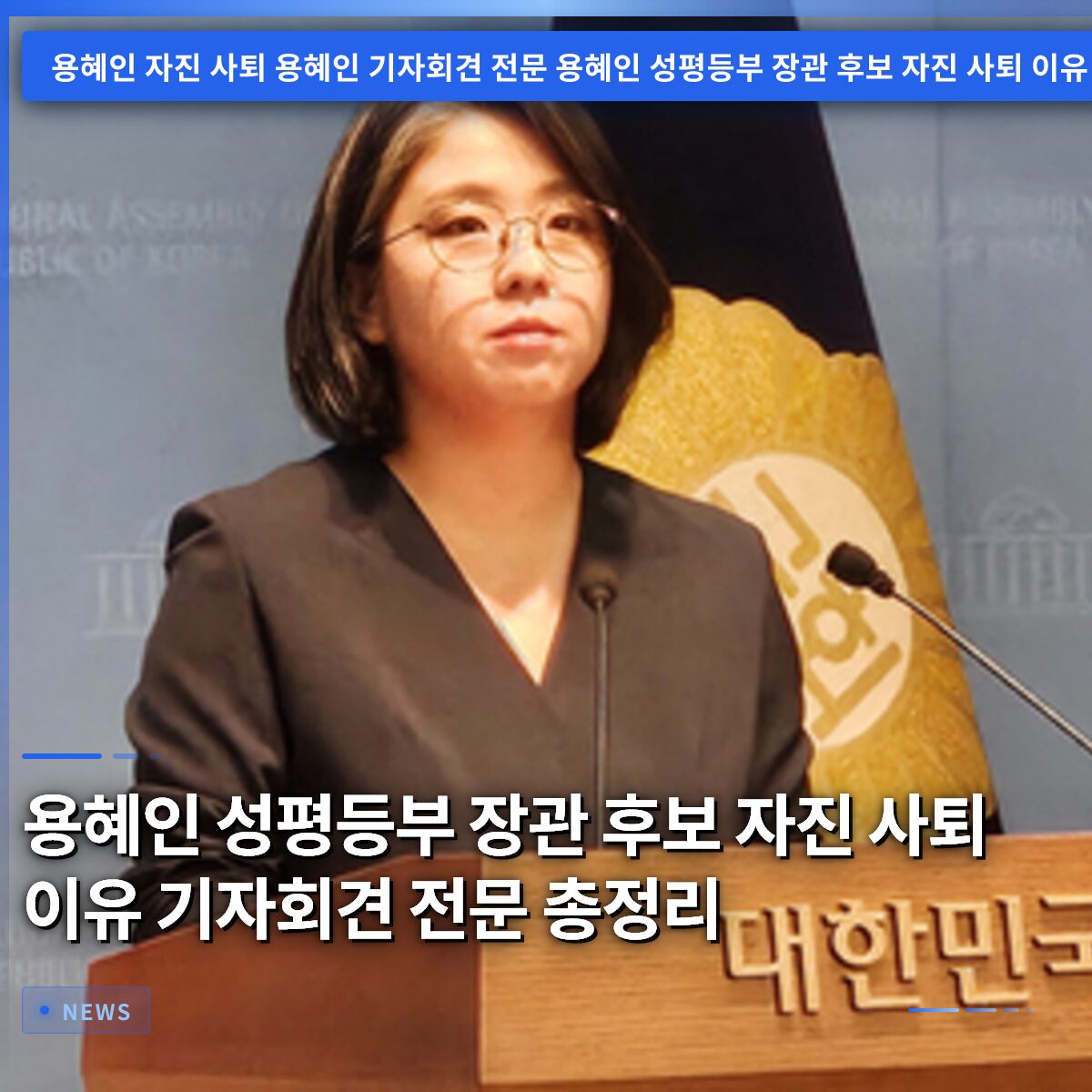
Yong Hye-in, the nominee for Minister of the Ministry of Gender Equality and Family, officially announced her sudden voluntary resignation from the candidacy at an emergency press conference held at the National Assembly Communication Center on the morning of September 13, 2026. This decision, made less than two weeks after she was nominated by President Lee Jae-myung on August 30, has sent shockwaves throughout the political sphere. It marks a 180-degree turn from her stance just three days prior, on September 10, when she vowed to confront various suspicions and controversies head-on and refused to step down. One cannot help but wonder what exactly compelled her to reverse her firm refusal to resign overnight and step away from the position. In this article, we will thoroughly examine the decisive background behind her resignation and the specific positions she clarified during the press conference. Those who have long been interested in political news will be able to clearly understand the political significance of this incident.
=
Yong Hye-in’s Resignation as Gender Equality Minister Nominee: Full Summary of Press Conference
1. Background and Details of the Resignation Announcement
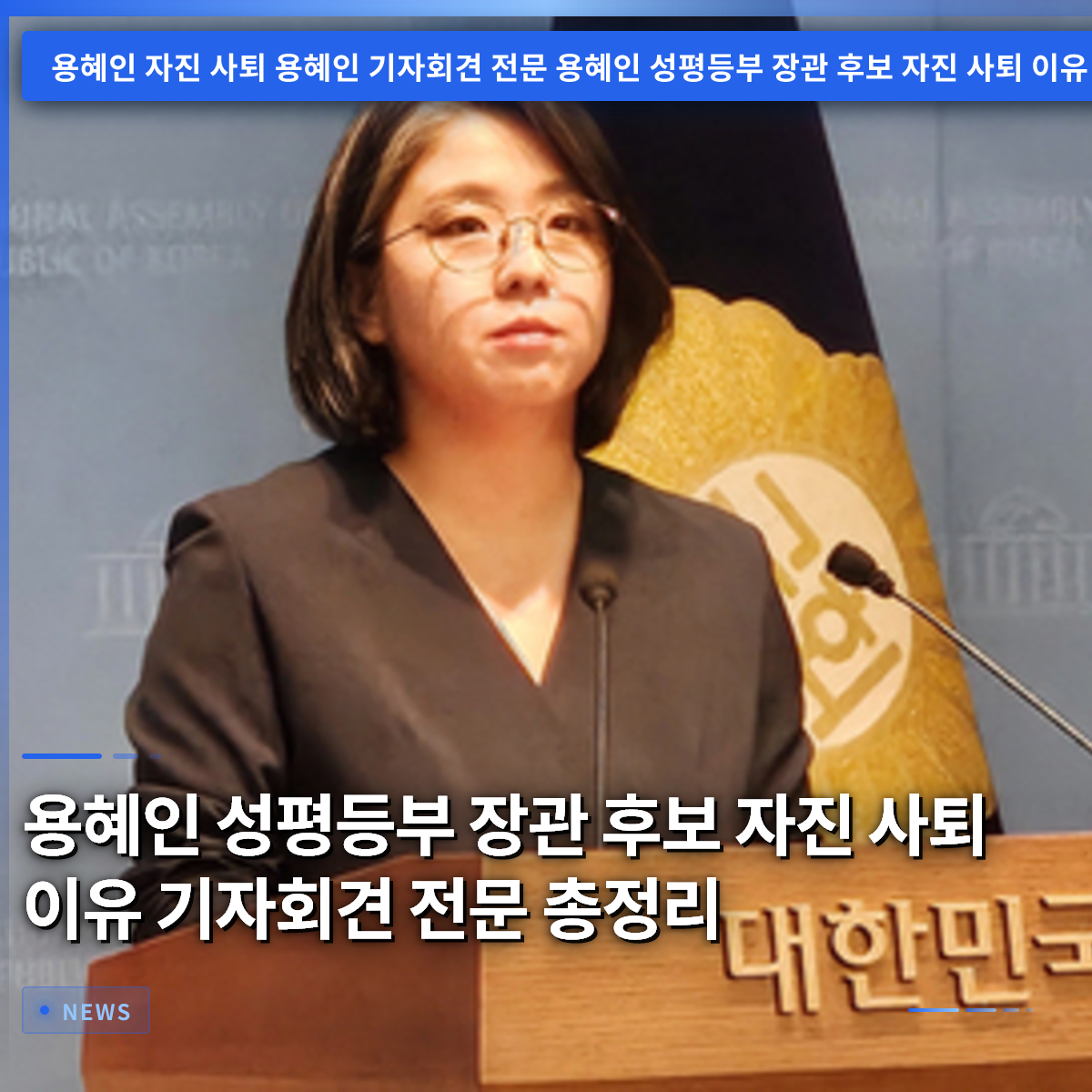
On the morning of September 13, Nominee Yong Hye-in voluntarily requested an emergency press conference at the National Assembly Communication Center, where she announced her resignation from the ministerial candidacy while being watched by numerous reporters. This announcement came as a significant shock to many, given that she had previously maintained her resolve to serve simultaneously as a proportional representation member of the National Assembly and as a minister. As she had been appointed to lead a key ministry following the inauguration of the Lee Jae-myung administration, public opinion was divided between high expectations and deep concerns. From the moment of her nomination, fierce debates erupted both inside and outside the political circle regarding the validity of an incumbent proportional representation MP concurrently holding a cabinet position. However, the nominee herself repeatedly emphasized that there were no legal issues and refused to back down, insisting on facing the challenges head-on. Ultimately, she appears to have raised the white flag under pressure to withdraw the nomination, unable to withstand the intensifying critical public opinion and concerns within her own party. It is reported that the behind-the-scenes negotiations between the ruling party leadership and the nominee played a decisive role in this voluntary resignation. While the Democratic Party of Korea respected the unique political position of the Basic Income Party and Candidate Yong, they did not hide their concerns about the current situation. They conveyed that public perception of holding both a proportional representation MP seat and a ministerial position was far colder than anticipated. Even within the ruling party, voices emerged warning that if this continued, it would become a significant burden not only for the upcoming confirmation hearings but for the overall operation of the state. Although she had left a strong impression on the public with her bold voice since her early days in politics, she apparently could not withstand the trend of even the ruling party turning its back on her. Ultimately, recognizing the harsh reality of the political landscape and the lack of public consensus, she chose to step down on her own.
Nominee Yong Hye-in voluntarily resigned just two weeks after her nomination, unable to overcome the ruling party’s concerns and the lack of public consensus.
2. The Controversy Over Concurrent Positions and Public Pressure
The most heated trigger of this incident was undoubtedly the so-called controversy over her attempt to hold both the position of a proportional representation MP and a ministerial post. Under the Constitution of the Republic of Korea and the National Assembly Act, it is generally permissible for a member of the National Assembly to concurrently serve as a state council member, and there have been several such precedents in the past. Therefore, Candidate Yong maintained her stance, arguing that there was no legal violation. To use a workplace analogy, it was similar to an employee insisting on taking on the role of a team leader for a critical internal project while keeping their primary job, citing company regulations that allow concurrent roles. However, the public’s perspective was on a different level than simply citing a single legal article. A proportional representation MP is a representative sent to the National Assembly by voters who support a specific party’s policies, so moving to a cabinet position could be perceived as a betrayal. Both the political sphere and civil society raised voices criticizing that this contradicted political ethics and common sense, rather than focusing on legal validity. There were also continuous points raised that since members of the National Assembly have the solemn duty to monitor and check the executive branch through the legislative branch, becoming a head of the executive branch would undermine the basic spirit of the separation of powers. It was as if a team leader, while colleagues were working overtime to verify a project, got promoted to a department that directly receives orders from the CEO, inevitably causing internal backlash. Even as this controversy snowballed, the candidate’s side continued to shout “head-on confrontation” and showed no sign of retreating. However, as polling support rates worsened and criticisms from all walks of life continued, it became a ticking time bomb that would burden the entire administration the longer she held out. Ultimately, it left a painful lesson that no political ambition can be realized without winning the hearts of the people, regardless of legal validity.
The claim of legal validity for holding both an MP seat and a ministerial position faced a strong backlash for contradicting public sentiment and the principle of separation of powers.
3. Reversal of Stance in Just Three Days
The change in attitude displayed by Nominee Yong Hye-in will be remembered as a representative example of how ruthless and fast-paced the political world can be. Just three days earlier, on September 10, at a press conference at the National Assembly Communication Center, she declared that she would face all suspicions and pressure to resign head-on and would never give up her seat as an MP. At the time, her expression was very resolute, and she characterized the criticism against her as nitpicking by the vested interests, burning with a firm will. It felt like a team leader facing an unfair audit, staging a one-person protest in front of the CEO’s office, determined to survive and prove their worth through results. Her appearance, where she logically argued her points for over 30 minutes in front of reporters to assert her confidence, also left a deep impression on her supporters. However, it appears that immense political pressure and behind-the-scenes negotiations took place beneath the surface during that short span of three days. It seems that not only the ruling party leadership but also the atmosphere in the Blue House determined that it would be difficult to maintain control of the political situation if the candidate continued to hold out. Realistic calculations played a role, such as the fear of providing the opposition party with ammunition ahead of the upcoming national audit and budget review. The public could not hide their bitterness seeing a politician who loudly declared she would never back down yesterday announcing her resignation today by accepting the party’s recommendation. Fans had no choice but to turn their backs as they watched the political zeal to uphold her principles collide with the wall of realistic politics and break powerless. This sudden change in stance dealt a significant blow to her existing image as a principled politician and is expected to be a considerable burden on her future political career.
Candidate Yong’s declaration of resignation just three days after vowing a head-on confrontation at the September 10 press conference was due to the ruling party’s internal atmosphere and realistic pressure.
4. Message of Gratitude and Apology to the President
At this press conference, Nominee Yong Hye-in bowed her head to President Lee Jae-myung, who had trusted and selected her, expressing her deep gratitude. She expressed respect for the President’s decision to entrust her, a member of a minor party, with the heavy responsibility of Minister of the Ministry of Gender Equality and Family. She bowed her head in apology, stating that while she wanted to contribute to the country to live up to the President’s trust, she had to withdraw midway due to her own shortcomings and was unable to fulfill her duty. It was similar to a farewell exchange in a situation where a company representative had ambitiously promoted a young talent to an executive position, but had to withdraw the appointment due to internal backlash and lack of capability. There were signs that she tried to maintain at least minimal political ethics by taking the form of stepping down voluntarily to avoid burdening the President’s appointment power. This humble attitude stood in perfect contrast to her aggressive rhetoric and confident rebuttals of various suspicions just three days prior. At that time, she had shown determination not to back down, characterizing the criticism against her as a political offensive, but on this day, she took a submissive posture. It can be seen as a scene showing the fate of a politician who abandons her principles and stubbornness in the face of the ruthlessness of power. Within her gratitude and apology to the President, one can sense a subtle mix of resentment toward the ruling party for not protecting her and complex feelings. Although her entry into the ministerial post was thwarted, she likely learned painfully from this experience about how to build relationships with the administration and the techniques of political negotiation. When she seeks a political comeback in the future, this incident will undoubtedly serve as a major lesson.
Her expression of gratitude to President Lee Jae-myung and her apology for not fulfilling her duty contrasted sharply with her previous confidence.
5. The Basic Income Party and Outlook for Future Political Activities
This voluntary resignation has also left the Basic Income Party, led by Representative Yong Hye-in, with significant political setbacks and concerns. The party’s grand plan to maximize its presence as a minor party in the National Assembly and expand its influence through entry into the executive branch has come to nothing. This incident has also created considerable cracks in its strategy of asserting an independent voice between the two major parties and acting as a swing voter. It is similar to a small venture company aiming for a merger with a conglomerate or winning a large project, but disappointing even its existing clients due to over-expansion. As Representative Yong, the party’s star and sole focal point, has been wounded, her negotiating power in future election periods or political alliances is likely to shrink. Although she stepped down from the ministerial candidacy, Representative Yong Hye-in still holds her status as an incumbent proportional representation MP and has expressed her intention to focus on her legislative activities. She vowed to return to the National Assembly to handle livelihood issues and focus on her original duty of sharply monitoring government policies as an opposition MP. It has become more important than ever to demonstrate her pledge to humbly accept the public’s harsh criticism and return to her original intentions through action. Instead of pursuing the glamorous title of Minister, she must focus on achieving substantive legislative passes and policy results within the National Assembly to regain lost trust. It is worth watching whether she can mature into a more seasoned politician, learning from the trial and error that any young politician might experience.
The Basic Income Party and Representative Yong suffered political setbacks from this incident but stated they would return to the National Assembly to focus on legislative activities.
6. Lessons Left for the Political Sphere and Conclusion
The voluntary resignation of Nominee Yong Hye-in clearly demonstrated the vast gap between the logic that something is legally possible and the sentiment that the public actually accepts. It was re-proven that no matter how well-grounded an appointment is in the Constitution and laws, it is difficult to survive if it ignores the standards of the times and public consensus. It is the same logic as in the workplace, where forcing a unilateral appointment while ignoring colleagues’ backlash just because it is written in the rulebook ultimately leads to trouble. This incident will likely lead to stricter evaluations of alignment with public sentiment, beyond simple capability checks, in future high-level official appointments. It left a painful warning to politicians about the importance of conduct that aligns with public common sense and morality before arguing the boundaries of the law. This incident reminded us once again that politics is ultimately the art of winning people’s hearts and the task of keeping a ship afloat on the sea of public opinion. For Representative Yong personally, this is a significant political wound and a time of trial, but she will also have gained the valuable lesson that she must be faithful to the basics rather than grand ambitions. It will be an interesting point to watch how she will win back the hearts of voters with remorse and reflection from her original seat in the National Assembly. We hope that readers will not dismiss this incident as mere gossip but use it as an opportunity to seriously consider our society’s personnel verification system and methods of political communication. We conclude by reaffirming the truth that public opinion is the will of Heaven, and that power or politics that goes against it can never last long.
This incident left a painful lesson for the entire political sphere that public sentiment and common sense must be respected over legal validity.
Frequently Asked Questions
=