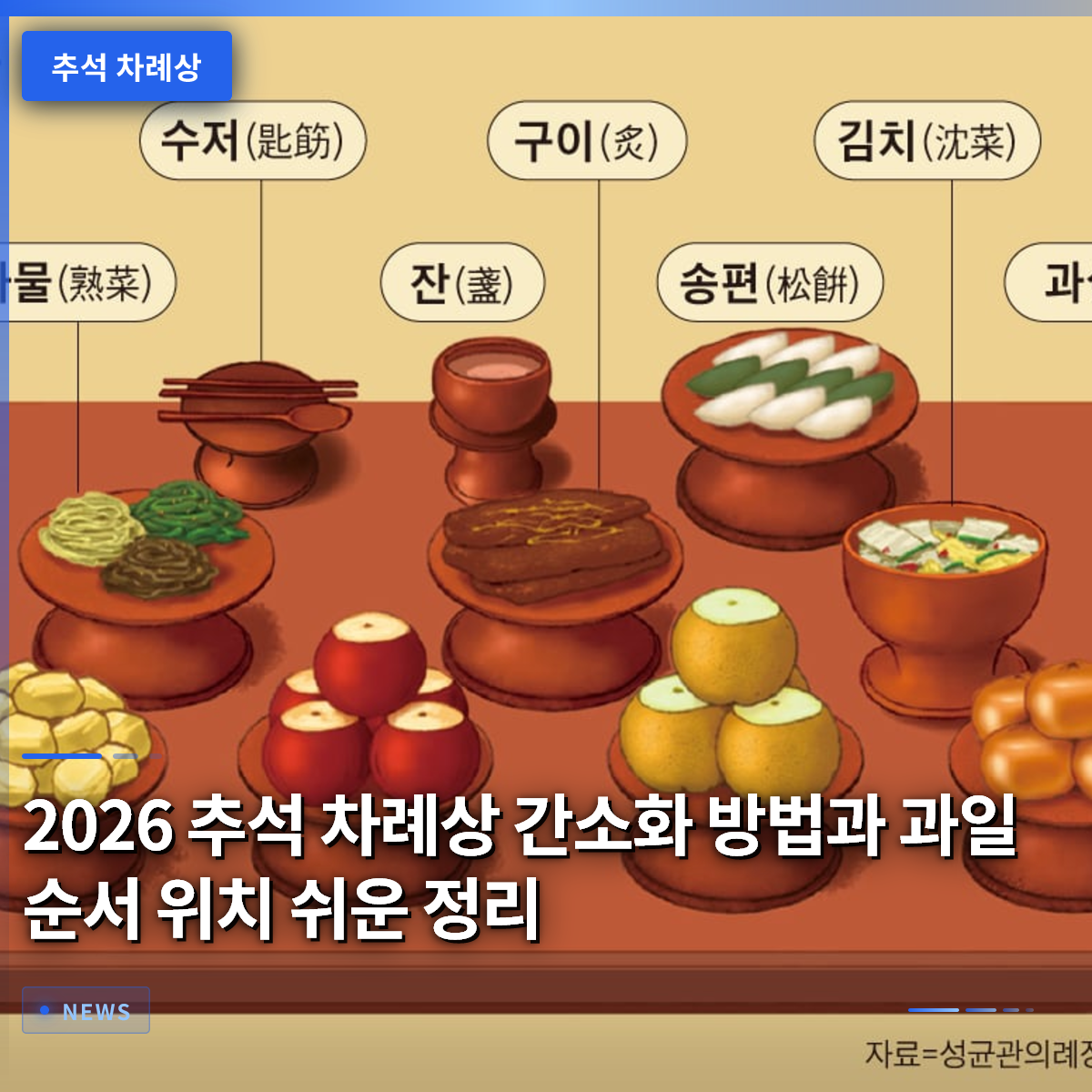
For the 2026 Chuseok ancestral rites, the trend has shifted toward simplified table settings that prioritize family harmony and sincerity over complex rules. The scene of families frying jeon (Korean pancakes) until their ligaments feel like they’re tearing, or raising their voices over fruit placement, is a thing of the past. The Seonggyungwan Ritual Establishment Committee has repeatedly emphasized that strict placement based on fruit color or type is not mandatory. In fact, I vividly remember sweating profusely at the supermarket last year, holding apples and pears, trying to adhere to the “red east, white west” rule for our family ritual. As long as the intention to honor our ancestors is sincere, there is no problem in freely reducing the number or placement of dishes based on family consensus. In this article, we will thoroughly examine practical standards for a Chuseok table that anyone can set up easily, significantly reducing stress this year.
=
How to Simplify Your 2026 Chuseok Ancestral Rites Table: A Simple Guide to Fruit Order and Placement
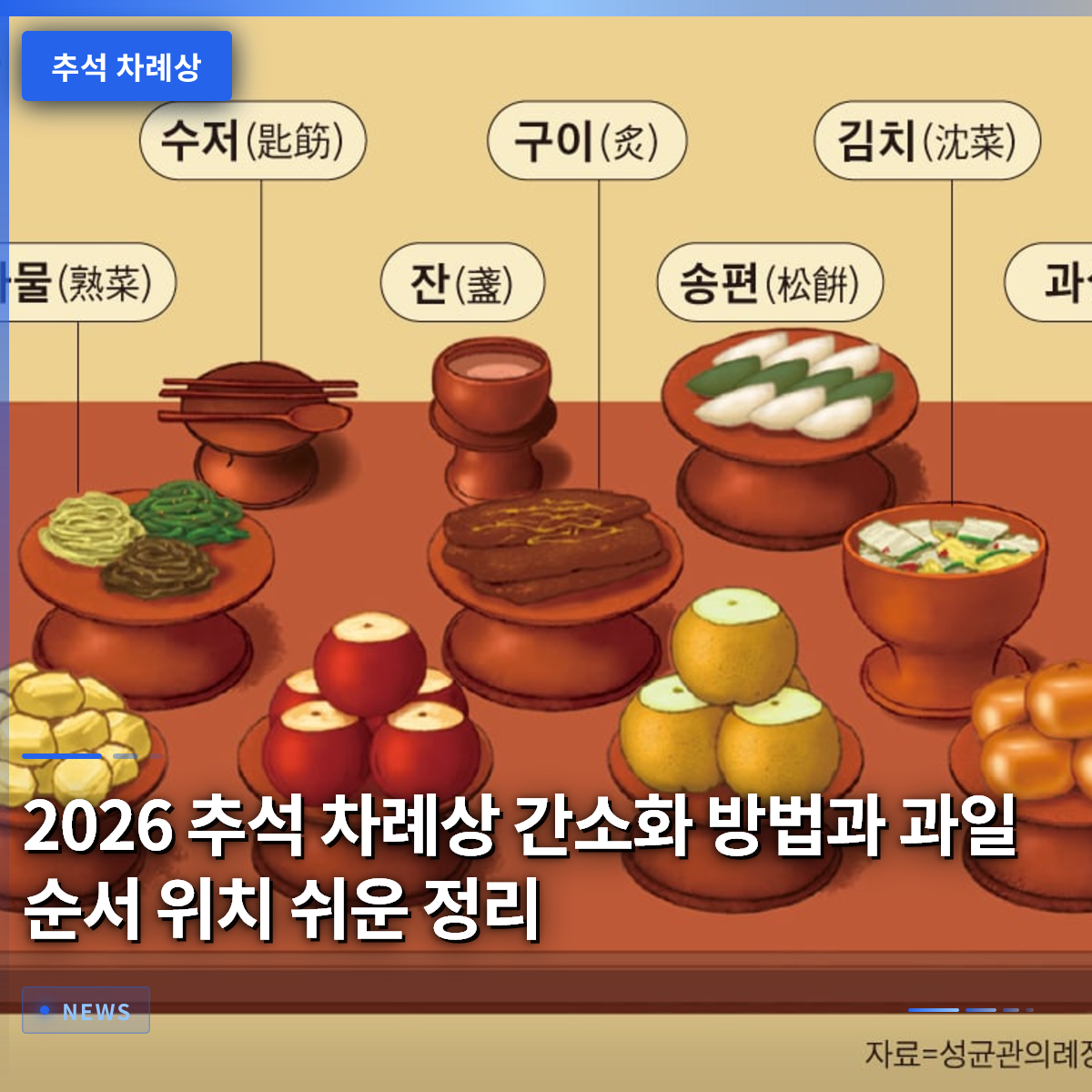
1. The Truth About Simplifying the Chuseok Table According to Seonggyungwan
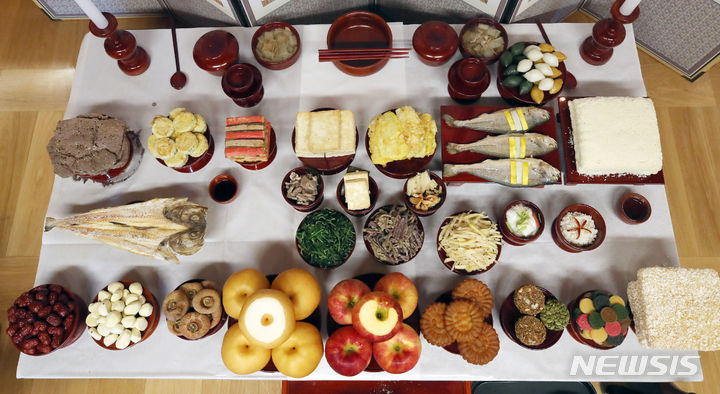
We are moving away from the traditional method of offering dozens of dishes, shifting toward a table setting focused on foods that the family can enjoy together. In the past, people mistakenly believed that they had to memorize difficult Sino-Korean idioms like “Jo-yu-ri-si” or “Hong-dong-baek-seo” to set the table properly to show true filial piety. However, as times have changed, there is a growing recognition that ancestors would be happier seeing their descendants comfortable and exchanging warm words rather than exhausted from hard work. Seonggyungwan has explicitly stated that it is acceptable to offer just four or five fruits simply and that frying jeon is not mandatory. Recently, the number of households significantly reducing their preparation process by using commercially available holiday convenience foods or assorted jeon has exploded.
In fact, it is reported that at a friend’s house last year, a radical suggestion was made to offer pizza and chicken—favorites of the family—instead of frying jeon. Although there was strong opposition from the elders initially, after the ritual was completed, everyone expressed satisfaction, feeling relieved to have shed the burden of empty formalities. The essence of the holiday is not a grand feast to fill hungry bellies, but for family members who rarely gather to ask after each other’s well-being. Even for the sake of parents and children suffering from holiday syndrome due to complex procedures, we must boldly omit unnecessary steps. For this year’s Chuseok, I recommend practicing a comfortable simplification rather than frying jeon until your back hurts.
Simplification that prioritizes family convenience and sincerity over complex traditional rules like fruit types or frying jeon is the right approach.
2. Fruit Order and Food Placement: Do You Really Have to Follow the Rules?
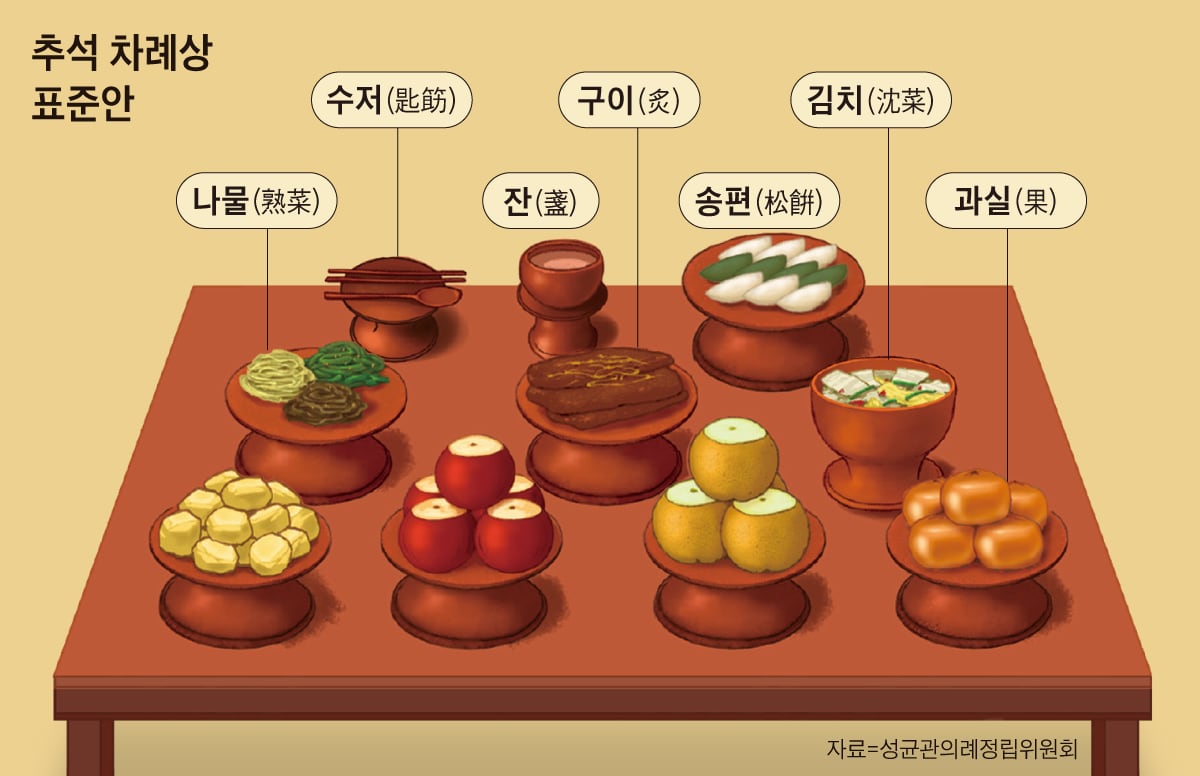
Typing “fruit order” or “how to write the memorial tablet” into a smartphone search bar every holiday morning is a permanent holiday routine in South Korea. In reality, if you know the basic principle of distinguishing left and right based on the side where the spirit tablet is placed, the specific arrangement or position of fruits is not a big deal. Rules like “Hong-dong-baek-seo” (red east, white west) or “Jo-yu-ri-si” are just part of the etiquette established by Confucian scholars in the Joseon Dynasty, not absolute laws. Offering seasonal fruits like apples, pears, and persimmons in a way that is good to eat and look at is itself an excellent offering.
Many housewives used to scratch their heads every time they went grocery shopping due to the superstition that tangerines or bananas should not be offered at ancestral rites. However, nowadays, it is much more natural and respectful to offer fruits that the deceased loved most in life or fruits that are easily available in the current era. Traditional Korean sweets like dried persimmons or yakgwa are not mandatory and can be replaced with snacks the family usually enjoys without anyone complaining. The important thing is to completely prevent family members from turning red in the face over formal placement choices.
Detailed rules like fruit order or fish placement are not fixed, immutable laws, so it is fine to arrange them however is comfortable for you.
3. How to Write the Memorial Tablet and the Order of Bowing: A Complete Guide
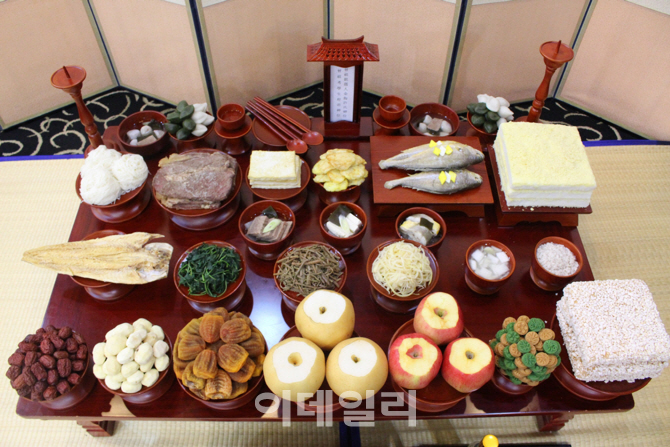
The moment that makes people sweat the most every holiday morning is when they write the jibang (memorial tablet) on blank paper with a brush or pen to replace the spirit tablet. If the method of writing the deceased’s clan, official position, and name in Chinese characters feels too complex, writing it sincerely in Hangul (Korean alphabet) nowadays carries no fault. Using intuitive Hangul notations like “Father’s Spirit Tablet” or “Mother’s Spirit Tablet” makes it easy for the whole family to read and eliminates the risk of typos. Once the jibang is written, place it on a folding screen or altar and align it reverently with the mindset of inviting the ancestors.
After placing the jibang, the process involves Gangsin (offering wine to invite the spirits) and Heonjak (pouring wine into cups for the father and mother in order). After completing the Napshi (placing chopsticks neatly on the rice), take a moment to bow your head and honor the ancestors’ benevolence during the Sirip (standing bow) time. When bowing, men should place their left hand on top, and women should place their right hand on top, bowing twice. Even if the order is a bit confusing, if the family proceeds calmly while helping each other, it will result in a perfect ritual.
You can write the memorial tablet in Hangul instead of complex Chinese characters, and the bowing order is easy if you just pay attention to the hand position for men and women.
4. How to Use Convenience Foods and Dining Out to Reduce Holiday Stress
It is time to end the suffering of mothers who shop days in advance and cannot straighten their backs in the kitchen while preparing the ancestral table. Recently, the food industry and convenience stores are competitively launching high-quality convenience products like japchae, assorted jeon, and namul (vegetable side dish) sets targeting the holiday season. Not only single-person households spending the holiday alone, but also large families are rapidly increasing their use of these convenience foods to set up the ancestral table. By reducing the hard work of peeling, frying, and stir-frying, the incidence of falling ill with the flu after the holiday has decreased significantly.
In fact, some welfare facilities and support programs for vulnerable groups in the Seoul area have also received great response by preparing communal ancestral tables using convenience foods. You can take care of both taste and sincerity without going to the market at dawn to buy expensive ingredients and frying jeon in the heat. Using the time and energy saved this way to go on a palace outing with the whole family or watch a traditional performance is a much more meaningful way to spend the holiday. Flexibly changing food preparation methods to match the times is truly a smart strategy for enjoying the holiday.
You can significantly reduce physical pain and stress by actively using commercially available holiday convenience foods instead of making every dish by hand.
5. Enjoying a 2026 Chuseok Outing with Family After the Ritual
Once the ritual is safely completed, I recommend getting out of the stuffy house in the afternoon and enjoying Seoul’s holiday events with the whole family. Local governments, including the Seoul Metropolitan Government, operate diverse programs during the Chuseok holiday period so that citizens can enjoy a rich Mid-Autumn Festival without spending money. Special exhibitions featuring traditional foods, explanatory programs reflecting on the meaning of the ancestral table, and beautiful photo zones await citizens. In particular, in the mid-afternoon of the holiday, traditional tightrope walking performances or lively traditional performance events are held, further heightening the holiday atmosphere.
Taking a stroll through a quiet palace with relatives you haven’t seen in a long time or enjoying the autumn breeze in a city park is enough to wash away the fatigue of daily life. You can have a vibrant holiday, completely different from the past when you poured all your energy into setting the table and spent the entire holiday lying on the sofa. It is wise to devote the remaining time entirely to family love and rest after honoring the ancestors with the ritual. For this year’s Chuseok, I hope you find leisure through a simplified table setting, enjoy diverse cultural events, and create unforgettable memories.
Your satisfaction with the holiday will double if you enjoy traditional cultural events or palace outings hosted by local governments after finishing the ritual simply.
6. Why Family Happiness Matters More Than Formality in 2026 Chuseok
This year’s Chuseok should be a turning point to break away from empty formalities through bold simplification of the ancestral table and reclaim the true meaning of the family community. It is putting the cart before the horse that family discord arises and more people visit hospitals for holiday syndrome due to repetitive holiday stress. Just as recommended by the Seonggyungwan Ritual Establishment Committee, significantly reducing formalities and exchanging warm words of consideration is likely what the ancestors desire most. We should simplify the preparation process by utilizing convenience foods and flexible fruit placement, and use the remaining time entirely for rest and sharing.
South Korea’s holiday culture is rapidly evolving from showy, large-scale table settings to a healthy culture centered on practicality and sincerity. During this Chuseok holiday, try to be wise by cutting the time spent in the kitchen in half and doubling the laughter of your family. Instead of minor conflicts over the ancestral table, let us welcome a peaceful morning where we wish for each other’s health and exchange words of blessing. I sincerely hope that a special and happy 2026 Mid-Autumn Festival memory unique to our family will bloom beautifully amidst the changing holiday customs.
Focusing on family harmony and rest rather than formal table settings is the most valuable way to spend 2026 Chuseok.
Frequently Asked Questions
=