Receiving your retirement pension is not simply about money landing in your bank account on your last day of work; it is a crucial financial procedure that requires your direct choice and application. Mr. Kim, a corporate employee, received his severance pay as a lump sum to buy a new car, only to face a massive tax bill later and deeply regret his decision. Many people do not know how to receive their retirement funds in the most advantageous way, often choosing a lump sum blindly or postponing the process due to its complexity. In this article, we will walk you through the concepts of Defined Benefit (DB) and Defined Contribution (DC) plans, as well as Individual Retirement Pension (IRP) accounts. We will cover the specific conditions for receiving benefits and how to significantly reduce taxes by opting for pension payments. Let’s thoroughly examine the key information you need to check right now to build a secure monthly income for your retirement. Please read to the end to protect your valuable retirement funds, which will serve as a sturdy pillar for the rest of your life.
=
Complete Guide to Receiving Your Retirement Pension: How to Use IRP Accounts and Save on Taxes
1. Identifying Your Retirement Pension Type
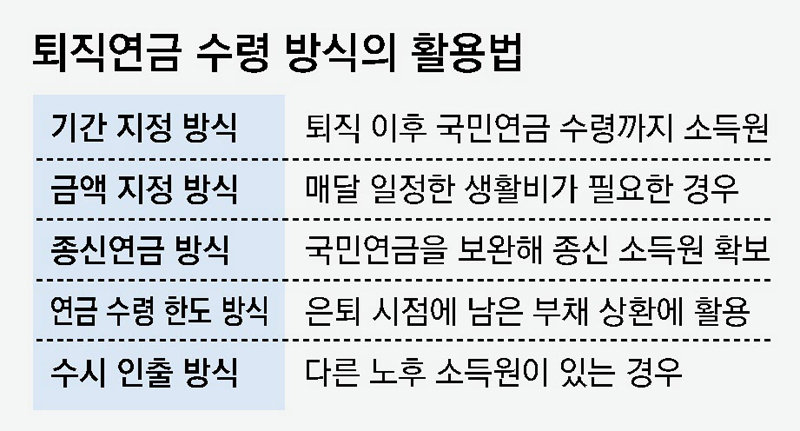
To receive your retirement pension correctly, you must first accurately determine whether your current company’s plan is a Defined Benefit (DB) or a Defined Contribution (DC) type. In a DB plan, the company directly manages the funds and guarantees a specific amount at the time of retirement, so employees do not need to worry about investment management. In contrast, in a DC plan, the company deposits a fixed amount into the employee’s account each year, and the employee directly selects and manages financial products. If you manage the investments yourself and incur losses, your final severance pay may decrease, so caution is required. Recently, more employees are actively growing their assets by utilizing default options while adhering to the investment limits for risky assets.
The quickest way to check which type of account you have is to contact your company’s HR department or log in to the financial institution’s website. You need to identify which account holds your retirement benefits to plan your future pension receipt. Participants in DB plans must transfer their funds to an Individual Retirement Pension (IRP) account at the time of retirement to begin the receipt process. Since DC plan participants already have funds accumulated in an account in their own name, they can proceed with the receipt application immediately after retirement. If you visit a bank without knowing these basic facts, you may waste your time, so prior research is essential.
The first step in receiving your retirement pension is to accurately identify your participation type and prepare the appropriate account.
2. The Difference Between Lump Sum and Pension Payments
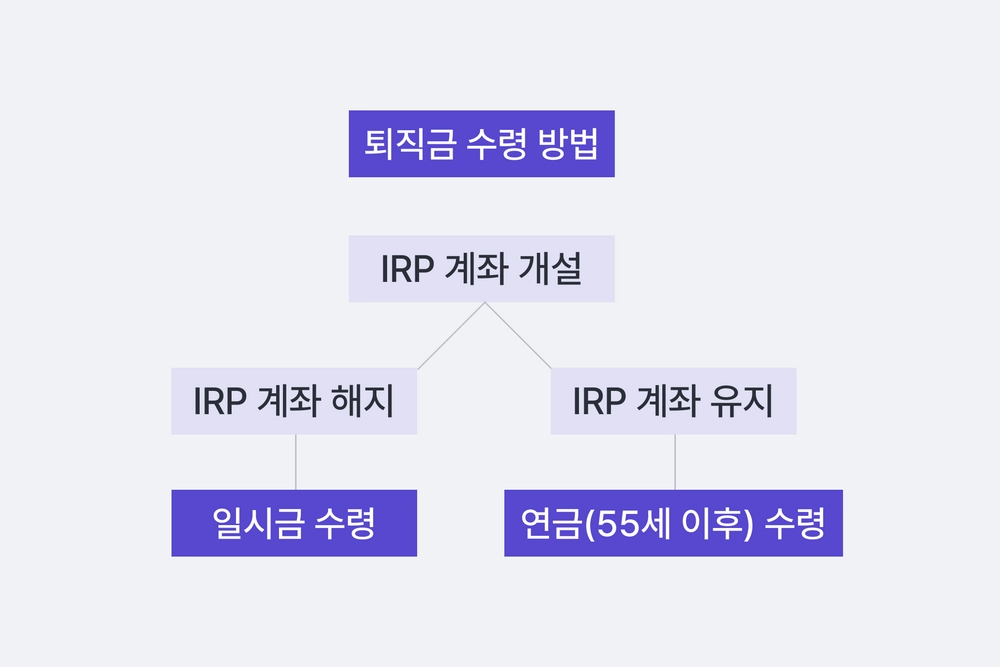
Deciding whether to receive your severance pay as a lump sum or as monthly pension payments is a very important choice. A lump sum provides a large amount of cash at once, which can be useful for major expenses such as buying a house or funding a business. However, receiving the money all at once means that the severance income tax rate applies, resulting in a significant tax bill paid in a single go. On the other hand, receiving it as a pension allows you to benefit from tax incentives encouraged by the government, significantly reducing the taxes you would otherwise have to pay.
In fact, the longer the period over which you receive the pension, the more significantly your severance income tax burden decreases, allowing you to secure more funds for your retirement. For example, if you spread the payments over more than 10 years, you can save a substantial amount on taxes, resulting in a much higher actual receipt amount. You should carefully consider your retirement period and expected lifespan, calculate the monthly living expenses you will need, and then decide on the receipt method. It is wise to coordinate the timing with fixed incomes such as the National Pension and personal pensions to lower your tax bracket. Rather than assuming a lump sum is always better, you should weigh the advantages from a long-term perspective.
Receiving your severance pay as a lump sum increases the tax burden, so receiving it as pension payments is much more advantageous.
3. Everything About Individual Retirement Pension (IRP) Accounts

The Individual Retirement Pension (IRP) account is an essential gateway that you must pass through to safely receive your severance pay and grow your retirement funds. The retirement benefits received upon leaving a company must be transferred to this specific account for the standard pension receipt process to begin. This account can hold various financial products, which greatly helps in steadily growing your assets even after retirement. Since you can also take advantage of tax deduction benefits, it is one of the most popular financial products actively used by employees for wealth management.
When opening an account, you should carefully compare fee conditions and the types of products offered to choose the financial institution that best suits you. Recently, various institutions such as securities firms and banks are providing customer-tailored asset management support services, adding to the convenience. After opening the account, you transfer your severance pay to it, set your desired receipt period, and submit the application. Although it may seem complex, it is a process that anyone can easily handle with guidance from a branch clerk or through internet banking.
Transferring to an IRP account is mandatory to receive your retirement pension, allowing you to enjoy both tax benefits and asset management.
4. Tax Benefits and Saving Tips When Receiving Pension Payments
Receiving your retirement pension as monthly payments offers a significant tax benefit, greatly reducing the severance income tax compared to receiving a lump sum. From the first to the tenth year of receiving the pension, you only pay 70% of the original severance income tax, with 30% being exempted. Once you pass the tenth year, the exemption rate increases further, meaning you only have to pay 60% of the tax. This institutional framework prevents retirees from spending all their money at once and helps them maintain a stable life in their old age.
Additionally, if you make additional cash deposits into your pension account to reach the tax deduction limit, pension income tax will apply when you withdraw the funds later, which is more advantageous. The key to saving on taxes is to carefully consider the relationship with public pensions and other income, adjusting your pension receipt amount so that it does not exceed a certain annual threshold. A very wise strategy is to appropriately distribute the monthly amount you receive to avoid falling under the comprehensive taxation of financial income. If you lack knowledge about taxes, actively utilize the expert consultation services of financial institutions to find tax-saving solutions.
Receiving your pension in installments allows for significant reductions in severance income tax depending on the duration, helping you protect your valuable assets.
5. Application Procedures and Precautions
The application process for receiving your retirement pension should be carried out systematically alongside the completion of your resignation procedures with your company to avoid any issues. First, you must confirm that the company has properly deposited your retirement benefits into your IRP account. After that, you can fill out the pension payment application by visiting the branch of your financial institution or through a smartphone app. If you prepare necessary documents such as your ID and a copy of your bankbook in advance, the process can be handled quickly without delay.
When applying for payment, keep in mind that it may take time to liquidate assets depending on the type of investment products, so you should plan your schedule accordingly. Assets invested in various products such as stocks or bonds may experience a slight time lag during the liquidation process. You should also be aware that financial institutions’ fund disbursement schedules may be delayed more than usual during holidays or long weekends. Once your severance pay is in the account, set it up so that the money is deposited on a specific date each month, in line with your retirement planning.
To complete the process smoothly, check the liquidation schedule for each product and the required documents in advance when applying for receipt.
6. Smart Retirement Pension Strategies to Change Your Old Age
To have a successful retirement, you need to look at overall asset management from a long-term perspective, going beyond just knowing how to receive your retirement pension. You need to practice wisely adjusting your withdrawal cycle to ensure your funds do not run out, taking into account your expected lifespan after retirement. It is a good idea to accurately calculate the fixed monthly income from the National Pension, housing pensions, and personal pensions combined. If there is a shortfall in living expenses, you can maintain economic stability by appropriately balancing your retirement pension receipt amount.
Since pension systems may change slightly due to shifts in the financial market, it is important to always stay informed about related news. Retirement is not the end but the beginning of a new life, so only thorough preparation can guarantee a comfortable and abundant life. Based on what you have learned today, please write down the receipt plan that best suits you right now. A secure retirement fund is not built overnight; small attention and actions accumulate to make a big difference.
You should design a harmonious mix of various pension incomes centered around your retirement pension to prepare for a stable and abundant retirement life.
Frequently Asked Questions
=