It has been revealed that nearly 1.18 million suspected fake real estate listings have remained openly displayed on real estate brokerage websites even after contracts were completed, over a period of more than four years. For genuine buyers who are diligently searching for a home, often while job hunting, these fake advertisements are a serious nuisance that wastes both time and money. According to data from the National Assembly and the government, the number of such undeleted property listings has been showing an explosive upward trend every year. In the midst of lax information management, bait listings that cunningly lure home-seekers are cited as the main culprit undermining the transparency of the real estate market. In this article, we will take a detailed look at the reality of fake real estate listings that remain online after transactions are completed, the main causes, and effective countermeasures. Properly understanding this issue is essential to prevent wasted efforts in the process of securing your own home.
=
The Reality of 1.18 Million Fake Real Estate Listings Still Publicly Displayed After Transactions Are Completed
1. Surging Undeleted Listings: 1.18 Million Cases in 4 Years and 7 Months
According to data submitted by the Ministry of Land, Infrastructure and Transport to a member of the National Assembly’s Committee on Land, Infrastructure and Transport, the total number of undeleted listings after completed transactions identified from 2022 to July of this year reached 1,178,345. This is a figure far too large to be dismissed as a simple system error, and the steep annual upward curve it presents raises significant concerns. The number of suspected fake listings, which was around 90,000 in 2022, has ballooned to an enormous scale in just a few years. In particular, last year saw a record surge of more than four times the 2022 figure. The situation has not improved this year either, with the number already exceeding 250,000 in just seven months. These statistics clearly demonstrate that property information registered on websites is not being accurately reflected in real-time.
Examining the annual increase trend reveals just how much chaos has been added to the real estate market. The figure of 95,161 cases in 2022 jumped almost double to 181,834 in 2023. It then reached 248,863 in 2024, peaking at a staggering 399,868 last year. Even this year, 252,619 cases have been identified from January to July, already surpassing 60 percent of last year’s total. Despite continuous monitoring by the government and related agencies, there is little sign of a decrease. The fact that completed listings remain “alive” suggests the possibility that brokers are intentionally leaving advertisements up. Such a massive number of fake listings also causes honest brokers to be viewed with suspicion.
Suspected fake real estate listings that were not deleted after transactions were completed have reached nearly 1.18 million over 4 years and 7 months, showing a steep annual increase.
2. The Status of Government Monitoring and Actual Deletion Actions
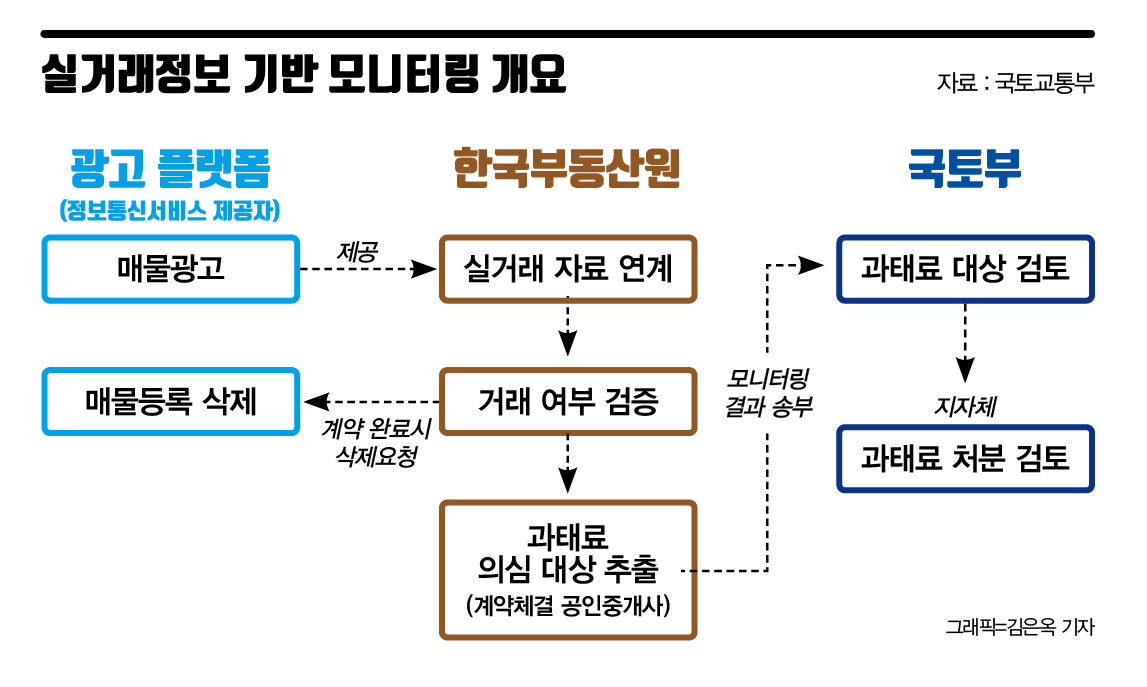
Based on the Real Estate Brokerage Act, the Ministry of Land, Infrastructure and Transport continuously cross-references property information provided by major brokerage platforms with actual transaction data. If it is detected that an advertisement remains despite the transaction being completed, the ministry requests the local government to investigate the broker who posted the listing. Thanks to this active verification process, a significant number of cases have led to actual deletion actions. Among the posts that were still exposed online despite violations being detected during property verification, a whopping 625,211 were forcibly removed. This figure, accounting for approximately 53 percent of the total suspected advertisements, proves that administrative efforts are yielding practical results.
However, the problem is that many genuine buyers are exposed to fake listings and suffer damages before the government’s crackdown can reach them. Since there is a time lag between notification to local governments and the issuance of penalties, new victims inevitably arise in the meantime. While the Ministry is collaborating with platform companies to upgrade their information linkage systems, it is insufficient to completely block the cunning methods used to evade enforcement. In particular, there are many cases where brokers do not immediately take down advertisements after a transaction is completed, manually leaving them up so they do not automatically disappear just because a contract stamp is applied. It is widely pointed out that this behavior is difficult to eradicate completely without the voluntary cooperation of brokerage offices. Therefore, the government must shorten the monitoring cycle and further increase the severity of penalties, such as fines and business suspensions, upon detection.
As a result of the government linking actual transaction data with property information for enforcement, 53 percent of suspected advertisements were actually deleted.
3. The Reality of Fake Listings by Platform Revealed Through Public Reporting

In addition to the government’s continuous monitoring, numerous suspected violations have come to light through the public reporting system, which allows general citizens to participate directly. The total number of reports related to brokerage target property advertisements received by the Ministry from 2021 to June of this year reached 87,156. Of these, a whopping 54,255 cases, accounting for 62 percent, were classified as suspected actual violations and immediately notified to the relevant local governments. As of July this year, looking at the number of reports by platform, Naver Real Estate had the highest proportion with 25,702 cases. This was followed by Jikbang with over 70,000 cases, Dabang with over 6,600, Peter Pan’s Good Room Hunting with over 4,300, and Carrot Market with over 600.
Looking solely at the number of actual suspected violation cases, Naver Real Estate showed an overwhelmingly large share with 16,379 cases. This was followed by Dabang with 4,744, Jikbang with 4,654, Peter Pan’s Good Room Hunting with 2,778, and Carrot Market with 438. An important point here is that it is difficult to definitively conclude that a specific platform has poor management or moral hazard based solely on the number of reports or violations. This is because it is common for a single property to be registered simultaneously on multiple brokerage platforms. Furthermore, the ultimate subjects of corrective measures or fines are not the platforms themselves, but the individual licensed brokers or offices that actually posted the false advertisements. Nevertheless, voices are growing that platform companies must introduce stricter pre-filtering mechanisms.
A significant number of advertisements received through public reporting have been identified as suspected violations, and there is a characteristic of properties being registered on multiple platforms.
4. Illegal Advertising and Blind Spots via Social Networking Services
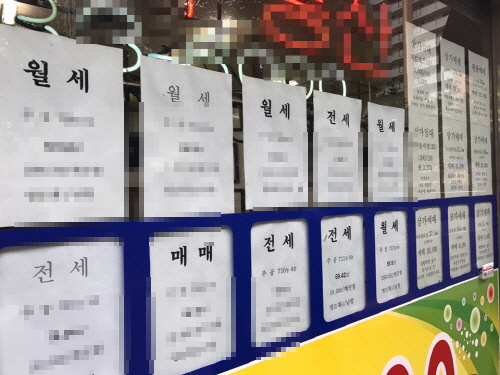
Fake property advertisements via various social networking services (SNS) are also at a serious level, in addition to official real estate brokerage platforms. The number of related reports received through major social networking services such as Naver Blog, Instagram, and Facebook reached 29,559. Among these, 18,701 cases, accounting for about 63 percent, were classified as clear suspected violations and underwent thorough investigation. Due to the nature of SNS, where individuals can freely post and delete content, there is a blind spot where government enforcement is much easier and faster to bypass. Brokers are exploiting SNS, which has relatively lax surveillance, as a channel for distributing bait listings to avoid large platforms with strict regulations.
These SNS-based fake listings primarily use the tactic of luring users with prices much lower than the market rate and then claiming the contract is already finished. They directly borrow the so-called “bait and switch” sales method, where customers who make contact are recommended other, more expensive properties. Ordinary citizens looking for a home often waste their precious holiday time being deceived by fake advertisements full of fake listings and making futile trips. An even bigger problem is that these personal blogs or SNS accounts often cunningly bypass the scope of the Real Estate Brokerage Act, making enforcement itself difficult. The government and local governments must significantly expand the scope of monitoring to include not only large brokerage websites but also personal property promotion channels. Building a thorough surveillance network is the only way to reduce innocent victims and establish a healthy market order.
Reports of fake real estate listings via social networking services and blogs also number in the tens of thousands and are being exploited as enforcement blind spots.
5. The Devastating Impact of Bait Listings on Genuine Buyers
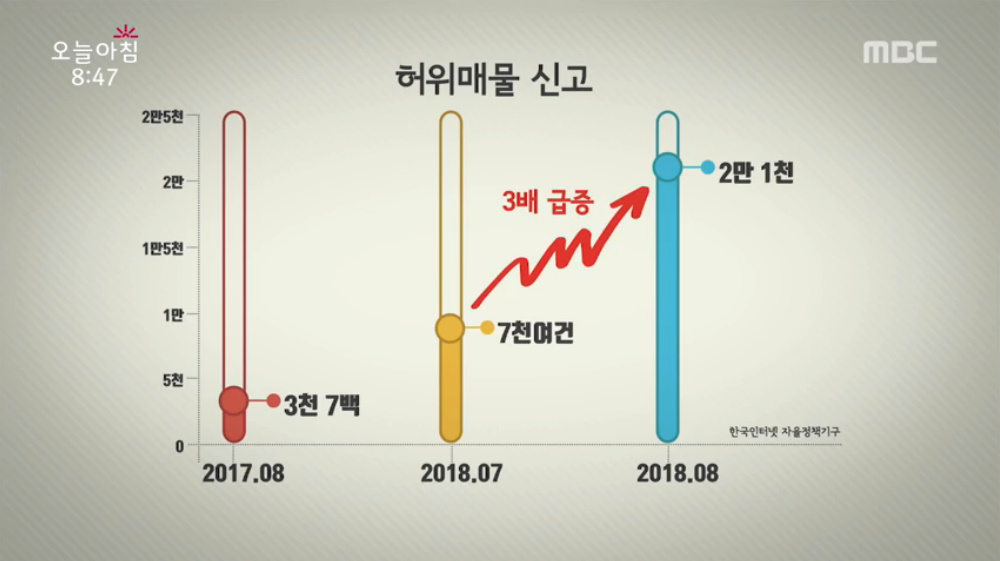
Property advertisements that are intentionally left up even after transactions are completed act as a deadly weapon that disrupts the daily lives of genuine buyers, going beyond simple information errors. It is not uncommon for young people or newlyweds who take annual leave from work to find a home to be disappointed after seeing a property with conditions much better than the market rate. Upon arriving at the brokerage office, they are told a lie that the property was just contracted and are naturally recommended other expensive or poorly conditioned properties. Falling for these sales tactics leads to not only time loss but also financial damage and extreme mental stress. Young people entering society, who lack the ability to judge market prices, may even misinterpret the overall flow of the real estate market by believing distorted price information to be true.
As an actual case, an office worker in Seoul looking for a jeonse (long-term lease) home found a one-room apartment they liked on an internet website and immediately contacted the broker. After making an appointment and taking annual leave to visit the licensed brokerage office, the broker brazenly replied that the contract had already ended yesterday and offered to show other properties. It turned out that the property had actually been completed a month prior but was intentionally left up as bait to attract customers. Such malicious fake listing practices undermine the transparency of the real estate market and become a major obstacle to the housing stability of the public. These illegal acts, which mock the efforts of those who honestly work hard, must be eradicated. If the government and the industry do not join hands to make strong self-purification efforts, the damage will remain entirely with the public.
Fake listings are the main culprit stealing the time and money of genuine buyers and blurring accurate market price judgments in the real estate market.
6. Institutional Improvements and Strengthening the Responsibility of the Brokerage Industry

Voices are growing that the level of punishment for malicious licensed brokers who repeatedly post fake listings must be raised much more strongly than it is now. The National Assembly and the government should not stop at one-time warnings or light fines, but should introduce systems like a three-strikes rule to strictly apply expulsion measures. In addition, platform companies must build a system that takes responsibility for managing properties from the registration stage until the moment they are deleted after a transaction is completed, rather than simply brokering properties. It is urgently required to improve technical algorithms to force real-time linkage between actual transaction price reports and property deletions. Only when an environment is created where citizens looking for a home can feel safe and trust the system can the trust in the real estate market be restored.
Going forward, the government has stated that it will maintain a close coordination system with local governments and related agencies to completely eliminate blind spots in illegal advertising enforcement. It also plans to conduct intensive monitoring of illegal advertising through social networking services and personal blogs to bring them within the legal framework. Readers, too, need the wisdom to suspect properties offering unreasonably low prices or unreasonable conditions when looking for a home. If you discover a property that has already been transacted but is still exposed, you should actively report it to help prevent further damage. A transparent and fair real estate trading environment is only completed when the government’s strong regulation, the industry’s self-purification efforts, and consumer interest come together. We hope for a healthy market where no one sheds tears due to fake listings anymore.
Strong sanctions against repeat fake listing posters and improvements to the platform’s responsible verification system are urgent.
Frequently Asked Questions
=