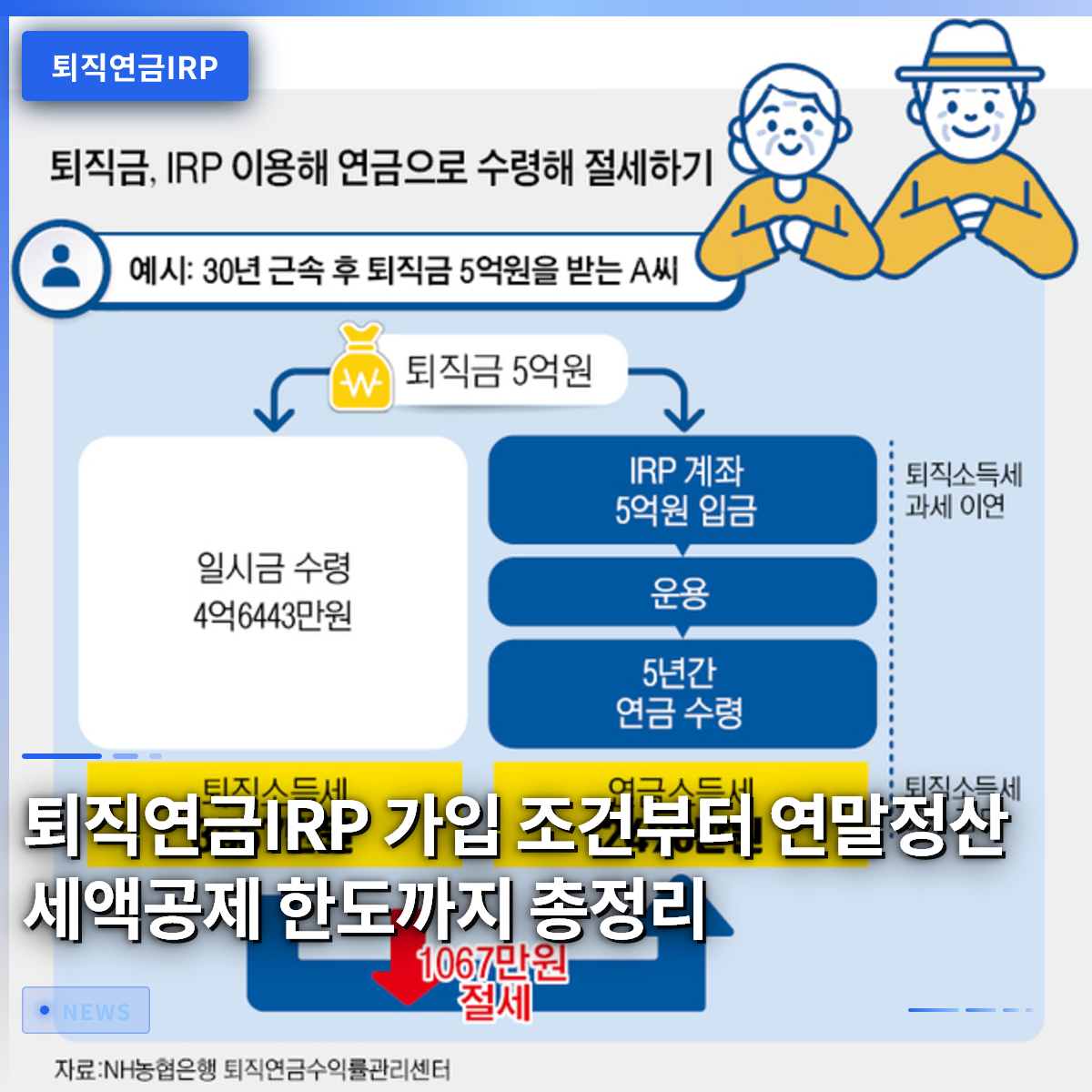
The IRP (Individual Retirement Pension) account has become an essential financial product for all employees. This is because it allows you to receive tax refunds ranging from several hundred thousand to several million won during the annual year-end tax settlement. If you have heard colleagues boasting about receiving large tax refunds, the secret is usually this account. It offers more than just tax benefits; it serves as an excellent means to independently build a solid financial foundation for your retirement. However, when you actually try to open one, you might feel unsure about the eligibility requirements or how to manage the account. In this article, we will clearly explain the basic concepts, eligibility conditions, tax deduction benefits, and specific usage methods for IRP accounts.
=
A Complete Guide to IRP Pension Account Eligibility and Year-End Tax Deduction Limits
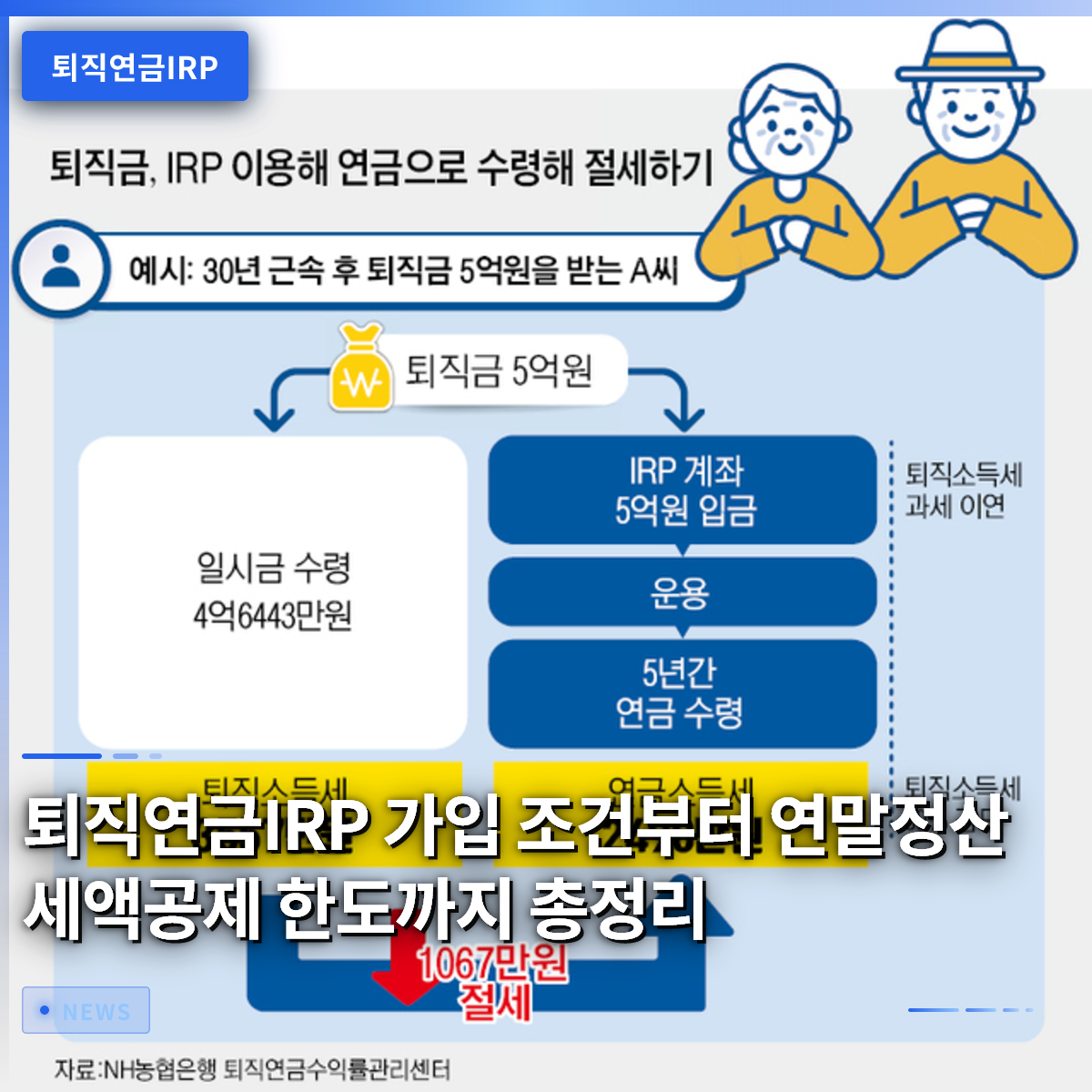
1. IRP Pension Account: Concepts and Basic Definitions

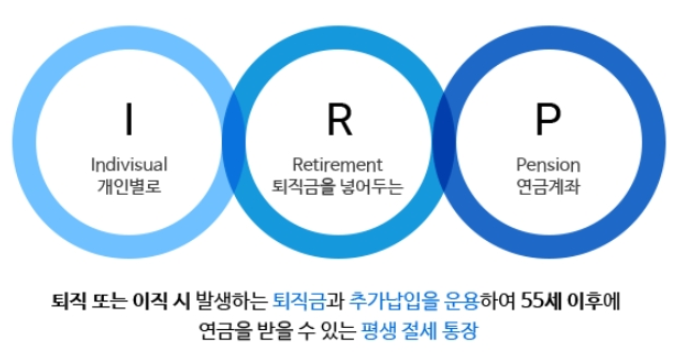
An IRP account is a personalized account that allows individuals to consolidate their severance pay, received upon changing jobs or retiring, and invest it for their retirement. In the past, employees simply received and spent the severance pay managed by their company, but now it is an era where individuals take the lead in managing their assets. A major advantage is that anyone can freely open an account, including not only employees but also self-employed individuals with income, public officials, and military personnel. If you transfer your severance pay to this account, you can defer taxation until retirement without paying taxes immediately. During this period, you can benefit from the power of compound interest as your funds grow, which is highly advantageous for retirement planning. You can also make additional contributions from your surplus funds while working to further grow your assets. Many people tend to neglect this account, thinking it is merely a place to store severance pay. However, you must remember that it is the core channel for creating a stable cash flow after retirement. When you consider who the original owner of the pension contributions made by your company is, you will realize that you cannot afford to be negligent in managing it. Anyone can easily open an account through financial institutions such as banks or securities firms, and with non-face-to-face channels, you can sign up conveniently without visiting a branch. You can also develop strategies to increase returns by allocating assets according to your investment style.
An IRP account is a personalized account that allows you to store your severance pay and independently manage your retirement funds.
2. Eligibility Conditions and Scope of Beneficiaries
The eligibility conditions for an IRP account are not as strict as one might think, and almost all economically active individuals with income are eligible. While it was once considered exclusive to employees, legal changes have allowed self-employed individuals and freelancers who can prove their income to open accounts. Even housewives or students who do not have a regular job can qualify if they have a certain level of income. Participants in occupational pension schemes, such as military personnel and teachers, are also eligible to open individual retirement pension accounts without exception. Those with no income at all may face restrictions on opening an account, so it is advisable to verify your ability to provide proof of income in advance. In fact, a friend who works as a freelancer opened this account after completing their comprehensive income tax filing and received significant benefits. Since self-employed individuals with irregular income need a safety net for their post-retirement life, the expansion of eligibility is welcome news. You can open an account in just a few minutes by visiting a financial institution branch with your ID or by completing a simple identity verification through a smartphone app. The required documents may vary slightly depending on whether you are an employee or a self-employed individual, so it is safe to check in advance. If you meet the eligibility requirements, it is wise to sign up without delay to establish a foundation for tax benefits.
Anyone who is an economically active individual with income, such as employees or self-employed individuals, can open an account.
3. Year-End Tax Deduction Benefits and Limits
The biggest reason why employees’ fortunes vary during the year-end tax settlement season is the difference in tax deduction benefits. By contributing funds to this account, you can receive a portion of your taxes back or significantly reduce the amount of taxes you need to pay at year-end. Combined with pension savings products, the annual contribution limit eligible for tax deductions is up to 9 million won. If your total annual salary is 55 million won or less, a 16.5% deduction rate applies, allowing you to receive a refund of up to 1.485 million won. Even if your total annual salary exceeds 55 million won, you can save up to 1.188 million won in taxes with a 13.2% deduction rate. This is why consistently contributing a fixed amount each month to reach the annual limit is considered the best tax-saving technique among employees. A good example is a colleague who was disappointed by a small refund last year but received a large refund this year with a smile because they had set up automatic monthly transfers. You can reinvest the tax refund or use it for necessary living expenses, yielding a two-fold benefit. However, please note that tax deduction benefits do not apply to contributions exceeding the 9 million won annual limit, so you must carefully calculate your limit. To maximize tax benefits, you need a strategy to check your contribution amount before the end of the year and make up any shortfall.
You can receive tax deductions on contributions up to 9 million won annually when combined with pension savings products, allowing you to get a tax refund.
4. Types of Asset Management Products and Selection
After opening an IRP account, you must choose which financial products to invest your money in. You can keep your money in safe assets with guaranteed principal, such as deposits or savings accounts, or you can invest in performance-linked products like funds or Exchange-Traded Funds (ETFs). Recently, there is a growing trend of investors increasing their allocation to equity assets or ETFs to preserve the real value of their retirement funds. Legally, you are required to allocate at least 30% of your total accumulated assets to safe assets, so you must consider this ratio when allocating your assets. It requires wisdom to flexibly adjust your portfolio according to stock market trends while managing long-term returns. If you find it difficult to select funds or equity products on your own, utilizing AI-based asset management services provided by financial institutions is a good alternative. Banks and securities firms are rapidly introducing systems that analyze customer profiles to create portfolios and conduct periodic reviews. Rather than blindly following what others say is good, you should calmly consider your retirement timeline and risk tolerance. When investing in products with principal loss risk, it is essential to have the resilience to withstand market volatility and a long-term investment perspective. If you find the golden ratio between safe and risky assets and consistently accumulate, you will face satisfying results over time.
You can manage your own investment portfolio by combining various products, including principal-guaranteed products and ETFs.
5. Precautions for Early Withdrawal and Cancellation
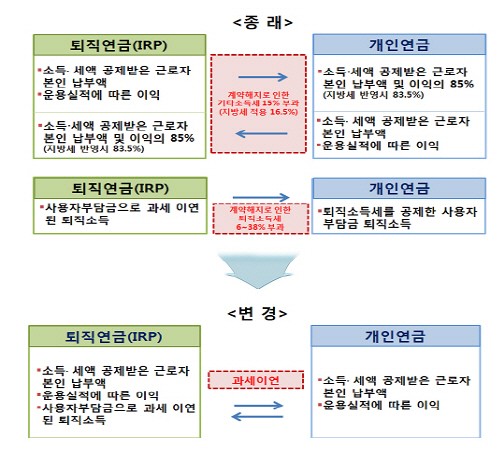
Since IRP accounts deal with long-term retirement assets, there are significant restrictions on withdrawing funds or canceling the account midway. In principle, funds are locked until the age of 55, which has the effect of forcing savings. However, early withdrawal is permitted in exceptional legal circumstances, such as purchasing a home or securing a deposit for a lease if you are a non-homeowner, receiving medical treatment for three months or longer for yourself or a dependent, or being declared bankrupt. If you cancel the account due to a simple change of heart without meeting these legal requirements, you must return all the tax deduction benefits you have received. In reality, people often end up in tears after canceling their accounts because they urgently needed money, only to be hit with a “tax bomb” in the form of other income tax. You must keep in mind that a high tax rate of 16.5% is applied to the principal and investment returns that received tax deductions, which can result in a significant tax burden. Therefore, if the funds are intended as an emergency reserve that you may need within the next few years, you should carefully consider whether to put them in this account. Unless it is an absolutely necessary situation, maintaining the account until retirement is always beneficial from both a tax and retirement preparation perspective. If you suddenly need a large sum of money, utilizing the collateral loan system offered by financial institutions can be a viable alternative to canceling the entire account.
If you cancel the account midway without a compelling reason, you must pay a high tax rate on the amount for which you received tax deductions.
6. Final Recommendations for Retirement Preparation
An IRP account is not a complex or difficult financial tool, but a natural right and essential shield that every employee should enjoy. It serves as a sturdy pillar supporting your life after retirement, in addition to the sweet benefit of immediate year-end tax refunds. We recommend that you start today by reviewing your income and expenditure structure and beginning to make small, manageable monthly contributions. With the advancement of financial technology, the environment for easily checking assets and adjusting portfolios through mobile apps is well-established. Do not postpone retirement preparation until tomorrow; open an account or check your contribution limits now to prepare for a prosperous future. Even if you start with a small amount, such as 100,000 or 200,000 won per month, it will return as a tremendous compound interest effect over time. Instead of just envying successful financial cases around you, take action to achieve practical tax savings and asset growth. Imagine yourself smiling when your retirement arrives; the small steps you take today will bring you lifelong financial stability. With consistent interest and a proper asset allocation strategy, even an ordinary employee can fully embrace a successful retirement. Open your smartphone right now to check the status of your pension assets and make a smart plan for next year’s year-end tax settlement.
You must prepare for a stable life after retirement through consistent contributions and proper asset management.
Frequently Asked Questions
=