The most reliable way to receive a tax refund ranging from several hundred thousand to several million won during the annual year-end tax settlement through personal pension savings is to strategically combine pension savings and individual retirement pensions to reach the maximum limit. If you have ever felt envious of the amount of tax refunds your colleagues receive every year, it is time to review your accounts and take action starting today. Many people vaguely recognize the need for retirement preparation but hesitate because they are unsure which products to choose and how much to invest. This article will detail practical strategies for office workers to manage their salaries, maximize tax benefits, and grow their assets. The small savings habit you start today will be the key to a comfortable retirement life decades from now.
=
Maximizing the 9 Million Won Tax Deduction for Personal Pension Savings: Tips for Retirement Planning
1. Understanding the Differences Between Personal Pension Savings and Pension Savings Funds
Pension savings products are divided into various categories depending on the financial institution and the management method, so it is essential to carefully consider your investment style before signing up. Trusts opened at banks or products sold by insurance companies offer high stability but may fall short in terms of returns. On the other hand, pension savings funds opened through securities firms allow direct investment in stocks, bonds, and exchange-traded funds (ETFs), enabling asset growth that can outpace inflation. You can operate this by setting up automatic monthly transfers and consistently investing in high-quality assets you have selected yourself.
Many people who are afraid of stock investing are often unaware that they can include safe assets like bond funds or deposit products within their pension accounts. A strategy of pursuing higher returns with a more aggressive asset allocation in youth and gradually increasing the proportion of safe assets as one ages is highly effective. It is also wise to meticulously compare fees and event benefits charged by different financial institutions to choose the most advantageous option. Even after opening an account, you must develop the habit of regularly reviewing and managing your assets in line with market changes.
Utilizing pension savings funds allows you to efficiently grow your retirement funds while balancing stability and profitability.
2. Specific Allocation Strategies to Reach the 9 Million Won Tax Deduction Limit
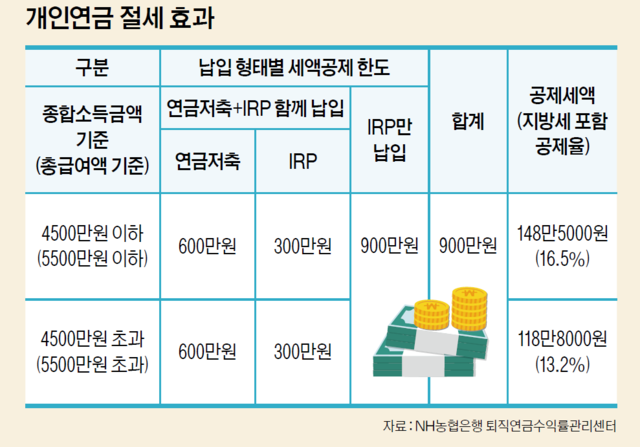
To enjoy the maximum refund benefit during the National Tax Service’s year-end tax settlement, you must accurately understand and combine the contribution limits for pension savings and individual retirement pensions. A pension savings account alone qualifies for tax deductions on contributions up to 6 million won annually. However, when combined with an individual retirement pension, the total limit increases to 9 million won. For example, if you fully contribute 9 million won annually, you can receive a direct tax refund ranging from 13.2% to a maximum of 16.5% of your total income. If you are an office worker earning 3 million won a month, you must utilize this structure to save on the taxes that are automatically deducted from your salary.
In reality, it is common to see office worker friends anxiously checking their bank balances and sighing as they rush to meet the limit just before the year ends. To prevent this, it is much wiser to spread the burden by setting up automatic split contributions for a fixed amount every payday. The most common and stable tax-saving method is to fill the pension savings account with 6 million won and allocate the remaining 3 million won to the individual retirement pension. Because these accumulated amounts grow through the power of compound interest over the long term until retirement, they create a significant asset gap over time.
The core of tax savings is combining 6 million won in pension savings and 3 million won in individual retirement pensions to reach the annual tax deduction limit of 9 million won.
3. Investment Restrictions and Advantages to Know When Joining an Individual Retirement Pension
The individual retirement pension is a very useful retirement planning tool that allows you to make additional contributions to your retirement funds while enjoying tax benefits. However, unlike general pension savings accounts, it has a specific feature where investment in risky assets like stocks is limited to 70% of the total accumulated funds. The remaining 30% must be invested in safe assets such as deposits or bond funds, which may feel restrictive for those with an aggressive investment style. However, during periods of high market volatility, this mandatory safety mechanism actually serves as a reliable shield to protect your assets.
It is considered an essential part of working life because, in addition to the severance pay received upon retirement, you can consistently manage it by adding your own discretionary funds. By utilizing asset management programs or AI-based review services provided by financial institutions, you can check and supplement your account status at any time. You can easily sign up through bank branches or non-face-to-face apps, and you can also enjoy various financial institution events such as waived transfer fees. In addition to tax deduction benefits, the tax-deferred effect allows you to reinvest without paying taxes until retirement, creating a tremendous compound interest effect.
Although the individual retirement pension has limits on risky asset investments, it simultaneously offers strong tax savings and asset protection features.
4. Linking with Asset Management Accounts and the Risks of Early Withdrawal
Another tax-saving account commonly encountered by young professionals and office workers in their 40s as they grow their assets is the Individual Comprehensive Asset Management Account (ISA). This account offers tax-exempt and separately taxed benefits on profits generated during the subscription period, and the amount can be transferred to a pension account upon maturity. Transferring the matured funds to a pension account allows you to receive additional tax deduction benefits, making it a mandatory course among high-income office workers. A major advantage is the high flexibility in fund management, as you can freely buy and sell various financial products within a single account.
However, withdrawing money from a pension account set aside for retirement before maturity is one of the most foolish actions that erodes your future assets. If you cancel the pension account or make an early withdrawal because you suddenly need a large sum of money, you will not only have to return all the tax deduction benefits you received but also face a “tax bomb” in the form of miscellaneous income tax. In reality, it is often heartbreaking to hear stories of people breaking their pension accounts for urgent cash needs and ending up paying millions of won in taxes. Therefore, you need the wisdom to resolve that retirement funds are money you should not touch even in death, and to keep emergency funds in a separate checking account.
Transferring ISA matured funds to a pension allows for additional tax savings, but early withdrawals should be absolutely avoided as they invite a tax bomb.
5. Age-Specific Pension Savings Management and Portfolio Strategies
Just as our income levels and investment styles change with age, the way we handle pension savings accounts must also flexibly change according to our life cycle. In the early stages of one’s career, it is important to consistently set up automatic transfers, even if the amount is small, to experience the compound interest effect of long-term investing firsthand. When you reach your 30s and 40s, your income increases significantly, and so does the tax burden; therefore, you should prioritize filling the annual 9 million won limit. At this stage, a strategy of increasing the proportion of stock-based assets to actively grow your assets and expand the pie of your retirement funds is very effective.
Even during periods of high expenses due to children’s education or home purchases, you must never stop contributing to your pension account to avoid regretting it at retirement. After the age of 50, when retirement is just around the corner, you should drastically revise your portfolio to focus on preserving principal and obtaining stable dividend or interest income rather than aggressive investing. After retirement, you will receive the funds accumulated over decades as a monthly pension. At this point, you must adjust the pension receipt amount so that it does not exceed a certain annual threshold to reduce the tax burden. Only a systematic plan and consistent execution throughout your life can prevent poverty in retirement and guarantee a prosperous life.
The secret to success is adjusting asset allocation ratios according to income and expenditure levels by age and consistently contributing until retirement.
6. Practical Proposals and Outlook for Successful Retirement Planning
In today’s rapidly changing economic environment, it is now a common sense known to everyone that the state cannot be solely responsible for our retirement. In this era of self-reliance, personal pension savings and individual retirement pensions are not optional but essential weapons for survival. Amidst soaring monthly inflation and an unstable job market, the most certain and safe way for office workers to prepare for the future is to actively utilize tax-saving accounts that offer tax benefits. You need to take the small step of immediately opening your bank or securities app to meticulously check your pension account contribution limits and current investment status.
Initially, the monthly savings amount of several hundred thousand won may feel burdensome and regrettable, but your perspective will change completely when you see the substantial refund amount deposited into your account during the year-end tax settlement. You must take one step at a time starting today, imagining yourself holding much more comfortable and abundant assets at retirement 10 or 20 years from now. Maintaining a posture of always listening to and flexibly responding to changes in government tax policies and the financial market will elevate the quality of our lives. Please never forget that the small savings habit you start today is the greatest investment that will save your future self.
To prepare for an uncertain future, it is most important to immediately check your pension account and consistently contribute.
Frequently Asked Questions
=