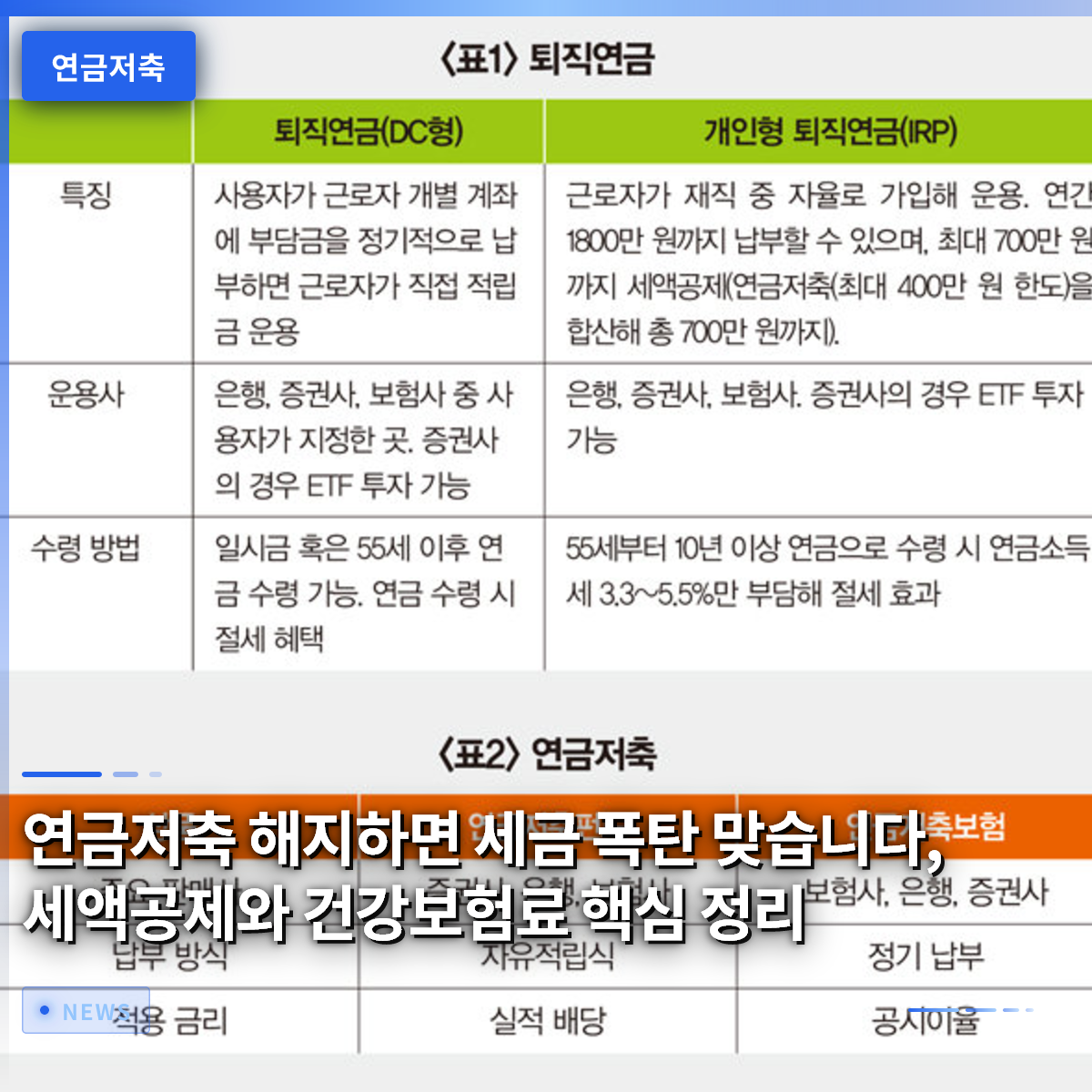
If you terminate your pension savings account midway, you not only have to return all the tax deduction benefits you have received so far, but you also face a massive tax burden due to additional income tax and surcharges. It is quite common to see people who rashly withdraw their retirement funds because they urgently need cash, only to end up paying millions of won in taxes and regretting their decision. Given that our society has a high rate of poverty among the elderly, it is more important than ever to build a solid asset base in advance to support life after retirement. In this article, we will carefully examine the benefits of maintaining a pension savings account, the risks to avoid if you terminate it early, and its relationship with health insurance premiums. By reading this content to the end, you will accurately understand how to protect your valuable retirement assets and wisely reduce your tax burden.
=
Cashing Out Your Pension Savings Triggers a Tax Bomb: A Key Guide to Tax Deductions and Health Insurance Premiums
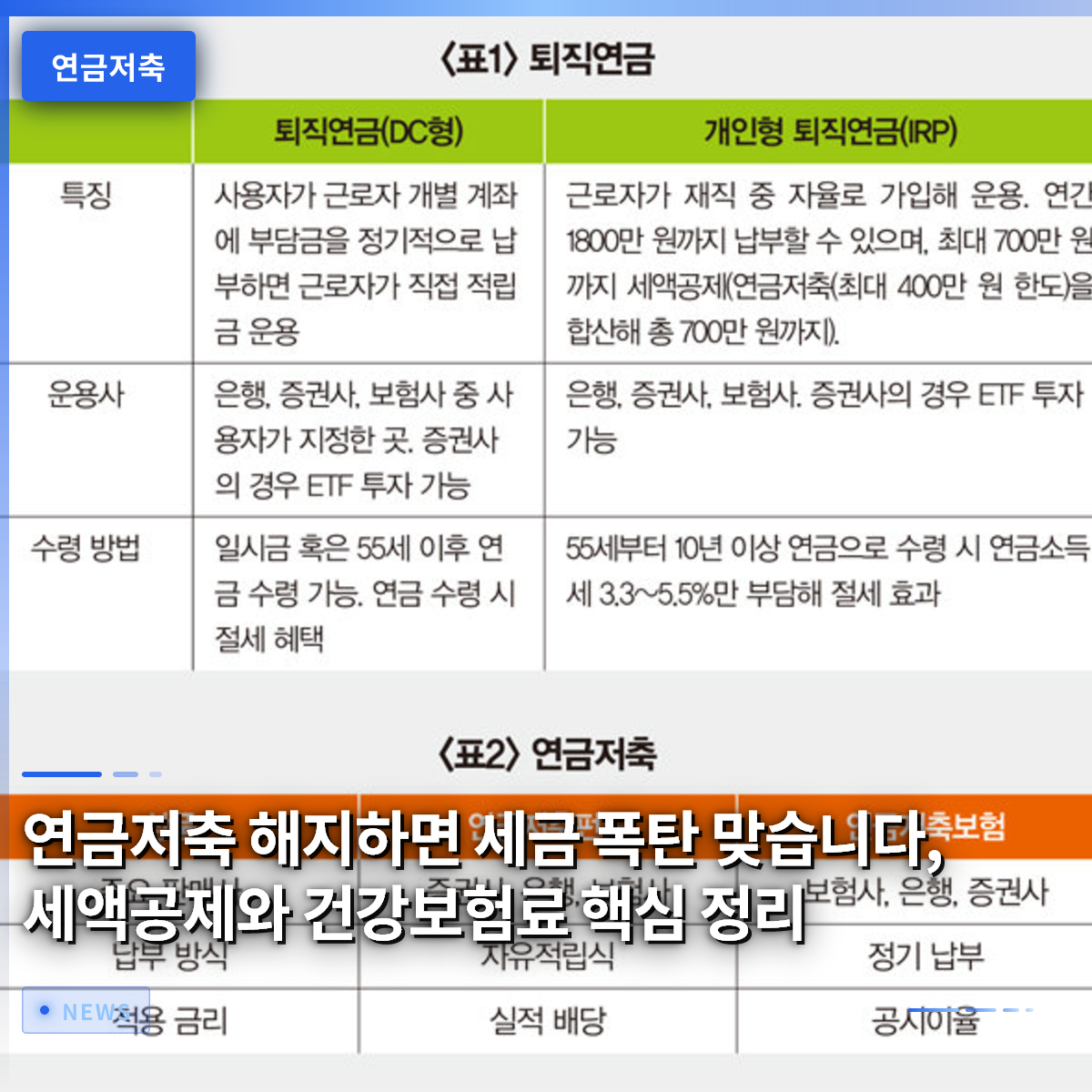
1. The Truth About the Tax Bomb When Terminating Pension Savings Early

The moment you terminate your pension savings account early, you face the daunting situation of having to return all the tax deduction amounts you carefully secured during your year-end tax settlement. On top of this, a high additional income tax rate of 16.5% is applied to both the investment returns and the deducted principal, meaning the amount you actually receive is far less than you might expect. For instance, Mr. Kim, an office worker, needed urgent cash and closed a product he had diligently funded for several years, only to be hit with a lump sum tax bill of several million won, causing him significant shock. As seen here, rashly terminating products classified as long-term assets for short-term needs can lead to a painful experience where even the principal is significantly reduced. Therefore, simply because you need cash immediately, it is absolutely not a wise choice to list your valuable retirement assets as the first target for termination. If you need an emergency fund, you should first utilize deposits or other short-term assets and protect your pension assets to the end; this is a fundamental principle of wealth management.
Terminating pension savings early results in the return of tax deductions and the imposition of a 16.5% additional income tax, leading to significant financial loss.
2. Contribution Strategies to Maximize Tax Deduction Benefits

Every time the year-end tax settlement season arrives, one of the items office workers look forward to the most is the tax deduction benefit. Contributions to pension savings accounts play a crucial role as a “helper” product that helps you receive a substantial refund during year-end tax settlement within a certain limit. For example, if you consistently contribute up to the annual limit, you can get back or pay less in taxes ranging from several hundred thousand won to over one million won each year. To solidly grow your asset size, you must develop the habit of strictly and systematically allocating the remaining funds after deducting housing costs and savings from your salary. Occasionally, people try to receive larger benefits by forcibly depositing a lump sum at once, only to find their cash flow blocked and struggling with insufficient living expenses. Therefore, the safest approach is to accurately assess your monthly income and fixed expenses, and then consistently contribute a fixed amount via automatic transfer every month.
Consistently contributing to pension savings monthly according to your income level allows you to maximize tax deduction benefits during year-end tax settlement.
3. The Correlation Between Private Pensions and Health Insurance Premiums

Surprisingly, many retirees worry that their health insurance premiums will skyrocket due to the pension payments deposited into their accounts every month after retirement. Public pensions, such as the National Pension or the Civil Servants’ Pension, can increase your burden by affecting the calculation of health insurance premiums if the received amount exceeds a certain standard. However, private pensions like pension savings accounts or Individual Retirement Pensions (IRPs) have the advantage of not being directly reflected in the current actual health insurance premium assessment base. Therefore, if you prepare private pensions solidly in addition to public pensions, you can significantly alleviate concerns about a “health insurance premium bomb.” Many people misunderstand the system after seeing acquaintances reluctant to receive pensions due to health insurance premiums, but you can rest assured if you accurately understand the detailed regulations. To create a stable cash flow in retirement, it is very advantageous to adopt a strategy of diversifying assets by increasing the proportion of private pensions, which carry a lower health insurance premium burden.
Private pensions like pension savings accounts are not currently included in the health insurance premium assessment base, making them effective in reducing the health insurance premium burden after retirement.
4. Differences Between Pension Savings and IRPs and How to Choose Correctly
When visiting a financial institution to prepare for retirement, you may find yourself deeply pondering which to choose between a pension savings account and an Individual Retirement Pension (IRP). Pension savings are very popular among younger office workers because they allow relatively free investment in various products such as stocks and bonds. On the other hand, IRPs are suitable for those with a conservative investment tendency because regulations require a certain minimum percentage of safe assets. While both products share the commonality of providing tax deduction benefits, there are subtle differences in investment autonomy and fee structures. You should accurately understand your investment tendency from the early stages of your career, carefully compare the pros and cons of the two accounts, and then sign up to avoid regret later. If you want to grow your assets aggressively, it is much more advantageous to primarily utilize a pension savings fund account while filling up the tax deduction limit.
Pension savings offer high investment autonomy, while IRPs have a mandatory safe asset ratio; you should choose based on your personal tendency.
5. Pension Receiving Timing and Asset Reallocation Strategies by Age
As retirement approaches, the strategy of how to safely withdraw and use your assets becomes as important as simply growing them. As you age, labor income decreases, so if asset income and pension income do not fill the gap, you can fall into economic difficulty in an instant. If you neglect asset reallocation upon entering your 60s, you may face a tragic situation where your quality of life drops sharply due to insufficient living expenses. Therefore, it is advisable to strictly manage and separate long-term held assets from living cash by purpose, operating separate accounts so they do not mix. When receiving your pension, you should receive it in installments appropriate for your age rather than all at once to lower the tax burden and maintain your retirement funds for a long time. To live a comfortable and abundant life after retirement, you need to start coordinating the timing of receipt and making plans step by step from now.
After retirement, you should separate assets by purpose and choose an installment receipt method to reduce the tax burden and protect your retirement funds.
6. Final Conclusion on Pension Savings Management That Changes Your Retirement
So far, we have examined in great detail the tax deduction benefits of pension savings, the risks of early termination, and its relationship with health insurance premiums. When facing the huge barrier of retirement, the pillar that most solidly protects us is ultimately the pension assets we diligently built from our younger days. If you repeatedly make the foolish act of breaking your account and paying regrettable taxes due to immediate spending pressure, future abundance will remain forever out of reach. The most ideal wealth management is to consistently invest funds monthly, enjoy tax benefits to the maximum, and calmly plan for life after retirement. In line with the coming era of an aging population, please check the status of your pension account starting today and fill in any deficiencies. Only thorough preparation and correct knowledge will prevent poverty in old age and gift you a truly comfortable and happy retirement life.
Consistently maintaining and managing pension savings without terminating it is the shortcut to preventing poverty in old age and creating an abundant future.
Frequently Asked Questions
=