The IRP (Individual Retirement Pension) is an essential account for retirement preparation, offering tax deduction benefits on contributions of up to 9 million KRW annually. Many have likely felt envious seeing their working friends receive refunds ranging from hundreds of thousands to over a million KRW during their year-end tax settlement. While this account was once viewed merely as a storage place for severance pay, its utility has evolved; how you utilize it now significantly impacts your total asset size. Interest among employees has surged, particularly because you can now directly invest in various financial products such as performance-linked funds and government bonds. In this article, we will explore in detail how to maximize your tax deduction limit and practical strategies for effectively managing your returns.
=
A Complete Guide to IRP Pension Tax Deduction Limits and Strategies to Boost Returns
1. Basic Concepts of IRP and Eligibility
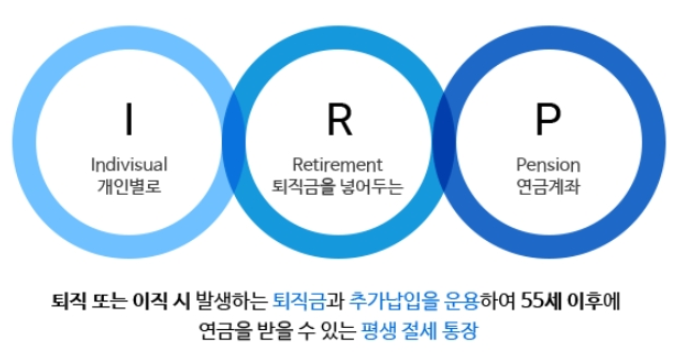
The Individual Retirement Pension (IRP) is a financial account where workers can either transfer their severance pay upon resignation or retirement, or contribute their own funds to build retirement assets. In the past, employees had to rely solely on the method designated by their company, but the system has now evolved to allow a wide range of participants, including all employed individuals with income and self-employed workers. Not only employees, but also freelancers and sole proprietors can open an account at a bank or securities firm if they can prove their income. By contributing a fixed amount monthly, similar to savings, you can safely consolidate your severance pay into a single account, even if you change jobs during your career. These accumulated funds can later be received as a pension rather than a lump sum upon retirement, significantly reducing the tax burden. Many young professionals mistakenly believe that pension products are only for middle-aged and older individuals nearing retirement. However, to maximize the effect of compound interest, it is advantageous to open a pension account as early as possible when starting your career. Even small, consistent monthly contributions will lead to a noticeably larger asset base over time. Using the mobile applications of securities firms or banks, you can easily open an account non-face-to-face with just a few taps on your smartphone, without visiting a branch. It is wise to carefully compare financial institutions based on your income level and investment style to choose the one with the most reasonable fees.
The IRP is an essential account for retirement preparation that anyone with income can join, allowing for integrated management of severance pay upon job changes and the benefit of compound interest.
2. Year-End Tax Settlement Benefits and How to Utilize Limits

Combining pension savings and IRP contributions allows for a tax deduction on up to 9 million KRW annually, making it the top tax-saving tool for employees during the year-end tax settlement season. Employees with a total annual income of 55 million KRW or less can receive a refund of 16.5% of their contributions, while those exceeding 55 million KRW are subject to a 13.2% deduction rate. For example, if you contribute the full annual limit of 9 million KRW, you can receive a substantial tax refund of up to 1.485 million KRW. For employees who rely solely on their salaries, the year-end tax refund is like a ray of hope; missing out on this tax-saving benefit is a significant loss. However, if you have already contributed 6 million KRW to a pension savings account, you can flexibly allocate the remaining 300 million KRW limit to your IRP. It is common to see colleagues hastily depositing large sums at year-end to meet the tax deduction limit, but splitting contributions monthly is much more advantageous for cash flow management. Withdrawing a large sum at once can strain living expenses, so setting up automatic monthly transfers of a fixed amount is a prudent asset management method. Additionally, any contributions exceeding the annual deduction limit can be carried over to the following year for tax deduction, so it is not necessarily a loss. You can check your annual contributions and expected refunds in advance through the National Tax Service’s HomeTax service, so it is good to develop the habit of checking regularly. Treat saving on taxes as equivalent to generating returns, and ensure you fully utilize the tax-saving limits.
By combining pension savings and IRP contributions up to the annual maximum of 9 million KRW, you can enjoy a high tax deduction benefit of up to 16.5%.
3. Allocating Performance-Linked and Safe Assets to Maximize Returns
IRP accounts allow you to actively invest in performance-linked products such as equity funds and exchange-traded funds (ETFs), rather than just depositing money in principal-and-interest-guaranteed products. Recent statistics show that performance-linked products tend to yield significantly higher returns compared to defined benefit or principal-guaranteed products. However, legally, you are required to hold at least 30% of your portfolio in safe assets, preventing you from investing your entire fortune in risky assets. Therefore, the core of asset management lies in allocating up to 70% to risky assets and filling the remaining 30% with safe assets. By effectively utilizing bond-mixed products or bond ETFs recognized as safe assets, you can maintain a solid overall portfolio return while meeting legal ratio requirements. One acquaintance, trusting their aggressive investment style, invested the maximum allowable amount in risky assets, specifically US index-based ETFs, and reportedly earned substantial capital gains. On the other hand, another acquaintance, who was too conservative and kept their funds only in bank deposits, expressed regret, noting that their assets had effectively decreased when accounting for inflation. As such, it is essential to periodically rebalance the ratio of stocks to bonds, considering the time remaining until retirement and your personal investment style. Securities firms’ mobile trading screens display your current risky asset ratio in real-time, making it easy for anyone to adjust their allocation. You should exercise wisdom in diversifying investments within the 30% safe asset rule, such as allocating to dollar-denominated assets or domestic government bonds.
By adhering to the 70% risky asset and 30% safe asset investment ratio while actively utilizing performance-linked products, you can expect returns significantly higher than deposit interest rates.
4. Restrictions on Early Withdrawal and Unavoidable Exceptions
Since the IRP is an account with a clear purpose for retirement funds, restrictions on early withdrawal are very strict under normal circumstances. Many people are shocked to learn that if they decide to cancel their account because they suddenly need a large sum of money, they must return all the tax deduction benefits they previously received. You must pay a high tax of 16.5% as miscellaneous income tax on the deducted amount and investment returns, so this should never be taken lightly. If you need emergency funds, you should first check if your situation qualifies for legally permitted exceptional early withdrawal reasons, such as purchasing a house or securing a deposit, rather than simply canceling the pension. Under specific conditions, such as a non-homeowner purchasing a house in their own name or a head of a non-homeowner household needing to pay a deposit, you can withdraw funds while avoiding a tax penalty. Additionally, if you or a family member requires medical care for more than six months due to a serious illness or injury, this also qualifies as a legal reason for early withdrawal. Exceptional provisions also allow for the withdrawal of principal if you face severe economic crises, such as a bankruptcy declaration or the initiation of personal rehabilitation proceedings. Proving these exceptional reasons requires careful preparation of documents from relevant agencies, so it is helpful to familiarize yourself with the required documentation in advance. Remember that canceling your retirement fund account for immediate consumption is no different from robbing your future self to survive the present. Ideally, growing your assets intact until retirement without early withdrawal or cancellation is the most advantageous strategy for long-term asset formation.
IRP accounts generally do not allow early withdrawal, and general cancellation requires returning the tax deduction benefits, so it is crucial to know the specific exception reasons, such as home purchases.
5. Transferring IRP Accounts Upon Job Change or Retirement and Pension Receipt Methods
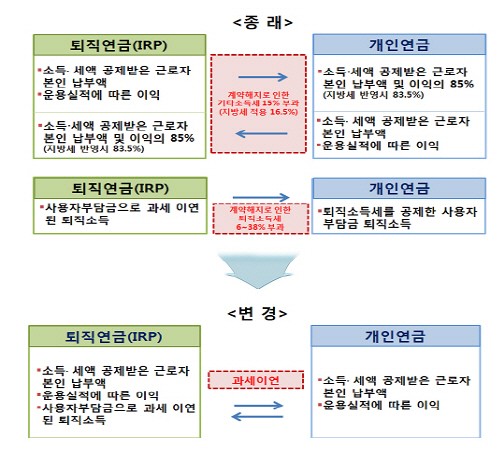
When you change jobs or retire, you must transfer the severance pay managed by your company to your personal IRP account to continue growing it. In the past, many employees would cash out their severance pay as a lump sum to buy a new car or cover living expenses. However, using severance pay midway leaves you without a safety net for life after retirement, which is why the government is moving to mandate account transfers. If you transfer your severance pay directly to an IRP account instead of receiving it as a lump sum, you can defer severance income tax and enjoy the benefit of tax deferral. The transferred funds can continue to grow through investment products until retirement, becoming a core channel for fully enjoying compound interest. Once you reach the age of 55, you can apply to receive your pension, allowing you to receive a fixed amount monthly. If you extend the pension receipt period to 10 years or more, you can receive a tax reduction of up to 30% to 40% compared to receiving a lump sum. The monthly pension income deposited into your account provides stable living expenses, serving as a sturdy pillar that significantly improves your quality of life after retirement. Financial platforms and securities firm apps offer convenient tools that allow users to simulate their pension receipt period and amount. Only those who have carefully linked and managed their accounts through moves and job changes since their youth can enjoy a comfortable and abundant cash flow after retirement.
Transferring severance pay to an IRP account upon job change or retirement allows you to benefit from tax deferral, and receiving it as a pension after age 55 can significantly reduce taxes.
6. Future Outlook for Wise Pension Asset Management
As our society enters the era of super-aging, it will become increasingly difficult to guarantee a stable retirement relying solely on state-provided pensions. The importance of self-prepared private pensions is emphasized more than ever, and the IRP stands at the center as a core asset management tool. Recently, with the integration of artificial intelligence technology into investment solutions and mobile platforms, even beginners can easily diagnose their pension status and adjust their portfolios. The era has arrived where busy employees, even without complex financial knowledge, can manage their returns using customized asset allocation strategies recommended by AI. The difference in post-retirement life between those who started preparing early and those who procrastinated and regret it later will be as vast as the difference between heaven and earth. We recommend starting with a small step today: turn on your smartphone, check the status of your pension account, and begin gradually increasing your monthly contributions.
To prepare for the aging society, you should start managing your IRP pension assets now by utilizing convenient AI-based mobile platforms.
Frequently Asked Questions
=