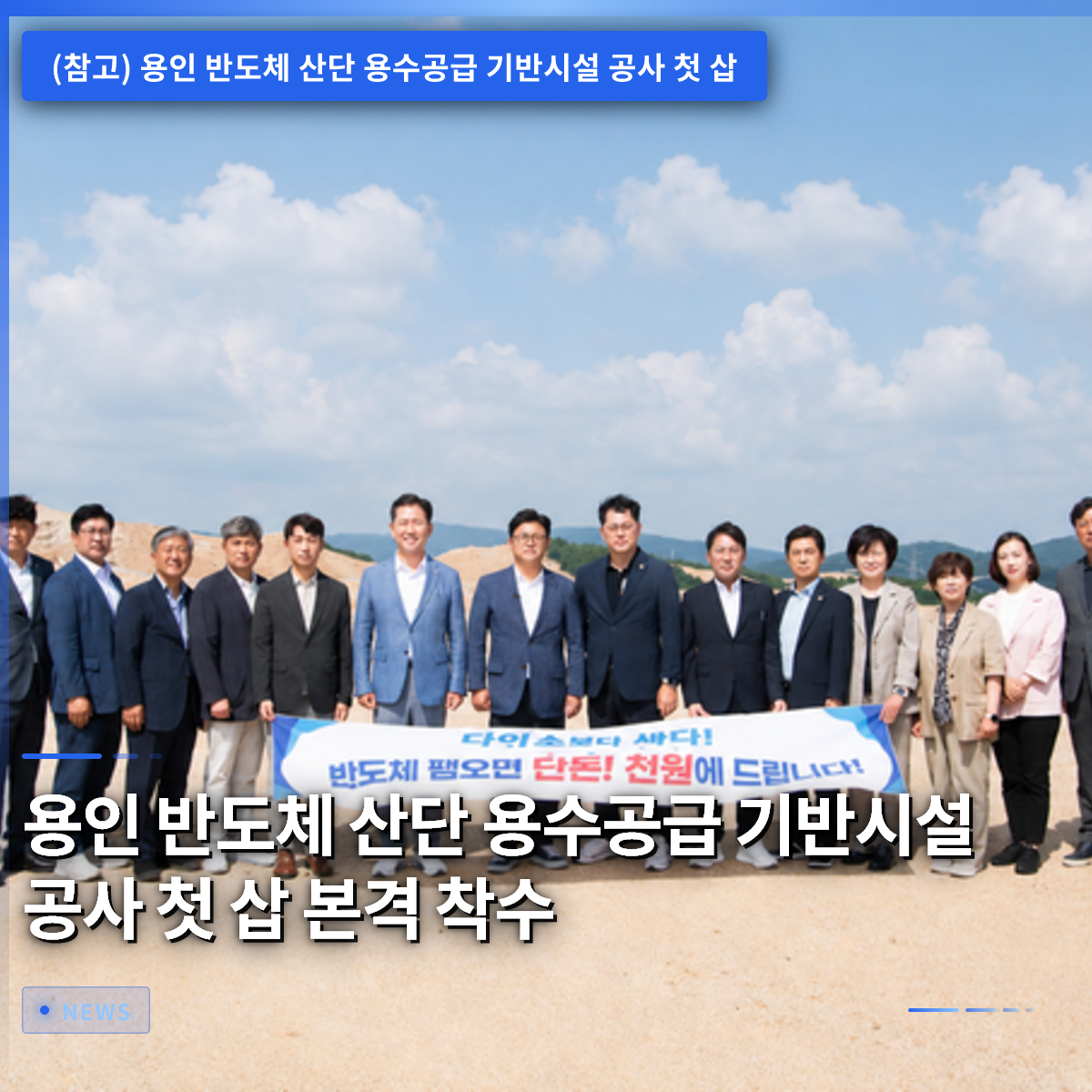
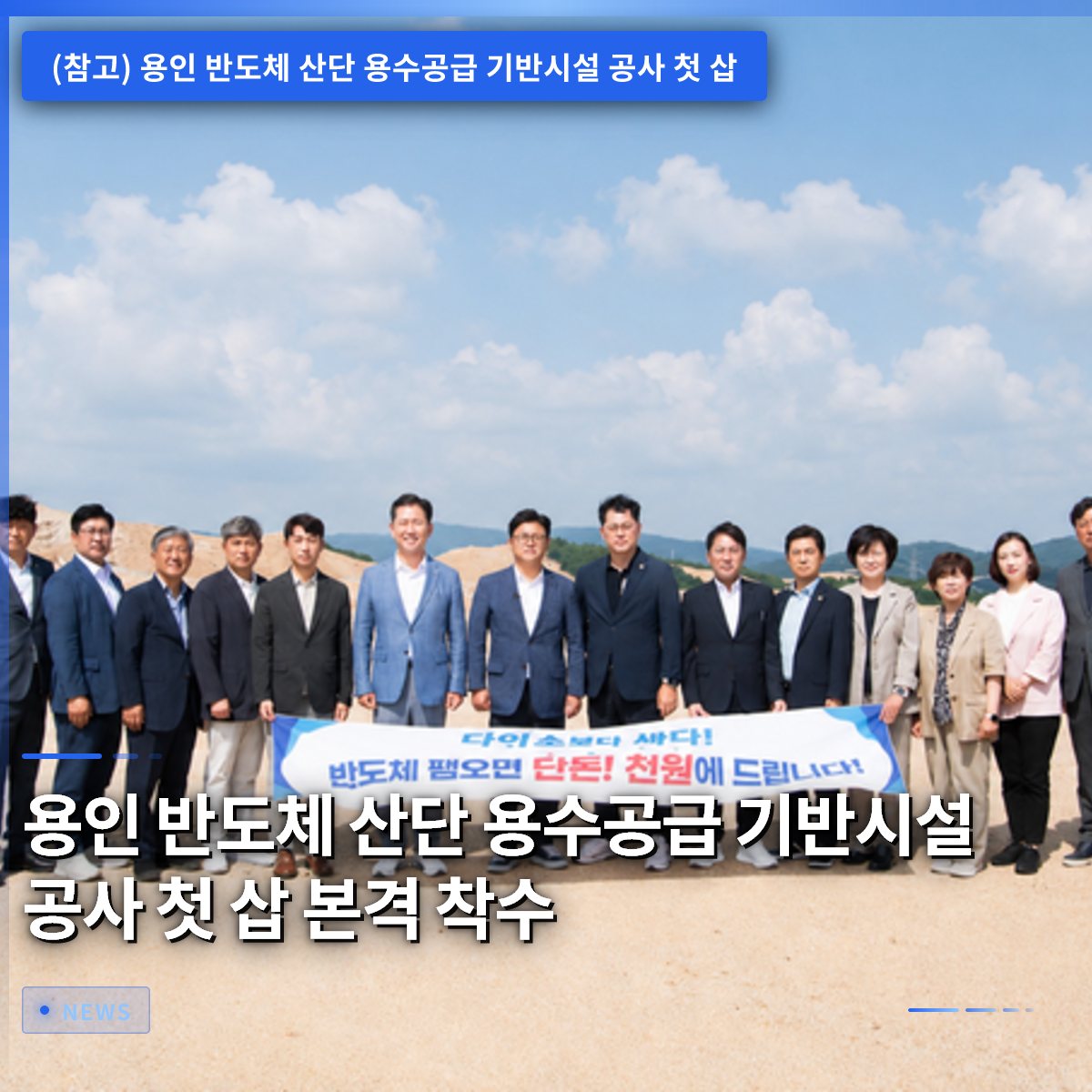
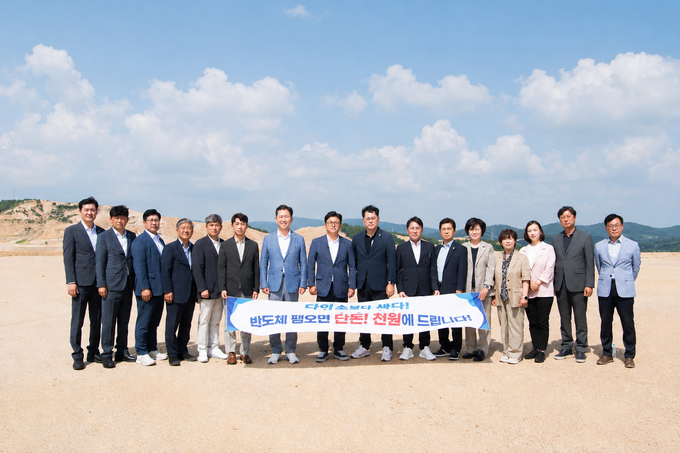
The Ministry of Climate, Energy and Environment announced that construction has officially begun on the priority section of Phase 1 of the Integrated Water Supply Project for the Yeoju Semiconductor Industrial Complex on September 18. This prompt commencement was made possible by the approval and official announcement of the project implementation plan on the same day. Semiconductor manufacturing processes do not tolerate even a one-second interruption and require a constant, massive supply of water. In response to these industrial demands, the government and relevant agencies have rolled up their sleeves to ensure that companies’ factory construction schedules are not compromised. In particular, they adopted a strategy of proactively starting construction in sections where design and administrative permits were completed first, thereby shortening the overall project duration. The remaining sections will also enter the construction process immediately upon the completion of relevant procedures, with a full commitment to timely supply. It would be greatly beneficial for readers to examine in detail how the core infrastructure for South Korea’s future food industry has taken its first step.
=
Groundbreaking for Water Supply Infrastructure at Yeoju Semiconductor Industrial Complex Officially Begins
1. Background and Importance of the Yeoju Semiconductor Industrial Complex Water Supply Project
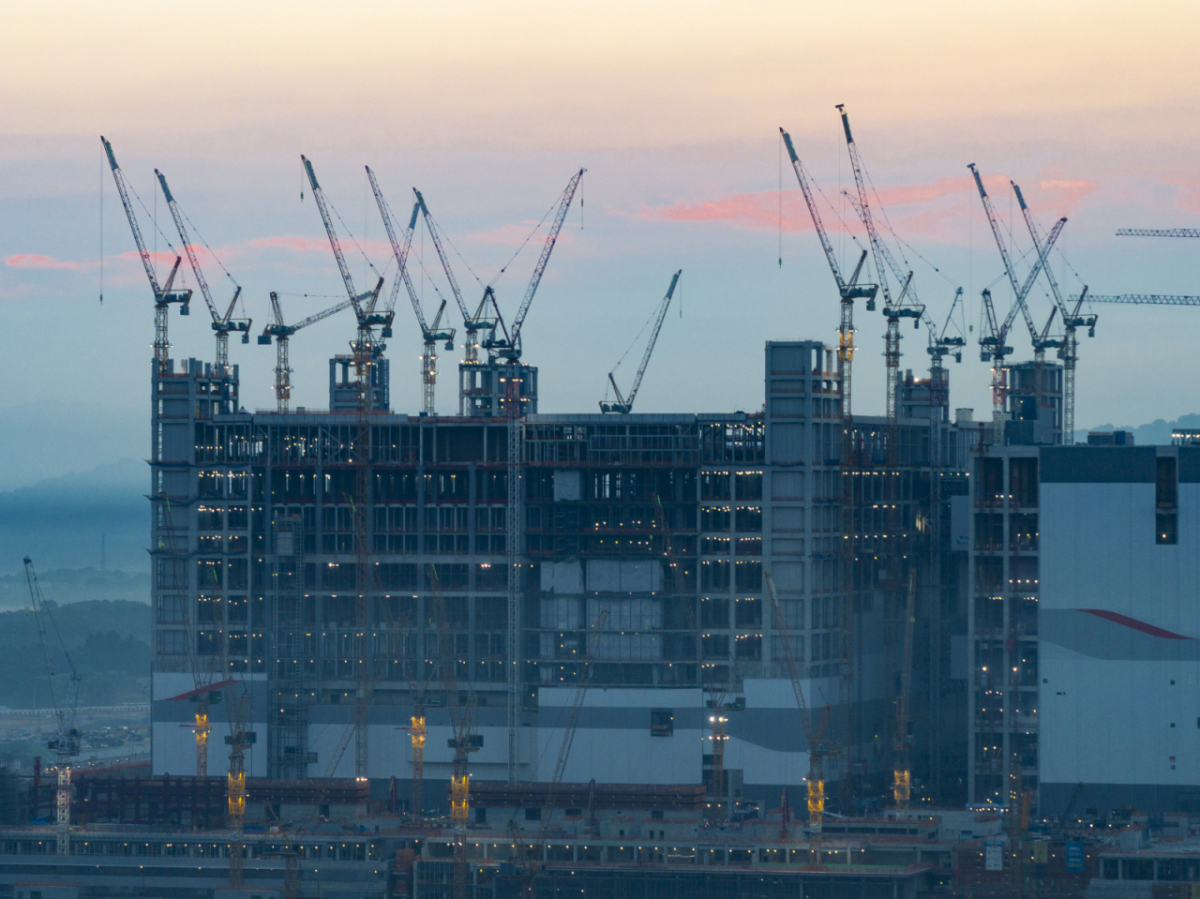
Semiconductor factories are often described as being at war with water scarcity due to their enormous consumption of water resources. Ultra-pure water must be supplied continuously throughout all processes, from cleaning wafers to etching circuits, to prevent defects. The Yeoju Advanced System Semiconductor National Industrial Complex, where Samsung will be located, and the Semiconductor Cluster General Industrial Complex, home to SK Hynix, are the primary beneficiaries. For these two massive industrial complexes to operate smoothly, the construction of a large-scale national water supply network was absolutely essential. If water is not supplied on time, an unprecedented situation could arise where state-of-the-art factories, invested in with trillions of won, are completed but forced to halt operations. This is why the government has designated this infrastructure project as a top national priority and is pushing it forward swiftly. On-site, numerous workers and technicians have taken the first step in the process, maintaining a thorough state of readiness 24 hours a day. Valuable experiences gained from the development of semiconductor clusters in Gumi and Pyeongtaek in the past have been fully integrated into this Yeoju project. It is encouraging that meticulous plans for coexistence with local residents have been prepared through thorough preliminary surveys and environmental impact assessments. Thanks to this rigorous preparation, the project has proceeded smoothly from the moment the first shovel hit the ground, without significant disruptions.
The government and companies have joined forces to begin infrastructure construction to ensure the timely supply of large-scale water resources, an essential element of semiconductor manufacturing.
2. Specific Details of Phase 1 Priority Section Construction
The Phase 1 project, which has just broken ground, involves connecting a massive lifeline from Paldang Dam to the Yeoju Semiconductor Industrial Complex. To maximize efficiency, construction has begun with the priority sections where design and permits have been completed. A dedicated pipeline spanning a total of 47.0 kilometers will be buried underground to ensure that clean raw water drawn from Paldang Dam is transported safely. Additionally, one large-scale pumping station will be constructed to smoothly push water to higher or more distant locations. Once this Phase 1 facility is fully completed, a massive amount of 310,000 tons of industrial water per day is expected to be supplied directly to the industrial complex. Given that the pipeline construction passes under urban areas and farmland, various technologies, including trenchless construction methods, are being applied to minimize inconvenience to residents. To reduce traffic congestion on the surface and minimize noise and vibration, on-site engineers have collaborated to find the optimal route. The pipeline material itself is made of top-grade materials that are highly resistant to corrosion and external shocks such as earthquakes, prioritizing safety. Thanks to this meticulous engineering design, a perfect water resource network free from leaks or supply interruptions can be maintained for decades to come.
Through Phase 1, a 47-kilometer dedicated pipeline will be built from Paldang Dam to the Yeoju complex to supply 310,000 tons of water daily.
3. Phased Supply Plan and Future Outlook
The 310,000 tons of water supplied by Phase 1 will serve as a precious initial supply to ease the startup of early semiconductor factories. However, when the two industrial complexes are fully activated and all production lines are running at full capacity, this amount will be grossly insufficient. Accordingly, the government has planned to complete a super-large integrated water supply facility with a total capacity of 1,072,000 tons in phases from a long-term perspective. The Phase 2 project, to be implemented following Phase 1, will additionally secure a supply capacity of 762,000 tons per day to prepare for surging demand. This phased approach is a wise measure not only for the efficient execution of the budget but also to precisely align with the completion schedules of the actual semiconductor factories. It prevents the situation of pulling water first and leaving it unused before the factories are built, as well as the opposite scenario of factories being completed but lacking water. Process management teams for each phase hold regular meetings to coordinate the speed of factory construction and pipeline laying in real time. This massive waterway, which will become the main artery of South Korea’s semiconductor industry, is being connected without a single deviation according to the set schedule.
Starting with the 310,000-ton supply in Phase 1, facilities will be expanded in phases to a total of 1,072,000 tons to perfectly respond to increasing demand.
4. Rigorous Safety and Quality Management by Relevant Agencies
The most important value on a large-scale civil engineering construction site is undoubtedly safety and zero accidents. The Ministry of Climate, Energy and Environment and the construction companies are applying the highest level of safety management guidelines to the Yeoju Semiconductor Industrial Complex water supply construction site. Government officials, including Kim Ho-eun, the Water Use Policy Officer, frequently visit the site to inspect workers’ compliance with safety rules daily. State-of-the-art exploration equipment is being deployed to prevent potential ground subsidence accidents or damage to underground buried objects. Furthermore, strict quality verification procedures are implemented at every process stage to ensure the water quality and durability of the pipelines. All processes, from material receipt to welding, burial, and pressure testing, are recorded as data and managed transparently. Disaster prevention measures have also been thoroughly established to ensure the pipelines function safely even during harsh winter freezes or summer heavy rains. On-site engineers are working hard with the determination to create a perfect water supply network that citizens and companies can trust.
The government and construction companies are building accident-free, perfect infrastructure through rigorous safety inspections and strict quality management.
5. Coexistence with the Local Community and Environmental Conservation Efforts
The task of burying a 47-kilometer pipeline in the ground can inevitably cause minor inconveniences in the daily lives of local residents. To address this, the project implementers have maintained close communication with residents in areas adjacent to the construction zones. Construction notice banners are installed in various locations, and noise generation time slots are coordinated to thoroughly protect residents’ right to sleep and right to a healthy life. Furthermore, road surfaces or surrounding green spaces that may be damaged by construction will be promptly restored to their original state or even improved to be more beautiful once the work is completed. The introduction of eco-friendly construction methods to minimize environmental destruction is also a hidden hero of this project. In sections passing through water resource protection zones, dedicated environmental monitoring personnel are stationed at all times to prevent ecosystem disruption. Considerate measures to avoid obstructing fish migration routes and protect wildlife habitats have been reflected in the civil engineering design stage from the beginning. Local residents, recognizing that this is an effort to sustain the nation’s major industry, are showing positive reactions to the government’s transparent communication while accepting some inconvenience.
Construction is proceeding in coexistence with the local community by minimizing resident inconvenience and applying eco-friendly construction methods.
6. The Future of South Korea’s Semiconductor Industry and Final Outlook
The groundbreaking for the water supply infrastructure at the Yeoju Semiconductor Industrial Complex is more than just the start of a civil engineering project; it is a signal of a new leap in the South Korean economy. For the production of semiconductors, known as the “rice” of the advanced industry, to proceed smoothly, a solid foundation of water is required to gain an advantage in global competition. The government’s responsiveness to corporate voices and its swift completion of administrative procedures will be recorded as a model case of public-private cooperation. If the remaining Phase 2 processes are completed without issues, Yeoju will rise as a de facto world’s largest semiconductor mega-cluster. Readers are asked to send warm interest to this massive journey as our country advances toward becoming a high-tech powerhouse. It will also be a great pleasure to watch how this exemplary site, where environment and economy grow in harmony, is completed. We sincerely hope that this achievement, accomplished by the trinity of the government, local authorities, and private enterprises, will inject vitality into the South Korean economy. We will continue to deliver the latest news related to semiconductor industrial complexes quickly and accurately, so please visit the blog often.
This groundbreaking is a historic turning point in laying the most important water resource foundation for South Korea’s leap to become a global semiconductor powerhouse.
Frequently Asked Questions
=