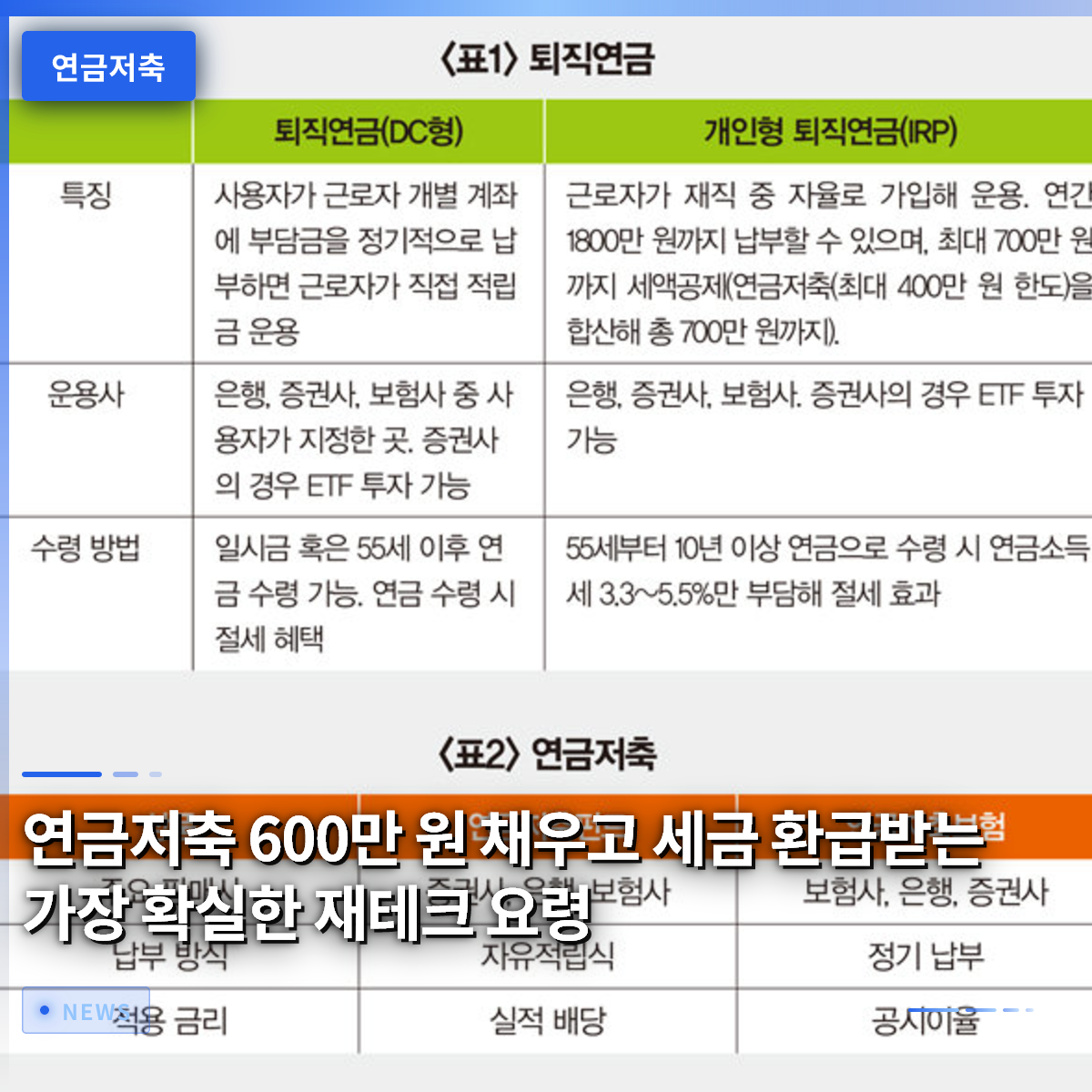
Pension savings accounts are an essential financial product that guarantees the most certain tax refund during the year-end tax settlement. Many office workers actively utilize these accounts to prepare for their post-retirement life while simultaneously reducing their immediate tax burden. Everyone has likely experienced envy after seeing acquaintances receive refunds ranging from hundreds of thousands to millions of won annually from their pension savings. As the perception that public pensions alone are insufficient for a comfortable old age spreads, individual savings and investments are becoming increasingly important. In this article, we will examine in detail specific strategies to maximize tax deduction benefits through pension savings and wisely grow your assets.
=
The Most Reliable Way to Max Out Your 6 Million Won Pension Savings and Get a Tax Refund
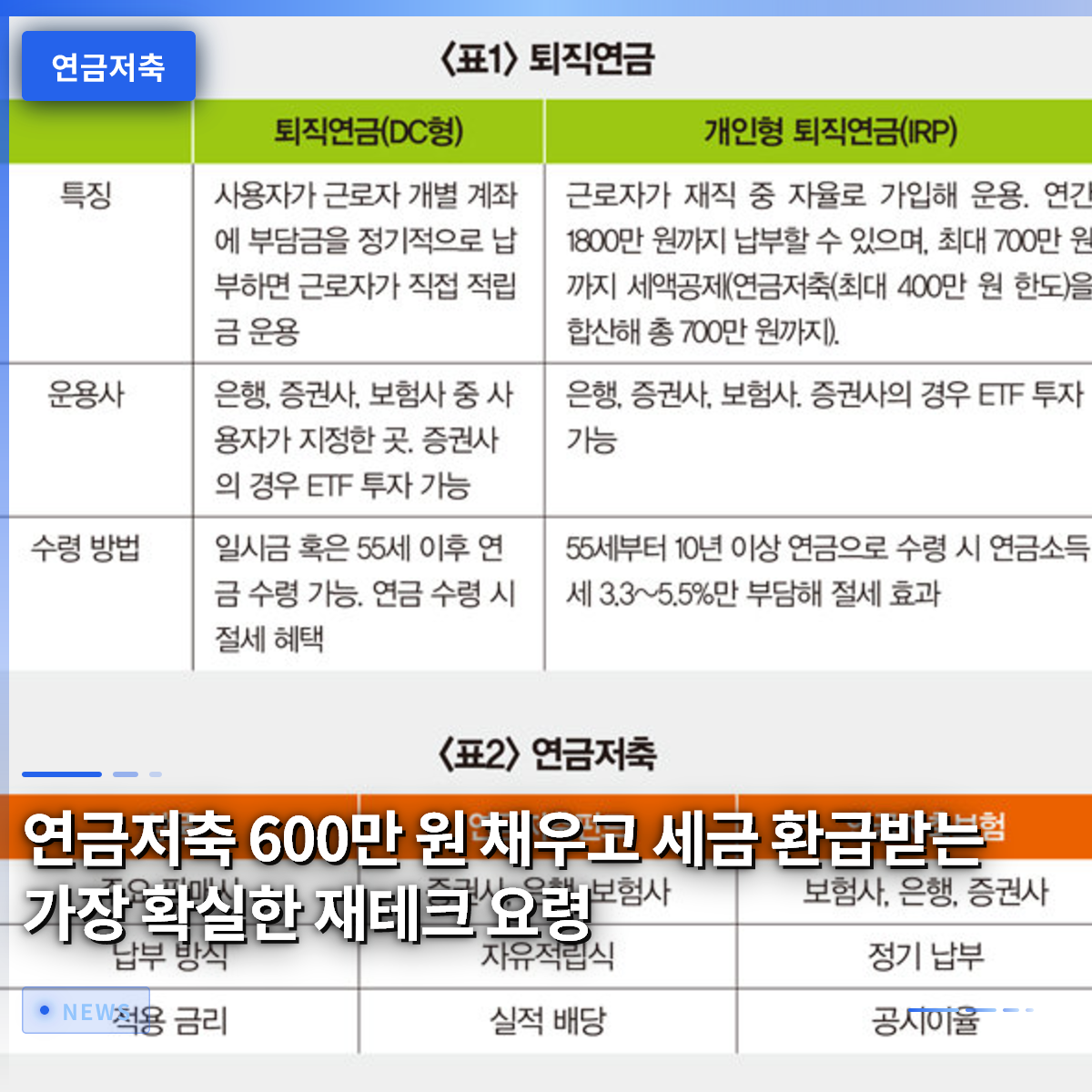
1. Basic Concepts and Necessity of Pension Savings Accounts

Pension savings are a representative tax-benefited financial product promoted by the state to ensure income security in old age. Both office workers and self-employed individuals can join, and the funds can be received in the form of a pension after the age of 55. With the recent entry into a super-aged society, life after retirement has become longer, meaning that failing to prepare funds in advance can lead to significant difficulties. In the past, simply saving money in a bank was the extent of preparation, but now active investment is essential to overcome inflation. Consistently accumulating funds in small monthly installments allows you to enjoy the pleasure of watching your assets grow into a substantial sum over time. For this reason, countless savvy investors make sure to deposit a fixed amount into their pension accounts every year. The importance of personal savings to prepare for the period when income stops after retirement cannot be overstated. In particular, as the number of single-person households increases, the social vulnerability of having to handle crises alone has grown, making individual self-reliance even more urgent. Although a public pension system exists, the cold reality is that it is difficult to fully cover living expenses after retirement with it alone. Therefore, individuals must consistently increase their lifetime savings each year to safely navigate the income cliff. The habit of saving little by little right now serves as the most reliable shield protecting your future self.
Pension savings are an essential savings tool that allows you to secure both retirement preparation and tax benefits simultaneously.
2. Combined Tax Deduction Limits for Pension Savings and Retirement Pensions
If you use only a pension savings account, you can receive a tax deduction benefit on up to 6 million won of your annual contributions. However, if you utilize a Defined Contribution Retirement Pension or an Individual Retirement Pension (IRP) in addition to it, the deduction limit increases significantly to a total of 9 million won. For example, if you fill your pension savings account with 6 million won and additionally contribute 3 million won to your retirement pension account, you can fully utilize the maximum limit. While the applicable deduction rate varies by salary bracket, you can receive a substantial refund during the year-end tax settlement, which significantly boosts your effective rate of return. Mr. Kim, an office worker, used this method last year to receive a nice tax refund and reinvested that money. Many people worry about the optimal order of deposits, but it is generally advisable to fill the pension savings limit first. This is because pension savings accounts offer slightly more flexibility in asset management during the operation process. Since 9 million won is the maximum limit for a year, it is wise to split the contributions monthly, considering your income and savings capacity. If you do not have a lump sum available, we recommend setting up automatic monthly transfers to steadily fill the amount without burden. Once you directly experience the tax refund effect, waiting for the year-end tax settlement becomes quite enjoyable.
You can enjoy a maximum tax deduction benefit of 9 million won by combining 6 million won in pension savings and 3 million won in retirement pensions.
3. Account Splitting and Diversified Investment Strategies

A pension savings account is not just a place to park money; it is an investment account where you can directly manage stocks, Exchange-Traded Funds (ETFs), and other products. Since these assets must be managed long-term over decades until they are received after age 55, you must build a robust portfolio. Recently, the strategy of splitting accounts into multiple ones to diversify investments according to purpose and character has gained great popularity. For example, one account might focus on safe bond-type assets, while another invests in high-growth overseas index products. This approach allows you to flexibly respond to market volatility while simultaneously pursuing stable returns. ETFs that track the stock indices of high-quality U.S. companies are a representative investment destination most loved by long-term investors. While investing in overseas products through a regular securities account requires paying high taxes on profits, using a pension account defers taxation. Because you do not pay taxes immediately and the money continues to grow through compound interest, a significant difference emerges in long-term performance. Ms. Lee, an office worker, is steadily growing her retirement assets by regularly accumulating overseas index-related products monthly. You must accurately understand your investment style and retirement timing to create your own customized asset allocation plan.
Diversifying investments with various products within a pension savings account allows you to maximize compound growth along with the tax deferral effect.
4. Tailored Savings Tips for Young and Middle-aged/older Adults
To achieve effects suitable for your life stage, your perspective on and method of utilizing pension savings should vary slightly depending on your age. For newcomers to the workforce or young people, it may feel burdensome to deposit large sums monthly, so it is important to start consistently, even with small amounts. When you are young, time is an asset, so starting earlier allows you to fully enjoy the magic of compound interest, giving you a significant advantage. On the other hand, middle-aged and older adults approaching their 50s are nearing the income cliff, so they should fill the contribution limit to the maximum to solidify their assets quickly. As the retirement date approaches, the focus should shift from products with high principal loss risk to generating stable cash flow. Looking around, people who have consistently managed pension savings since their youth often enjoy a comfortable life after retirement. Conversely, it is common to hear sad stories from middle-aged and older adults who started preparing for old age too late and now regret it. The government continues to refine various institutional support measures to help citizens voluntarily prepare for old age. The key is to precisely reflect your income level and expenditure plans to increase savings without overextending yourself. Time is passing even now, so do not procrastinate; check your account today.
Tailored to life stages, young people should aim for long-term compound interest, while middle-aged and older adults should increase savings to prepare for the income cliff.
5. Converting Matured Comprehensive Asset Management Account Funds to Pensions
As you invest or save, you will eventually face a situation where a comprehensive asset management account matures and a lump sum of money comes into your hands. At this point, rather than simply moving the matured funds to a regular deposit, it is worth seriously considering transferring them to a pension savings account. There is a system that allows you to receive additional tax deduction benefits on a certain percentage of the transferred amount when converting matured funds to a pension account. For example, you can receive an additional deduction of about 10 percent of the transferred amount, and since there is a maximum limit, it offers a nice tax-saving opportunity. At first, the system may seem complicated and cause hesitation, but once you experience it, you will quickly understand why everyone recommends it. Even if you move a lump sum to a pension account at once, the entire amount is not taxed or locked in all at once; it can be managed systematically. Funds entered into pension savings are safely managed until they are received as a pension, maximizing tax-saving benefits. One acquaintance transferred the funds from a matured account entirely to a pension account, significantly increasing their year-end tax refund this year. By utilizing various financial systems in connection with each other, you can save on taxes while growing your asset size much faster. If you pay a little attention to financial news in your daily life, you can secure a more advantageous position than others.
Transferring matured funds from a comprehensive asset management account to a pension account allows you to obtain both additional tax deductions and tax-saving effects.
6. Creating Post-Retirement Cash Flow and Future Outlook
The most important aspect of life after retirement is a stable, regular cash flow, and pension savings play a central role in this. If the assets you diligently saved in your youth start flowing into your account monthly after retirement, you can escape economic anxiety. As the pace of aging accelerates, the role of individual private savings will become absolutely larger in addition to state-guaranteed pensions. Experts unanimously advise that you must gradually increase your savings scale starting now to fill the income gap before and after retirement. A prosperous future does not come by chance; it is the result of the small savings choices we make today. Please open your smartphone app right now to check your pension savings enrollment status and contribution amount, and fill in any gaps. If you increase your savings amount with the mindset of saving a few cups of coffee each month, you will face assets that have grown like a snowball in a few years. There are not many wealth management strategies that allow you to secure a comfortable old age along with the sweet reward of a tax refund. A small action started today can completely change your daily life decades from now. Start your wisest investment for yourself right now.
Thorough management of pension savings is the most reliable path to ensuring a stable cash flow after retirement.
Frequently Asked Questions
=