KB Life significantly boosted its new contract Contractual Service Margin (CSM) by over 21% in the first half of this year, establishing a solid growth foundation for future profits. The results of its decisive portfolio restructuring, moving away from a sales structure heavily skewed toward whole life insurance, are now proven by the numbers. This fundamental transformation, driven since the appointment of President Jung Moon-cheol, serves as a crucial catalyst for strengthening the core of the insurance business beyond mere external growth. In fact, according to the insurance industry, the scale of new contracts in the first half of this year increased noticeably compared to the same period last year, demonstrating robust underlying strength. This article closely examines how KB Life achieved these results and the direction it is heading in the future. It will be a beneficial time for readers to understand why an insurance company’s financial metrics are important.
=
KB Life’s New Contract CSM Up 21% in First Half, Expanding Foundation for Future Profits
1. Steep Growth in New Contract CSM
1. Steep Growth in New Contract CSM
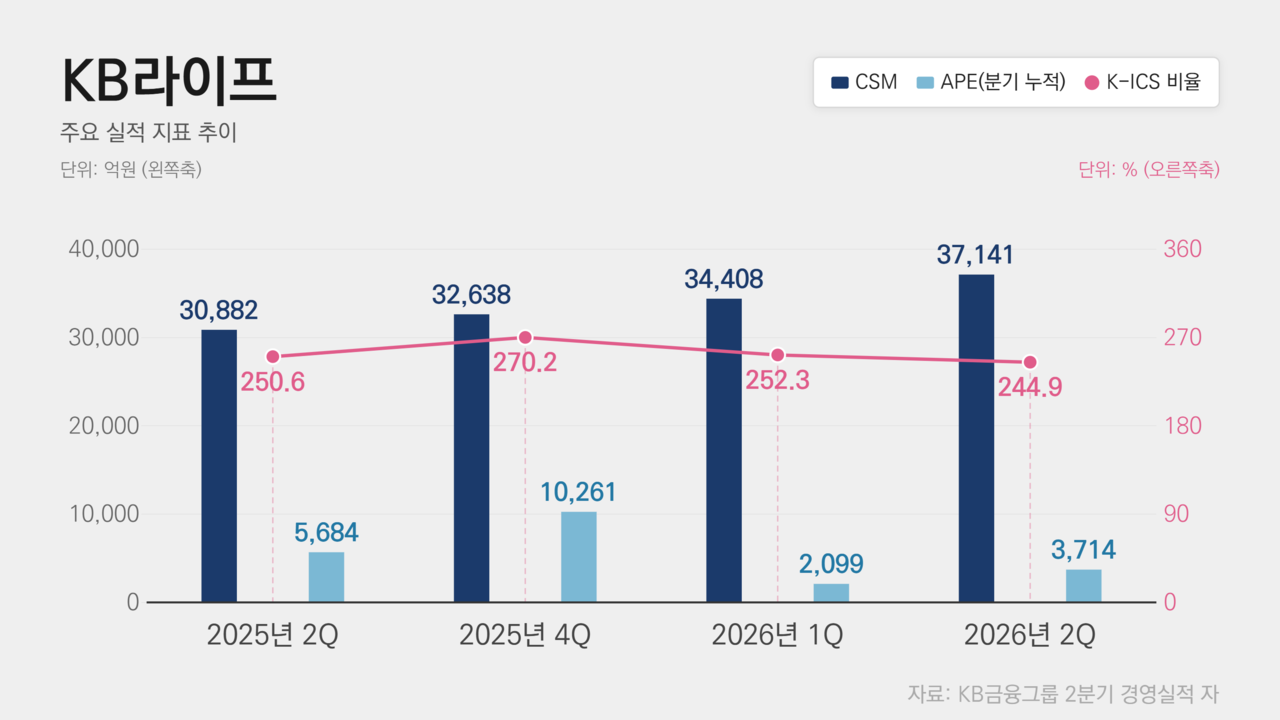
In the first half of this year, KB Life’s new contract CSM reached 282.7 billion won, a remarkable 21.2% increase compared to 233.2 billion won in the same period last year. The CSM is a core resource that pre-calculates the profits a company can earn while providing future insurance services to customers. An increase in this figure means the company has a much more substantial reservoir of profits it can earn over the long term. It holds significant meaning in that the company has secured the ability to generate stable future revenues without being swayed by short-term performance fluctuations. The total margin balance for all in-force policies also swelled by 450.3 billion won, rising from 3.2638 trillion won at the end of last year to 3.7141 trillion won at the end of June this year. Compared to the same period last year, the total balance increased by more than 20%, tracing a steep upward curve. These metrics provide clear evidence of how many high-quality contracts the company successfully secured during the new contract acquisition process. While it may be difficult to feel the impact of such large-scale corporate metric changes just by seeing acquaintances renew or maintain their insurance, massive shifts are occurring within the financial statements.
💡 Key Point KB Life built a solid foundation for future profits as its first-half new contract CSM increased by 21.2%.
2. Diversification from Whole Life to Health and Pension Insurance
2. Diversification from Whole Life to Health and Pension Insurance
KB Life is adopting a strategy to boldly break away from its previous sales practice, which focused primarily on whole life insurance, the core of its growth. Recently, it has actively expanded its product lineup of health insurance with strengthened disease coverage and pension insurance that secures income for old age. This product diversification strategy is the result of accurately targeting actual customer demand in line with the massive demographic shifts of low birth rates and an aging population. Relying on a single product category makes a company vulnerable to changes in the market environment, making portfolio diversification an essential choice. For example, it is similar to how acquaintances approaching retirement show more interest in health insurance that alleviates immediate medical concerns or pension products that provide stable monthly income, rather than whole life insurance. The company has been introducing new coverage assets to meet these consumer expectations, broadening the choices available to policyholders. As the revenue base for each product has diversified, the company has developed a robust structure where overall performance does not fluctuate significantly even if specific risk factors arise. Ultimately, this qualitative improvement in the sales structure serves as a key driver for enhancing the company’s long-term financial soundness.
💡 Key Point By expanding its product portfolio from a whole life insurance focus to health and pension insurance, it is responding flexibly to market changes.
3. Diversification of Sales Channels and Strengthening of Subsidiary-type Agencies
3. Diversification of Sales Channels and Strengthening of Subsidiary-type Agencies
The channels for selling insurance products are also expanding into diverse routes beyond the traditional exclusive agent organization. KB Life executed a large-scale capital increase of over 2 billion won in its subsidiary-type agency, KB Life Partners, last year to significantly boost on-site competitiveness. Simultaneously, it strengthened partnerships with external major sales agencies and comprehensively organized non-face-to-face channels via the internet to broaden customer touchpoints. Over-reliance on a specific channel can cause performance to be heavily influenced by changes in fee structures or the sales environment, making this diversification a wise approach. In fact, today’s consumers clearly prefer joining through online comparison platforms or agencies that allow them to compare various products at a glance, rather than meeting agents directly. The company is accurately reading these changes in consumer behavior and deploying customized sales strategies tailored to the characteristics of each channel. As a result, an efficient division of labor has been established where the agent organization focuses on professional asset management consultations, while online channels absorb customers seeking easy enrollment. This diversification of distribution networks is the secret to rationally controlling sales costs while consistently generating new contracts.
💡 Key Point By investing in subsidiary-type agencies and expanding external and online channels, it has reduced dependence on specific channels and strengthened sales power.
4. Leveraging the Care Business as a New Growth Axis
4. Leveraging the Care Business as a New Growth Axis
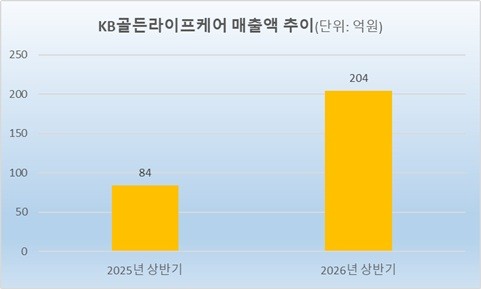
The care business, which organically combines the insurance industry with retirement life, is another core pillar where KB Life boasts differentiated competitiveness. Through its subsidiary, KB Golden Life Care, it directly operates professional care facilities, providing essential care services for the aging era. It is a plan to take responsibility not just for paying financial insurance benefits, but also for the housing and care infrastructure that seniors actually need as they age. This is evaluated as a very innovative attempt to realize the essential value of insurance: customers’ lifelong peace of mind. Visiting the Yoksam Center located within the KB Life Tower in Yoksam-dong, Seoul, allows one to directly see how this philosophy is implemented. Here, services go beyond consulting on insurance coverage details, offering one-stop solutions for retirement asset management and professional care services. For families caring for elderly relatives who feel overwhelmed by the issue of end-of-life care, this comprehensive consultation space serves as a reliable solution, like a ray of light. This unique business model connecting insurance and care will be a powerful weapon ensuring the company’s sustainable growth in the coming super-aged society.
💡 Key Point It has established a new business area covering retirement and care services through the operation of subsidiary care facilities and integrated consultation centers.
5. Challenges in Profitability Management and Capital Efficiency
5. Challenges in Profitability Management and Capital Efficiency
Just because new contract margins have increased significantly does not mean it will immediately translate into a surge in net income, so careful attention is required. For insurance products, managing the contract retention rate to keep policies in force over the long term and controlling the loss ratio for unexpected claims are as important as signing the contract itself. Furthermore, the actual size of profits can vary depending on how efficiently various costs incurred during the sales process and maintenance costs are controlled. Therefore, a risk management process that steadily strengthens internal stability behind the flashy metrics is indispensable. The newly expanding health and pension insurance products also need to maintain stable loss ratios over the long term to establish themselves as truly solid products. For the care business, considering initial facility investment costs and monthly fixed operating expenses, securing robust profitability from a long-term perspective is a challenge. Just as one occasionally sees major corporations entering new businesses and suffering from cost burdens, meticulous calculation and management are essential. Management is well aware of this and is tightening the reins to focus on improving capital efficiency rather than just quantitative growth.
💡 Key Point Since increased new contract margins do not directly translate to net income, thorough management of retention rates, loss ratios, and costs is required.
6. Leap Toward the Future and Outlook for the Senior Market
6. Leap Toward the Future and Outlook for the Senior Market
The series of portfolio diversification strategies pursued under President Jung Moon-cheol’s leadership is now taking shape as a definitive formula for KB Life’s successful fundamental transformation. By building a solid profit structure in its core insurance business and securing a position in the senior care sector, an essential industry for the aging era, the company has further elevated its corporate value. To continue this growth trend, it requires the wisdom to respond nimbly to the changing trends in the financial market while maintaining rigorous soundness management. Readers should also cultivate the insight to look not just at visible performance numbers but at how companies adapt to social changes. Innovative services that blend insurance and care hold the potential to completely change the landscape of our lifelong asset management. If you want to prepare wisely for the coming era, carefully examining the future blueprints drawn by financial institutions will be of great help. The positive metrics from this first half are merely the prelude to a greater leap ahead, making future developments even more anticipated. We hope you use this opportunity to re-establish your criteria for finding a reliable partner to entrust your precious retirement and assets to.
💡 Key Point Through fundamental transformation and securing the senior market, it is continuing sustainable growth and preparing for a solid leap toward the future.
Frequently Asked Questions
What exactly does Contractual Service Margin (CSM) mean?
It refers to the future profit resource calculated in advance from the insurance premiums paid by customers, representing the profits to be earned while providing future insurance services.
What products is KB Life strengthening besides whole life insurance?
It is actively expanding its product lineup of health insurance with strengthened disease coverage and pension insurance that stably secures income for old age.
How is the care business specifically being conducted?
Through its subsidiary, KB Golden Life Care, it directly operates professional care facilities and provides insurance coverage along with retirement asset and care consultations.
Does an increase in new contract margins necessarily lead to an increase in net income?
Not necessarily. The actual size of profits can vary depending on how contract retention rates, loss ratios, and sales costs are managed.