When choosing driver’s insurance, you must carefully compare coverage details and discount riders to get the best value. Today, based on the latest 2026 data, we will look at changes in mileage-based discount riders from major insurance companies and how to effectively use comparison sites. First, we will examine the details of Heungkuk Life Insurance’s discount rider offering up to 48% off, and also look at Samsung Fire & Marine Insurance’s newly introduced AI-based safety training evaluation method. Next, we will highlight common pitfalls when using insurance comparison sites and show which items you must always verify through real-world examples. Finally, we will briefly summarize driving habits that maximize discount benefits and anticipated changes in the insurance market. After reading this article, you will be able to immediately put into practice how to smartly choose the driver’s insurance that suits you.
=
Driver’s Insurance Comparison Guide: 2026 Latest Discount Rider Summary
1. Basic Concepts and Essential Coverage Items of Driver’s Insurance
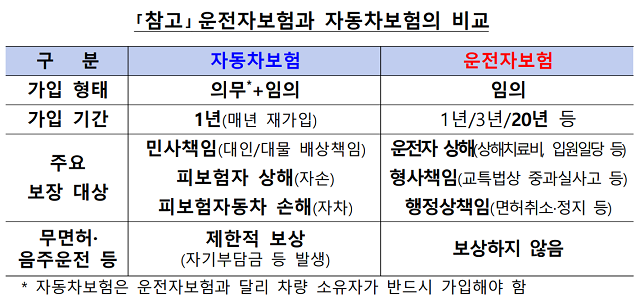
Unlike mandatory auto insurance, driver’s insurance is an optional product that covers legal costs and settlement amounts incurred in the event of an accident. Key coverage items include attorney fees, which are paid to retain a lawyer for criminal or civil litigation. Additionally, the traffic accident handling support fund provides financial assistance up to a certain amount for various costs required to handle the accident. The criminal settlement support fund helps alleviate the financial burden that arises when a settlement is required. Meanwhile, some products offer additional riders for hospitalization daily allowances or surgery costs to provide broader coverage. These items vary slightly depending on standard terms, so you must always check the product description before enrolling. Therefore, it is a smarter approach to first understand the scope of coverage rather than simply looking at the price.
Driver’s insurance should be compared based on core coverages such as attorney fees, traffic accident handling support funds, and criminal settlement support funds.
2. Latest Trends in Mileage-Based Discount Riders (Focus on Heungkuk Life Insurance)

Heungkuk Life Insurance announced that it has significantly revamped its mileage-based discount riders at the beginning of 2026, applying discounts of up to 48% for annual mileage of 1,000 km or less. This more than doubles the discount rate compared to previous tiers, providing a substantial premium reduction effect for low-risk drivers. Additionally, it offers discounts of up to 18% for the 10,000 to 12,000 km range, allowing drivers with relatively high mileage, such as those commuting to work, to also benefit. The insurance company explained that this adjustment can lower the base premium to a 0% level. In response, Samsung Fire & Marine Insurance has developed an AI-based safety training evaluation method, which is used to quantify drivers’ safe driving scores to determine discount eligibility. These initiatives reflect an industry-wide trend to more finely reflect individual risk factors in premium calculations. Therefore, it is expected that driving habit data will increasingly be reflected in discount conditions, in addition to mileage.
Heungkuk Life Insurance’s mileage-based discount riders have been significantly increased to up to 48% for 1,000 km or less and up to 18% for the 10,000 to 12,000 km range.
3. Tips for Using Insurance Comparison Sites
When using an insurance comparison site for the first time, it is important to accurately enter your occupation and purpose of driving during the personal information input stage. For example, the applicable discount riders may differ depending on whether the vehicle is used for commuting or leisure, so you must provide accurate information to avoid issues with future claims. Next, you must expand the list of optional riders beyond basic coverage and check the limits for attorney fees and the maximum amount for traffic accident handling support funds. Some sites use slightly different names for riders even under the same conditions, so it is necessary to develop the habit of carefully comparing item names. In reality, my friend Minjun contracted based solely on the discount rates shown on a comparison site, only to later realize he had missed rider exclusion clauses and ended up facing higher out-of-pocket costs than expected. To prevent such mistakes, it is best to click on rider description links and read the detailed conditions. Finally, utilizing the save function on the comparison results page allows you to reopen and compare under the same conditions later, saving you time.
The key to using insurance comparison sites is ensuring the accuracy of personal information, verifying detailed rider conditions, and utilizing the save function.
4. Driving Habits to Maximize Discount Riders
To receive mileage-based discounts, it is effective to develop the habit of reducing unnecessary travel in your daily life. For example, using a bicycle for short distances and taking public transportation during the rainy season can significantly lower your monthly mileage. When planning weekend leisure activities, it is best to optimize your route before departure to avoid traveling the same distance multiple times. Recently, utilizing built-in mileage tracking apps on smartphones allows you to check your movement in real-time and set goals. Giving yourself small rewards upon achieving goals can help maintain motivation. Additionally, maintaining proper tire pressure through regular inspections improves fuel efficiency, reducing fuel consumption for the same distance, which indirectly helps with mileage management. These small habits accumulate, allowing you to adjust your annual mileage to fit within discount tiers.
To receive mileage discounts, you need to reduce daily travel volume, use app-based tracking, and perform regular vehicle maintenance.
5. Future Outlook and Expected Changes
Insurance companies are expected to launch customized products that analyze drivers’ real-time behavioral patterns by further combining artificial intelligence and big data. For example, pilot programs that score factors such as the frequency of sudden acceleration/braking or the ratio of night driving to reflect in discount/surcharge criteria are already being tested in some regions. Along with this, models that further subdivide mileage tiers to apply differentiated discount rates down to 500 km units are also under consideration. Regulatory authorities are also establishing guidelines to ensure that such user-centric insurance aligns with consumer protection, so transparent information provision is expected to be emphasized further in the future. Consumers can expect a wider range of options to receive lower premiums in exchange for providing their driving data. Therefore, becoming familiar with current mileage-based riders will make it easier to adapt to more sophisticated products that will emerge in the future.
In the future, customized discount products utilizing driving behavior data, in addition to mileage, are expected to increase.
6. Conclusion and Action Plan
As we have seen, to gain actual benefits when choosing driver’s insurance, you must compare coverage details and discount riders as two main axes. Heungkuk Life Insurance’s mileage-based discount riders offer significant advantages to low-mileage drivers, and Samsung Fire & Marine Insurance’s AI-based safety training evaluation shows a trend toward strengthening rewards for safe driving. When using comparison sites, you must thoroughly check the accuracy of personal information and detailed rider conditions, and save the results for later review. Based on this, you can prevent losses due to minor oversights, as seen in real-world cases. Furthermore, by developing habits to reduce mileage in daily life and managing goals with smartphone apps, you can maximize discount benefits. Since more sophisticated products combining AI and big data will emerge in the future, it is necessary to maintain a posture of continuously monitoring the insurance environment based on the knowledge gained now.
To make a wise choice, you must compare coverage and discounts together, actively use comparison sites, and develop habits for mileage management.
Frequently Asked Questions
=