You must keep in mind that if you receive your National Pension up to 5 years early, it is reduced by 6% per year for life, resulting in a maximum reduction of 30%. Many people regret applying hastily out of fear of the “income cliff”—the sudden loss of income after retirement—only to live with a permanently reduced amount. While many approaching retirement consider this option due to immediate living expenses, it is crucial to thoroughly evaluate the long-term pros and cons. Before following the lead of those around you who are receiving it early, you should first assess your life expectancy and health status. In this article, we will dissect the exact reduction structure of early old-age pensions and the break-even point through real-world examples. For a wise retirement preparation, please carefully examine which choice is advantageous all the way to the end.
=
A Complete Guide to Calculating the Reduction Rate and Break-Even Point for Early National Pension Receipt
1. Basic Concepts and Application Conditions for the Early Old-Age Pension System
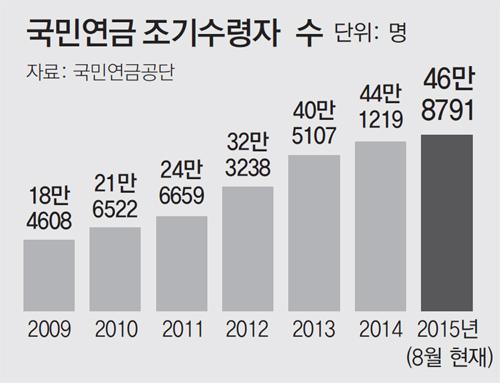
The early old-age pension may seem like a grateful system that allows you to receive benefits up to 5 years earlier than the standard age, but it comes with strict reduction conditions. It was created as a supplementary measure for those who have stopped income-generating activities earlier than the designated benefit commencement age and find it difficult to maintain their livelihood. However, to use this system, you must have a minimum enrollment period of 10 years and meet conditions regarding low or no income. For example, if your retirement age is 65, you can start receiving this money as early as age 60. However, applying impulsively just because you urgently need living expenses can lead to great disappointment later due to the reduced amount. While the intent of the system is to ensure livelihood stability after retirement, it has the fatal drawback of reducing the total amount received for life in the long term, so careful judgment is required. Mr. Yeong-su, in his late 50s and living in Seoul, is seriously considering early receipt because he has no immediate cash flow after leaving his company early. He is eager to apply quickly due to the lack of monthly living expenses, but his mind is confused by hearing from others that it is a lifelong loss. While this money can be like a timely rain in the face of immediate financial drought, one must not take lightly the weight of the reduction that follows like a tail for the rest of one’s life. Even if you meet the application qualifications, you must first comprehensively review your overall asset situation and future expected expenses.
The early old-age pension can be received up to 5 years early, but you must meet enrollment period and income conditions and be prepared for a lifelong reduction.
2. The Scary Truth About the 6% Reduction Per Year

The reduction rate applied when receiving the pension early is 6% per year, and it is reduced by 0.5% for every month brought forward. If you receive it up to the maximum of 5 years early, 0.5% is applied to 60 months, resulting in an exact 30% reduction. If you were originally eligible to receive 1 million won per month, a 30% reduction means you will only receive 700,000 won per month for life. The difference of 300,000 won per month may not seem significant at first, but over ten or twenty years, it leads to a massive cumulative loss. While the public servant pension is reduced by a maximum of 25%, the National Pension is reduced by up to 30%, making it even more painful. There is a high risk of falling into the quagmire of poverty for the entire long old age after retirement, just to receive a slightly higher amount for a few years in the short term. Mr. Min-su, living in Gyeonggi-do, was originally supposed to receive 1.2 million won per month, but because he applied 5 years early, he is only receiving 840,000 won per month. For the first three years, he felt at ease thinking he had money in hand earlier than others, but as time passed, the gap with his friends widened. With prices continuing to rise while his pension remains fixed at the reduced amount, he is struggling with increasing insufficiency in his living expenses. Thus, the figure of 6% per year is not just a number but a massive rock that shakes the quality of life in old age to its core. Compared to the regular pension, which increases to reflect the annual inflation rate, the relative sense of deprivation among early recipients grows larger over time.
The reduction structure of 6% per year, up to a maximum of 30%, results in enormous cumulative losses as time passes.
3. Understanding Pros and Cons Through Break-Even Point Calculations
The break-even point for early receipt, which many people are curious about, is formed around the age of 80, and passing this age guarantees a loss. Even if you receive it 5 years early and accumulate a larger total amount in the initial years compared to others, the total cumulative amount of regular recipients overtakes yours once you pass a certain age. The total receipt graphs of a person who starts receiving the pension normally at age 65 and a person who receives it reduced from age 60 cross over as time passes. In today’s era, where the probability of living healthily and long past age 80 is increasing, early receipt can become a bad move that increases longevity risk. An irony occurs where, although you received it early because you needed money immediately, you end up in straitened circumstances in the latter half of old age when you are sick and expenses are highest. Ms. Suk-ja, living in Busan, began to regret her choice after passing her seventies and seeing her friends receiving their full regular pensions. In her early 60s, she mistakenly believed she had plenty of leisure, doing home repairs and giving allowances to her grandchildren, but now, approaching 80, she struggles to even cover medical bills. The money she had accumulated in her bank account by receiving it early has already been spent, and the reduced monthly pension amount cannot keep up with inflation, leading to more sighs. Mathematically, in a reality where average life expectancy is increasing, early receipt is a structure where the longer you live, the greater the loss. Therefore, you must honestly reflect on your health status and family longevity history and seriously calculate the break-even point.
Once you pass the break-even point of age 80, the total amount received early is overtaken, leading to a clear loss the longer you live.
4. The Trap of Pension Payment Suspension Regulations Upon Income Generation
You must be aware that if you earn income above a certain level while receiving the early old-age pension, the pension payment may be completely suspended or partially reduced. You may face a sudden blow where your pension stops if you find a job as a security guard or contract worker to supplement your living expenses after retirement. Under the National Pension Act, strict regulations exist that deny or significantly reduce pension payments to early recipients if their income exceeds a certain amount. It is an absurd situation where trying to earn money through work leads to the double burden of also losing the pension provided by the state. Therefore, if you plan to earn additional income through work, it is wise to reconsider applying for early receipt altogether. Mr. Dong-su, who runs a small shop in Incheon, applied for early receipt at age 58 and was shocked after concurrently doing small part-time jobs. He received a notice that he exceeded the income standard, and for several months, his pension was either fully suspended or reduced, creating a huge hole in his household budget. The money earned from work doesn’t leave much after taxes and other costs, and with the pension cut off, it was a situation where it would have been better not to work at all. As such, the early old-age pension is a system for people whose income-generating activities have completely stopped, so the relationship with additional income must be thoroughly examined. If you have the health and opportunity to continue working, it is much safer to receive the pension normally according to age rather than opting for early receipt.
If income exceeds a certain level, the early receipt amount may be suspended or reduced, so it must be carefully considered along with work plans.
5. Impact on Spousal Beneficiaries and Health Insurance Premiums
When both spouses receive the National Pension or choose early receipt, you must definitely check for unexpected institutional reductions or fluctuations in health insurance premiums. In the case of the Basic Pension, if both spouses receive it simultaneously, a reduction system exists where a certain percentage is deducted from each person’s amount, resulting in a lower receipt amount than expected. Additionally, if the National Pension is received early and counted as income, it affects the calculation criteria for regional health insurance premiums, potentially leading to a premium bomb. An absurd reversal occurs where, by rushing to receive the pension by a few hundred thousand won earlier, expenses actually increase due to higher health insurance premiums. The household economy of retirees is highly sensitive to even small variables, so the impact of the pension receipt method on taxes and insurance premiums must be calculated in advance. Mr. and Mrs. Yeong-hee, living in Daejeon, started receiving their National Pensions early, but were shocked shortly after seeing their regional health insurance premium notices. This was because their pension income was counted, causing them to lose their dependent status, and their monthly health insurance premiums jumped up by several hundred thousand won. Ultimately, a significant portion of the increased cash income from early receipt was directly deducted for health insurance premiums, leaving almost no actual benefit. As such, early receipt of the National Pension is not just about the reduction in pension amount but is also complexly intertwined with various public utilities and insurance premium systems. This is why retirees urgently need the wisdom to meticulously examine the correlation with government subsidies and tax benefits.
Additional reductions or increased expenses may occur in the process of spousal benefits and health insurance premium calculation, so a comprehensive review is necessary.
6. Alternatives and Wise Retirement Strategies to Overcome the Income Cliff
Before receiving a reduced pension due to immediate lack of living expenses, you should first seek various escape routes, such as utilizing housing pensions or other assets. The method of utilizing housing to bridge the gap between retirement and the full National Pension receipt period in the early 60s is very popular. Housing pensions, where you use your home as collateral to receive a monthly salary-like payment for life within the range allowed by market prices, are an excellent alternative to fill the income cliff. Additionally, utilizing various government support measures, such as reduced guarantee fees, can significantly lower initial cost burdens while building a stable cash pipeline. Rather than unconditionally receiving the National Pension early with a reduction, you must build a strong shield to withstand decades after retirement by reallocating your assets. Mr. Min-cheol, who owns an apartment in the countryside, completely revised his strategy to combine a housing pension because he found the 30% reduction for early receipt too wasteful. From his early retirement in his mid-50s, he decided to ease his financial pressure with a housing pension and receive the National Pension normally at the appropriate age without any reduction. As a result, he secured a stable monthly cash flow while avoiding the tragedy of a reduced pension in old age, finding peace of mind. Retirement planning should not simply be about putting out immediate fires, but a wise process of completing the long marathon of life. Before being swayed by the temptation of early receipt, please mobilize all your assets and systems to find the most advantageous optimal combination.
You should utilize various alternatives such as housing pensions to fill the income cliff and plan your retirement strategy aiming for normal receipt without reduction.
Frequently Asked Questions
=