Capital gains tax is levied on the profit generated from selling real estate. Without a clear understanding of the exact calculation methods and exemption requirements, you risk facing an unexpected, massive tax bill. Recently, the real estate market has seen significant shifts, with apartment prices in the Gangnam “Three Districts” showing weakness due to tax reform and increased burdens from property holding and capital gains taxes. In fact, the National Tax Service has reported that one in six tax assessments is erroneous, meaning taxpayers must carefully verify their own tax calculations. The market has become particularly active around the expiration of the grace period for surtax on capital gains for multi-home owners, with a surge in gifts and sales. Even if you qualify for an exemption, you must complete the filing procedure to ensure that the funds are recognized as a legitimate source of income for your children in the future. This article will walk you through the basic concepts of capital gains tax and provide specific, easy-to-understand tax-saving strategies based on real-world cases.
=
A Complete Guide to Capital Gains Tax Savings and Exemptions: How to Avoid Real Estate Tax Bombs
1. What is Capital Gains Tax?
Capital gains tax is a national tax levied on the profit realized when transferring real estate, such as land or buildings, to another party. Simply selling a house does not automatically trigger a tax liability; you are only taxed if you sell the property for a higher price than you paid, resulting in a profit. “Transfer” encompasses all cases where ownership of an asset is transferred for consideration, including sales, exchanges, and in-kind contributions. A common misconception is that no tax is owed if you sell at a loss. In fact, if you incur a capital loss, it is advisable to consult with an expert to see if it can be offset against capital gains from other assets. To avoid additional penalties, you must file a provisional tax return with the competent tax office within two months of the end of the month in which the property was sold. Carefully documenting all costs incurred during the disposal process is the first and most reliable step in reducing your tax burden. When calculating the tax, the capital gain is determined by subtracting your actual acquisition cost and various necessary expenses from the total sale price. For example, interior renovation costs or legal fees are all recognized as necessary expenses. If you lose receipts or tax invoices, these expenses will not be recognized, potentially leading to a higher tax bill. Therefore, it is crucial to develop the habit of meticulously collecting proof of expenditure for home repairs and maintenance. Keep in mind that simply managing these necessary expense items can save you anywhere from a few million to tens of millions of won in taxes.
Capital gains tax is based on the capital gain, and meticulously keeping proof of necessary expenses is essential to reduce the tax burden.
2. Criteria and Pitfalls of the One-Home-Per-Household Exemption
Individuals who own a single home in Korea can enjoy a full exemption from capital gains tax if they meet certain conditions when selling the property. Generally, you must have owned the home for at least two years. If the home was acquired while the area was designated as a regulated area, you must also meet the two-year residency requirement. While the exemption threshold was previously 900 million won, it is now 1.2 billion won based on the actual transaction price. For instance, if you sell a home for 1.6 billion won, tax is only levied on the 400 million won excess over the 1.2 billion won threshold, calculated proportionally. Additionally, a 10% local income tax is added, meaning the actual tax burden is slightly higher than the calculated amount. Do not assume that meeting the exemption criteria is enough; you must file an exemption declaration with the tax office to avoid future issues. It is dangerous to skip the tax filing process under the belief that you qualify for the one-home exemption. Even for exempt homes, filing provides clear documentation of the source of funds, which is crucial if a source-of-funds investigation arises later. Cases are frequent where owners of officetels or villas mistakenly believe these properties do not count toward their home count, only to face the surtax for multi-home owners. In reality, if you are using an officetel for residential purposes, you may not qualify for the one-home exemption when selling your apartment. Under the principle of substantive taxation, if a person is living in an officetel, it is counted as a home regardless of its official classification. When calculating your home count, you must carefully assess the actual usage of all your real estate and seek expert review.
The one-home exemption applies up to 1.2 billion won. You must verify hidden home counts, such as whether an officetel is used for residential purposes.
3. Long-Term Holding Special Deduction and Tax Rate Structure
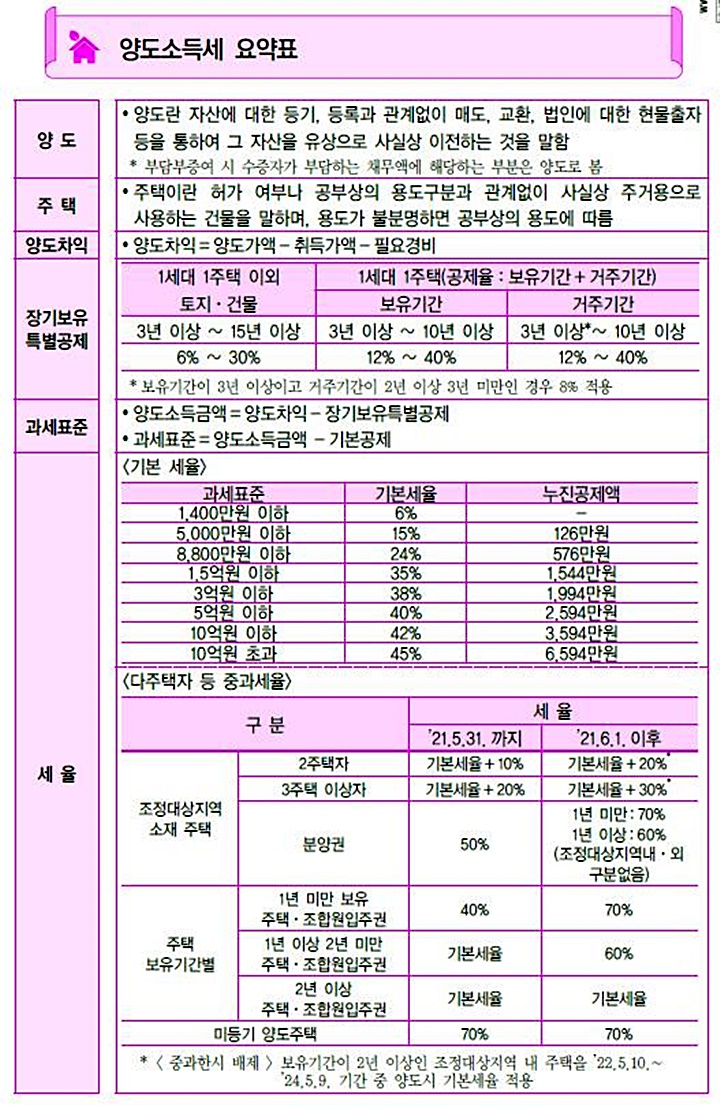
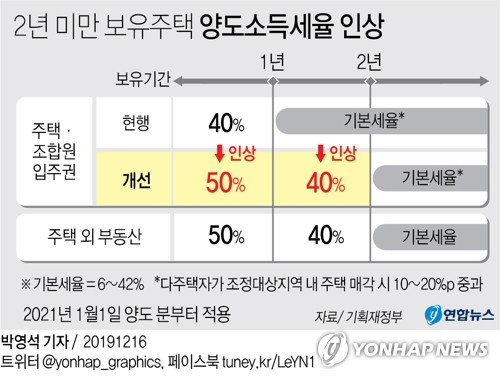
The Long-Term Holding Special Deduction is a key mechanism for reducing capital gains tax, offering greater relief the longer you hold real estate. For general real estate, the deduction begins after holding the property for at least three years, with a certain percentage of the capital gain deducted based on the holding period. Specifically, for one-home-per-household owners, the holding period and residency period can be combined for a maximum deduction of 80% (up to 40% for each). For example, a single-home owner who has lived in Seoul for a long time and maintained their property value may owe little to no tax thanks to this deduction. However, multi-home owners may be excluded from or restricted in this benefit, so the order of sales must be planned carefully. The holding period is calculated from the date of acquisition to the date of transfer, so do not let a one-day error in date calculation cost you. Capital gains tax rates follow a progressive structure, ranging from a minimum of 6% to a maximum of 45% depending on the taxable income bracket. If a multi-home owner sells a home in a regulated area, the surtax is added, making it difficult to avoid a heavy tax bill. This is why many multi-home owners rushed to make gifts before the grace period for the surtax expired. While gifting can help distribute ownership and reduce the home count at the time of future sales, the burden of acquisition tax must also be considered. Attempting to split assets through gifts or using illegal methods to reduce taxes can lead to tax audits and additional penalties from the National Tax Service. Therefore, you must accurately calculate your number of homes and expected capital gains to find the most advantageous tax bracket.
The Long-Term Holding Special Deduction can reduce capital gains by up to 80% based on holding and residency periods. Be cautious of surtax rates for multi-home owners.
4. Everything About Necessary Expenses and Capital Expenditures
The most practical way to reduce capital gains when calculating capital gains tax is to meticulously account for all eligible necessary expenses. Necessary expenses are broadly divided into capital expenditures and disposal costs, and construction costs that substantially increase the value of the real estate are almost always included. For example, the cost of completely replacing a boiler, expanding a veranda, or replacing window frames are all considered capital expenditures. On the other hand, revenue expenditures, such as simple wallpapering, flooring replacement, or minor leak repairs, are not recognized as necessary expenses, so it is important to distinguish between them. If you pay for construction in cash without obtaining a receipt, the tax office will not recognize it as an expense. You must strictly keep objective proof, such as bank transfer records, tax invoices, or credit card receipts. Brokerage fees paid to licensed real estate agents and legal fees are also naturally included in necessary expenses. Furthermore, inheritance or gift taxes paid when acquiring real estate through inheritance or gift can be deducted as necessary expenses upon future transfer. These expense items are often overlooked, but they are crucial factors that can determine a tax difference of tens of millions of won. If you plan to sell your home, it is wise to collect repair receipts from the past few years in a separate folder. The National Tax Service is also strengthening guidance to reduce cases of overpayment due to missed necessary expense declarations. If you realize you overpaid taxes, you can apply for a correction to get a refund, so it is worth reviewing your past filings.
Capital expenditures like boiler replacement or window frame work, as well as brokerage fees, are recognized as necessary expenses and can reduce capital gains.
5. Temporary Two-Home Status and the Rules for Disposal Deadlines
The Temporary Two-Home Exemption exists to provide relief for those who inevitably end up with two homes due to relocation or job changes. If you dispose of your existing home within a certain period after acquiring a new home while already owning one, you can receive the tax exemption. While disposal deadlines were shorter in the past, current policies allow you to sell your existing home within a specified period after acquiring the new one. If you miss this deadline by even a single day, the special exemption for temporary two-home status does not apply, and you may suddenly face the tax burden of being classified as a multi-home owner. In reality, many homeowners are stuck because buyer sentiment has frozen, and their homes are not selling at the desired time. Therefore, when planning a move, you should set a schedule with ample buffer, considering current market transaction volumes and turnover rates. To meet the requirements for the temporary two-home exemption, you must strictly evaluate regional regulations at the time of acquiring the new home and the time gap between acquiring the old and new homes. Depending on whether the area is a regulated area, the obligation to move into the new home and the disposal deadline vary, so it is safe to consult with a tax expert before signing a contract. Stories of people who proceeded with contracts lightly, believing they met the exemption criteria, only to receive a tax bomb notice and regret their actions, are endless. During periods of rising real estate prices, tax burdens can make people hesitate to move, but understanding the system allows for legal tax exemption. It is important to develop the habit of verifying in advance, through online inquiries or tax office consultations, whether your home strictly meets the temporary two-home criteria.
Temporary two-home owners must sell their existing home within the specified disposal deadline to fully receive the tax exemption benefit.
6. 2026 Real Estate Tax Outlook and Smart Response Strategies
The real estate market in the second half of this year is showing clear regional polarization due to tax reform and increased burdens from property holding and capital gains taxes. High-value areas like the Gangnam “Three Districts” are seeing properties come to market or prices weaken as owners struggle with tax burdens, while non-Gangnam areas may see concentrated demand. Government tax policies change frequently, so you should not treat tax law amendments as someone else’s business and always stay informed. If you plan to sell or buy a home, you must coldly review the currently applicable capital gains tax rates and exemption requirements before rushing into a transaction. You must avoid the frustrating situation of receiving a tax assessment notice from the National Tax Service due to miscalculation, along with unnecessary additional penalties. The more complex the tax issue, the more you need to prepare thoroughly based on objective facts and laws rather than relying on hearsay. Future real estate transactions are about more than just buying and selling; the era has arrived where asset growth depends on how legally you can reduce taxes. Even when gifting funds to children, blindly trusting unverified tax-saving methods like “split deposits” can lead to serious trouble. Even when gifting within legal limits, you must file the gift to ensure that the acquisition cost is clearly recognized when calculating capital gains tax on future real estate transfers. Tax is one of the most frightening costs because you can only reduce it as much as you know about it; if you don’t know, you lose your money. Starting today, begin organizing a notebook to check the acquisition cost, necessary expense receipts, and holding period of your real estate one by one. Thorough preparation and tax knowledge will serve as the most reliable shield to protect your valuable assets.
In the 2026 real estate market, thorough prior filing and proof management are essential, considering tax reform and tax burdens.
Frequently Asked Questions
=