
With the implementation of the Financial Investment Income Tax (FIIT) this year, the criteria for capital gains and dividend income from domestic and overseas stocks have become clearer. It is essential to fully understand these rules to avoid unfair taxation. While many investors simply assume that any profit is subject to tax, the system is actually complex and applies only to those with financial assets exceeding 500 million KRW, leading to widespread confusion. In this article, we will thoroughly examine the latest operational status of the system as of October 2026 and the tax criteria that general investors must know. We will also cover related effects, such as growth funds for the general public and pension asset withdrawals, which will be highly beneficial for those responsible for asset management. Let us unravel the practical benefits and precautions hidden behind the complex tax system, step by step, to learn how to protect our valuable assets. This content is not merely a list of information but provides insight-centric guidelines that can be immediately applied to actual investments.
=
A Complete Guide to Mastering the 2026 Financial Investment Income Tax and Tax-Saving Strategies

1. Understanding the Basic Structure and Taxable Scope of the Financial Investment Income Tax

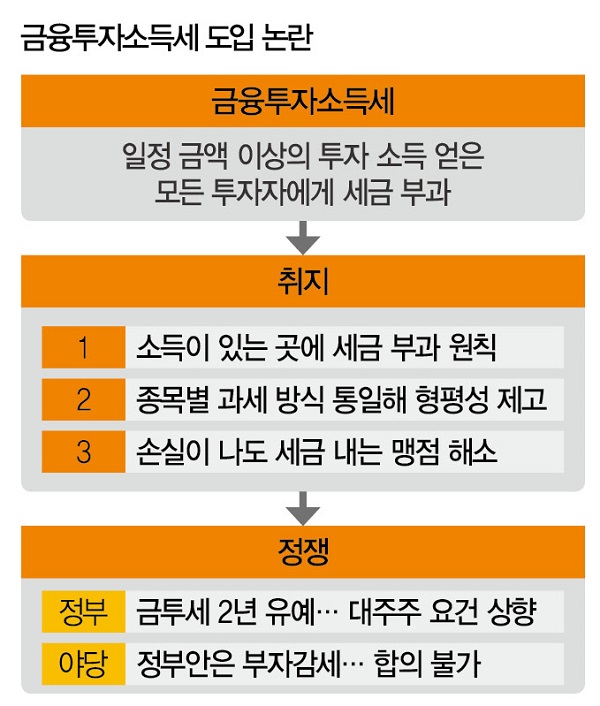
The Financial Investment Income Tax is a system that aggregates and taxes the capital gains from trading stocks and derivatives, as well as dividend income from bonds and index funds, for individual investors. This tax moves away from the previous system where only dividend income was separately taxed at 15.4%, adopting a method that applies progressive tax rates to the total financial investment income based on the amount. As of 2026, if financial income is 50 million KRW or less, a tax rate of 22% is applied, resulting in a total of 24.2% when local income tax is included. If financial income exceeds 50 million KRW but is 300 million KRW or less, the tax rate is 33%, becoming 36.39% including local tax. The most significant feature of this system is the full deduction of the basic exemption amount of 2.5 million KRW, meaning that small-scale investors or those who incurred losses in a given year effectively do not have to pay taxes. Therefore, it is crucial to carefully assess your financial asset size and expected rate of return from the beginning of the year. If you anticipate crossing this threshold, implementing active tax-saving measures is essential.
※
Understand the tax rate structure and the application principle of the basic exemption amount for the Financial Investment Income Tax to predict your tax liability in advance based on your asset size.
2. Annual Netting of Gains and Losses and Tax-Saving Points for Active Investors

The application of the annual netting system (netting of gains and losses) to the annual profit calculated based on the closing price on December 31st presents both a significant opportunity and a burden for investors. We must aggregate all financial investment gains and losses incurred within the same year. However, if a confirmed loss occurs, it can be carried forward for a maximum of five years for deduction in subsequent years. For example, even if you made a profit of 10 million KRW in the first half of the year, if you incur a loss of 12 million KRW in the second half, no income tax will be withheld for that year, and the remaining 2 million KRW loss will be carried over to the next year. To leverage this system, it is effective to regularly check the monthly profit and loss statements provided by your brokerage and, as the year-end approaches, strategically realize losses up to a conservative level of your choice. However, selling stocks implies accepting liquidity issues and additional market volatility risks, so caution is required. Ultimately, the standard approach is to minimize the tax burden through active portfolio rebalancing in response to market conditions that cannot be controlled at will.
※
Actively utilize the annual netting and confirmed loss carry-forward systems to learn how to defer or reduce the tax burden even in a net loss situation.
3. How to Utilize Deduction Benefits Linked with ISA and Pension Savings
Allocating assets to Individual Savings Accounts (ISA) or pension savings products offers a significant advantage in terms of tax burden compared to investing in general accounts in the long run. Dividends and capital gains generated within an ISA benefit account are tax-exempt up to a limit of 2 million KRW, and even the excess amount is subject to a low tax rate, allowing you to counter the risk of double taxation with the Financial Investment Income Tax. Furthermore, as mentioned in news reports, until the pension asset accumulation period transitions to the withdrawal period, the principal supplemented by tax credits and management returns are taxed only at a low pension income tax rate of 3.3% to 5.5%. Compared to the top tax rate of 33% for the Financial Investment Income Tax, this is a powerful tool to maximize the efficiency of long-term investments for retirement fund preparation. For the younger demographic, considering policy products like the National Growth Fund can also significantly enhance the total tax savings effect on income and local income taxes. Ultimately, it is advisable to diversify assets from neglected general accounts into appropriate vehicles to create a tax-optimized portfolio.
※
To mitigate the Financial Investment Income Tax, combine the tax-exempt limit of ISA with the low tax rates of pension savings to maximize tax credit benefits for long-term asset formation.
4. The Possibility of Reviving Dividend Stock Investment and High-Dividend Strategies
Since the implementation of the Financial Investment Income Tax, the taxation of dividend income has been strengthened, and it is important to recognize that the strategy of blindly buying high-dividend stocks as in the past is collapsing. However, recently, the financial sector has actively launched products such as monthly distribution index funds and specific products that apply separate taxation to certain distribution income. For example, as seen in cases like Hanwha Investment & Securities, there is a structure where dividend income generated over a certain period from the investment date is subject to separate taxation at a low rate, including local income tax. By utilizing this effectively, you can enjoy the benefit of being taxed at a separate low rate rather than under comprehensive financial income taxation, and it is not included in the comprehensive income tax base. Even when investing in such products, you must carefully verify the tax base criteria and actual tax structure for each product. Note that overseas indices and bond-type products have different structures, so caution is required. It is decisive to consider how the tax treatment method is reflected in your assets, rather than judging solely by the dividend yield.
※
Accurately verify the applicability of separate taxation for dividend income and the tax rate structure of each product to focus on low-tax dividend products excluded from the high-rate taxation of the Financial Investment Income Tax.
5. Overseas Stock Investment and Tax Treatment Based on Exchange Rate Fluctuations
If you are an overseas stock investor, you must deeply consider how much exchange rate fluctuations impact the imposition of the Financial Investment Income Tax. As of 2026, capital gains from overseas stocks are aggregated into financial investment income in the same way as domestic stocks, and the tax base applies the exchange rate at the time the profit is realized. If exchange rates fluctuate sharply, the KRW-based rate of return may differ significantly from expectations, easily leading to a change in the tax bracket. Therefore, a strategy is needed to mix in currency-hedged index funds or bond-type financial products to defend against a sudden increase in tax burden due to exchange rate risk. Additionally, just as in cases like Newstart where investors did not receive their principal due to investment fraud but were still charged interest income tax, you must always verify the tax statements notified by financial institutions against your own investment results. You should never comply with requests for additional deposits in the name of income tax from unknown individuals or websites, and it is safe to trust only official channels of the National Tax Service.
※
Defend against the impact of exchange rate risk on overseas assets on taxes through hedging strategies, and be wary of illegal impersonation sites while managing your financial records is essential.
6. Outlook for Financial Taxation After 2026 and Action Guidelines
With the full implementation of the Financial Investment Income Tax, it is expected that the expansion of tax benefits according to asset classes will accelerate. The government and the financial sector are highly likely to increase dedicated financial products such as the 2nd National Growth Fund and the Youth Future Savings to help the general public and the younger demographic form assets. These policy financial products provide government contributions and low-tax or tax-exempt benefits, so they should be considered for priority allocation before general stock investments. Investors should no longer focus on short-term gains but shift their judgment system to center on after-tax rates of return from a long-term perspective of managing assets for more than 20 years after retirement. As the year-end tax settlement season approaches, it should become an essential routine to check your financial income size and the possibility of loss carry-forward in advance. Right now, extract your profit and loss statements from your brokerage app and consider reallocating funds to a tax-saving portfolio with expert advice.
Re-evaluate after-tax returns from a long-term asset management perspective, actively utilize various low-tax financial products provided by the government, and protecting your identity from potential financial fraud is the top priority.
Frequently Asked Questions
=