
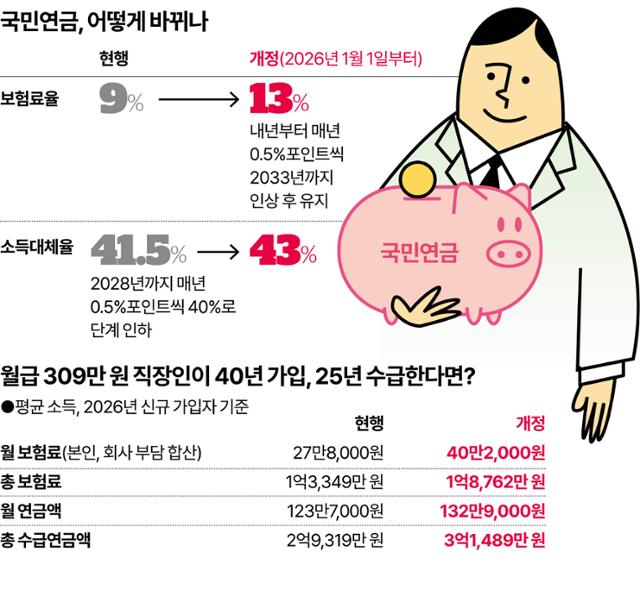
Starting in 2026, the National Pension premium rate will rise from the previous 9% to 9.5%, bringing significant changes to the monthly deductions. While only 9% of your salary was deducted until last year, the new 9.5% rate takes effect this year, undeniably increasing the financial burden for employees. In reality, for an employee earning 3.09 million won per month, the monthly amount they must bear increases slightly, leading many to sigh when keeping their household accounts. However, it is not simply a case of money going out like taxes; the income replacement rate, which determines the pension amount we will receive later, has also been adjusted accordingly. Today, we will clearly explain how these institutional reforms specifically affect your bank account and life after retirement. If you have felt that the monthly premiums are a waste, this article will help you accurately grasp the hidden significance of the system.
=
A Complete Guide to the 2026 National Pension Premium Rate Increase and Benefit Changes

1. The Background of the Premium Rate Increase from 9% to 9.5% and the Actual Burden

This year, the National Pension premium rate has officially risen from 9%, a rate maintained for a long period, to 9.5%. As this is the first time the rate has changed since 1998, it is causing considerable ripples throughout society. Since the amount withheld at source from monthly salaries has increased, it is true that household income feels reduced in the immediate term.
Specifically, calculating based on an employee with a monthly salary of 3.09 million won, a difference in the perceived deduction amount arises within the structure where the company and the individual share the burden equally. The total combined payment, which was previously around 278,000 won, has been adjusted slightly upward due to this increase. Even though the company covers half the cost, the fact that the fixed monthly outflow is increasing is a burden on households. The rate will continue to rise slightly each year over the next 8 years, ultimately reaching 13%, so preparation is necessary.
For the first time since 1998, the National Pension premium rate has been increased to 9.5%, raising the monthly payment burden for employees.
2. The Increase in Income Replacement Rate and Changes in Future Pension Benefits

In exchange for paying higher premiums, the amount of pension we will actually receive after retirement has also been adjusted upward. Previously, the guaranteed level was 41.5% of the lifetime average income, but this institutional reform has raised it to 43%. Since the ratio of money returned later relative to what was earned has increased, the nature of old-age security is somewhat strengthened from a long-term perspective. While the monthly outflow may feel like a loss in the short term, it serves as a sturdy pillar that protects a stable life after retirement by reflecting inflation rates.
In particular, the longer the National Pension enrollment period, the more fully one can enjoy the benefits of this income replacement rate, making consistent payments essential. This is also why more people are using voluntary enrollment or subsequent payment systems to complete their enrollment periods, even if they quit their jobs and their income stops. The sight of seniors nearing retirement looking into the Basic Pension because the National Pension alone is insufficient for their livelihood suggests much to us. Since the pensions diligently paid in youth become the most honest and reliable source of income in old age, we must endure the current rate increase process well.
Along with the premium rate increase, the income replacement rate has risen to 43%, further strengthening the long-term old-age security function.
3. The Reality for National Pension Enrollees with Less Than 10 Years and the Importance of the Basic Pension
People who worked hard but failed to complete 10 years of National Pension enrollment due to circumstances face significant difficulties after retirement. Statistics show that more than 1.3 million people cannot receive a pension at all because they did not complete 10 years of enrollment. They must receive a lump sum or find other solutions, and as a result, their minimum livelihood in old age is often threatened.
The image of children secretly worrying about how much their parents’ pension will be while giving them cash envelopes during holidays or anniversaries is a mirror of our own reality. Since many seniors find it difficult to maintain their livelihood with the National Pension alone, the government supplements the shortfall through the Basic Pension system. By carefully reviewing income and asset criteria and providing the Basic Pension to seniors who do not exceed certain standards, it provides a minimum safety net. Therefore, it is wise to accurately understand the pension you have paid and the supplementary systems supported by the state, and to plan your retirement in advance.
Since many enrollees have not completed 10 years of National Pension enrollment, the importance of supplementary measures like the Basic Pension after retirement is growing.
4. Increasing Pension Benefits Using Refund Repayment and Subsequent Payment Systems
Many people who previously received a refund lump sum due to unavoidable circumstances such as unemployment or business closure are now paying money again to restore their enrollment periods. While one might ask why they should pay again for money already spent, it is far more beneficial when considering the pension amount they will receive later. Paying the refund repayment revives enrollment periods that were previously not recognized, significantly increasing the amount received after retirement.
Similarly, the subsequent payment system, which allows those who could not pay premiums due to being a full-time housewife or military service to pay them all at once later, is also very popular. If you have spare funds, paying premiums retroactively for past exemption periods increases your enrollment period, which is advantageous. However, when utilizing these systems, you must carefully consider your financial situation and the remaining period during which you can pay before making a decision. Rather than blindly following others, you should find the most advantageous method for yourself through consultation with the National Pension Service.
Utilizing the refund repayment system or the subsequent payment system can significantly increase your pension benefits.
5. Reduction Criteria and Countermeasures When Working While Receiving a Pension
The number of seniors who continue economic activities to earn living expenses, even after reaching retirement age and starting to receive the National Pension, is gradually increasing. However, if you receive a salary from a job while simultaneously receiving the National Pension, your pension will be reduced if your income exceeds a certain level. You must accurately know the reduction criteria currently applied in 2026 to prevent the unpleasant situation of your pension being reduced later.
Even if you engage in income-generating activities, you can receive the full amount without any reduction if it is below a certain amount, so wisdom in adjusting your work type is necessary. If you do not keep this reduction system in mind when re-employing yourself or running a small business after retirement, you may be disappointed by a pension amount lower than expected. It is best to compare your expected income and pension amount through the National Pension Service website or counseling center and adjust the most efficient timing for receipt. To work and receive your pension in full, it is essential to be diligent in frequently checking for changes in relevant legal criteria.
You must be familiar with the reduction criteria applied when receiving the National Pension while working after retirement to avoid disadvantages.
6. Fund Management Transparency, Future Outlook, and Reader Action
The National Pension is not just a place to store individual retirement funds; it is a public fund that wields enormous influence in the massive capital market. Recently, in the financial market, a major topic is how thoroughly large pension funds like the National Pension establish their risk management systems when handling investment assets. Only by achieving stable returns based on a transparent and objective risk management system can the precious retirement funds of our citizens grow safely.
Continuous efforts are required to balance fairness and efficiency in issues such as relocation to local areas and the selection of various investment stocks. Various attempts to increase the value of the fund continue, such as faithfully performing the role of a shareholder while holding shares in major companies like the DB Group. Readers, please do not view the premiums deducted from your accounts every month as mere expenses, but as the most certain investment for your future self. You need to take action by checking your enrollment records right now and directly verifying which system you can use to fill any missing periods.
Transparent fund management and thorough risk management enhance trust in the National Pension, and enrollees themselves must actively check their records.
Frequently Asked Questions
=