
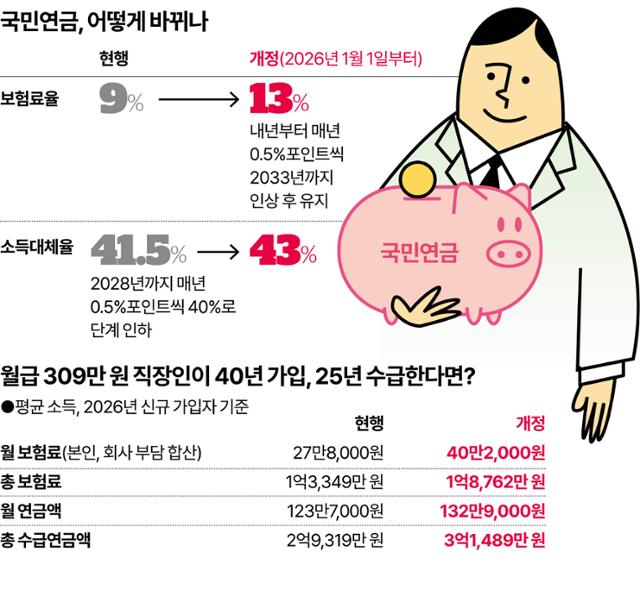
With the National Pension contribution rate increasing from the previous 9% to 9.5%, the practical financial burden on office workers who check their bank statements monthly has grown. As the contribution rate, which had been frozen for a long period since 1998, is adjusted, direct changes have occurred in the structure where employees and employers share the cost equally. If you are an office worker earning 3 million KRW per month, it is essential to accurately calculate how much the amount deducted monthly will increase. In this article, we will carefully examine the revised contribution rate, changes in the income replacement rate, and the benefits of delaying the pension receipt age. We will organize various criteria that can provide practical help to those preparing for life after retirement. We will explain these concepts in an easy-to-understand manner based on specific cases commonly encountered in the community.
=
Raising the National Pension Contribution Rate and Retirement Age: Changes for Office Workers Earning 3 Million KRW Monthly

1. The Magnitude of the National Pension Contribution Increase Felt by Office Workers Earning 3 Million KRW Monthly

Since January this year, the most noticeable change on office workers’ pay stubs has undoubtedly been the National Pension deduction amount. As the contribution rate, which had been stuck at 9% for a long time, rose to 9.5%, a subtle but clear difference has emerged in the monthly payment amount. For example, an office worker earning 3 million KRW per month previously paid 135,000 KRW as their personal share, but now pays 142,500 KRW. Since the employer and employee split the cost in half, the additional amount felt by the individual is in the range of a few thousand KRW per month, but it accumulates to a significant amount over the course of a year. This increase in the contribution rate is not a one-time event but is scheduled to be adjusted gradually over the next several years, so it is important to monitor the changes in the payment amount annually. For contributors who have diligently paid premiums every month, this serves as an opportunity to carefully calculate how much their future pension amount will increase. As the amount deducted from pay stubs increases monthly, voices are emerging among office workers that household budgets need to be restructured. With prices continuing to rise and social insurance burdens increasing, housewives who manage fixed monthly expenses are sighing more deeply. However, it is necessary to recognize that this money is an asset that will return in old age, which is different from a simple tax. When office workers gather at lunch to discuss the pension reform plan, realistic concerns pour out about whether they will have to work longer in the future. Calls to the company’s HR department inquiring why the insurance deduction amount has changed have continued, reaching a peak in public interest in the National Pension.
With the contribution rate rising to 9.5%, the personal burden for a salary of 3 million KRW has increased by approximately 7,500 KRW per month.
2. The Correlation Between the Upward Adjustment of the Income Replacement Rate and Post-Retirement Benefits

The biggest reason for paying higher premiums is that the income replacement rate, which represents the real value of the pension received after retirement, has also been raised. There have been continuous criticisms that the existing income replacement rate was too low to fill the income gap after retirement, and through social consensus, it has been adjusted to around 43%. It is designed so that contributors who have diligently paid premiums throughout their lives can expect a more substantial monthly pension amount at retirement compared to the past. Of course, the premiums going out every month may feel like a waste right now, but a stable cash flow coming in every month in a situation where income stops after retirement becomes the strongest support above all else. The quality of life after retirement differs greatly between those who have diligently contributed to the National Pension and those who have not, making this change in figures very important. Looking around, it is easy to find elderly people who are on the verge of retirement and complain that it is difficult to cover living expenses with the National Pension alone. Statistics showing that more than 1.3 million people receive a lump-sum refund or must rely entirely on the Basic Pension because they have not met the 10-year National Pension contribution period starkly reveal our reality. The reason why consistently increasing the contribution period and diligently paying premiums while employed becomes the most reliable financial management strategy later on lies here. An increase in the income replacement rate ultimately means that the sweat shed during one’s active working years returns as a greater reward in old age. Therefore, rather than being absorbed only in the immediate increase in expenditure, a strategy should be formulated to expand the overall scale of pension assets from a long-term perspective.
With the income replacement rate raised to 43%, contributors who have diligently paid during their contribution period will receive a higher pension after retirement.
3. Analysis of the Pros and Cons of Delaying the National Pension Receipt Age by 5 Years
As the retirement point approaches, the number of office workers seriously considering when to start receiving their pension increases rapidly. The calculations become complex regarding whether it is advantageous to receive the pension immediately upon reaching the designated age or to delay the receipt age by up to 5 years to significantly increase the monthly benefit. According to guidance from the National Pension Service, delaying pension receipt by 5 years results in a certain percentage being added to the amount each year, allowing one to receive up to 36% more pension for life. A person who could receive 1 million KRW per month can make over 1.3 million KRW deposited into their account monthly by delaying receipt, creating a significant difference in post-retirement cash flow. Retirees who are short on living expenses would naturally choose to receive it immediately, but those with other income sources may seriously consider delaying receipt. Mr. Oh, who works in Seoul and is preparing for mandatory retirement, recently had a long conversation with his wife about the timing of pension receipt. While he thought it would be better to receive it now to travel and enjoy leisure, he concluded that delaying it would be beneficial when considering long-term medical costs and fixed expenses after age 80. There are also many stories among friends about some applying for early receipt to give allowance to their grandchildren, while others are enduring the delay to build up their surplus funds. Since the correct answer varies completely depending on individual health status, financial comfort, and expected lifespan, one cannot blindly follow what others are doing. Wisdom is needed to find the optimal timing that best suits oneself by utilizing the various simulation services provided by the National Pension Service or seeking expert advice.
Delaying the pension receipt age by 5 years allows one to receive an amount increased by up to 36% for life, which is advantageous for long-term survival.
4. The Reality for Contributors with Less Than 10 Years of Service and the Role of the Basic Pension
There are surprisingly many people who do not receive a single won of pension when their retirement time arrives because their National Pension contribution period is less than 10 years. Those who were unable to pay premiums consistently due to business failures or unemployment in their youth face significant financial difficulties in old age. For the more than 1.3 million people who fall outside the scope of the National Pension, the Basic Pension paid by the state serves as the last reliable support. The Basic Pension, which is paid to elderly people who meet certain criteria after a thorough review of income and assets, is like a lifeline that protects the minimum standard of living in old age. Therefore, rather than being discouraged by an insufficient National Pension contribution period, it is important to check the eligibility criteria for the Basic Pension system in advance and ensure one qualifies. If you visit a local senior center, you can easily see elderly people boasting about their monthly National Pension receipt amount and exchanging information about whether they have been selected as Basic Pension recipients. Grandfather Park, who worked as a non-regular employee in his youth and was unable to pay proper pension premiums, sighs with relief, saying he would have been in a desperate situation without the Basic Pension from the government. To live while maintaining a minimum dignity without having to ask children for help, one must accurately understand the nature of such state subsidy systems. The National Pension Service and local government welfare departments are strengthening inspections to ensure that benefits reach those who truly need them by carefully checking annual changes in income and assets. Even if one has not been able to build a sufficient pension through their own efforts, various supplementary measures exist to fill the gaps in the system, so one should not be disappointed and should actively seek them out.
For contributors who have not completed 10 years of National Pension, the Basic Pension plays a crucial role as a support for old age.
5. How to Utilize the System of Repaying Refunded Amounts and the Reduction System for Re-employment
If you have previously received a National Pension lump-sum refund due to financial difficulties, you can utilize the system of repaying it when you have some financial leeway later. Many people ask why they should pay back money they have already used, but repaying the refund fully restores the past contribution period, significantly increasing the final pension amount. Since it fills the past gap period, it is considered a hidden, high-value financial management tool for contributors who want to maximize their post-retirement receipt amount. Additionally, many office workers worry that their National Pension receipt amount will be reduced if they find a job and receive a salary after retirement. While part of the pension amount may be reduced if income exceeds a certain level, the criteria are applied differently depending on the scope of labor income and age, so careful verification is essential. Mr. Kim, who was re-employed as a security guard after retirement, was greatly surprised when he received a notice of pension reduction while receiving both his monthly salary and National Pension. It initially felt unfair that his pension was reduced due to income earned through hard work, but after carefully examining the relevant laws and reduction criteria, he was able to accept it. The current system is designed to adjust part of the pension for income exceeding certain standards to maintain fairness between high-income retirees and general workers. Therefore, retirees planning to re-employ themselves should carefully calculate the intersection of expected income and pension receipt amount to minimize losses due to taxes or reductions. You can estimate whether a reduction will occur by inputting your expected income through the National Pension Service website or customer center, so it is good to utilize this actively.
Repaying a previously received refund restores the contribution period, and one must check the pension reduction criteria based on income in case of re-employment.
6. Fund Management Soundness and Future Strategies for Preparing for Old Age
As the National Pension is a massive organization managing enormous funds, the importance of a system that manages investment asset risks and makes objective decisions is growing daily. With recent financial market volatility intensifying, voices are emerging from all sides demanding that the National Pension Fund Management Headquarters increase its investment return rate and thoroughly control risk factors. To guarantee the sustainability of the system, it must safely protect the precious old-age funds of the people while achieving stable returns that exceed the inflation rate. Solving the problem of the outflow of excellent personnel from the Fund Management Headquarters, which relocated to Jeonju, and maintaining expertise is also one of the core tasks that will determine the future of the pension. Contributors should monitor these macro-level changes while simultaneously setting up thorough personal old-age asset management plans. Even now, Korean office workers are diligently paying National Pension premiums every month, steadily preparing for a distant future retirement. Even if the contribution rate rises and the system changes slightly, the essential goal of securing a reliable pension asset to support one’s life never changes. An active attitude is needed to frequently check one’s contribution period, verify the expected receipt amount, and adjust the receipt timing or utilize refunds if necessary. Only by relying on the national system while simultaneously pursuing personal savings and retirement planning can one truly welcome a prosperous old age. We recommend that you carefully examine your National Pension payment records starting today and draw a concrete blueprint for the upcoming retirement point.
A successful retirement can only be achieved by combining thorough fund risk management with the individual contributor’s proactive old-age planning.
Frequently Asked Questions
=