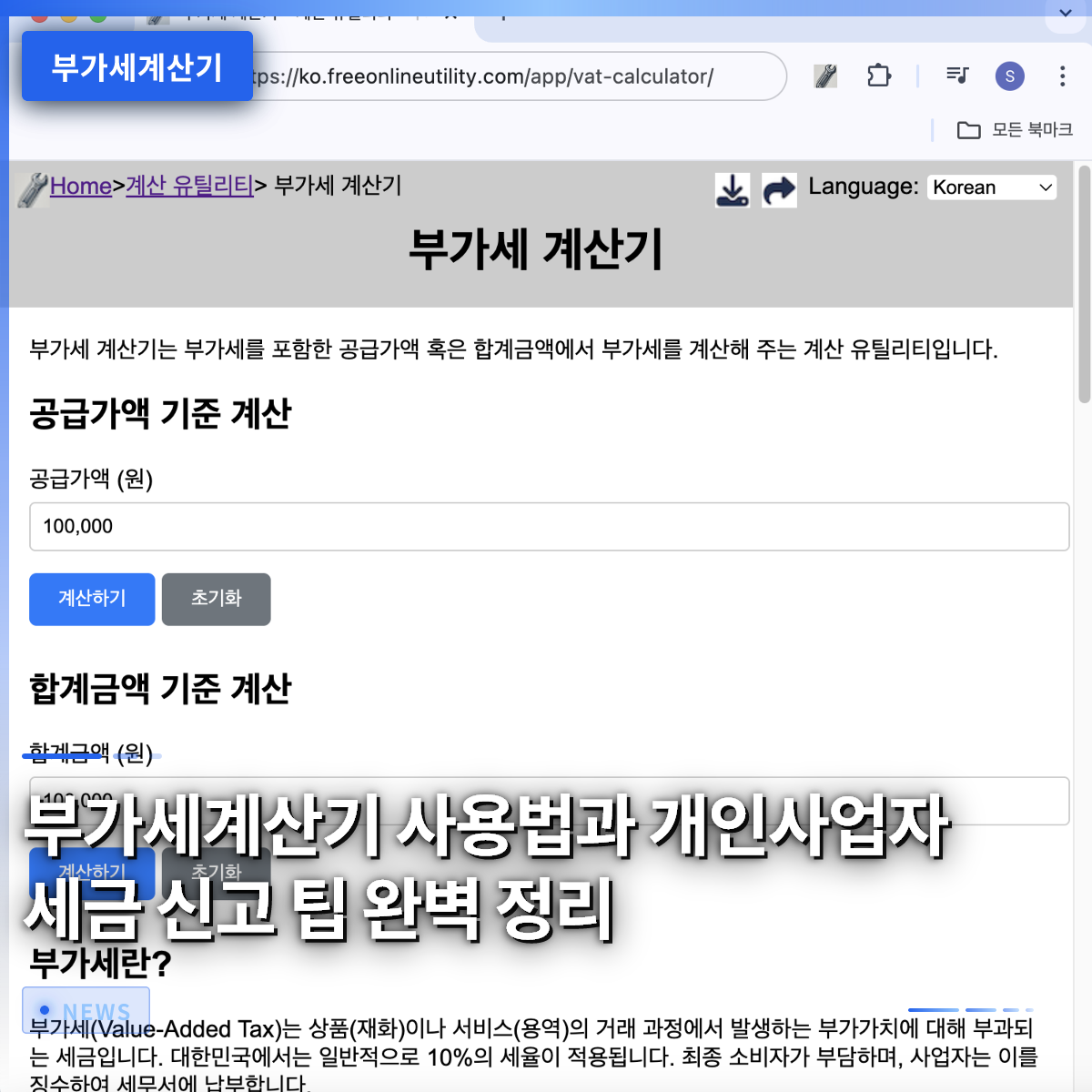
If you use a VAT calculator without accurately understanding the principles of tax calculation, you may face significant difficulties during the actual filing process. Value-Added Tax (VAT) applied to the purchase and sale of goods requires a nuanced understanding that goes beyond simply multiplying the amount by one-tenth. Recently, banks have introduced various VAT filing support and calculation tools to reduce the tax burden on small business owners and sole proprietors. For example, financial institutions like Kookmin Bank and Kakao Bank are strengthening their features for simple tax inquiries and loan limit calculations for business owners. Therefore, this article will detail the correct way to use the VAT calculator and the calculation structures for different tax types that business owners must know. After reading this, even novice business owners will be able to overcome the daunting nature of tax calculations and prepare for filing wisely.
=
A Complete Guide to Using the VAT Calculator and Tax Filing Tips for Sole Proprietors
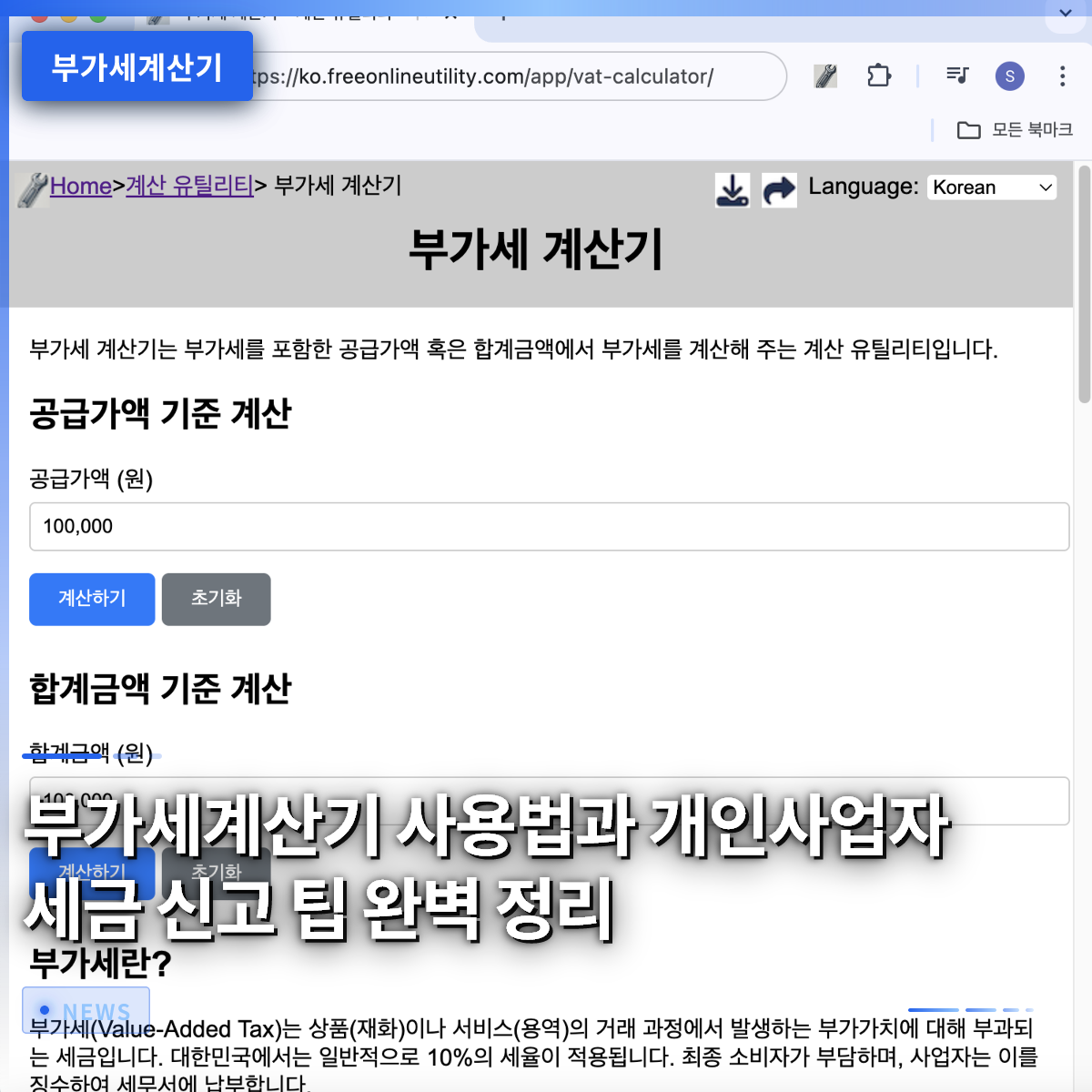
1. Understanding the Basic Principles of the VAT Calculator and Taxable Amounts
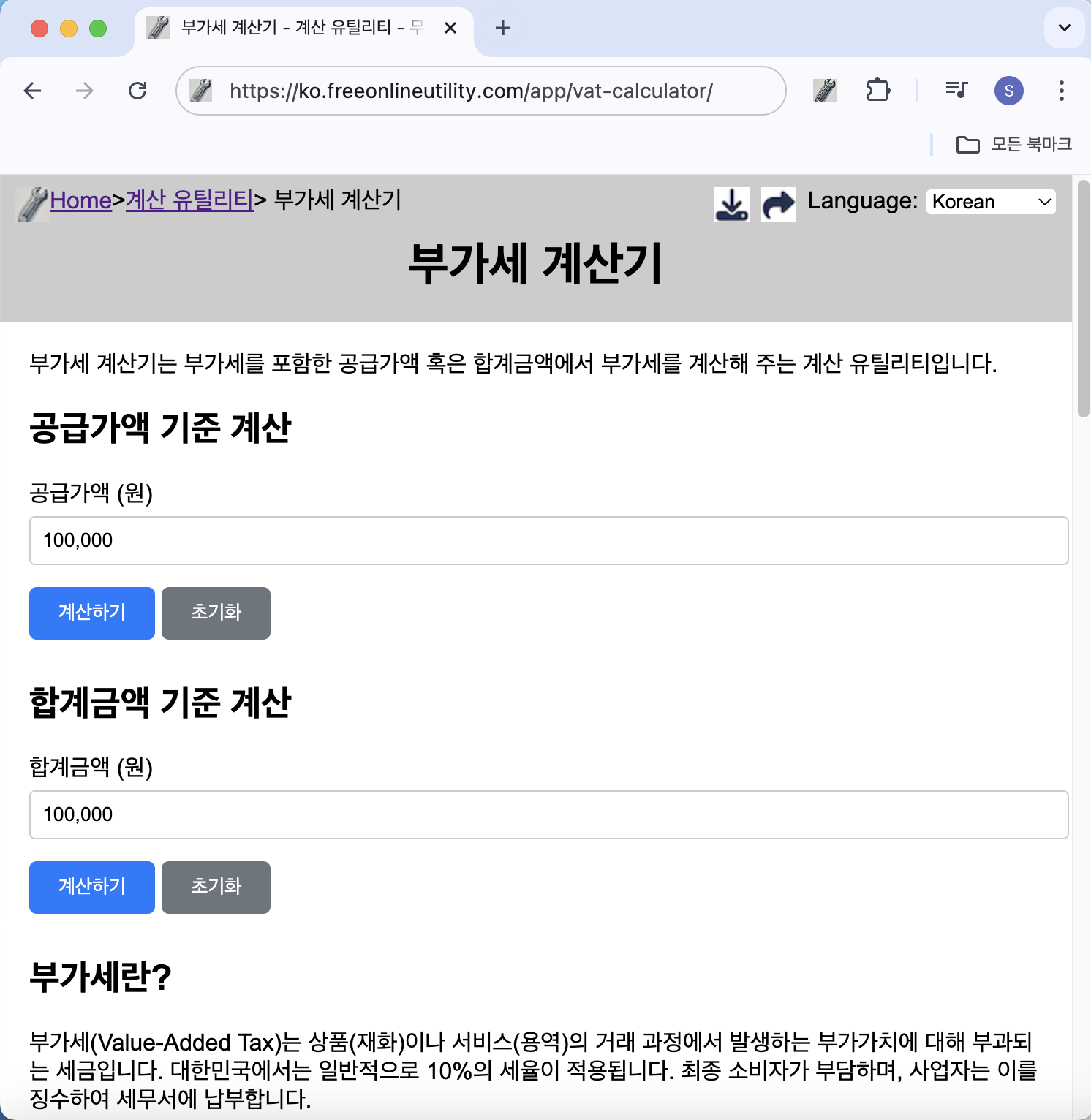
The first concept to understand when using a VAT calculator is how to separate the taxable amount from the VAT. The final payment amount we commonly encounter includes both the pure price of the item (the taxable amount) and the tax on it (VAT). If a cup of coffee costs 4,500 KRW, it already includes tax, so simply multiplying by one-tenth will result in an incorrect amount. To find the exact taxable amount, you must divide the total by 1.1; the remaining amount is the tax. Without understanding this principle, it is easy to mistakenly believe that the money coming into your pocket includes the tax that will eventually be paid, leading to errors when calculating your profit margin. Therefore, when preparing quotes for clients or settling payments for goods, you must always develop the habit of clearly separating the taxable amount and the tax. Before using a calculator, you must first confirm whether the total amount is tax-inclusive or tax-exclusive. Many small business owners mistakenly calculate their profit margins by assuming material costs are tax-exclusive. This is because the VAT included in materials purchased via tax invoices or credit cards can be refunded or deducted when filing taxes. Therefore, when using a VAT calculator, you should not limit yourself to one-off calculations but cultivate the ability to link calculations with expenditure receipts. These small differences accumulate to significantly influence the scale of taxes paid over a year. Going forward, it is best to always keep the formula for calculating the taxable amount (dividing by 1.1) in mind when you turn on your calculator.
When using a VAT calculator, you must divide the total amount by 1.1 to accurately separate the taxable amount and the tax.
2. Differences in Calculation Methods Between General and Simplified Taxpayers

The reason the result from a VAT calculator may not match the actual tax payable is due to the business owner’s tax type. For general taxpayers, the calculation is done by subtracting the input VAT paid on business expenses from the output VAT on sales. In other words, the final tax payable is the output VAT minus the input VAT, so how well you collect input receipts directly leads to tax savings. On the other hand, simplified taxpayers, whose annual sales fall below a certain threshold, calculate tax by applying a VAT rate specific to their industry, resulting in a fundamentally different structure. Simplified taxpayers differ from general taxpayers in that they cannot receive a full refund even if their input VAT exceeds their output VAT, due to different applicable laws. Therefore, you must first confirm your tax type on your business registration certificate and then apply the corresponding calculation method. Considering a restaurant owner, a common sight, helps easily understand the importance of tax types. A general taxpayer restaurant owner must carefully collect input VAT from tax invoices for vegetables and meat to significantly reduce their tax burden. Conversely, a simplified taxpayer must separately master the input receipt deduction limits and the VAT rate calculation method for their industry to avoid tax disadvantages. For this reason, simple VAT calculators available in the market are for reference only, and the final filing amount requires review by Hometax or a tax professional. Ignoring your tax type and blindly trusting the calculator’s numbers carries the risk of facing unexpected penalty taxes. Accurately determining which category your business falls under is the first step in all tax management.
General taxpayers subtract input VAT from output VAT, while simplified taxpayers apply industry-specific VAT rates, resulting in different calculation methods.
3. Bank Tax Support Services and How to Use Calculators

Recently, commercial banks, including Kookmin Bank, are competitively launching comprehensive tax support services for sole proprietors. In the past, during tax filing periods, people would struggle with the complex Hometax interface or have to pay high fees to tax accountants. However, an era has arrived where you can log into a bank app to check estimated VAT and handle self-filing in a one-stop manner. Places like Kakao Bank are also offering dedicated calculators to easily check business loan limits and interest rates, helping small business owners with their convenience. The development of these financial platforms drastically reduces the time and costs for self-employed individuals who must manage tax affairs amidst busy business operations. Therefore, it is wise to regularly check the business-specific menus of your primary bank and actively utilize related features. Specifically, using Kookmin Bank’s tax support service allows you to automatically load sales and purchase records to estimate your VAT in advance. Even novice entrepreneurs with limited tax knowledge can complete a draft filing by following the on-screen instructions with just a few touches. Events offering various coupons to commemorate service launches are also frequent, allowing you to enjoy practical benefits. However, since bank calculation services are auxiliary tools to assist with National Tax Service filings, you must carefully check for any omitted sales or receipts before final submission. Properly linking bank apps with the Hometax system can free you from the fear of the annual VAT filing period. The ability to utilize the advanced technology of financial institutions like a secretary for your business is the competitiveness of a modern business owner.
Utilizing commercial banks’ VAT inquiry and self-filing support services can significantly reduce your tax burden.
4. VAT Calculation for Overseas Direct Purchases and Special Transactions
Not only for domestic transactions, but also when using overseas direct purchasing, the principles of the VAT calculator apply directly, so it must be examined carefully. When purchasing goods directly from places like the US or Europe, if the amount exceeds 150 USD, both customs duties and VAT are imposed. In this case, the basis for taxation is the item price plus international shipping costs, so considering only the item price is problematic. This is why items that seemed cheap in the cart on global shopping malls end up costing more than domestic prices once taxes are added. It is frequent for people to proceed with purchases without using an overseas direct purchase customs calculator in advance and experience unexpected customs holds. Therefore, it is essential to develop the habit of carefully calculating in advance whether taxes will apply, considering exchange rate fluctuations and tax-free limits. The same tax calculation method applies when doing side jobs like buying small quantities of goods to resell or purchasing on behalf of acquaintances. When importing goods for sales purposes rather than personal use, tax-free limits are strictly applied, making it easy to face a tax bomb. If you use an overseas direct purchase calculator to estimate the tax amount in advance, you can accurately calculate your remaining margin. You should learn from the mistakes of novice self-employed individuals who set margins without considering taxes and end up taking a loss. The more transactions cross borders, the more wisdom is needed to clearly understand the criteria for VAT and customs duties and to use calculators. Transparent and accurate calculation is the shortcut to preventing tax disputes and conducting safe business.
For overseas direct purchases, you must use a calculator to check in advance whether the total amount including shipping exceeds the tax-free threshold.
5. Tips for Creating Quotes and Using Excel Auto-Calculators
When running a business, you often have to send quotes to clients, and manually using a calculator frequently leads to mistakes. Calculating the taxable amount, VAT, and total amount one by one can result in discrepancies of 10 won, potentially losing the trust of clients. To prevent this, many business owners use Excel quote templates that automatically calculate taxes when only the quantity and unit price are entered. If you pre-set formulas in an Excel file, you can instantly calculate the exact taxable amount and VAT without complex mental arithmetic. Using this template allows you to neatly organize essential items like quote numbers and issue dates without omission, maximizing work efficiency. Since the basics of business are accuracy and speed, it is important to fully integrate digital tools into your work. In fact, showing a client that you can instantly calculate amounts using an Excel calculator on a smartphone or laptop during a meeting to adjust delivery prices builds trust. It leaves a more professional impression than calculating by hand and can give you an advantage in price negotiations. You can also respond immediately when providing service items to regular customers or negotiating whether VAT is included. There are numerous free quote templates shared online, so you can download and modify one that fits your business style. Creating one proper template for frequently used forms can significantly reduce the fatigue of repetitive paperwork. Be sure to master the use of Excel calculators, which improve not only the accuracy of tax calculations but also work efficiency.
Using Excel auto-calculation quote templates eliminates 10-won discrepancies and improves work efficiency.
6. Mindset and Outlook for Successful Tax Management
The VAT calculator is more than just a tool for crunching numbers; it is like a mirror reflecting the health of your business. Rather than just trying to avoid taxes, the process of calculating transparently and filing accurately ultimately becomes the foundation for long-term business prosperity. In the future, financial institutions’ tax support services and mobile calculation tools are expected to become more advanced, further reducing the burden on business owners. It is most important to establish your own tax management routine in line with changing tax laws and the trends of various digital platforms. Instead of feeling stressed when the tax filing period arrives, try to develop the habit of steadily collecting receipts and using calculators in your daily life. The diligent tax filing of business owners will create a better business environment and drive robust business growth. I hope you will check your business’s tax type right now and start smart tax management. Only self-employed individuals who do not settle for the status quo and expand their tax knowledge can survive for a long time in the rapidly changing economic situation. More important than saving on small taxes is establishing a system to legally save taxes without paying unnecessary penalty taxes. You should take an active stance in accepting and learning about the more convenient financial calculation tools that will be released in the future. Sharing useful tax information and calculator tips with fellow business owners is also a good way to expand your business network. Based on the VAT calculation principles and bank service usage methods learned today, I hope you can face the upcoming filing period with ease. I sincerely support the bright future of all business owners who build their businesses diligently and wisely.
Developing the habit of calculating VAT regularly and utilizing the latest tax support services can completely eliminate tax stress.
Frequently Asked Questions
=