Capital gains tax is levied on the profit generated from the sale of real estate, so without thorough preparation, you could face a tax bill far larger than you imagined. In today’s volatile real estate market, it is common to hear stories of people who were shocked by unexpectedly high tax bills after selling their homes. In fact, a significant portion of objections to tax assessments filed with the National Tax Service relates to this complex and intricate tax. Today, we will examine in detail the calculation methods, tax exemption requirements, and practical tax-saving tips that are easy to overlook in daily life. There is no need to be intimidated by a lack of tax knowledge; if you follow the content step by step, anyone can save money wisely. We will now clearly unravel the complex world of real estate taxes, so please stay with us until the end.
=
Capital Gains Tax Savings Guide: A Complete Overview from Calculation Methods to Tax Exemptions
1. Basic Concepts and Taxable Scope of Capital Gains Tax
Capital gains tax is a tax imposed on income generated from transferring real estate, such as land or buildings, or rights, such as subscription rights, to another person. It is not levied on the total value of the property; rather, the tax is calculated based on the capital gain, which is the difference between the purchase price and the selling price. Many people mistakenly believe that the process ends once the title is transferred, but the tax burden varies significantly depending on the magnitude of the profit generated. In particular, residential officetels and subscription rights may be counted toward the number of houses owned depending on the situation, so it is crucial to accurately assess your overall asset status. If you are actually using the property for residential purposes, you may face disadvantages in tax calculations when applying for apartment subscriptions or selling the property, so caution is required. Understanding the fundamental framework of the tax is the first step in any tax-saving strategy. Carefully determining whether your real estate falls under the taxable scope is a basic element of asset management. Occasionally, people feel reassured because they believe they meet the tax exemption criteria and neglect to file their tax returns, which can result in substantial additional penalties later. Even for tax-exempt housing, it is advantageous to transparently report transaction details to prove the source of funds in the future. In financial or real estate transactions between parents and children, failing to strictly adhere to tax law standards can easily lead to a “tax bomb” of gift tax or capital gains tax. Therefore, from the moment you decide to make a transaction, you need to prepare documents and evidence step by step, based on relevant regulations and advice from tax professionals. As the saying goes, “You can only reduce taxes as much as you know,” so building a solid foundation of basic concepts is the safest approach.
Capital gains tax is levied based on capital gains, so accurately identifying the taxable scope and the number of houses owned is the starting point for tax savings.
2. Calculating Capital Gains and All About Necessary Expenses
The core of calculating capital gains tax lies in accurately determining the capital gain by deducting the acquisition cost and necessary expenses from the transfer amount. The transfer amount is the actual price at which the real estate was sold, while the acquisition cost refers to the price paid when the real estate was originally purchased. How meticulously you account for necessary expenses, such as capital expenditures and fees, can significantly reduce the final tax bill. For example, if you incurred interior costs while renovating your home, capital expenditures such as replacing heating systems or expansion work are recognized as necessary expenses. On the other hand, revenue expenditures, such as simple wallpapering or replacing floor coverings, are not recognized as expenses, so careful distinction is required when collecting receipts. This habit of compiling detailed cost evidence can work magic later, saving you hundreds of thousands or even millions of won in taxes. In reality, many taxpayers naively think that having just the sales contract is enough, only to miss significant expense items. You must keep receipts and bank transfer records for not only legal counsel fees and brokerage commissions but also improvement costs like installing system air conditioners. If you omit these necessary expenses when filing with the tax office, your capital gain will be inflated, resulting in an unfair situation where you pay more tax. According to National Tax Service statistics, calculation errors or omitted expenses account for a considerable proportion of tax assessment errors and objection cases. Therefore, all receipts and expenditure evidence generated throughout the process of acquiring, holding, and disposing of real estate should be safely stored in a separate file. Never forget that a single piece of paper can serve as a sturdy shield defending against a massive tax bill in the future.
To reduce capital gains, you must provide evidence for necessary expenses, such as interior costs and legal counsel fees, in addition to the acquisition cost.
3. One-Household-One-Home Tax Exemption Requirements and Practical Application
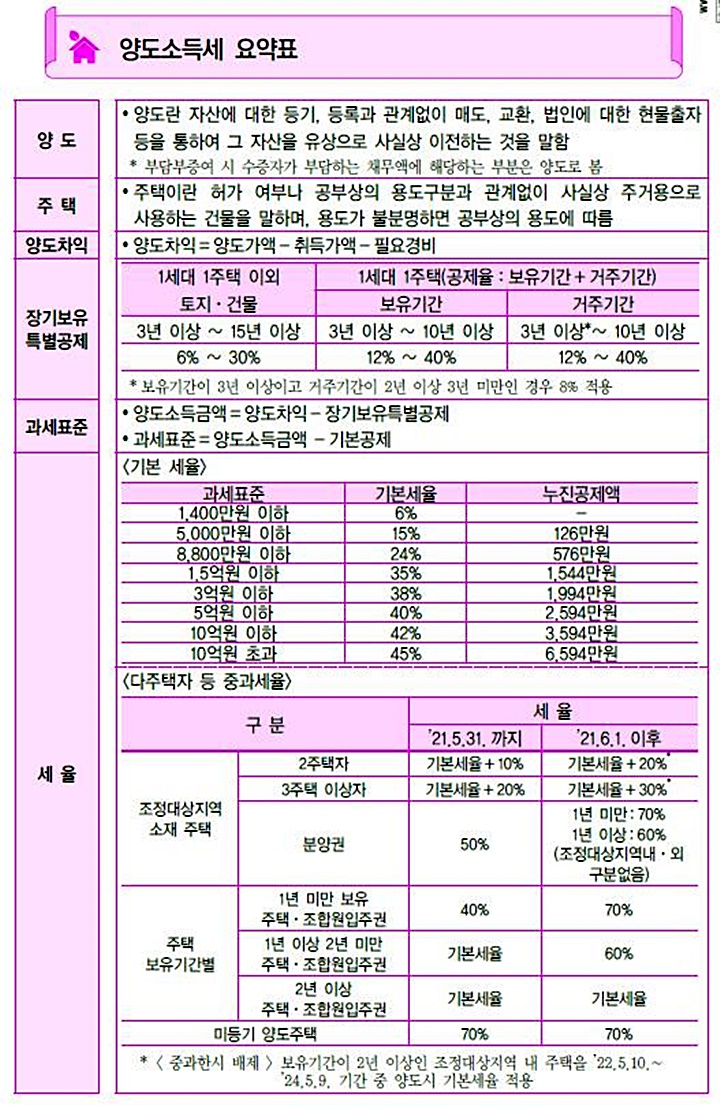
The one-household-one-home tax exemption benefit, granted to those who own a single house domestically and have resided in it for a certain period, is the ultimate tax-saving tool. Under current standards, no capital gains tax is levied on transfer amounts up to 1.2 billion won, which is why many people strive to meet this condition. However, simply owning one house does not guarantee tax exemption; residency requirements are added depending on whether the property is located in a designated area. Unlike in the past, in designated areas, you must actually reside in the property for at least two years to receive the tax exemption benefit, making actual residency crucial. If you had a tenant and could not actually reside in the property, you must consider various complex variables to meet the exemption requirements. If you have unavoidable circumstances such as moving or a job transfer, it is safe to consult with a tax professional to see if you can apply for exception regulations. For high-value homes exceeding the 1.2 billion won exemption threshold, tax is levied only on the portion exceeding 1.2 billion won, not on the entire amount. For example, if you sell a house for 1.6 billion won, you only need to pay tax on the 400 million won profit exceeding 1.2 billion won, according to the applicable rate. If you have lived in the house for a long time, you can apply the Long-Term Holding Special Deduction to significantly reduce your tax burden. For single-home owners, the deduction rate can be up to 80% depending on the residency and holding periods, resulting in a tremendous tax reduction effect. To fully enjoy these benefits, you must accurately calculate the holding and residency periods down to the day to avoid errors. Rather than relying on hearsay, you need the wisdom to carefully examine the latest tax law amendments and apply them to your specific situation.
The one-household-one-home tax exemption applies to homes valued at 1.2 billion won or less, and homes in designated areas must strictly meet the two-year residency requirement.
4. How Temporary Two-Home Owners and Multi-Home Owners Can Avoid Surcharge Taxes
There is a temporary two-home tax exemption special provision designed to protect people who temporarily own two homes due to reasons such as moving, inheritance, or marriage. Even if you acquire a new home while owning an existing one, you can maintain the tax exemption benefit if you dispose of the existing home within a specified period. This deadline can vary depending on the location of the homes and market conditions, so you must verify the exact disposal deadline before signing a contract for a new home. If you miss this disposal deadline by even a single day, you will lose the tax exemption benefit and may be subject to heavy multi-home owner taxes. On the other hand, if multi-home owners miss the grace period for the capital gains tax surcharge or the trends in related tax system reforms, they face a massive tax bomb. In major popular areas like Gangnam or Seocho, the burden of holding taxes and capital gains taxes has increased due to tax system reforms, leading to a surge in property listings and gifts. Cases of multi-home owners being caught attempting to split assets or make gifts between parents and children to avoid the tax bomb are increasing. If you blindly follow unverified tax-saving methods circulating on YouTube or the internet, you are likely to face a tax audit by the National Tax Service and be subject to additional penalties. To legally transfer funds to your children and clearly determine the acquisition cost of real estate, you must adhere to the gift tax deduction limits allowed by tax law. Even if you exchange funds within the deduction limit, you must complete the tax filing to ensure it is recognized as a legitimate source of funds for your children in the future. You must be careful not to make the foolish mistake of violating the law in an attempt to reduce taxes, resulting in greater financial loss. Building a step-by-step tax-saving plan with a professional within the legal framework is the shortcut to wise asset defense.
Temporary two-home owners must dispose of their existing home within the specified deadline, and excessive asset-splitting gifts become targets for tax audits.
5. Capital Gains Tax Savings Strategies Through Inheritance and Gifts
The impact on capital gains tax is significant not only when disposing of real estate but also when choosing inheritance or gifts during the holding period. In times when real estate prices are expected to continue rising, gifting property to children in advance can be a way to reduce future capital gains tax. This is because the acquisition cost recognized at the time of the gift is higher, which reduces the capital gain itself when the children later sell the property. In fact, the number of gift cases in the Seoul area surged by more than three times compared to the previous year ahead of the end of the multi-home owner surcharge grace period or tax system reforms. This can be seen as a quick move by homeowners to disperse tax burdens in advance and lower the total tax amount from a long-term perspective. However, a simulation comparing the total of incidental taxes such as gift tax and acquisition tax with the future capital gains tax is essential. In the case of inheritance, the acquisition cost is determined based on the market value at the time of the decedent’s death, giving it a different tax-saving structure than gifts. The evaluation of inherited property is complex according to tax regulations, so you must thoroughly check the market value before and after the start of inheritance. Occasionally, people delay the transfer of ownership or leave it in a complex form of shared ownership to reduce taxes, which can lead to larger disputes later. You must determine whether inheritance or gifting is more advantageous by considering the long-term trend of real estate prices and the direction of the government’s tax policies. In times of high volatility in the housing market, it is safer to determine objective value through appraisal or tax advice. Remember that timing is life when it comes to taxes; if you miss the timing, the opportunity for tax savings disappears with it.
Gifts or inheritance can be a strategy to increase the acquisition cost and reduce future capital gains, but a prior tax amount simulation is essential.
6. Capital Gains Tax Filing Deadlines and Correcting Incorrect Tax Assessments
After selling real estate, you must voluntarily file and pay capital gains tax at the competent tax office within two months from the end of the month in which the transfer date falls. If you miss this filing deadline by even a single day, you will be subject to scary penalties such as late payment surcharges and non-filing surcharges, so thorough schedule management is necessary. After completing the provisional filing, capital gains tax is finalized separately from the annual comprehensive income tax final filing in May of the following year, so you must calculate the dates correctly. If there are missing documents or calculation errors when filing taxes, you can use the correction request system to get a refund. In fact, a significant portion of taxes assessed by the National Tax Service are either incorrectly assessed or corrected through objections, so you must check if your tax is accurate. Since capital gains tax-related objections account for a high proportion of review requests and appeals, you must actively defend against unfair taxes. The future real estate market is highly likely to see capital gains tax burdens become even more complexly intertwined due to tax system reforms and economic conditions. Therefore, if you plan to buy, sell, or gift a home, you must thoroughly calculate the expected tax amount with a tax professional before signing the contract. You must recognize that taxes are not just an expense but one of the most important variables determining the success or failure of asset management. Only asset owners who pay attention to government policy changes and formulate tax-saving strategies one step ahead of others can fully protect their assets. Do not forget the importance of tax exemption requirements and expense evidence learned today, and we hope you become a complete winner in your upcoming real estate transactions. Thorough preparation and wise response are the only certain ways to protect your valuable assets from a tax bomb.
Capital gains tax must be voluntarily filed within two months from the end of the month in which the transfer date falls, and incorrectly assessed taxes can be corrected through a correction request.
Frequently Asked Questions
=