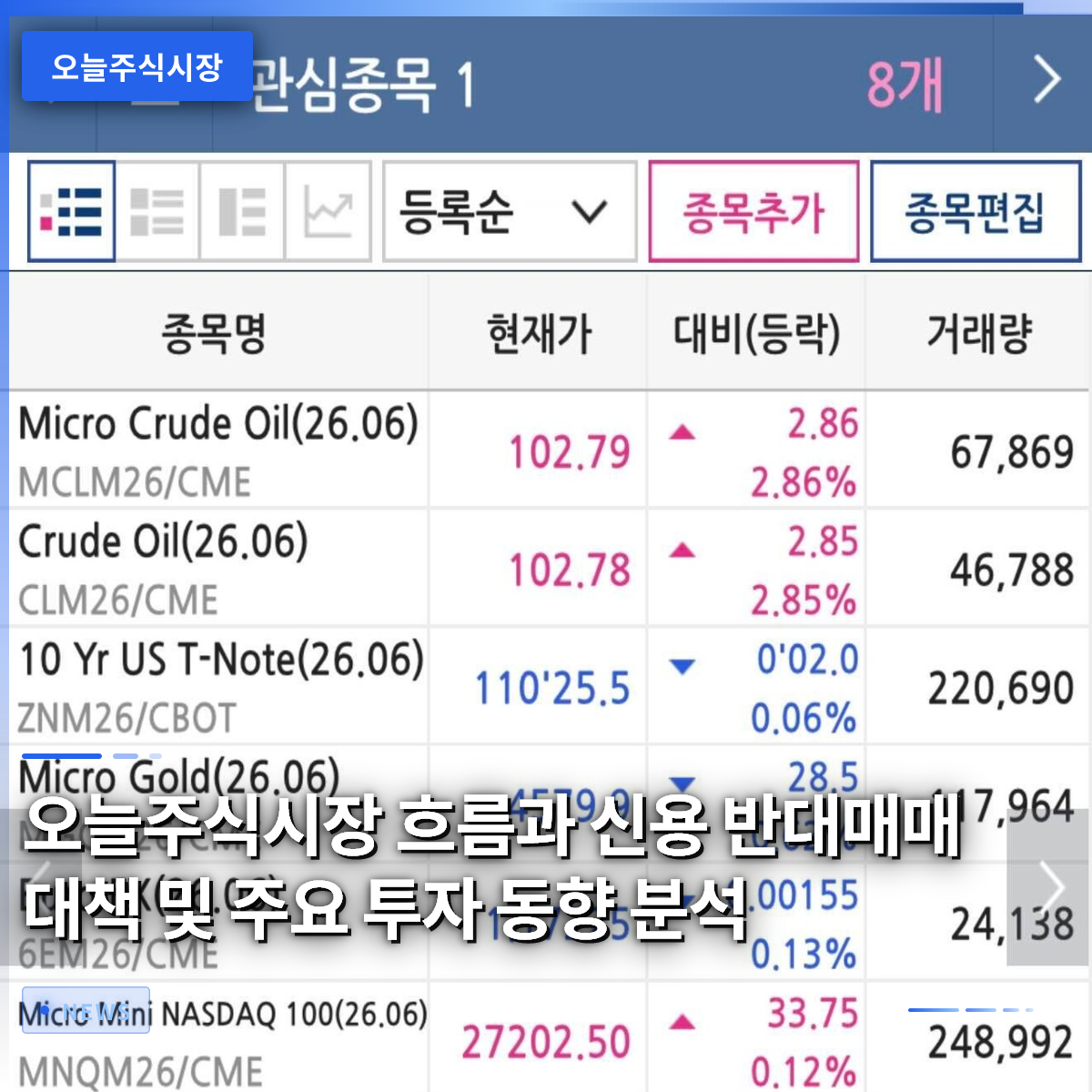
Today’s stock market is facing a critical juncture where volatility has intensified, necessitating a thorough review of credit margin call risk management and the shifting leadership in the artificial intelligence industry. Over the past week, while the index has engaged in fierce battles within a specific range, large-scale capital inflows from foreign investors and moves to expand shareholdings in certain companies have been simultaneously observed. Investors who have experienced the sudden pain of a margin call because they failed to check their account’s credit ratio during sharp index fluctuations will surely feel the harshness of today’s market dynamics. If you do not maintain a comfortable collateral ratio, it is easy to suffer the pain of having your stocks forcibly liquidated during unexpected market downturns. In this article, we will thoroughly examine the major economic news shaking today’s stock market, promising industries for the next phase of AI, and practical strategies for safe asset management. Through rigorous analysis and specific case studies, we aim to provide significant assistance in protecting your valuable assets and setting a wise investment direction.
=
Analysis of Today’s Stock Market Trends, Credit Margin Call Countermeasures, and Key Investment Trends
1. Credit Margin Call Risk Management and Response Strategies
The most critical task to check first in today’s stock market is to thoroughly verify credit margin call price conditions and the collateral maintenance ratios required by each securities firm. As stock market volatility becomes extreme, securities firms begin to indiscriminately liquidate accounts with insufficient collateral ratios to recover the funds they have lent. If the collateral ratio on your stock balance screen starts to fall below 140 percent, it should be viewed as a flashing emergency light.
The story of an investor who bought Samsung Electronics shares on margin last year and lost them due to an automatic margin call executed at exactly 9:00 AM following a sudden drop in the early trading session offers us a significant lesson. At the time, the investor casually dismissed the securities firm’s text message requesting additional collateral, relying on the naive belief that the index would rebound quickly. Since margin calls involve the bulk liquidation of stocks at market prices regardless of the investor’s will, they create a vicious cycle that further crashes the stock price of the affected company. Therefore, it is wise not to set credit limits too high for held stocks and to always keep a cash buffer in the account to prepare for sudden market crashes.
Credit margin calls can arrive without warning, so you should manage your collateral ratio comfortably in advance and secure emergency funds to prevent forced liquidation during market crashes.
2. Foreign Investor Capital Inflows and Major Stock Trends

Among the supply and demand players in today’s stock market, the most striking aspect is that foreign investors are aggressively deploying large amounts of capital centered on specific large-cap stocks. Since the period when expectations of credit rating upgrades were in play, foreign investors have been sweeping up shares of certain companies worth hundreds of billions of won, acting as the vanguard in defending the index. In fact, even when the market index repeatedly fluctuated boringly within a narrow range, the top net-buy stocks by foreign investors demonstrated relatively firm price movements.
It is not difficult to find sighs from novice investors who chased stocks that foreign investors had been buying daily, only to get stuck at short-term highs and suffer losses. While foreign supply and demand is an important indicator for gauging the overall market direction, there is a clear gap between the timing of their purchases and when individual investors receive the information. Therefore, rather than blindly following foreign buying trends, one should first calmly examine the financial statements and industry conditions to understand why they are focusing on that particular company. Investors who calmly assess the intrinsic value of a company, especially when supply and demand are concentrated, will ultimately win the battle for account returns.
Large-scale capital inflows from foreign investors are a positive signal, but prudence in reviewing the actual value of the company is essential rather than simply following supply and demand trends.
3. Analysis of the Next Phase of AI Industries and Promising Companies

Investors looking for long-term growth drivers in today’s stock market should broaden their horizons beyond the semiconductor-centric market that led the first phase of AI to the next stage of industries. For the past few years, the core theme dominating the US and domestic stock markets has been the monopoly of specific companies manufacturing AI semiconductors. Now, we have entered a phase where application software and infrastructure companies that actually apply AI technology in the field to create substantial profits are receiving full attention.
The painful confession of a corporate investor who invested their entire fortune in a company with only the name “AI” while ignoring its performance, only to suffer significant losses when the bubble burst, offers us much to think about. In the next phase of the AI industry, only companies whose actual revenue and operating profits are proven by numbers will survive and establish themselves as true leading stocks. We must carefully compare the performance reports of companies providing cloud services, data analysis, and various industrial automation solutions, going beyond semiconductor hardware. In the upcoming deepening phase of AI, the ability to accurately predict the feasibility of technology and the speed of commercialization will determine the success or failure of investment outcomes.
The AI industry is moving from the first phase centered on hardware to a second phase focused on application and infrastructure companies that generate actual profits.
4. Shareholding Expansion and New Opportunities in the Logistics Industry
In today’s stock market, changes in corporate control and announcements of large-scale share purchases act as powerful catalysts that sharply boost short-term stock prices. Recently, news emerged that a financial investment capital had significantly increased its shareholding ratio by purchasing a large amount of shares in a representative domestic port handling and transportation company. Such active shareholding expansion by external investment institutions is evidence that the company’s future cash-generating ability and asset value are undervalued.
The success story of a veteran investor who noticed the boom in the logistics industry by observing the turnover rate of cargo in warehouses and container trucks, and bought related stocks to earn substantial dividend income, is highly instructive. The logistics and handling industry is sensitive to the economic cycle, but once global supply chains stabilize and cargo volumes increase, it becomes a solid business that delivers consistent results. Companies where large investment capitals are expanding their shareholdings mostly possess robust financial structures and exclusive infrastructure, giving them relatively strong defensive capabilities even in a bear market. Therefore, we should pay close attention to even minor changes in the logistics field, such as the increase in delivery boxes or news of ship arrivals at ports.
Active shareholding expansion announcements by large investment institutions are a signal indicating the undervalued appeal and stable logistics infrastructure value of the company.
5. Investment in Resource-Rich Countries and the Importance of Mineral Supply Chains
When viewing today’s stock market from a macro perspective, one should keep a close eye on investment opportunities related to resource-rich countries that possess mineral resources essential for electric vehicles and advanced battery production. Major corporations are making large-scale investments in countries with the world’s most abundant natural resources, staking everything on the competition to secure key minerals. From smartphones to electric vehicles and large-scale energy storage systems, no advanced device in modern society can function for even a single day without battery minerals like cobalt or lithium.
The lament of an individual investor who invested in resource development companies in Africa or South America and saw their stock price cut in half due to local political instability or permitting issues serves as a warning about the risks of resource investment. While resource development projects have immense potential, they always come with the massive reefs of geopolitical risks and environmental regulations, requiring special caution. It is very dangerous to invest based on rumors without understanding the progress of overseas mine development projects led by major corporations and the actual mining cost structure. Reading the changes in the raw material supply chain becomes the key to predicting the landscape of global manufacturing and the battery industry for the next few years.
Movements by companies to secure mineral resources essential for advanced batteries and electric vehicles are becoming active, containing both long-term investment opportunities and risks.
6. Successful Investment Advice and Future Outlook
Considering the complex flow of today’s stock market, investors should focus on macroeconomic indicators and the intrinsic value of companies rather than rejoicing or grieving over short-term stock price fluctuations. To escape the fear of credit margin calls and secure a position in promising industries for the next phase of AI, thorough study and fund management must precede action. It is most important to establish your own unwavering investment principles, using changes in foreign supply and demand and shareholding investment announcements by major corporations as a compass.
The only people who have survived after experiencing countless trial and error in the stock market over the years are those who have acquired the wisdom to reduce greed and strictly control risk. Before opening your account every morning and sighing, please calmly check whether the collateral ratio of your held stocks is safe and whether the company’s performance is actually supported. I sincerely hope that the various economic news and investment strategies reviewed today will serve as a reliable guide for your successful asset growth. I encourage you to become a wise investor who makes smart choices without being shaken in the rapidly changing market environment, taking another step toward economic freedom.
To overcome the volatility of today’s stock market, one must adhere to a long-term investment strategy based on performance, along with thorough risk management.
Frequently Asked Questions
=