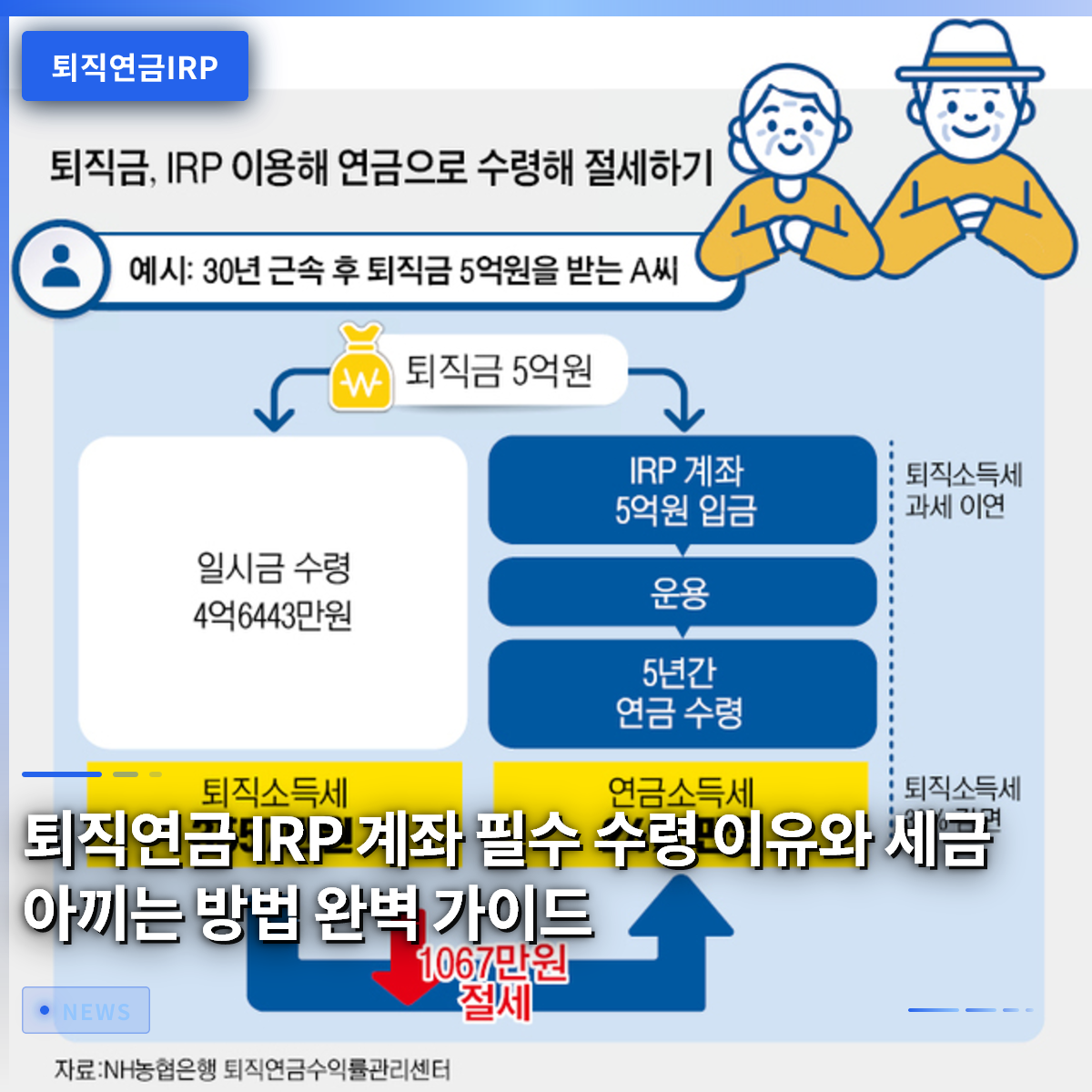
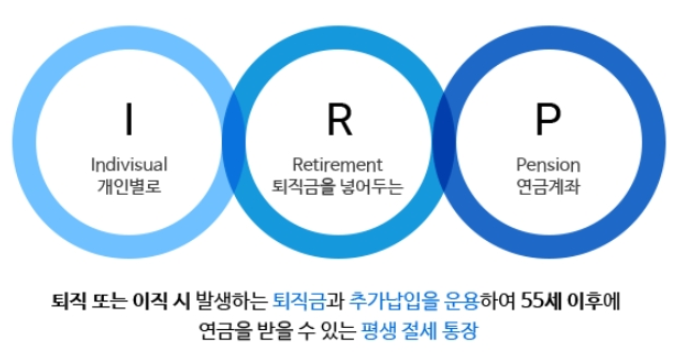
To save on taxes and protect your valuable assets, you must receive your severance pay into an Individual Retirement Pension (IRP) account. When leaving a job or changing careers, many people make the mistake of receiving their severance pay into a regular savings account, thinking they need the cash immediately. However, this results in immediate withholding of retirement income tax, significantly reducing the amount you actually receive. It is common to see people around you shocked by how much less they received after having their severance pay deposited directly into a regular account. Today, we will look in detail at why you must receive your retirement pension in an IRP account and specific methods to reduce taxes and save on fees. If you read this article to the end, you will find a great answer to protecting your retirement funds.
=
Complete Guide to Mandatory IRP Account Receipt for Severance Pay and Tax-Saving Strategies
1. Why You Should Not Receive Severance Pay in a Regular Account

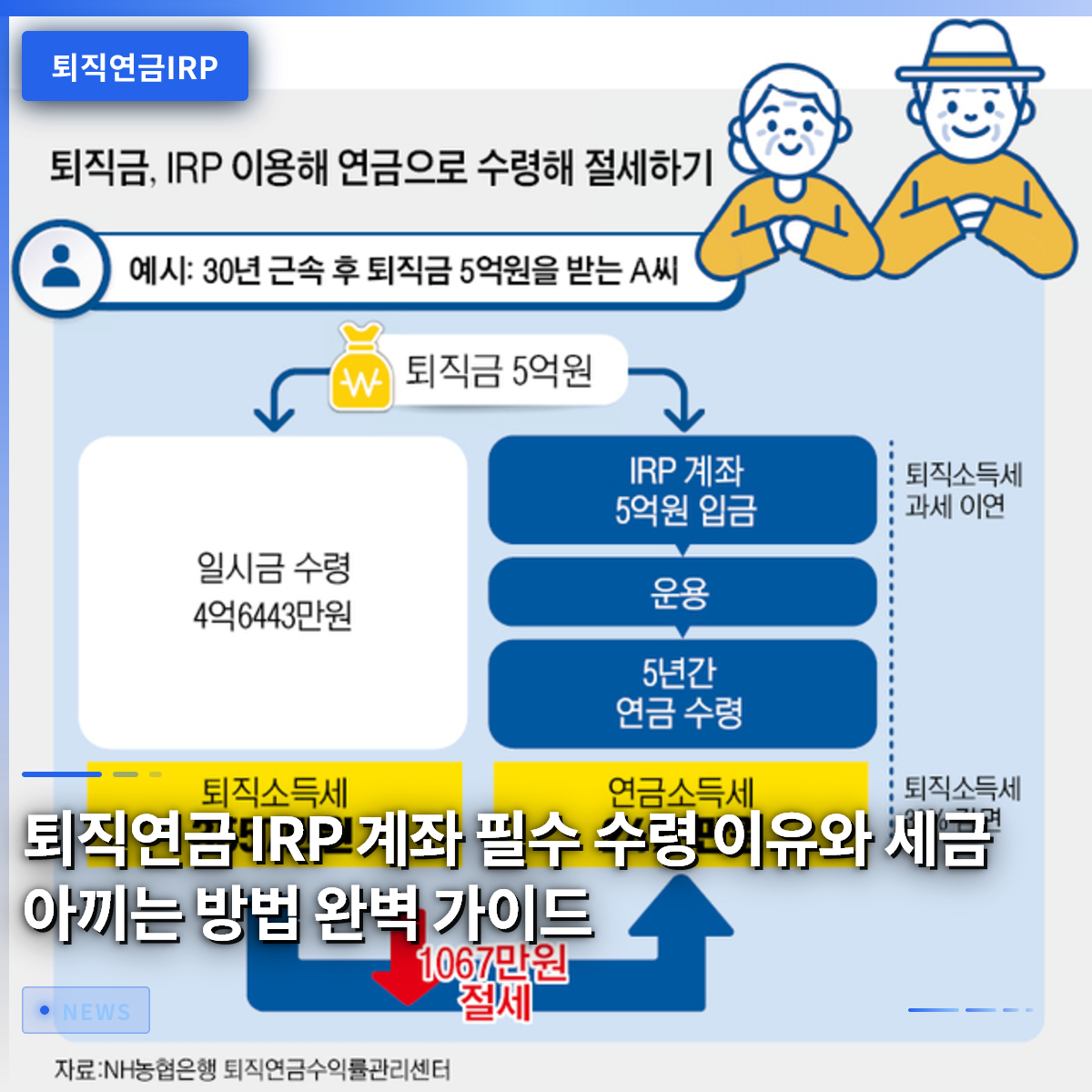
Receiving your settled severance pay directly into a regular checking account at a commercial bank when leaving a job causes significant losses from an asset management perspective. When a company pays out severance pay, the principle is to transfer it to an Individual Retirement Pension (IRP) account designated by the employee without withholding retirement income tax. If you receive the money directly into a regular account without a legal exception, the National Tax Service will immediately treat it as retirement income and deduct a high tax rate. Seeing a large portion of your hard-earned severance pay, accumulated over more than ten years, deducted as tax can be disheartening. For example, if you receive 50 million won in severance pay but several million won is deducted as tax at once, it can greatly disrupt your plans for immediate living expenses or investment funds. Therefore, unless there is a special legal exception, you should inform your company’s HR department of your IRP account number in advance to ensure the severance pay is deposited there. To safely protect your severance pay, you must establish a structure that allows you to enjoy the full tax deferral benefit from the moment of receipt. Money received in a regular account is also disadvantageous during reinvestment, making it difficult to enjoy compound interest effects, and it is easy to fall into the temptation of consuming it midway. On the other hand, if you leave it in a dedicated account, taxes are not immediately imposed, and taxation is deferred until you receive it as a pension later, allowing the entire principal to grow. You must remember that this small difference in choice can lead to an asset gap of tens of millions of won several years after retirement. Therefore, when you hear news of your retirement, the basic financial common sense for an employee is to first open a pension account in your own name and prepare for the transfer.
Receiving severance pay in a regular account results in immediate tax imposition, reducing your assets, so it must be transferred to an Individual Retirement Pension (IRP) account.
2. The Secret to Deferring Retirement Income Tax to Avoid a Tax Bomb
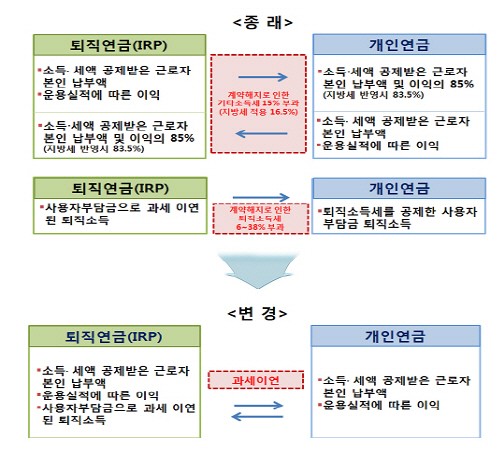
The most powerful weapon of an Individual Retirement Pension (IRP) account is the deferral benefit that postpones the taxation of retirement income tax. If you transfer the severance pay generated when leaving a company entirely into this account, the government waits without collecting taxes until you receive it as a pension after retirement. Because the money that would have been paid as tax immediately remains intact in the account, the combined principal and interest create a larger compound interest effect. If you receive this money in installments during the pension receipt period, you can reduce the original retirement income tax by 30% to a maximum of 50%. In reality, many retirees actively utilize this system to significantly reduce their tax burden and secure their post-retirement living expenses with much more ease. What employees approaching retirement fear most are unexpected tax notices and post-retirement poverty, and this system serves as the key to solving both simultaneously. Looking at the case of Manager Kim, who voluntarily retired after 30 years of work, the difference becomes clear. Manager Kim received his severance pay in a regular account, had taxes deducted at once, and lived on the remaining money, only to suffer from running out of funds a few years later. On the other hand, Manager Lee, who strictly transferred the funds to a pension account and locked in the taxes, was able to maintain a stable cash flow while paying less tax by receiving the pension annually. As such, the tax deferral system provides not just a delay in taxes but also substantial reduction benefits, making it a system you must never miss.
Transferring severance pay to a pension account defers tax payment to the future and allows for significant tax reductions when receiving the pension.
3. How to Save on Fees Through Non-Face-to-Face Account Conversion
When maintaining an Individual Retirement Pension (IRP) account, the annual management fees deducted are a subtle but annoying cost factor for long-term investment. Opening or managing an account by visiting a bank or securities branch directly often results in higher fee rates than expected, leading to losses over long-term investments. Recently, many financial institutions are offering drastic fee waivers or reductions to customers who open or convert accounts through smartphone apps to promote non-face-to-face channels. In fact, compared to signing up at an offline branch, converting to a non-face-to-face account often reduces fees by more than half. For investors managing assets of less than 50 million won, non-face-to-face conversion opens up the opportunity to reduce the fee burden to nearly zero. Looking around, there are too many employees who leave their accounts neglected for a long time because they don’t know how to save on fees or find it troublesome. However, you can easily convert your existing account to a non-face-to-face preferred type with just a few touches on your smartphone, so you should check this immediately. Fees that are subtly deducted every year can become a huge amount over decades, so the attitude of saving even small costs is the shortcut to asset growth. Especially for money that must be kept for a long time, like retirement funds, the fee-saving effect is maximized as time passes. You need the wisdom to carefully compare the fee preference conditions offered by different financial companies and choose the platform most advantageous to you.
Converting your Individual Retirement Pension (IRP) account to a non-face-to-face type via a smartphone app can significantly save on management fees.
4. Strategies to Maximize Year-End Tax Deduction Limits
Individual Retirement Pension (IRP) accounts are widely used not only for holding severance pay but also for depositing your own cash to receive tax deductions. Previously, deductions were only available up to a certain amount when combining pension savings funds and IRPs, but recently, the tax benefit limit has been significantly raised. For employees, it has long been established as an essential financial product that must be managed to avoid a tax bomb during year-end tax settlement. By consistently depositing a certain amount each month according to your annual income level, the state returns a certain percentage of the deposited amount in cash at year-end. Because it brings a refund like a blessing in the rain to salaried workers, it is considered the best wealth management tool in employee communities. For example, if you consistently deposit a certain amount each month to reach the annual limit, you can enjoy the joy of receiving hundreds of thousands to over a million won as a tax refund. Junior Manager Park, who has used this account since the early days of their career, receives envious looks from colleagues every year during year-end tax settlement. Junior Manager Park simply sets up automatic transfers to deposit a certain amount into the subscribed product each month, achieving the double benefit of accumulating retirement funds and getting taxes refunded. As such, making voluntary additional contributions alongside this can cause the pension amount you can receive in old age to snowball, bringing you one step closer to financial freedom. However, if you terminate the account midway, you may have to return the tax benefits received so far, so it is safe to manage it with surplus funds.
Making voluntary additional contributions allows you to receive strong tax deduction benefits during year-end tax settlement, increasing your refund.
5. Portfolio Diversification Through Safe Assets and Government Bonds
Within an Individual Retirement Pension (IRP) account, you can combine various risky assets such as funds and Exchange-Traded Funds (ETFs) with safe assets like deposits according to your preference. According to relevant regulations, a certain percentage or more of the total assets must be allocated to safe assets, naturally maintaining the stability of asset allocation. Recently, various products have been launched, including US index-tracking products and domestic and international high-quality bond mixed products that investors prefer, greatly expanding the range of choices. In particular, the path to purchasing government bonds for individual investors through related accounts has recently opened, further enhancing the stability of long-term investment. For investors who want to defend against inflation while safely protecting their principal, including 10-year or 20-year government bonds is an excellent choice. Mr. Park, an employee approaching retirement, had painful memories of holding his breath every time the market fell because he had previously invested everything in equity products. However, following recent regulations, he secured a safe asset ratio of over 30% and restructured his portfolio with the remainder in stable bond mixed products and government bonds. As a result, he was able to sleep soundly even on days when the market fluctuated significantly and enjoyed the joy of seeing his assets steadily rise. As such, the key to successful retirement preparation is not just engaging in risky investments but creating a balanced long-term portfolio while utilizing legal safety measures. Do not neglect the retirement pension coming in every month; actively manage it by choosing excellent products that match your investment style.
You can build a stable long-term portfolio by utilizing various safe assets and government bonds, which have recently become eligible for inclusion.
6. Resisting the Temptation to Terminate and Completing Retirement Preparation Through Long-Term Investment
Even after opening a retirement pension account and depositing money, surprisingly many subscribers terminate it midway citing the need for urgent cash. In fact, statistics indicate that while a huge amount of money is transferred to accounts, a high rate of termination causes retirement funds to scatter in vain. If you terminate the account for simple consumption purposes without a mandatory legal exception such as buying a home or medical expenses, you will face a tax bomb and incur losses. Making the fatal mistake of mid-term termination renders the tax benefits and compound interest effects accumulated so far useless, so you must maintain it no matter what. Since retirement funds only shine 10 or 20 years later, patience to resist immediate temptations and endure quietly is most important. In conclusion, a retirement pension account is not just a storage account for severance pay but the most reliable shield responsible for lifelong economic stability. You need to turn on your smartphone right now to check the status of your account and verify if you are saving on fees. You must exercise the wisdom to wisely fill the income gap that will come in old age through consistent additional contributions and smart asset allocation every year. Life after retirement is determined by the financial habits of your younger days, so please make a solid asset management plan based on what you have learned today. The wise choice you make today for a prosperous future life will become a sturdy support for you several years from now.
You can only complete a truly prosperous old age by resisting the temptation of mid-term termination and continuing long-term investment.
Frequently Asked Questions
=