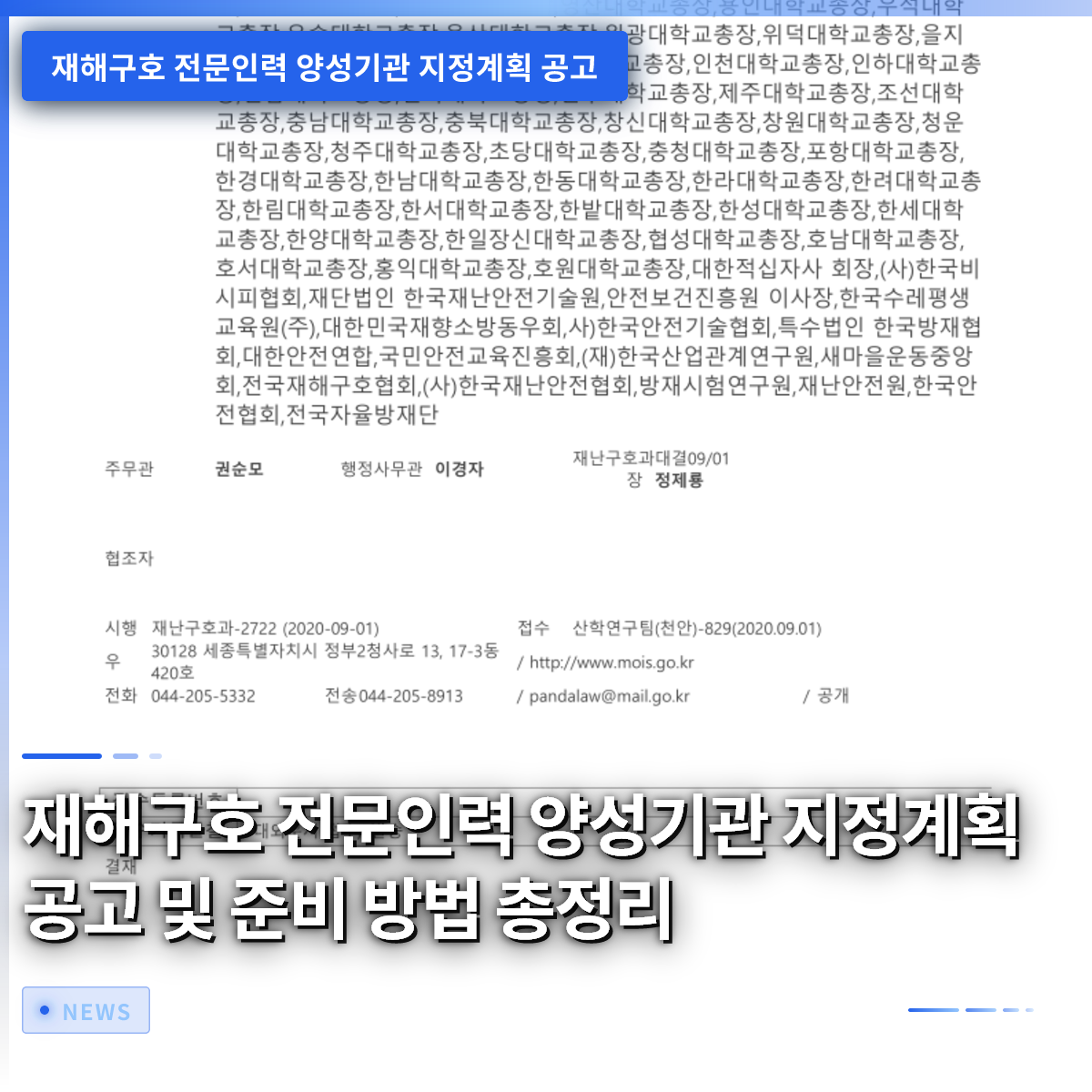
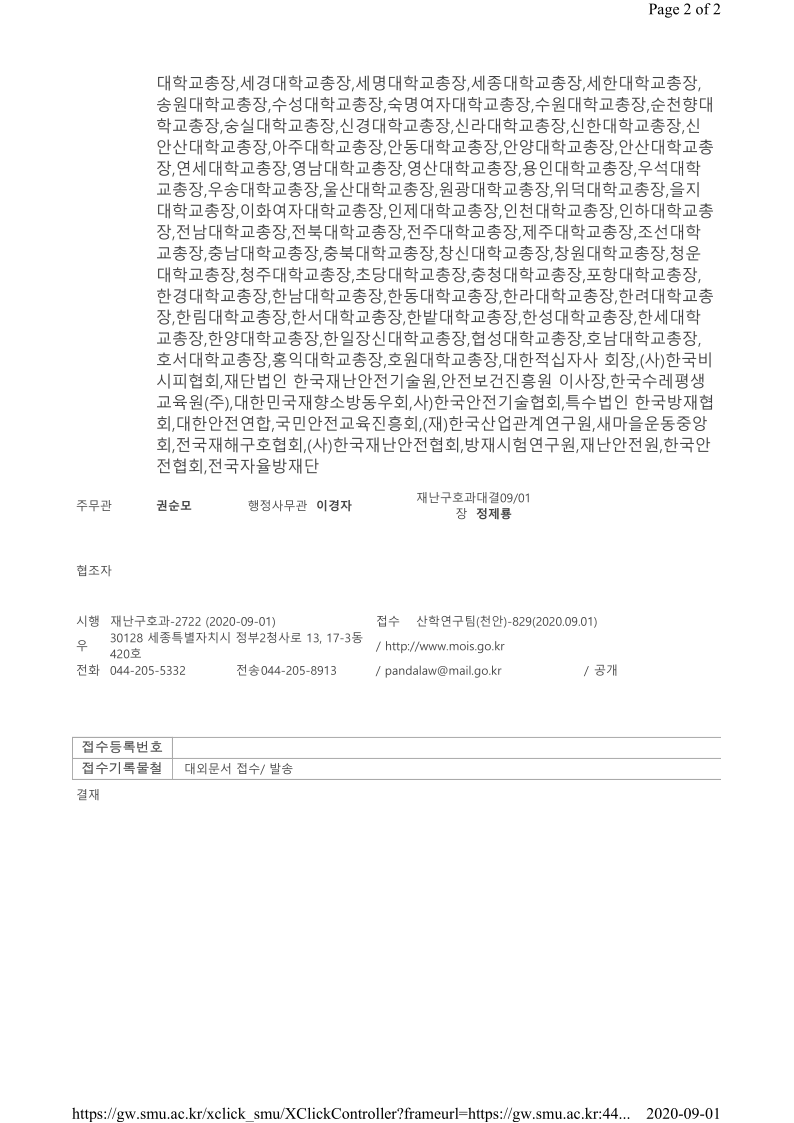
The announcement of the designation plan for disaster relief professional training institutions, released by the Ministry of the Interior and Safety, is a core policy aimed at systematically cultivating experts who can safely protect citizens and carry out substantive relief activities in various disaster situations. As unpredictable natural and social disasters increase every year, the need for skilled personnel who can accurately understand the field and assist disaster victims cannot be overstated. In the past, relief efforts were limited to simply distributing supplies, but now advanced relief capabilities are essential, ranging from psychological counseling to heal emotional trauma to coordinating the entire recovery process. Accordingly, the government aims to elevate on-site response capabilities to the highest level by designating excellent educational institutions through rigorous review criteria and fostering public-private cooperation. In this article, we will carefully examine the detailed contents of the announcement, specific application procedures, and the actual roles these professionals will play in the field. For those interested in disaster management and relief, this announcement will serve as an opportunity to deeply understand its significance and prepare accordingly.
=
Comprehensive Guide to the Designation Plan for Disaster Relief Professional Training Institutions and Preparation Methods
1. Background of the Designation Plan for Disaster Relief Professional Training Institutions
In recent years, unexpected disasters such as heavy rainfall and large-scale wildfires caused by climate change have frequently threatened our society. When such emergencies occur, there is an urgent need for hands that are first deployed to the scene to comfort disaster victims and help them recover their daily lives. However, if personnel lacking field experience or systematic training are deployed, relief activities may not proceed smoothly, potentially exacerbating confusion. The primary reason the government has issued this designation plan announcement is to overcome these on-site limitations. By cultivating true experts who possess both theoretical knowledge and practical skills, the goal is to ensure that a unified and professional relief system operates in any disaster scene across the country. This enables holistic support that goes beyond distributing relief supplies to comforting the hearts of affected residents. Ultimately, this designation plan will be a crucial milestone in strengthening the fundamental resilience of South Korea’s disaster safety net. In the past, confusion often arose at disaster scenes due to the lack of systematic manuals. Now, experts who have completed thorough pre-training will be deployed to command the scene stably.
The designation plan for disaster relief professional training institutions is established to reduce confusion at disaster scenes and establish a professional relief system.
2. Core Requirements for Designated Institutions
To be designated as a disaster relief professional training institution by passing the Ministry of the Interior and Safety’s rigorous review, several strict criteria must be met. First, dedicated classrooms and practical facilities capable of smoothly operating educational courses, as well as sufficient advanced educational equipment, are required. Additionally, a crucial evaluation criterion is whether excellent instructors with extensive experience in the disaster relief field are permanently stationed or stably secured on a non-permanent basis. To receive a passing score, institutions must have a practical curriculum that can handle various variables occurring in actual disaster scenes, rather than just book-based lessons. Various simulation programs and collaboration networks with related agencies are also essential requirements to help trainees acquire field sense. Only institutions that meet all these requirements will receive official government certification and the qualification to produce relief talent representing South Korea. Because the review process is rigorous, there is a natural effect of enhancing the institution’s own capabilities. Excellent facilities and instructors play a decisive role in improving trainees’ practical adaptability.
To be designated as a disaster relief professional training institution, one must possess a thorough practical curriculum, excellent instructors, and optimal educational facilities.
3. Cultivating Field Experts Through Systematic Educational Processes
The educational programs conducted at designated training institutions focus on cultivating vivid response capabilities in actual disaster situations, going beyond simple knowledge transfer. Trainees deeply learn practical aspects, including the disaster legal framework, relief logistics management, and methods for operating temporary housing facilities for disaster victims. In particular, sensitivity training to carefully care for vulnerable groups, such as the elderly and children who experience psychological anxiety while staying in shelters for long periods, holds a significant weight. Since unexpected variables constantly arise in the field, practical exercises to develop communication skills and conflict mediation abilities in crisis situations are consistently conducted. Trainees who sincerely complete all processes are granted field deployment qualifications through rigorous evaluation and begin their activities as full-fledged relief activists. The moment they are deployed to the field, one can directly see the quality of disaster response leap to the next level. Discussion-based classes are held based on various cases experienced in the field, resulting in very high educational effectiveness. Due to the educational process that perfectly harmonizes theory and practice, the field satisfaction rate of graduates is quite high.
The educational process of training institutions is systematically structured to simultaneously cultivate field practical skills and psychological support capabilities.
4. Strengthening Psychological Counseling and Disaster Victim Support Capabilities

The first difficulty faced by those who have experienced a disaster is not only physical damage but also severe trauma and a sense of loss deeply rooted in their hearts. In the past, focus was placed solely on physical relief such as distributing daily necessities, but now professional psychological counseling and mental health recovery support have become the core of relief activities. The training institutions designated this time will place significant emphasis on special education to help disaster victims overcome shock by collaborating closely with professional counseling personnel. In particular, they will intensively refine communication methods tailored to the level of the elderly, who make up the majority of affected residents, and methods for seeking emotional stability. When experts who have received this systematic psychological support education are deployed to the field, they greatly help disaster victims overcome their grief and return to daily life quickly. Through training institution education, one deeply realizes that the process of healing mental wounds is the true meaning of disaster relief. The ability to listen to and empathize with the stories of disaster victims encountered in the field is treated as the most important aspect. A network with mental health welfare centers is established to facilitate continuous healing.
Disaster relief professionals are required to possess psychological counseling capabilities to heal the trauma of disaster victims, going beyond physical support.
5. Designation Application Procedures and Future Schedule

Institutions or organizations hoping to be designated as disaster relief professional training institutions must carefully check the detailed guidelines announced by the Ministry of the Interior and Safety and submit documents within the specified period. Once the application is received, a review committee composed of experts in related fields will strictly conduct document evaluation and on-site inspections to determine eligibility. During the review process, the institution’s operational track record and financial soundness, as well as the distinctiveness and effectiveness of the educational program, are examined from multiple angles. The finally designated institutions will immediately begin recruiting new trainees after the official announcement and start the full-fledged race for talent development. The government plans to strictly manage the operational performance of designated institutions annually to ensure that educational quality is consistently maintained. Through this opportunity, we expect many willing institutions to participate, further upgrading South Korea’s disaster relief capabilities. Meticulousness is required to check the announcement several times in advance to ensure no items are omitted during the document preparation process. In the on-site inspection stage, the safety and accessibility of educational facilities serve as major review points.
Thorough document preparation and preparation for on-site review are essential for the designation application, following the announced guidelines.
6. The Future of Disaster Safety in South Korea and Our Tasks

The announcement of the designation plan for disaster relief professional training institutions is a great first step that fundamentally strengthens our society’s safety net, going beyond a simple administrative procedure. Due to the climate crisis, future disasters are likely to be more unpredictable and larger in scale, so our response posture must change accordingly. We have already witnessed in numerous disaster scenes that one well-trained expert can save the lives of many disaster victims and heal their pain. Only when the government’s policy support, the substantive education of training institutions, and the dedication of field activists form a trinity can a safe South Korea be completed. We hope that readers will continue to pay attention to this national safety policy and participate in disaster prevention activities in their communities. We must not forget that small concerns and preparations can gather to form a sturdy shield that protects our neighbors even in the midst of huge disasters. The process of the state and the private sector joining hands to complete a systematic relief system is a task for all of us. The numerous professional personnel to be produced in the future will faithfully play the role of safety guardians in various parts of South Korea.
A perfect disaster safety society can only be achieved when systematic personnel training and public interest are combined.
Frequently Asked Questions
=