
Hana Bank has raised the interest rate on its flagship fixed deposit product, Hana Fixed Deposit, to 3.4% annually, officially entering the competition to secure funds in the market. Having already increased rates once just ten days ago, Hana Bank’s recent upward adjustment of deposit rates is accelerating the pace of those who were hesitating to open deposit accounts. With recent volatility in the stock market and a lack of suitable investment options, large sums of money are once again flowing into the safety of the banking sector. Many people are likely wondering where to place their surplus funds after hearing news that deposit rates are rising again. In this article, we will examine in detail the background of Hana Bank’s rate hike, recent movements in deposit rates across major banks, and the most prudent ways to choose a deposit product at this point in time. We hope this information helps you make a wise choice to grow your valuable assets a little more.
=
Hana Bank Raises Fixed Deposit Rate to 3.4%: Confirmed Details and Tips for Opening an Account

1. Background of Hana Bank’s Fixed Deposit Rate Hike
In line with the recent upward trend in market interest rates, Hana Bank has increased the one-year maturity rate for its flagship fixed deposit product, Hana Fixed Deposit, from 3.3% to 3.4% annually, a 0.1 percentage point increase. This move is significant as it follows an additional hike just ten days ago on the 10th, when the rate was raised from 3.2% to 3.3%. The bank’s consecutive rate hikes are aimed at securing liquidity in the market and attracting deposit customers in the fierce competition for deposits. Over the past few months, a massive inflow of funds into the banking sector has continued, prompting each financial institution to carefully calculate rates considering their funding costs. Although not at the levels seen during the high-interest periods of last year or the year before, deposit products offering rates in the mid-3% range have reappeared, broadening consumers’ choices. Mr. Kim, an office worker, shared that he was considering reinvesting his maturing deposit from last year and is rushing to visit the bank after seeing news of the rate increase.
Hana Bank has further increased the rate on its Hana Fixed Deposit by 0.1 percentage points to 3.4% annually, igniting the competition for deposits.
2. Competition Among Major Banks and Interest Rate Comparison

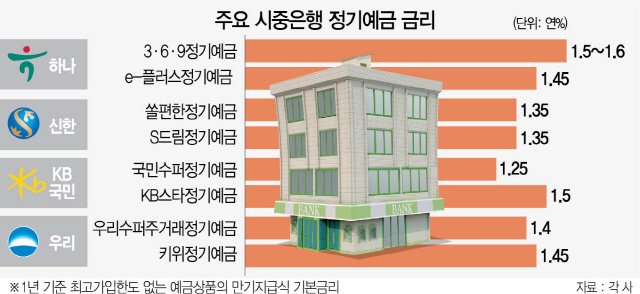
Not only Hana Bank but also other major commercial banks are collectively raising fixed deposit rates, joining the fierce battle to attract customers. KB Kookmin Bank raised the rate for its flagship KB Star Fixed Deposit with a maturity of one year or more but less than two years from 3.4% to 3.5% annually, a 0.1 percentage point increase. Woori Bank also adjusted the one-year maturity rate of its representative deposit product, Won Plus Deposit, from 3.4% to 3.5% annually, joining the mid-3% rate bracket. Other financial institutions, including Shinhan Bank, have also consecutively raised rates on products like the Soneuphan Fixed Deposit, causing deposit rates across the banking sector to follow an overall upward curve. The reason major banks are raising rates at different times is a strategic decision to secure stable deposits in preparation for year-end. From the perspective of financial consumers, it is a favorable time to carefully compare rates across banks and choose the one offering even a 0.1 percentage point higher interest.
Major commercial banks such as Kookmin Bank and Woori Bank have also raised fixed deposit rates to 3.5% annually, intensifying the competition.
3. Impact of Rising Deposit Rates

The consecutive increases in deposit rates by banks do more than just provide higher interest income to depositors; they trigger various ripples throughout the financial market. As banks offer high interest rates to attract deposits, their funding costs naturally rise, which in turn affects loan rates and the COFIX index. Indeed, with rising deposit rates, the likelihood of an increase in the COFIX index to be announced next month has grown, potentially increasing the interest burden for borrowers using variable-rate mortgages. Mrs. Park, a housewife, sighed, saying that while rising deposit interest is welcome news, she is worried about loan interest rates rising consecutively as well. Just as a coin has two sides, deposits and loans are linked; a movement in one rate inevitably causes a chain reaction in the other. Therefore, economic actors need to view not only the benefits of rising deposit rates but also the overall trend in financial costs in a balanced manner.
While higher deposit rates benefit depositors, they also lead to increased funding costs, which impacts loan rates.
4. Strategies for Managing Chuseok Bonuses and Surplus Funds
As the Chuseok holiday approaches, office workers who have received bonuses or people holding large sums of cash find themselves deeply pondering where to invest this money. Many are turning to fixed deposits for safe interest earnings, as the stock and cryptocurrency markets have recently been too volatile, posing a significant risk to principal. For example, depositing 50 million won in a Hana Bank product with a 3.4% annual rate for one year can yield a decent after-tax return. Experts advise that rather than locking all funds into long-term products at once, it is wise to use a “laddering” strategy by splitting maturities. By sequentially opening accounts with shorter maturities in line with the rate-hiking cycle, you gain the flexibility to switch to better rates if interest rates rise further in the future. Efficiently diversifying and managing funds is the most certain way to protect your assets in an uncertain economic environment.
A strategy of splitting maturities to open deposit accounts is useful for safely managing surplus funds such as Chuseok bonuses.
5. Points to Note When Opening a Deposit During a Rate-Hiking Period

Just because commercial banks are competitively raising rates does not mean you should blindly open any account; several careful verification steps are necessary. First, you must assess whether it is realistically easy to meet the conditions for preferential rates and check how early withdrawal penalties are applied if you need to access your funds urgently. Many banks offer the highest rates only if strict conditions, such as salary transfers or being a first-time customer, are met, so you should carefully examine the difference between the base rate and the preferential rate. Additionally, you must always keep in mind that under the Deposit Insurance Act, only up to 50 million won per person (principal plus interest) is protected. Rather than concentrating large sums in one bank, it is a smart tactic to reduce risk by splitting deposits of 50 million won each across multiple financial institutions. If visiting a bank branch is difficult, many products offer additional preferential rates for non-face-to-face sign-ups via smartphone apps, so it is advisable to take advantage of these options.
It is advantageous to carefully check preferential rate conditions and deposit insurance limits, and to utilize benefits for non-face-to-face sign-ups.
6. Future Interest Rate Outlook and Action Guidelines for Readers

Financial experts analyze that the possibility of further base rate hikes has not completely disappeared, depending on inflationary pressures and the direction of monetary policies in various countries. Based on this outlook, there is weight to the opinion that the upward trend in bank deposit rates or the current high level of rates is likely to be maintained for the time being. Therefore, if you have a large sum of money right now, rather than unconditionally locking it into long-term products, you need the wisdom to monitor the situation and make split deposits. If visiting a bank is a hassle, use your smartphone to check daily for changes in rates among major financial institutions and choose the one offering the most favorable conditions. The basics of wealth management lie in thorough information gathering and execution, so please make good use of the rate hike news shared today as a stepping stone for asset growth. Never forget that small efforts and diligence determine the size of the interest income you will hold by year-end.
You should monitor future interest rate trends, maintain a split deposit strategy, and actively compare rates via smartphone.
Frequently Asked Questions
=