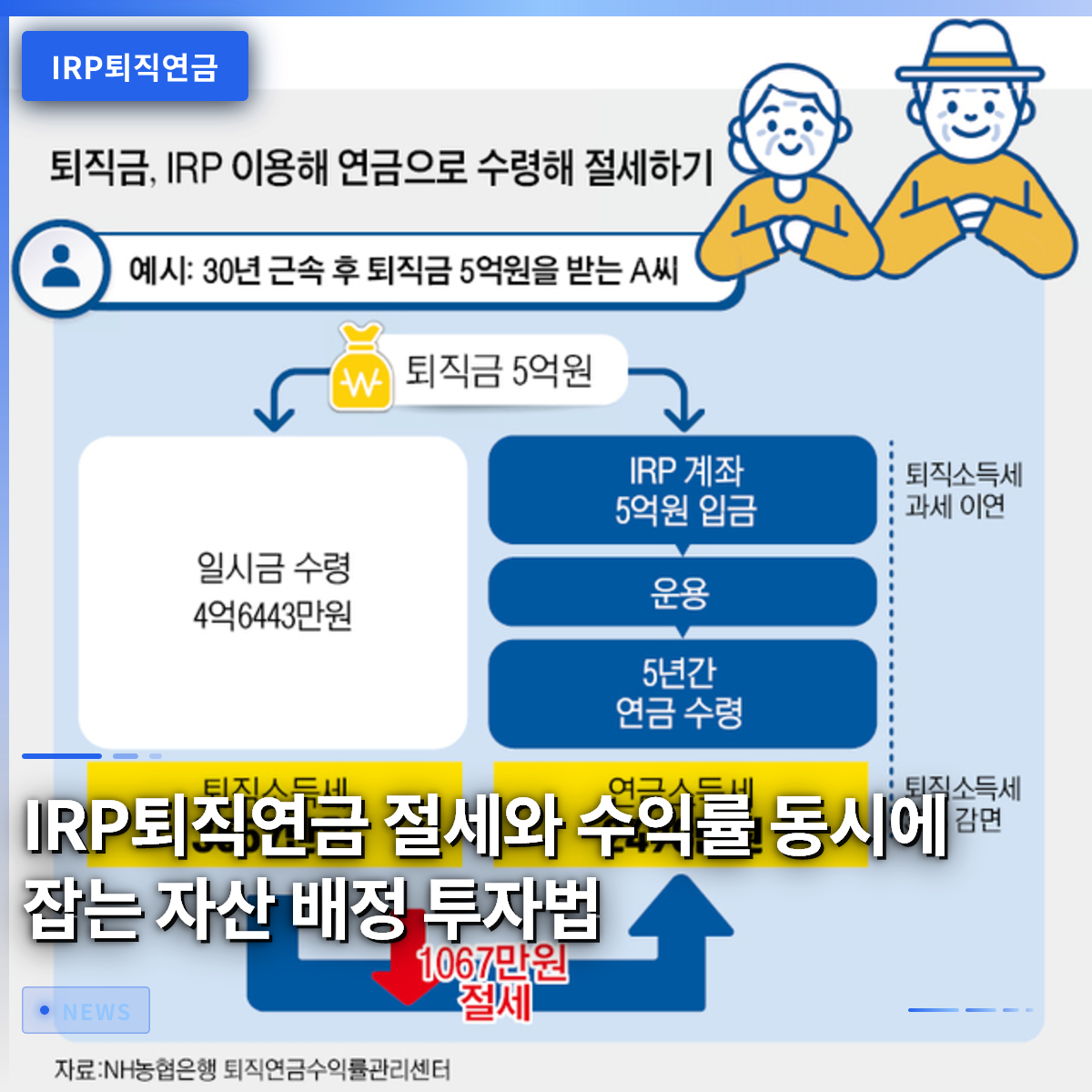
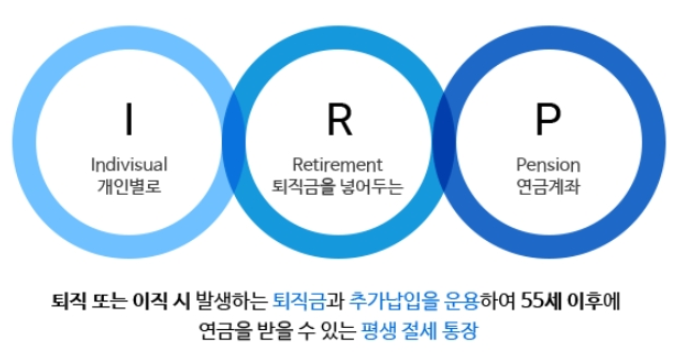
Properly utilizing your IRP (Individual Retirement Pension) account allows you to receive tax refunds of several hundred thousand won during your annual tax settlement while building a robust retirement asset base. Many employees unknowingly withdraw their severance pay or leave their accounts neglected when changing jobs, missing out on significant tax-saving opportunities. This account, which offers tax deductions of up to 9 million won annually, is not just an option but an essential asset management tool for working professionals in South Korea. Recently, the range of investment options has expanded to include individual investor government bonds and various parking-type products. In this article, we will specifically explore how to maximize the hidden benefits of IRP accounts and wisely allocate the ratio between risky and safe assets. Resolve all your doubts about retirement pension management, which may have seemed complex, with this comprehensive guide.
=
IRP Retirement Pension: An Asset Allocation Strategy for Simultaneous Tax Savings and Returns
1. Subheading

Understanding the IRP Tax Deduction Limit That Changes Your Year-End Tax Refund. Do you know that you can receive a tax deduction of up to 9 million won annually when combining pension savings and IRP contributions? If your total annual income is 55 million won or less, you can benefit from a high deduction rate of 16.5%, resulting in a maximum refund of 1,485,000 won. Even if your income exceeds 55 million won, you can still receive a refund of up to 1,188,000 won with a 13.2% deduction rate. Simply saving a small amount each month is equivalent to earning a guaranteed return of over 13%, which is a significant advantage for employees. In fact, a considerable number of my colleagues utilize this system to enjoy a substantial “13th-month bonus” every year. It is far more advantageous to set up automatic monthly transfers rather than rushing to sign up just before the year-end tax settlement period.
If you contribute solely to an IRP account, the full tax deduction limit of 9 million won annually is recognized. A representative tax-saving strategy is to contribute 3 million won to an IRP if you have already contributed 6 million won to a pension savings account, thereby reaching the limit. Conversely, you can enjoy the same tax benefits by contributing the full 9 million won to an IRP without any pension savings contributions. However, since you must repay the tax deductions received if you terminate the pension account early, it should be managed with surplus funds. If you receive the funds as a pension after retirement age (55), a lower tax rate is applied compared to receiving a lump sum, significantly saving on taxes. Thanks to this structure, it has established itself as the most reliable means of accumulating retirement funds from a long-term perspective.
By combining IRP retirement pension and pension savings, you can receive a tax deduction of up to 9 million won annually, resulting in a substantial refund every year.
2. Subheading
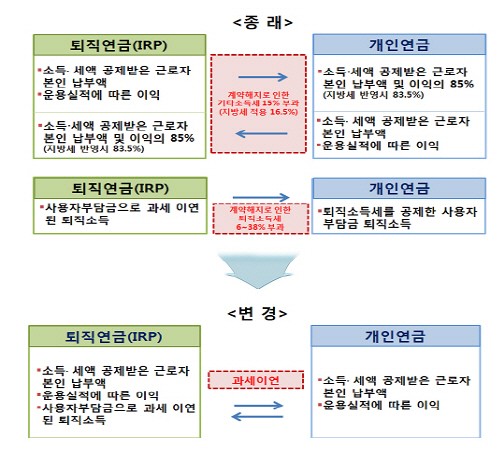
Achieving the Golden Ratio of 70% Equity Assets and 30% Safe Assets. By law, risky assets such as equity funds in a retirement pension account are limited to 70% of the total accumulated amount. The remaining 30% must be allocated to safe assets, which often leaves novice investors puzzled about how to structure their portfolios. If you have filled the 70% allocation with aggressive equity funds or ETFs, how to fill the remaining 30% becomes the key to determining overall returns. Recently, various products classified as safe assets, including bond-mixed products, have been launched, enriching the options. For example, utilizing bond-mixed products that appropriately blend stocks and bonds allows you to naturally increase your stock exposure without exceeding the risky asset limit.
There are frequent concerns in the field that the mandatory 30% safe asset regulation might lower returns. However, recently, a large number of parking-type products and interest-rate-linked products that allow 100% investment within pension accounts have emerged. The strategy is to fill the 30% allocation with products that offer stable interest income with low volatility, rather than just keeping money in regular deposits. When the stock market experiences significant turbulence, the safe asset allocation acts as a sturdy defensive shield, allowing you to continue long-term investing with peace of mind. It is wise to view the 70:30 rule not merely as a regulation but as a safety device to reduce account volatility. Carefully compare and combine equity products and safe assets according to your investment style.
By maintaining the 70% risky asset and 30% safe asset ratio while utilizing bond-mixed products, you can secure both stability and profitability.
3. Subheading
How to Utilize Individual Investor Government Bonds and Parking-Type Products Now Available. Due to recent financial system reforms, the path to directly purchasing 10-year and 20-year government bonds in IRP accounts has been opened. In the past, these could only be purchased through specific securities firms’ dedicated accounts, but now government bond investment is easily possible within retirement pension accounts. Investing long-term in state-guaranteed safe assets while enjoying compound interest effects is highly suitable for long-term retirement preparation. Additionally, parking-type products, which gain attention whenever stock market volatility increases, can be included 100% as safe assets in pension accounts. These products allow you to earn stable interest while temporarily holding funds via securities apps, making them perfect for managing investment waiting funds.
These new financial products are like a ray of hope for employees preparing for retirement. This is because various government bonds and bond-type alternatives have emerged in a situation where bank deposit rates alone were difficult to keep up with inflation. If you want to invest in dollar assets, you also need the wisdom to choose bond-type or synthetic dollar products to avoid derivative restrictions. Methods to diversify portfolios while responding to exchange rate volatility within an IRP are continuously increasing. This is why it is necessary to periodically review and rebalance assets within your account in line with changes in the financial market. Keep an eye on expert opinions and the latest financial news to manage the returns of your account.
The ability to directly purchase individual investor government bonds and parking-type products in IRP accounts has significantly broadened the options for managing safe assets.
4. Subheading
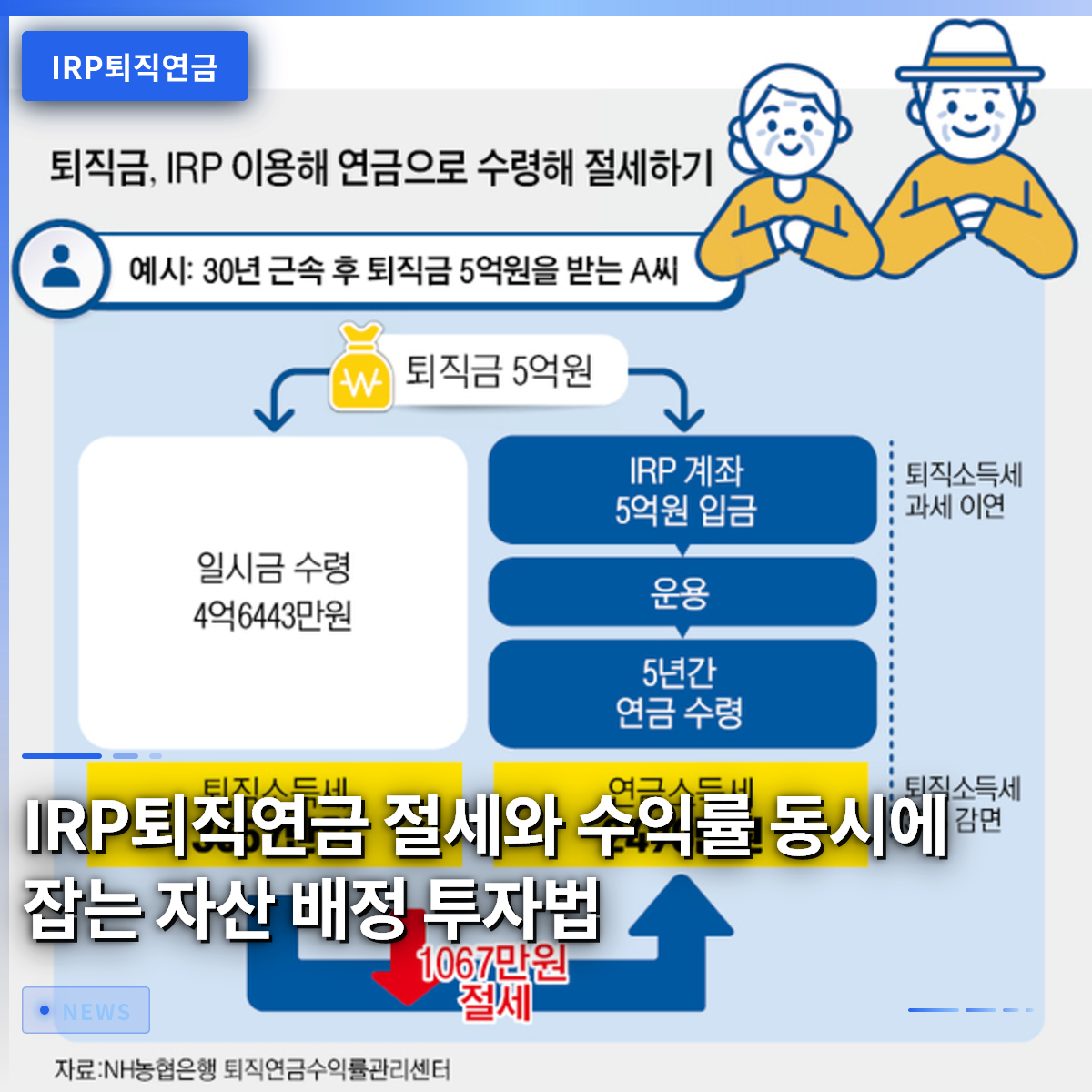
Why You Should Never Terminate Your Account When Changing Jobs or Resigning, and How to Transfer It. When you change jobs or retire, you receive your valuable severance pay, but there is one action you must be most careful about. It is the fatal mistake of receiving your severance pay in a personal bank account and using it for living expenses or other purposes, thereby terminating the account. If you do not transfer your severance pay to an IRP account and instead withdraw it in cash, you must repay all the taxes you were previously exempted from. Not only will you face a tax bomb, but your retirement funds will vanish in an instant, making your post-retirement life extremely unstable. Even if you leave your company, you must contact the existing retirement pension department and request that your severance pay be safely transferred to an IRP account in your name.
In reality, countless employees regret having immediately spent their severance pay on buying a new car or travel expenses. The IRP account is like a piggy bank where you accumulate severance pay bit by bit with each job change, performing the magic of growing it into a large sum of money later. Even if you change jobs, the tax deferral benefits are maintained if you continue to use the existing account or transfer the retirement benefits to a new account. Since taxes are deferred until the time you receive the pension in old age, you can maximize the compound interest effect. If you receive a notice about receiving your severance pay, do not panic; visit a nearby securities firm or bank to safely complete the transfer procedure to an IRP account.
If you do not transfer your severance pay to an IRP account upon retirement and instead terminate it, you will incur a massive tax burden, so you must definitely maintain the account.
5. Subheading
Pension Receipt Conditions After Age 55 and Tax-Saving Withdrawal Strategies. Age 55 is when you can finally access the IRP assets you have diligently saved for your retirement. However, simply withdrawing the money is not always advantageous, as taxes vary significantly depending on the pension receipt limit and duration. If you withdraw a lump sum all at once, other income tax or high tax rates may be applied, significantly reducing the amount received. On the other hand, if you receive a fixed amount each year in the form of a pension, the pension income tax rate is applied, allowing you to lower taxes to a level of 3% to 5%. Since tax rates decrease as you age, receiving funds in installments over a long period is much more advantageous in terms of tax savings.
The government provides greater tax benefits if the pension receipt period is extended to 10 years or more to stabilize retirement living. It is important to maintain a planned consumption lifestyle by adjusting the monthly pension amount deposited into your account so that it does not exceed the annual limit. In a situation where income stops immediately after retirement, the pension account becomes a grateful source of steady monthly rent or living expenses. In fact, success stories of retirees who started receiving pensions at age 55 to create a stable cash flow for life can be easily found in retiree communities. The IRP account, which you have consistently contributed to since your younger years, is the most powerful weapon determining your quality of life in old age. As your retirement approaches, consult with financial institution experts to plan the most suitable receipt strategy for you in advance.
If you receive IRP assets after age 55 in the form of a pension rather than a lump sum, the pension income tax is applied, allowing you to save significantly on taxes.
6. Subheading
IRP Account Long-Term Operation Scenarios and Practical Methods for Successful Retirement. As we have seen so far, the IRP retirement pension is not just a savings product but an essential asset management weapon for working professionals in South Korea. A strategy is needed to secure a substantial refund through annual tax deductions and solidify your portfolio with various bonds and government bonds. The habit of opening an account early in your career and setting up automatic transfers, even for small amounts, will change the scale of your future assets. You must continue investing steadily, looking toward your retirement point 10 or 20 years in the future, without being swayed by short-term fluctuations in the asset market. The most important attitude is to establish and practice your own clear asset allocation principles without being shaken by rumors heard around you.
Start by opening your smartphone financial app right now to check your IRP account balance and tax deduction limit. If you have remaining year-end tax deduction limits, you must not miss the opportunity for a tax refund by making additional contributions before the end of the year. The small action of saving the cost of a few chicken dinners each month and investing it in your pension account can completely change your life after retirement. It is no exaggeration to say that the abundance of your retirement in South Korea is determined by how well you utilize your IRP during your working life. Based on the tax-saving tips and asset allocation techniques learned today, complete a steady retirement asset management system. We wish you a wealthy and comfortable retirement with your IRP account, which will be your reliable retirement partner for life.
By consistently contributing to your IRP, even in small amounts, and adhering to asset allocation principles, anyone can achieve both successful retirement funds and tax savings.
Frequently Asked Questions
=