When comparing medical expense insurance, it is wise to look beyond just the lowest premium. You should carefully consider your age group, existing coverage scope, and out-of-pocket conditions to avoid future regrets. It is common to see people who, frustrated by rising premiums, cancel their old policies in a fit of anger and switch to new ones, only to end up crying over a massive medical bill. To reduce the monthly premium burden while fully enjoying essential medical benefits, you need the wisdom to accurately compare your current status with the structure of the latest contracts. This article will be particularly helpful for those who have been at a loss as to what criteria to use when choosing a product, especially given the recent sharp increase in non-covered medical costs. Let us go through the essential points you must know to make the most advantageous choice for yourself, step by step.
=
Key Takeaways on Comparing Medical Expense Insurance and Smart Tips for Saving on Premiums
1. The Dilemma of Maintaining vs. Switching Existing Contracts
First- or second-generation medical expense insurance policies, which have been held for a long time, often lead to serious contemplation about whether to cancel the contract due to premiums that skyrocket with each renewal period. Before blindly hitting the cancel button because the monthly deduction from your bank account feels burdensome, it is necessary to calmly reflect on how valuable the benefits you have been enjoying are. Older contracts often have little to no out-of-pocket costs, making them structurally absolutely advantageous for people who frequently receive hospital treatment. On the other hand, recent contracts have significantly increased out-of-pocket costs to prevent unnecessary medical shopping, meaning those who frequently visit hospitals may actually end up at a disadvantage.
If you simply compare the immediate monthly payment and hastily switch, you may find yourself in a predicament where you have to bear a higher out-of-pocket cost if you fall seriously ill later. It is more important than anything to coldly review your usual health status and hospital visit frequency rather than being swayed by insurance agents’ words. If you have chronic ailments and need regular prescriptions, it is wise to aim to maintain your existing coverage as much as possible. Conversely, if you are healthy and rarely visit hospitals, looking into the latest products with lower premiums to save on fixed monthly expenses can also be a good strategy.
Be cautious about canceling existing medical expense insurance; first compare your hospital visit frequency and out-of-pocket conditions.
2. Structural Differences in Medical Expense Insurance by Generation

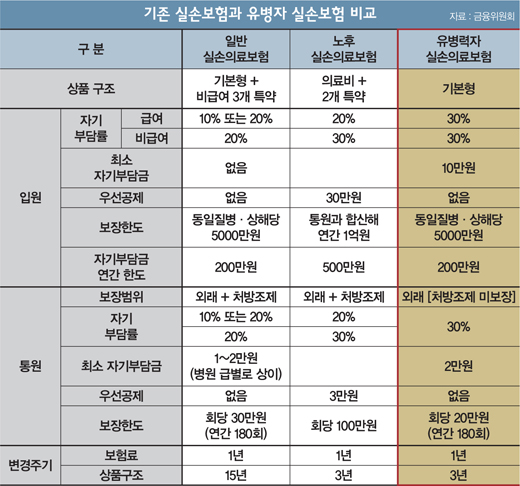
Looking at the history of medical expense insurance divided by generation clearly shows how insurance companies have managed their loss ratios over time. Early contracts were designed with terms too favorable to the policyholders, which was cited as a primary cause of deteriorating financial health for insurance companies. Subsequently, through several revisions, the coverage scope has gradually shrunk, and stricter controls have been implemented on non-covered medical treatments. As contracts become newer, the percentage you must bear has increased to prevent moral hazard, and brakes have been put on excessive prescription of injections and non-covered treatments.
Due to these structural differences, the nature of coverage for an old policy your parents might have and the latest policy you have can be considered completely different products. In the past, you could receive amounts close to the full cost of surgery or hospitalization, but now it has evolved into a form that strictly separates and covers covered and non-covered items. Therefore, you must accurately know which generation your product belongs to to avoid unexpected out-of-pocket cost bombs when receiving hospital treatment. Since the pros and cons of each generation are clearly distinct, it is absolutely forbidden to blindly follow rumors and join without proper consideration.
Medical expense insurance shows clear differences in out-of-pocket costs and non-covered coverage scope from the first generation to the latest.
3. How to Utilize Premium Comparison Disclosures
To find the most reasonable product that fits your conditions, you need to actively utilize official comparison disclosure sites such as the Korea Insurance Association. Relying solely on recommendations from specific insurance company agents makes it difficult to compare objective price competitiveness, so it is advantageous to view quotes from multiple companies at a glance. If you look for standardized disclosure data for a 40-year-old male or a specific age group, you will discover that premium differences between companies are larger than expected. Even with the same coverage content, the amount paid monthly can vary significantly depending on how business expenses are calculated.
By carefully comparing data from multiple companies, you can naturally narrow down the most reasonable option that places the least burden on your household economy. Simply taking the time to closely examine the premiums of insurance you previously joined in a rush can save a considerable amount of money every year. Recently, various information comparison platforms are well-established, allowing anyone to easily simulate expected premiums by age and gender. However, rather than choosing only the cheapest option, you should exercise wisdom by also checking the company’s financial stability and its ability to pay insurance claims.
You can save significantly on premiums by using official disclosure data and comparison platforms to contrast quotes from multiple insurance companies.
4. Tailored Enrollment Tips for Parents and Those with Pre-existing Conditions
When looking into medical expense insurance for older parents or those with chronic illnesses, it is often very difficult to apply general enrollment criteria. This is because situations frequently arise where enrollment in standard products is rejected due to age limits or where they hit a high wall in the underwriting process due to past medical history. In such cases, you should look into and compare senior medical expense insurance or products exclusively for those with pre-existing conditions, which have significantly relaxed age limits, instead of standard products. Products for those with pre-existing conditions go through simplified underwriting procedures, opening the door for those who are taking medication or have a history of surgery to apply.
However, you should keep in mind that products for those with pre-existing conditions may have slightly higher premiums than standard products and some non-covered items may be excluded from coverage. Since the maximum enrollment age varies from 75 to 80 years old depending on the company, it is essential to carefully compare the underwriting criteria of multiple companies. It is wise to accurately assess your parents’ health status and the types of medications they are currently taking, and then target companies with a high probability of underwriting approval. If you insist on standard products and end up with a rejection history, it may hinder your ability to look into other products, so you must approach this cautiously.
Parents or individuals with pre-existing conditions should carefully compare and select underwriting criteria for exclusive products with relaxed age limits.
5. Insurance Claims and Checking Hidden Coverage in Daily Life
For medical expense insurance, it is just as important to consider how convenient the post-enrollment process of actually claiming and managing hospital bills is as it is to enroll. Nowadays, systems are well-established that allow you to easily claim insurance money by taking a photo of your medical receipt and uploading it via a smartphone app. However, it is a good habit to carefully keep detailed itemized statements from hospitals you have visited to prevent missed claims. Sometimes, you may need to check if there are any overlapping parts between the medical expense coverage in a traveler’s insurance policy purchased for an overseas trip during a long holiday.
There are also many cases where useful coverages that we easily overlook in daily life, such as the Family Daily Life Liability Special Rider, are linked with medical expense insurance. You need to dig out old insurance policies that have been neglected for a long time, boldly clean up unnecessary special riders, and keep only the essential parts. Insurance is not something that ends once you enroll; it is part of living asset management that requires continuous checking and modification to match changes in your life. With just a little careful attention and effort, you can prevent unnecessary premium leakage and build a solid medical safety net.
Utilize easy claim systems and regularly check for hidden coverages in daily life and any overlaps.
6. Final Recommendations for Wise Insurance Consumption
The core of a successful medical expense insurance comparison starts with accurately analyzing your actual medical usage patterns without being swept away by others’ recommendations. As the medical environment changes rapidly and new forms of treatment costs increase, your insight into insurance products must be continuously updated to match the trends of the times. You must avoid the situation of hastily switching contracts just because the immediate monthly payment is cheap, only to cry later when you actually have to pay for major hospital bills. Going forward, the terms of medical expense insurance are highly likely to continue changing according to changes in medical policies and fluctuations in loss ratios for each insurance company.
In the midst of changing trends, establishing criteria to judge for yourself what the most advantageous conditions are will be your most reliable weapon. Please review the differences by generation, how to use disclosures, and tips for enrolling with pre-existing conditions that we have shared today, and check your current insurance status. Small attention and comparison habits can lighten your household’s fixed monthly expenses and wisely reduce large future economic burdens. Take out your policy now, check your coverage details, and complete the optimal choice that fits you best before it is too late.
You need to accurately analyze your medical patterns and maintain an attitude of continuously checking your insurance in line with changing trends.
Frequently Asked Questions
=