The Korea Exchange (KRX) has announced the immediate introduction of a new proprietary industry classification system called “KRICS,” designed to precisely reflect the structure of the domestic industry and the characteristics of listed companies. For a long time, there has been persistent criticism that existing classification standards struggled to adequately capture the core industrial groups of the rapidly changing domestic stock market. For instance, while electric vehicles and autonomous driving technologies have become mainstream, the old framework often resulted in the odd phenomenon of separating automobiles and transportation into distinct categories. The newly established standards were designed to overcome these practical limitations and accurately capture the actual business behaviors of listed companies. The related methodology will officially take effect from the 23rd of this month, and from the end of next month, investors will be able to directly verify the classification results of all listed stocks through the website. Many investors are closely watching what kind of changes this new standard will bring to the domestic stock market. Let’s carefully examine how this new classification system will be applied when we construct our portfolios.
=
KRX Introduces Proprietary Industry Classification System KRICS, Establishing New Mobility and Battery Sectors
1. Background of the New Industry Classification System KRICS
The Korea Exchange’s long-prepared proprietary standards for the systematic management of listed companies driving our capital market have finally been unveiled. After an initial draft was prepared through an external professional research project in 2024, it was finally completed after a process of gathering and incorporating feedback from numerous market participants. Earlier this month, a separate briefing was held for practitioners using major indices to actively reflect on-site voices. This was an essential measure to clearly manage the actual positioning of listed companies and proactively respond to the increasingly diverse demands for index development.
The previously used method, which followed global standards, had limitations in finely capturing the unique structure of the domestic economy and rapidly emerging new businesses. To address this, the Exchange analyzed the massive flow from the production process to the final consumption stage of the domestic economy to construct a new framework. Even investment experts on the ground had strongly raised the need for new standards, citing difficulties in grasping the essential value of companies. The system being introduced this time is expected to serve as a catalyst for fundamentally improving the quality of the domestic stock market, going beyond a simple renaming.
KRICS is a proprietary classification system developed by the Exchange over a long period to overcome the limitations of existing global standards and reflect the characteristics of the domestic stock market.
2. Top 9 Sectors and Detailed Sub-structure
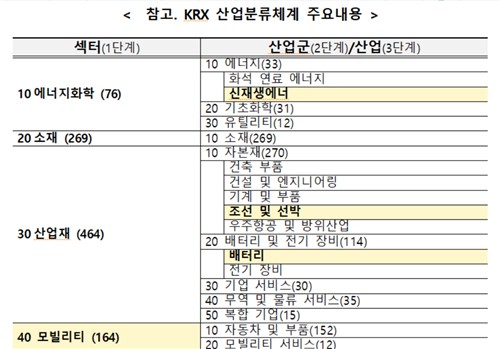
The newly introduced classification system is ambitiously composed of a total of 9 top-level sectors based on the value chain covering production and consumption across the domestic economy. It is meticulously structured with 9 Level 1 sectors, 24 Level 2 industry groups, 60 Level 3 industries, and 129 Level 4 sub-industries.
The nine newly designated sectors include Energy & Chemicals, Materials, and Industrials, as well as Mobility and Information Technology, which have recently attracted the most attention. Additionally, they comprehensively include core pillars of modern industry such as Financials & Real Estate, Consumer Goods, Healthcare, and Media & Content. Listed companies will be assigned precise positions within this vast network according to their primary business areas. It is designed with great precision to allow the ecosystem of domestic listed companies, which was previously complexly intertwined, to be grasped at a glance.
KRICS classifies domestic listed companies through a detailed four-tier network structure ranging from 9 sectors to 129 sub-industries.
3. Establishment of the Mobility Sector and Subdivision of Key Industries
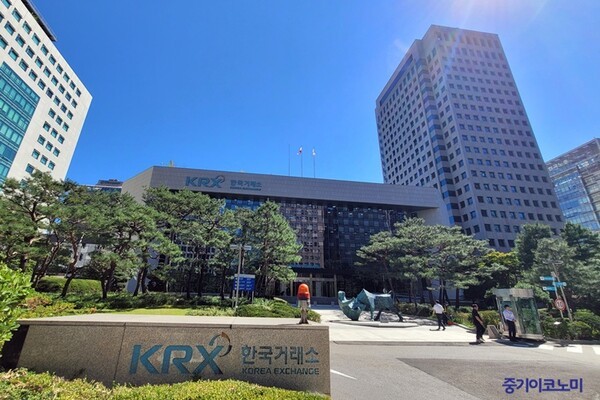
The most noteworthy aspect of this revision is the establishment of the “Mobility” sector, which combines automobiles and transportation. Previously, finished vehicle manufacturers and passenger transport businesses were scattered across different areas, making it difficult to see the massive trend of future means of transportation at a glance. However, by grouping these two fields into a single sector based on the common business area of “mobility,” it is now possible to comprehensively evaluate the value of related companies.
Furthermore, in the Industrials field, shipbuilding and vessel manufacturing, which are pillars of the Korean economy, and the recently surging battery industry have been clearly distinguished as separate independent industries. In the Information Technology field, semiconductors and displays have been separated, and in the Media & Content field, cultural entertainment and gaming services have been separated to enhance specialization. The most significant feature is the specific subdivision of core industries that hold a high market capitalization weight and attract intense investment interest in the stock market.
A new Mobility sector combining automobiles and transportation has been established, and key industries such as shipbuilding, batteries, semiconductors, and gaming have been significantly subdivided.
4. Transparent Management Through Regular Changes and Ad-hoc Reviews
The new industry classification results will be regularly updated based on the consolidated financial information from the latest business reports and audit reports published every April. Since the actual business content of companies changes every year, the policy is to periodically adjust the classification results to keep pace with these changes.
Of course, there may be cases where new listings occur mid-year or major events such as large-scale mergers and acquisitions happen, completely changing business characteristics. To prepare for such situations, the Exchange has established an ad-hoc review system to allow for flexible responses to market changes. Even if a listed company or a general index user determines that a classification change is necessary, they can officially request a re-review from the Exchange. Through this open communication channel, the Exchange plans to continuously provide accurate and transparent market data that investors can trust.
While regular changes are made every April as a principle, flexibility is ensured through ad-hoc reviews and re-review request systems in response to corporate events.
5. Utilization of Investment Indicators and Future Index Development Plans

The Korea Exchange plans to prioritize applying the newly established classification system to major domestic stock price indices representing the country starting from the second half of this year. Major representative indices such as the KOSPI 200 and KOSDAQ 150 will be the first to adopt the new framework, and the scope of application is expected to expand sequentially in the future.
Starting from the 26th of next month, investors will be able to access detailed industry classification results for each listed stock, as well as valuable market data such as stock prices and trading volumes, for free through the KRX Index website. By utilizing this, investors can develop their own investment strategies that precisely track the performance and growth trends of specific industries, going beyond simply looking at market capitalization rankings. The Exchange also plans to continue introducing innovative and diverse industry and thematic indices that will appeal to investors based on this classification system.
Starting with the application to representative indices in the second half and the release of related data, the development of various thematic indices will be fully launched based on this.
6. Improvement of Stock Market Quality and Future Outlook

The introduction of this proprietary industry classification system will be a significant turning point that elevates the level of the domestic capital market to the next level, going beyond simply ranking companies. A foundation has now been laid for the true value of core domestic companies, which had not been properly highlighted due to reliance on overseas standards, to receive proper evaluation. General investors can also find promising industries and companies much more intuitively and easily amidst complex market conditions.
Experts unanimously expect that as new indices are introduced, the flow of funds into the market will become more diverse and sound. In the midst of the changing massive industrial ecosystem, quickly understanding these institutional changes is more important than anything else to protect and grow one’s assets. Please mark the data release schedule for next month on your calendar and keep a close eye on what new position the companies you have invested in will occupy. We look forward to seeing the Korean stock market take another step forward using this new standard as a stepping stone.
The introduction of KRICS will be a core driving force for the healthy growth of the capital market by enhancing the comparability and understandability of the domestic stock market.
Frequently Asked Questions
=