A pension savings account is the most powerful tax-saving tool that allows you to secure a reliable tax refund during your annual year-end tax settlement while simultaneously growing your retirement funds. You often hear people say that not having a pension savings account is foolish, but many procrastinate because they are unsure of how to get started. The first step is to understand the structure that allows you to save a fixed amount monthly while fully enjoying the benefits of a tax credit, rather than a tax deduction. For instance, Mr. Kim, a 30-year-old office worker in Seoul, recently signed up for a pension savings account and, upon receiving his refund, immediately set up automatic monthly transfers. In this article, we will carefully examine the basic concepts of pension savings accounts, contribution limits, and successful asset management strategies.
=
Starting Your Retirement Planning: Pension Savings Account Tax Deduction Limits and Fund Investment Strategies
1. The Concept and Necessity of Pension Savings Accounts

A pension savings account is a representative tax-advantaged financial product promoted by the government to prepare for life after retirement. While it was once primarily a savings vehicle where you simply deposited money to earn interest, it has recently evolved into an investment account where you can directly select equity or bond-based products. It is considered an essential tool for retirement planning because it helps employees save on their annual taxes while allowing them to benefit from long-term compound interest.
As retirement approaches, anxiety about life after your working income stops increases, making it crucial to prepare in advance. It is common to hear senior colleagues complain that the National Pension alone is insufficient to cover their living expenses. In such situations, a pension savings account plays a vital role in filling the gap in retirement income. Therefore, if you start contributing early in your career, you can enjoy significant compound interest effects even with small amounts.
A pension savings account is more than just savings; it is a core investment tool for securing post-retirement living expenses and saving on taxes.
2. Tax Credit Limits and Refund Benefits

The biggest appeal of a pension savings account is undoubtedly the substantial tax refund you receive during your year-end tax settlement. The annual contribution limit is up to 18 million won, but the amount eligible for a tax credit is up to 6 million won for a standalone pension savings account. If you combine it with an Individual Retirement Pension (IRP) account, the deductible limit increases to a maximum of 9 million won, maximizing the refund effect. If your total annual income is 55 million won or less, you receive a refund of 16.5% of your contributions; if it exceeds this amount, the credit rate is 13.2%.
For example, an employee who maxes out their annual contribution of 6 million won can receive a cash refund of up to 990,000 won, depending on their tax bracket. Reinvesting this refunded amount into the account or using it for necessary expenses significantly improves the efficiency of your financial planning. By calculating your monthly contribution and setting up automatic transfers starting in January, you avoid the stress of scrambling for a lump sum at year-end. Remember that saving on taxes alone is equivalent to earning a guaranteed return of over 10% annually.
Pension savings accounts offer tax credits of up to 6 million won annually, making them an essential item for employees’ year-end tax settlements.
3. Fund and Exchange-Traded Fund (ETF) Investment Strategies
While pension savings accounts in the past were primarily stable products sold by banks, you can now invest in a variety of products through securities firm accounts. In particular, utilizing Exchange-Traded Funds (ETFs) that track domestic and international indices allows you to expect returns that outpace inflation over the long term. The most popular method is systematically accumulating US large-cap indices or bond-based products with your monthly contributions.
The key to long-term investing is to consistently increase your holdings without being swayed by sharp market rallies or crashes. For younger generations with decades until retirement, it is advantageous to maintain a high allocation to equity products while enduring volatility. Conversely, older individuals nearing retirement should adjust their portfolios to increase the proportion of safe assets to protect their principal. Experts emphasize the importance of regularly reviewing your account and rebalancing your asset allocation ratios.
Systematic investing in index-based ETFs through a securities firm’s pension savings account can enhance long-term returns.
4. Utilizing Integration with Comprehensive Asset Management Accounts
Transferring matured funds from a Comprehensive Asset Management Account (CAMA) to a pension savings account can yield significant additional benefits. You can receive an additional tax credit of up to 3 million won, equivalent to 10% of the transferred amount, making it a two-for-one deal. While moving a lump sum into a pension might feel burdensome, considering the tax-saving effects, there is no better deal.
Many investors hesitate to transfer funds due to the fear that their money will be locked up until retirement. However, given the magnitude of the tax benefits, this is a necessary step in the long-term asset formation process. Even if your income is temporarily interrupted or you need a lump sum, understanding the characteristics of each account and diversifying your holdings allows for flexible management. Splitting and managing two accounts according to their specific purposes is the shortcut to avoiding a tax bomb.
Transferring matured funds from a Comprehensive Asset Management Account to a pension savings account allows you to receive additional tax credit benefits.
5. Precautions for Early Termination and Pension Receipt
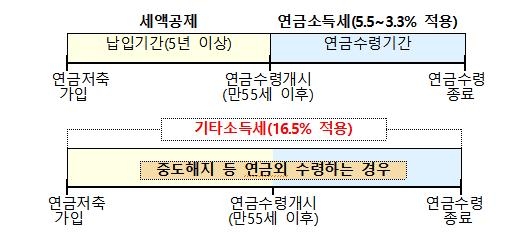
As the name suggests, a pension savings account is designed to be received as a pension in old age, so terminating it early can result in a significant tax penalty. If you terminate the account early or receive funds in a form other than a pension, you must return all the tax credit benefits you have received. Furthermore, a high tax rate of 16.5% is imposed as miscellaneous income tax, so it is an iron rule to maintain the account until retirement.
Even when receiving your pension in old age, you must ensure that your annual receipt amount does not exceed a certain threshold to avoid a comprehensive income tax penalty. Extending the receipt period or distributing the annual amount allows you to withdraw funds while paying only the lower pension income tax. Designing your post-retirement cash flow requires the wisdom to carefully consider the order of receipts and tax rates. It is essential to seek advice from tax professionals or study the relevant systems yourself.
Due to significant tax penalties for early termination, you should maintain the account until retirement and receive the funds in installments as a pension.
6. Securities Firm Events and Future Outlook
Recently, securities firms are trending toward offering various prizes and “jump-up” events to attract pension customers. There are many campaigns providing gift certificates to new subscribers or customers who actively use existing accounts, so it is advisable to take full advantage of them. Since delaying retirement preparation only increases your losses, it is recommended that you open an account by turning on your primary securities firm’s app today.
The government’s direction for tax reform is also continuously becoming more favorable and relaxed to assist in forming retirement assets. As the aging population accelerates, the importance of individual pensions, where individuals take responsibility for their own retirement, cannot be overstated. The habit of consistently accumulating small amounts monthly becomes a shield that securely protects your account 10 or 20 years from now. Use this article as a starting point to open a pension savings account in your name and begin your first contribution.
Utilize securities firm events to secure subscription benefits and start saving, even with small amounts, immediately.
Frequently Asked Questions
=