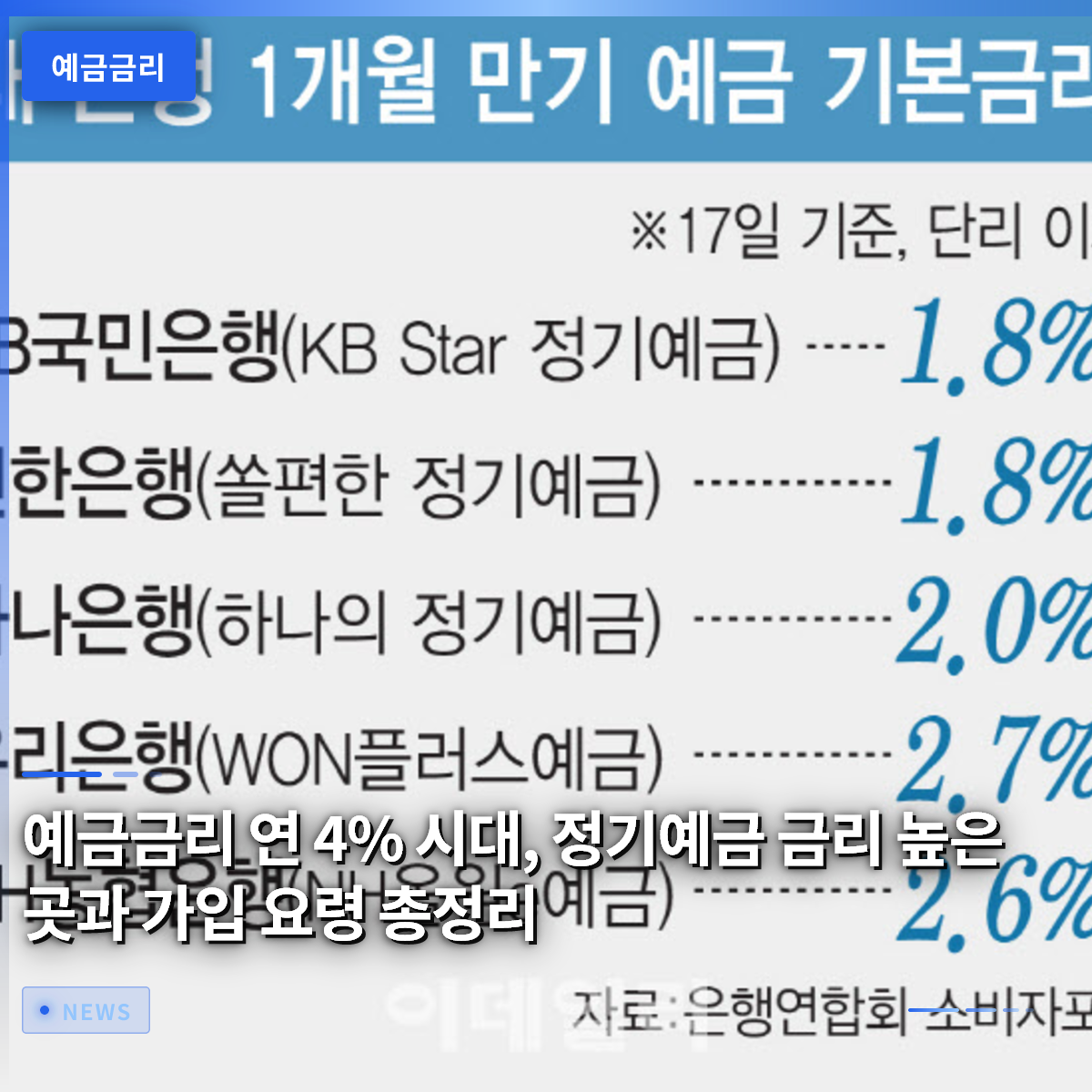
As deposit rates in the banking sector show signs of rising again, more people are looking for safe ways to secure interest income. Following the Bank of Korea’s recent base rate hike, commercial banks and savings banks have entered a fierce competition for deposits, with products offering rates approaching 4% annually appearing one after another. Mr. Kim, an office worker, found himself torn over where to invest his holiday bonus; instead of the stock market, he turned his attention to high-interest fixed deposits. While the “reverse money movement” phenomenon—where funds flow into stocks and cryptocurrencies—was previously prominent, there is now a growing trend of deposit products offering guaranteed interest regaining popularity. In this article, we will examine current deposit rate trends and provide a detailed guide on how to deposit your money under the most favorable conditions.
=
The Era of 4% Annual Deposit Rates: A Complete Guide to High-Yield Fixed Deposits and How to Maximize Your Returns
1. Recent Deposit Rate Trends and the Banking Sector’s Deposit Competition

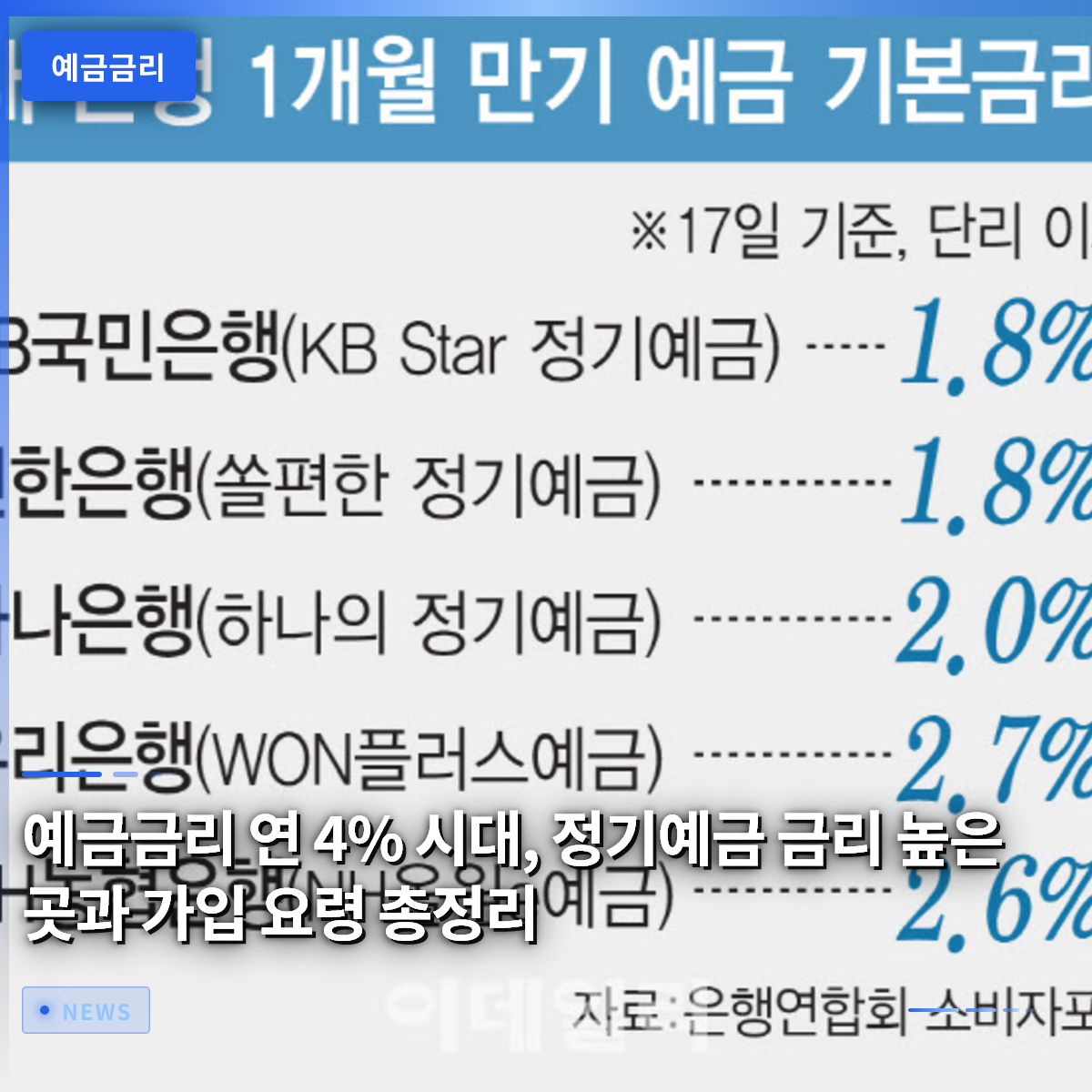
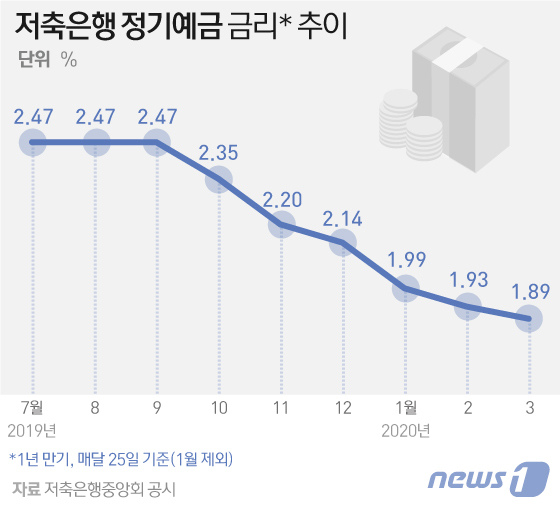
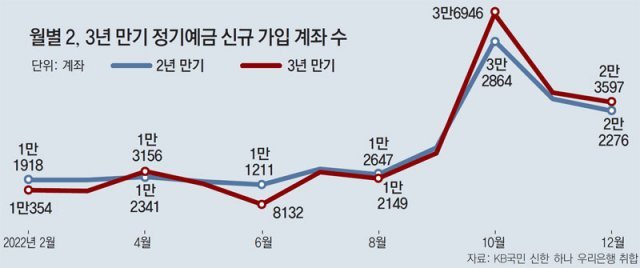
With banks raising their deposit rates, an environment has been created where interest income can be expected. Major financial institutions, including Nonghyup Bank, have consecutively raised rates on both lump-sum and installment deposits, intensifying the competition to attract customers. Representative fixed deposit rates at commercial banks now exceed 3.5% annually, while some savings banks are offering products close to 4% annually. As volatility in the stock market increases, the “reverse money movement” phenomenon, where funds shift from risky investments to principal-guaranteed deposits, is also accelerating. Banks are raising rates on deposit products as a strategic choice to secure liquidity in the market and capture customers. As household fund flows change, the criteria for selecting deposit products need to become much more rigorous. Rather than simply visiting the bank near your home, it is essential to compare conditions across various financial institutions first. While it is true that interest income has increased compared to the past, households that also utilize loans must simultaneously consider the burden of interest payments. When rates rise, the outcome of your asset management can vary significantly depending on where you allocate your surplus funds. Therefore, to properly utilize the current rate-hiking period, you must closely monitor the daily changes in the financial market.
As deposit rates rise due to competition in the banking sector, there is a vibrant flow of funds seeking safe interest income.
2. How to Find High-Interest Fixed Deposits and Precautions to Take
To find the highest deposit rates in the market, you must actively utilize comparative disclosures from financial institutions. By using the Korea Banking Finance Association’s consumer portal or various interest rate comparison tools, you can compare products from banks and savings banks nationwide at a glance. For example, regional banks and savings banks, such as Dream Savings Bank and Kwangju Bank, often offer slightly higher rates than commercial banks. However, caution is needed, as there are many cases where customers suffer losses by blindly signing up based solely on the highest advertised rate. In most cases, receiving the highest rate requires meeting strict preferential conditions, such as salary transfers, automatic payments, or marketing consent. Mrs. Lee, a housewife, tried to sign up after seeing an advertisement for the highest rate on a portal site, but ultimately received only the basic rate because she could not meet the complex conditions. Additionally, the rates listed in online comparative disclosures may differ from the rates actually applied to you, so you must always verify the final rate directly through the financial institution’s app. In particular, when using the auto-renewal function, the same rate as the existing account is often not applied; therefore, it is much more advantageous to manually switch to a new product at maturity.
To receive the highest deposit rate, carefully check preferential conditions and verify the actual applied rate directly via the app.
3. Deposit Insurance Limits and Safe Fund Diversification Strategies
When entrusting your valuable funds to a bank, you must always keep the deposit insurance limit in mind, not just the interest rate. Under current South Korean law, you are safely protected up to a maximum of 50 million won (principal plus interest) per financial institution. Mr. Park, an office worker, deposited over 100 million won (combining his severance pay and surplus funds) into a single savings bank, but after receiving advice from those around him, he was shocked and quickly diversified his deposits. Depositing a large sum exceeding 50 million won in one place just for a slightly higher rate is a risky investment approach that does not prepare for potential emergencies. To protect your assets safely, the standard practice is to split deposits into units of 50 million won across multiple financial institutions. For example, if you have 100 million won in surplus funds, you should deposit 50 million won in Savings Bank A and 50 million won in Bank B, ensuring each amount stays within the deposit insurance limit. While savings bank rates may appear more attractive than commercial bank rates, if safety is your top priority, diversifying deposits is not an option but a necessity. You must develop the habit of first verifying whether your principal is legally protected, rather than being swayed by rumors or high interest rates.
You should diversify your deposits to stay within the deposit insurance limit, which covers principal and interest up to 50 million won.
4. The Difference Between Deposits and Savings Plans, and the Truth About Interest Calculation
Many people confuse deposit rates with savings plan (regular savings) rates, leading to miscalculations of the actual interest they receive. Even if a savings plan offers a 10% rate, interest is only accrued for 12 months on the money deposited in the first month, while the money deposited in the last month only earns one month’s worth of interest. In contrast, a lump-sum fixed deposit earns interest for the full term because the entire amount is deposited from start to finish; therefore, if the rates are the same, a fixed deposit yields significantly more interest. Mr. Choi, a freelancer, had the experience of signing up for a savings plan based solely on an advertisement for a high rate, only to be greatly disappointed by the lower-than-expected maturity interest. If you have a lump sum of money, a fixed deposit is far more profitable than a savings plan, which requires monthly contributions. Of course, for office workers or young professionals with monthly income, savings plans can be an excellent tool for building a lump sum. However, if you already have seed capital, you should formulate a strategy to maximize interest income through deposit products rather than savings plans. You must accurately understand how interest is calculated and choose products that match the nature of your funds to prevent unnecessary interest losses.
Lump sums should be placed in deposits to earn full interest income, as the interest calculation method differs completely from savings plans.
5. The Invisible Link Between Loan Interest Rates and Deposit Rates
Ironically, as deposit rates in the market rise, the interest burden for people using mortgage loans or credit loans also begins to snowball. Since banks raise funds through deposits, rising deposit rates increase their cost of funds, which directly leads to higher loan interest rates. Mr. Jang, a business owner, was happy to see news that banks were raising deposit rates, but he later confessed that the interest on his own loans also rose, intensifying the pressure on his living expenses. For households with more debt than financial assets, the pain of increasing loan interest will far outweigh the joy of rising deposit rates. Therefore, when assessing the overall financial health of a household, it is wise to monitor loan interest rate trends alongside deposit rates. Households with sufficient surplus funds can enjoy substantial benefits from high deposit rates, but households that bought homes with loans or borrowed business funds are in a state of alarm. More people are also comparing the deposit rate with the conversion rate used when switching from a deposit-based lease (jeonse) to a monthly rent lease (woldae) to calculate their housing costs. You must carefully compare the interest income gained by depositing part of the deposit into a fixed deposit against the amount paid in monthly rent to prevent household losses.
Rising deposit rates lead to higher loan interest rates, so households with significant debt must thoroughly prepare for increased interest burdens.
6. Maturity Management, Future Deposit Rate Outlook, and Action Guidelines
Looking ahead, deposit rates are expected to remain volatile, with continued competition for deposits in the banking sector. Experts analyze that banks are likely to adjust rates frequently depending on changes in the US base rate and domestic inflation rates. Therefore, rather than locking up a lump sum all at once, a wise investment strategy is to split the maturity dates of your deposits. For example, instead of putting all your assets into a single one-year product, diversifying the terms into 6-month, 9-month, and 12-month periods allows for greater flexibility in responding to rising rates. You need to frequently check your bank app and, as the maturity date of your current product approaches, make the effort to switch to a product with better conditions rather than relying on auto-renewal. Do not leave your account neglected as per past habits; become a financial consumer who actively compares rates to protect your assets. Instead of reacting emotionally to stock market fluctuations, achieve stable asset growth through deposit products that offer guaranteed interest income. We recommend that you start today by opening your account drawer, checking the status of your dormant deposits and savings plans, and finding and executing the most favorable interest rate conditions.
You should prepare for future interest rate volatility by diversifying maturity dates and actively switching to better products.
Frequently Asked Questions
=