Deposit rates in the banking sector are on the rise, marking a period where interest yields approaching 4% annually are possible depending on the product. Following the impact of base rate hikes, commercial banks and savings banks have collectively raised rates on deposit products, leading to a clear trend of funds moving from the stock market to safer bank accounts. In fact, major commercial banks, including Nonghyup Bank, have increased rates on both lump-sum and installment deposits, accelerating the movement of household funds. In this article, we will examine the recent changes in deposit rates and detail the selection criteria you must understand to maximize your interest income. When choosing a deposit product, it is wise to carefully calculate the actual interest you will receive rather than blindly chasing the highest advertised rate. Let us now check the specific tips for securing maximum returns while keeping your principal safe.
=
As Deposit Rates Approach 4% Annually: Essential Conditions to Check Before Opening a Fixed-Term Deposit
1. Soaring Deposit Rates: The Current State of the Banking Sector

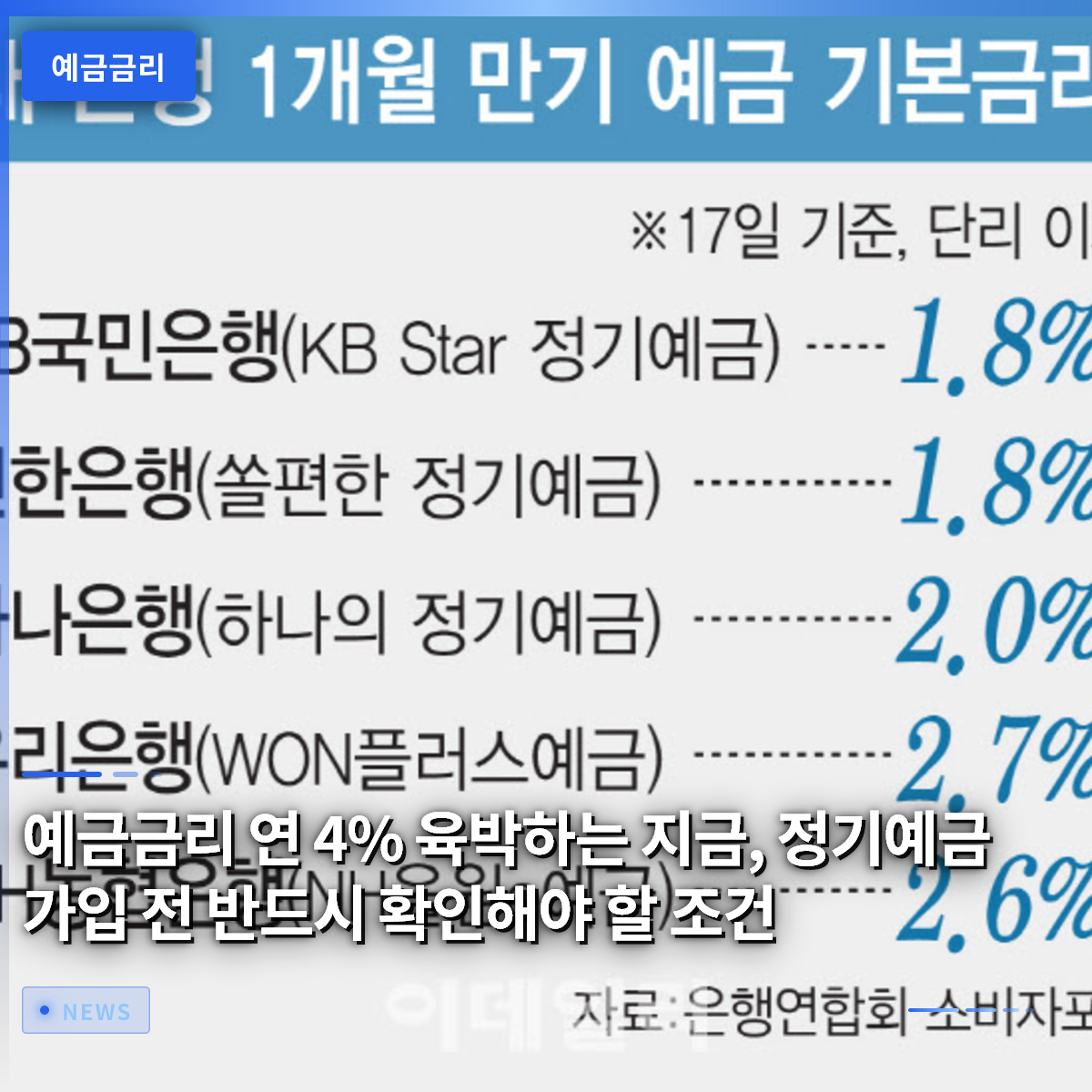
With deposit product rates in the banking sector rising again, people looking to deposit large sums of money are becoming very active. In line with the trend of the Bank of Korea’s base rate changes, commercial banks have collectively adjusted their deposit product rates upward. The fixed-term deposit rates of representative commercial banks have exceeded the 3.5% annual mark, while some savings bank products are approaching 4% annually. As volatility in the stock market increases, a preference for stable interest income over risky assets is spreading. This phenomenon is accelerating the so-called “money movement,” where funds flow out of stocks and risky assets into safe bank deposits. This is also why office workers are visiting bank counters to decide where to place their Chuseok bonuses or surplus funds.
Financial consumers can certainly expect higher interest income compared to the past, but this comes with the dual nature of increased interest burdens for households with loans. Banks are engaged in fierce competition to attract customers by touting high rates. However, the highest rates reported in the media often apply only if stringent preferential conditions are met, such as being a new customer, opening a salary-only account, or meeting automatic transfer performance criteria. Therefore, if you sign up based solely on the high numbers shown in advertisements, you are likely to be disappointed when the actual interest received falls short of expectations. It is essential to carefully compare and select the financial institution offering the most favorable conditions tailored to the nature and duration of your funds.
Although funds are flowing into banks as deposit rates approach 4% annually, the highest rates in advertisements often include stringent preferential conditions, so you must carefully calculate the actually applicable rate.
2. The Secret Behind the Highest Fixed-Term Deposit Rates: Preferential Conditions
Behind the attractive deposit rates offered by banks, there are often various preferential conditions that are difficult for the average customer to meet. For example, if you examine the details of a product promising interest close to 4% annually, you may find conditions requiring you to be a first-time customer or to use a specific card for a certain amount. Additionally, they may require cumbersome procedures such as consistently transferring your salary to an account at that bank or agreeing to receive marketing information. If you fail to meet even one of these conditions, the rate will be deducted from the initially expected rate, meaning the actual interest you receive may be less than you thought.
Mr. Kim, a young professional, recently visited a bank to sign up for a high-rate fixed-term deposit product he saw in an advertisement, only to discover an unexpected fact. To receive the prominently advertised rate, he had to switch his primary bank and automatically pay a certain amount of utility bills monthly. Since it was too much of a hassle to change all his existing transactions, Mr. Kim ultimately failed to meet the preferential conditions and had to settle for the basic rate, leaving him with a sense of regret. When choosing a bank product, you need the ability to coldly assess whether you can fully meet those conditions. Choosing a product that aligns with your financial lifestyle patterns is a much more advantageous long-term asset management strategy than blindly chasing high rates.
Receiving high deposit rates often requires meeting stringent preferential conditions, so you should choose a practical product that fits your transaction habits.
3. The Decisive Difference Between Savings and Deposits: Calculating Actual Interest
Many people underestimate the difference between deposit rates and savings rates, only to find themselves in trouble after blindly signing up for products with higher interest rates. Assuming an annual interest rate of 10% for both, there is a significant difference in the actual interest received between a fixed-term deposit (lump sum) and a savings account (monthly installments). Since a deposit keeps the full amount on deposit for the entire 12 months, you receive the full promised interest. In contrast, with a savings account, the deposit period varies for each monthly contribution; the money deposited in the first month earns interest for a full year, while the money deposited in the last month earns interest for only one month.
Due to this mathematical structure, even if the rates appear identical, the actual interest received from a fixed-term deposit is significantly higher than that from a savings account. Mr. Park, an office worker, signed up for a savings product with a high rate after hearing it was a good deal, but was shocked to find the interest received at maturity was less than expected. It turned out that because savings accounts accumulate monthly contributions, the average period during which the money actually worked was only about six months. If you already have a lump sum, opening a fixed-term deposit is overwhelmingly more advantageous in terms of interest income than a savings account. When signing up for financial products, do not be misled solely by the interest rate number; you must accurately understand how long your assets will remain in the bank.
Even with the same interest rate, deposits earn interest on the full amount for the entire period, whereas savings accounts have varying periods based on contribution timing, resulting in significantly higher actual interest for deposits.
4. How to Utilize the Deposit Insurance Limit for Safe Asset Management
As deposit rates rise and more people seek to deposit large sums in banks, it is crucial to pay close attention to methods for keeping your principal safe. All financial institutions in South Korea protect up to 50 million won per person (principal plus a small amount of interest) under the Deposit Insurance Act. Therefore, rather than putting all your assets into one bank, a diversification strategy of depositing 50 million won each in multiple financial companies is essential. Recently, some savings banks are attracting customers by offering rates much higher than commercial banks, but in such cases, it is even more important to evaluate the institution’s soundness and insurance limits.
Mr. Lee, who is approaching retirement, initially tried to deposit his lifetime savings all at once in the place offering the highest interest, but changed his mind after receiving advice from those around him. By splitting his large sum of over 100 million won into chunks of 50 million won and depositing them in first-tier financial institutions and high-quality savings banks, he thoroughly blocked any potential risks. This prevents the danger of losing precious assets if you blindly concentrate your funds based solely on bank interest rate rankings and an unexpected incident occurs. Safe asset formation begins with establishing thorough safeguards to protect your principal, just as much as chasing high interest. If your surplus funds exceed 50 million won, you must develop the habit of splitting them across multiple financial institutions.
Even if a financial institution goes bankrupt, up to 50 million won per person is safely protected by the Deposit Insurance Act, so large sums should be diversified across multiple institutions.
5. A Wise Perspective on Loans and Deposits During a Rate Hike Cycle
Ironically, the rise in deposit rates in the banking sector translates into a significant increase in interest burdens for households and businesses with loans. As commercial banks raise deposit rates, they also raise rates on mortgage loans and credit loans to match their funding costs. When comparing the conversion rate for converting a jeonse (lump-sum deposit) to a wolse (monthly rent) with deposit rates, the difference in housing costs between withdrawing the deposit to put in a bank or converting it to monthly rent becomes noticeable. If you do not carefully compare the interest income from depositing part of the jeonse in a fixed-term deposit with the increasing monthly rent burden, you may find yourself in trouble with increased fixed monthly expenses.
For households with high debt or small and medium-sized enterprises, rising deposit rates are less a cause for celebration and more a scary blade squeezing their cash flow. While the reverse money movement—funds flowing out of the stock market into safe banks—accelerates, the pressure to repay loan interest tightens the breath of ordinary citizens. Therefore, during this period, it is necessary to refrain from taking on excessive debt for investment and to adopt a conservative attitude by locking surplus funds in safe, high-interest deposits. Wise financial planning is required to coldly check your asset-to-debt ratio and balance interest income against loan costs. To build a solid personal household budget that remains stable during periods of rate volatility, you must periodically review the flow of your income and expenses.
While rising deposit rates are an opportunity for savers, they increase loan interest burdens for indebted households and businesses, necessitating comprehensive asset management.
6. Future Interest Rate Outlook and Practical Tips for Smart Deposit Sign-ups
The ability to predict future deposit rate trends and allocate assets accordingly is a core element of successful asset management. Experts forecast that financial market volatility will persist for the time being, leading to fierce competition for deposits in the banking sector. Consequently, there is a high likelihood that special products or products offering preferential rates based on duration will be released frequently. It is wise to use a “laddering” strategy—splitting maturities into multiple periods according to when you need the funds—rather than locking all your funds in for a long term at once. For example, if you diversify maturities into 6, 9, and 12 months, you can respond flexibly if interest rates rise further.
Additionally, developing the habit of regularly checking interest rate comparison websites or disclosures from the banking association allows you to secure high-rate products ahead of others. Utilizing internet-only products or preferential rates for non-face-to-face sign-ups can help you secure higher interest benefits without visiting a branch. During volatile periods like the current one, it is important to discard impatience and calmly check the safety mechanisms for your assets. Based on the various conditions and precautions examined today, please find the deposit product that best suits you. Small attention to detail and careful comparison will become the most reliable weapons for protecting and growing your precious assets.
By utilizing a diversified deposit strategy with multiple maturities and frequently checking interest rate comparison information, you can secure favorable interest income even during volatile periods.
Frequently Asked Questions
=