The Individual Retirement Pension (IRP) is an essential financial product that allows you to secure both year-end tax deduction benefits and retirement assets. When office workers prepare for their annual tax settlement, this pension account is often the first thing they check. Last year, Mr. Kim, an office worker with an annual salary of 50 million won, was pleasantly surprised to receive a much larger tax refund than expected thanks to his IRP contributions. However, when it comes to actually opening an account, many people have numerous questions, such as whether early withdrawal is possible and whether closing the account will result in a heavy tax burden. In this article, we will thoroughly examine the exact tax deduction limits for IRP pensions, the most advantageous methods for receiving benefits, and the risks associated with early termination that you should avoid.
=
The Ultimate Guide to IRP Pension Tax Deduction Limits and Early Withdrawal Conditions
1. Understanding the IRP: Concept and Necessity

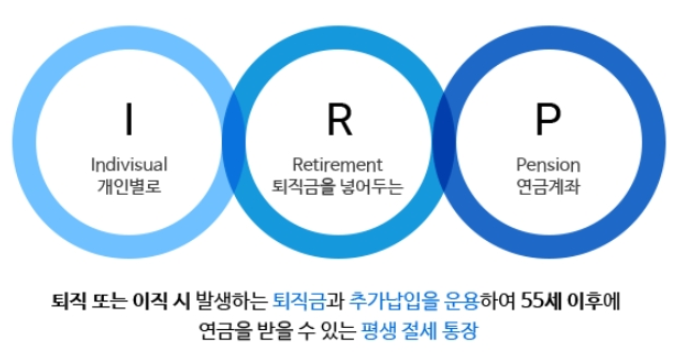
The Individual Retirement Pension (IRP) is a dedicated account that allows employees to voluntarily contribute funds during their employment or to transfer and manage their severance pay upon changing jobs. In the past, severance pay was settled in a lump sum by the company, but current laws encourage transferring these funds to an IRP account to be used as retirement funds. A key advantage is that while saving a fixed amount monthly or annually, you can manage your assets not only through deposits but also through various investment products such as funds and Exchange-Traded Funds (ETFs). For those with long careers, transferring severance pay to this account and investing it is far more tax-efficient than simply leaving it in a regular bank account. This is why many senior colleagues rush to banks or securities firms to open accounts immediately upon receiving their severance pay. Additionally, the government provides substantial tax incentives for personal contributions made in addition to the transferred severance pay. As aging societies accelerate, relying solely on state-provided pensions is no longer sufficient, making it an era where individuals must actively grow their own assets. Financial institutions like banks and securities firms are also running various sign-up events to attract customers and assist in asset formation. By choosing a financial institution that suits you and contributing consistently, you can lay a solid foundation for a secure retirement.
The IRP is an essential account that simultaneously addresses severance pay management and the growth of retirement assets.
2. The Truth About Tax Deduction Limits for Pension Savings and IRPs
Many people are confused about the tax deduction limits for Pension Savings accounts and IRPs, but these two accounts operate under a combined limit structure. A Pension Savings account alone offers a tax deduction of up to 6 million won, but when combined with an IRP, the total deduction limit increases to 9 million won. For example, if you contribute 6 million won to a Pension Savings account and an additional 3 million won to an IRP, you can fully enjoy the tax deduction benefits on the total 9 million won. If your total annual income is 55 million won or less, a deduction rate of 16.5% applies, allowing you to receive a substantial refund of up to 1.485 million won. If your income exceeds this amount, a deduction rate of 13.2% applies, with a maximum refund of 1.188 million won. You should be careful not to miss out on maximum benefits by arbitrarily depositing 9 million won solely into an IRP or over-contributing to a Pension Savings account without understanding this calculation method. Since tax deductions are based on contributions made by the end of December, it is essential to develop the habit of carefully checking your contribution status before the year ends. Mr. Park, an office worker, saves taxes efficiently by checking his pension contributions every autumn and making a lump-sum deposit to cover any shortfall. Simply understanding the structure of tax deduction limits can yield economic benefits ranging from several hundred thousand to several million won annually.
By contributing up to a combined total of 9 million won to Pension Savings and IRP accounts, you can receive a maximum tax deduction of 16.5%.
3. Unavoidable Crises: IRP Early Withdrawal Conditions
Although this account is intended for retirement assets, life inevitably presents situations where a large sum of money is urgently needed, making early withdrawal conditions a critical concern. Unfortunately, the IRP is strictly regulated by law, making it difficult to withdraw funds for general reasons. Early withdrawal is only permitted under specific circumstances, such as when a non-homeowner subscriber purchases a house in their own name or must pay a deposit for a rental property, or in other cases defined by law for securing housing for non-homeowners. Additionally, situations where the subscriber or a dependent family member requires medical expenses for continuous care of six months or longer are also recognized as exceptions. It is also possible to withdraw remaining assets early if a bankruptcy declaration is made or a decision to initiate personal rehabilitation proceedings is issued. If you do not meet these special criteria, you must maintain the account. Therefore, when depositing surplus funds, you must carefully consider whether you can afford to have that money locked away for several years. Mr. Lee, an office worker, nearly faced a major setback when he tried to break his IRP to raise funds for his wedding, only to realize he did not meet the early withdrawal conditions. He had to sweat profusely looking into loan products or other alternatives instead of closing the account. Therefore, it is wise to keep emergency funds in regular deposits or products with free access, and to use the IRP exclusively for retirement and tax reduction purposes.
IRP early withdrawal is very restrictive unless it is for legally defined special situations such as home purchases or medical expenses.
4. How to Avoid a Tax Bomb: IRP Termination and Pension Receipt Methods
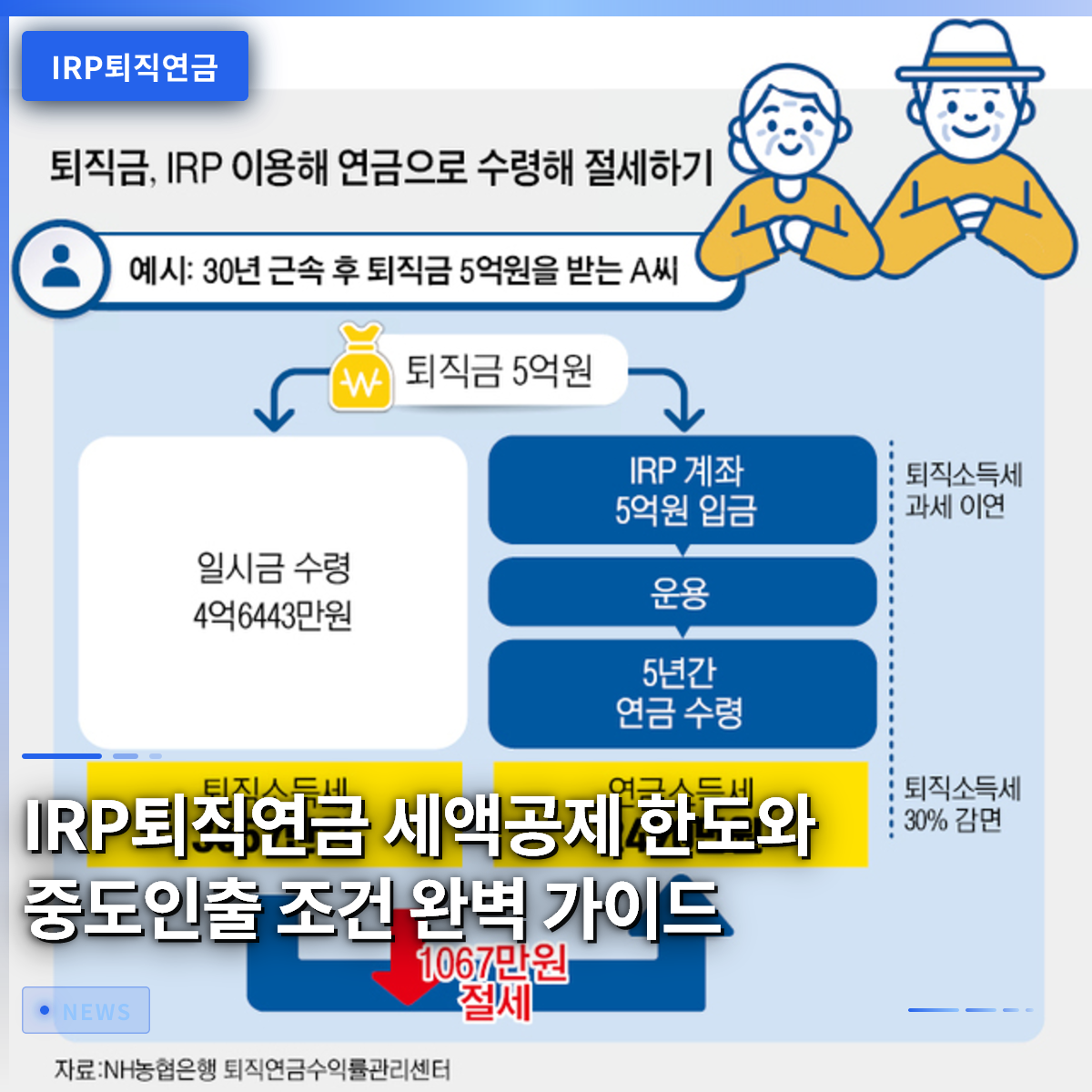
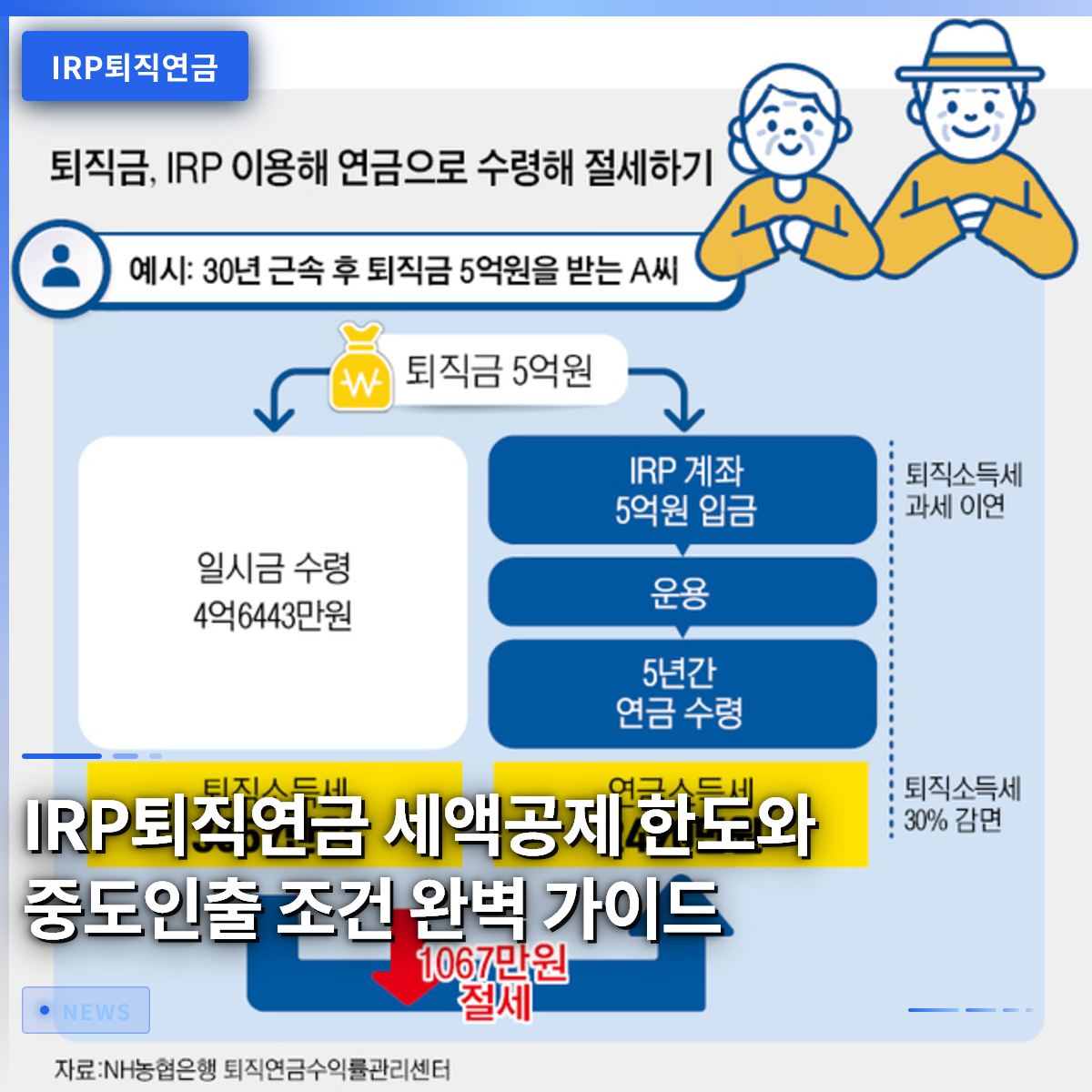
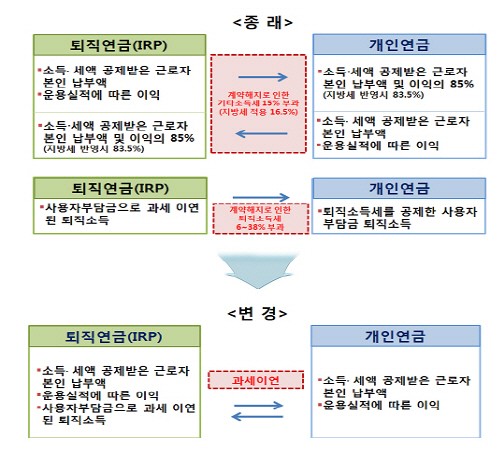
When leaving a job or retiring, you may want to receive your severance pay in cash immediately, but you must carefully decide on the receipt method to avoid a heavy tax burden. By law, severance pay provided by the company must be transferred to an IRP account. If you immediately terminate the account to cash out, you will have to pay a significant amount of taxes at once. In addition to the standard severance income tax, a high tax rate of 16.5% is deducted as miscellaneous income tax on the amounts for which you received tax deductions and on any investment gains. Therefore, to avoid a tax bomb, the most advantageous option is to choose the method of receiving the funds as a pension in installments after the age of 55. When receiving pension benefits, you can enjoy a tax reduction of 30% to 40% on the original severance income tax, and the pension income tax rate is lowered to between 3.3% and 5.5%. Mr. Choi, who retired at age 60, significantly reduced his tax burden and alleviated concerns about living expenses by receiving his severance pay as a monthly pension rather than a lump sum. If you are in a situation where you must inevitably terminate the entire account, you must make the decision with the full understanding that tax preferential benefits will be lost. To ensure a comfortable life after retirement, it is necessary to adopt a strategy of setting the pension receipt period to 10 years or more to minimize the tax burden.
To reduce taxes and prepare for retirement, severance pay should be received as a pension in installments after the age of 55.
5. Tips for Choosing a Financial Institution and Managing Your Portfolio
IRP accounts can be opened at various financial institutions, including banks, securities firms, and insurance companies, and the return on investment can vary significantly depending on where you open the account. Products from banks offer the advantage of safe management through principal and interest-guaranteed products, but they have the drawback of being difficult to beat inflation in the long term. On the other hand, accounts opened at securities firms allow for direct investment in various funds and ETFs, enabling more aggressive asset growth. Recently, many financial institutions are running events offering mobile gift certificates or various prizes to new subscribers, which can be a small but enjoyable benefit. When choosing investment products, you must accurately assess whether your investment style is stable or aggressive and comply with legal standards requiring a certain proportion of your total assets to be in safe assets. Mr. Jung, an office worker, regularly checks his returns via his securities firm’s mobile app, adjusts his portfolio, and manages a mix of equity funds and bond assets. You should also carefully examine the fee structures of financial institutions; many waive management fees for non-face-to-face sign-ups, so saving on costs is advantageous. Choosing the platform that offers the most suitable investment environment for you and managing it consistently is the shortcut to successful pension wealth management.
You should choose the appropriate financial institution, such as a securities firm or bank, by considering your investment style and fees.
6. Final Advice for Successful Retirement Planning
So far, we have examined in detail the concept of the IRP, tax deduction limits, early withdrawal conditions, and smart methods for receiving pension benefits. While the word “retirement” may still feel distant, as you collect your annual severance pay and tax deduction benefits, a solid retirement asset will be completed before you know it. Even those who used to sigh during the year-end tax settlement season can smile while receiving their refunds if they prepare their pension accounts in advance. Going forward, you should periodically check your pension assets in line with changes in the financial market and aim for long-term maintenance rather than hasty termination. We hope you will open your IRP account today, check if you have reached your contribution limit, and start designing a prosperous life for tomorrow.
Consistent attention and proper contribution habits are the keys to a successful retirement and tax savings.
Frequently Asked Questions
=