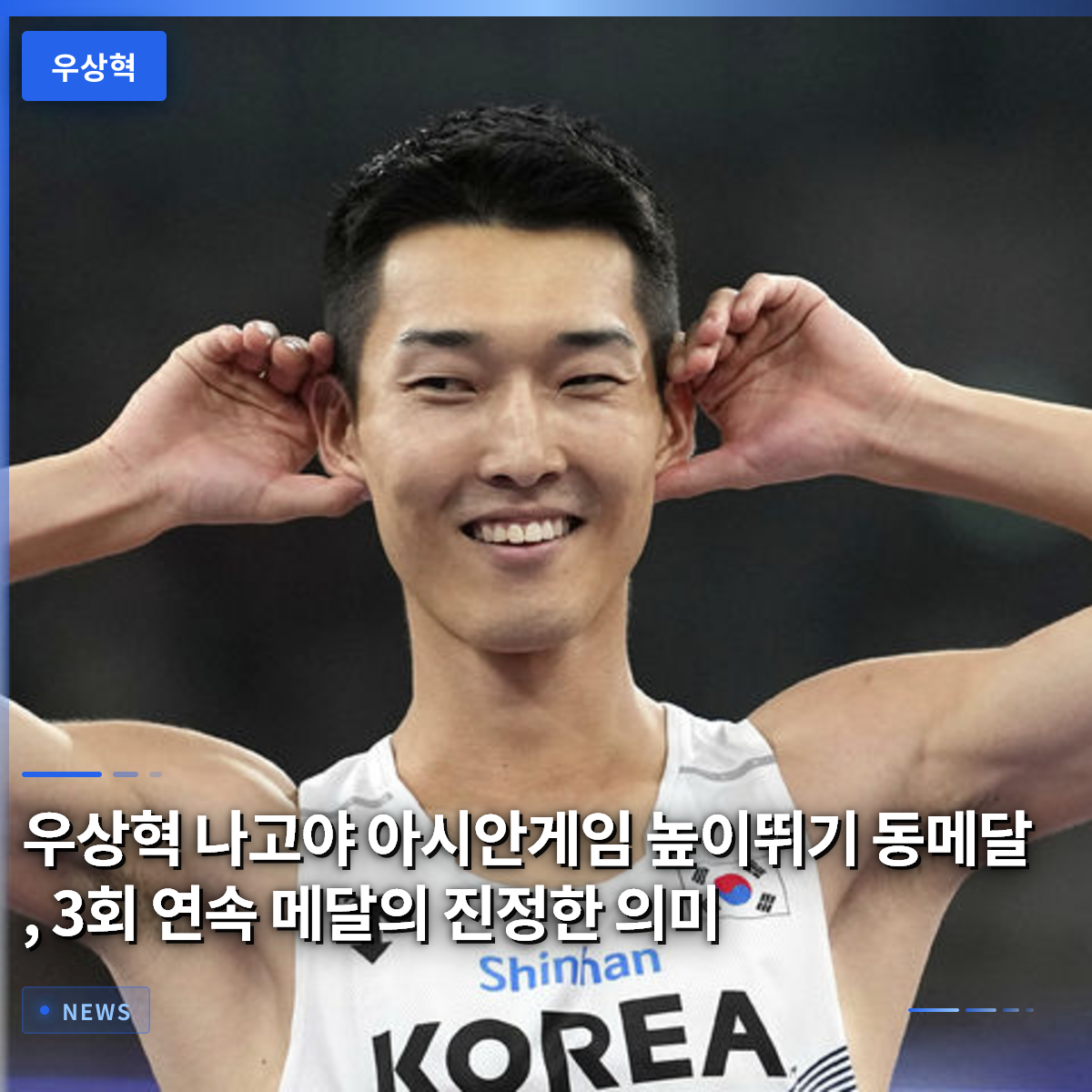
The “Smiling Jumper,” Woo Sang-hyeok, claimed a valuable bronze medal in the men’s high jump final at the 2026 Aichi-Nagoya Asian Games with a mark of 2.22 meters. With this achievement, Woo set a remarkable record by winning medals at three consecutive Asian Games, once again elevating the pride of Korean track and field. While there is certainly regret in not securing the gold medal, his fighting spirit in overcoming injury adversity moved everyone deeply. His ability to maintain a smile even under the worst possible conditions of pouring rain demonstrated what true sportsmanship looks like. In this article, we will take a detailed look at the competition at these Asian Games, his journey through injury, and the challenges that lie ahead. We hope readers can vividly recall the intense emotions of the scene they witnessed on their screens.
=
Woo Sang-hyeok Wins Bronze in High Jump at Nagoya Asian Games: The True Meaning of Three Consecutive Medals
1. The Final Stage in the Rain
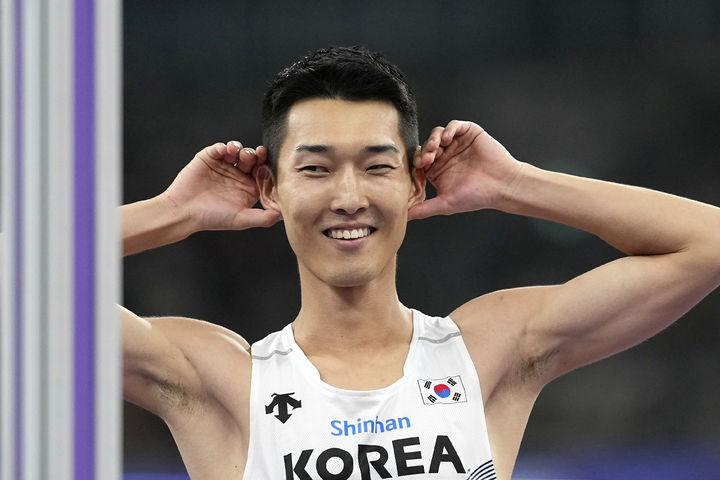
The men’s high jump final at this tournament, held at the Mizho Park Stadium in Nagoya, Japan, did not start smoothly. Heavy rain began to pour from the sky, turning the track and takeoff area into a highly disadvantageous environment for the athletes. Since high jump outcomes are often decided by a single takeoff, a slippery surface is the biggest enemy, increasing the risk of injury and hindering performance. Nevertheless, Woo Sang-hyeck entered the field with his trademark bright smile, trying to shake off the tension. The cheering crowds filling the stands and the viewers watching from behind the screens felt a great sense of relief just from his presence. While it is hard to imagine the mental state of an athlete competing in such bad weather, he chose to accept the given environment and focus rather than panic. Even as the rain intensified, Woo maintained his characteristic composure and navigated the competition. As the bar was raised, it was noticeable that other athletes failed repeatedly because they could not time their jumps due to the rain. However, Woo, a veteran with experience in numerous international competitions, calmly took his steps and steadily maintained his own pace. The eye contact he exchanged with his coaching staff clearly reflected his firm determination to win a medal. Thanks to this focus, he cleared the initial heights of 2.10 meters and 2.14 meters without a single miss, signaling a smooth start.
Woo Sang-hyeok demonstrated unwavering focus and easily cleared the initial heights despite the harsh conditions of heavy rain.
2. Fighting Spirit That Overcame the Injury Gap
This bronze medal is even more valuable because Woo overcame the pain of a serious injury suffered before the tournament. In May, Woo suffered an unexpected injury, facing the biggest crisis of his athletic career, and endured a long hiatus of about three months. For an athlete, a three-month break is not just a rest; it is a critical period where one can lose both competitive feel and muscle memory. Since this stage in Nagoya was effectively his return match after full recovery from injury, there were many voices expressing concern. Despite these worries, Woo poured everything into his rehabilitation, counting the days until he could jump again. It is widely assessed that his movements in this final were not perfect compared to his practice games at the athletes’ village or previous evaluation matches. He likely felt minor pain in his ankle with every landing, but he did not show it throughout the competition, focusing entirely on clearing the bar. If we consider how difficult it is to walk properly for several days after even a minor ankle sprain in daily life, we can easily understand the magnitude of his fighting spirit. It was a moment where his time of enduring bone-grinding pain, driven solely by the determination to stand on the field wearing the Taegeuk mark, finally bore fruit. By demonstrating a recovery speed that seemed medically impossible and miraculously taking the stage, he was already a winner in itself.
Returning after a long three-month injury hiatus, Woo Sang-hyeok displayed fighting spirit after rigorous rehabilitation to take the stage.
3. The History of Three Consecutive Asian Games Medals

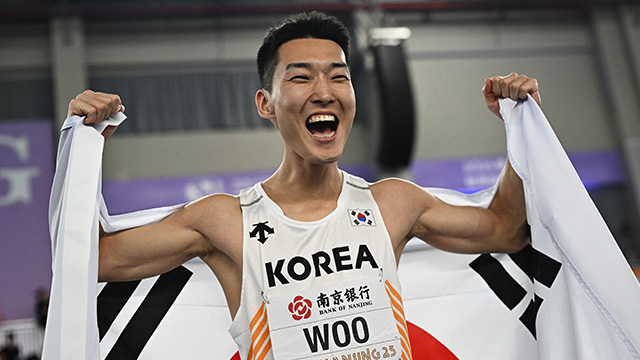
With a mark of 2.22 meters at this tournament, Woo added a bronze medal to his collection, completing the great record of winning his third Asian Games medal. Starting from the 2016 Rio de Janeiro Olympics, he has consistently maintained top rankings at World Championships and various international stages, writing new history for Korean track and field. In particular, on the Asian Games stage, he enjoyed the joy of standing on the podium at the 2018 Jakarta-Palembang Games, the previous Hangzhou Games, and now the Nagoya Games. Consistently collecting medals over three Asian Games proves that he is not a one-hit wonder but an athlete maintaining world-class skills. The value of this achievement is even higher considering that high jump is a discipline with extreme physical burden and high injury risk. It is extremely rare in the history of Korean track and field to find an athlete who has consistently maintained the top tier in Asia in a specific event for this long. He has become a giant mountain and a milestone for junior athletes, and has continuously proven the potential of his event as a source of pride for the entire Korean sports community. While some may express regret that the medal was not gold, in the world of sports, winning medals for three consecutive times is a height not everyone can reach. His perseverance in defending his position while fighting against changing competitors at every tournament is highly praised regardless of nationality. The records he will continue to write will undoubtedly be remembered as legends in the Korean track and field community forever.
By winning medals for three consecutive times from the 2018 Games to the Nagoya Games, he wrote a new legend in Korean track and field.
4. Regret and Challenge in Conquering the Summit
Although this was his fourth attempt at the Asian Games stage, the fact that he ultimately did not secure the gold medal remains the biggest regret for both fans and the athlete himself. In this final, a variable occurred when his strong rival, Qatar’s Barshim, withdrew, creating an opportunity for Woo to win gold. Barshim, who was considered the strongest favorite for victory even before the competition, dropped out due to injury or poor condition, sending the outcome into further uncertainty. However, in this changing situation, the psychological instability of the athletes increased, and Woo also failed to surpass his personal best of the mid-2.30-meter range. While hypothetical “what ifs” have no meaning in sports, this competition served as a stage that left him with many tasks. In the post-game interview, Woo did not hide his regret but showed a firm resolve to strengthen his determination. He knew better than anyone that he still had to overcome technical flaws and physical limitations to reach the top. His attitude of not fearing failure and immediately turning his gaze toward the next goal reveals true sportsmanship. The value of the sweat he has shed does not fade just because he did not wear a gold medal; rather, it will serve as a strong motivation for the future.
The regret of missing out on gold despite variables such as Barshim’s withdrawal will become the spark for new challenges in the future.
5. Comfort Offered by the Smiling Jumper
The nickname “Smiling Jumper,” which symbolizes Woo Sang-hyeok, shone even brighter at this Nagoya venue. Even in situations where the competition was not going well and he was burning with frustration, he smiled brightly at the cameras, reassuring the fans cheering for him. In our daily lives, it is never easy to force a smile after failing a major exam or making a mistake during an important presentation. However, Woo used his smile to comfort himself and brighten the atmosphere on an international stage dominated by extreme stress and pressure. That smile was not just for show; it was his own mental shield and source of energy for overcoming extreme pain. The countless citizens of South Korea watching the game through their screens could find deep comfort and positive energy in his smile. His bright expression provided small courage to office workers and students enduring tough days in their respective places. He personally proved that what is more precious than the color of the medal is the attitude of not giving up in the face of failure and standing up again, and the smile one maintains amidst it all. Woo Sang-hyeok reminded us once again that the true emotion sports give us lies not only in perfect victory but in the process of overcoming hardships. We wholeheartedly support his smile as it soars higher on the world stage of high jump in the future.
Woo Sang-hyeok’s attitude of not losing his smile even under harsh conditions provided deep emotion and comfort to many people.
6. Future Prospects and Reader Support
Using this Asian Games bronze medal as a stepping stone, Woo Sang-hyeok is now preparing for a new leap toward a bigger stage. Having successfully concluded the 2026 tournament, he will tie his shoelaces again for the upcoming World Championships and the Olympics in the more distant future. If he completely shakes off the injury and supplements his physical strength and technique, it will be only a matter of time before we see him standing tall at the world’s peak again. We hope that our readers, rather than focusing solely on the result of this competition, give him a generous round of applause for his fighting spirit in overcoming injury and finishing strong. If you send warm interest and support for all his upcoming competitions, it will be the greatest strength for the athlete. Let us all enthusiastically cheer for the dazzling flight that Woo Sang-hyeok, who is rewriting the history of Korean track and field every day, will show in the future.
Having concluded this tournament, Woo Sang-hyeok will move toward a bigger world stage, and continuous interest and support are needed.
Frequently Asked Questions
=