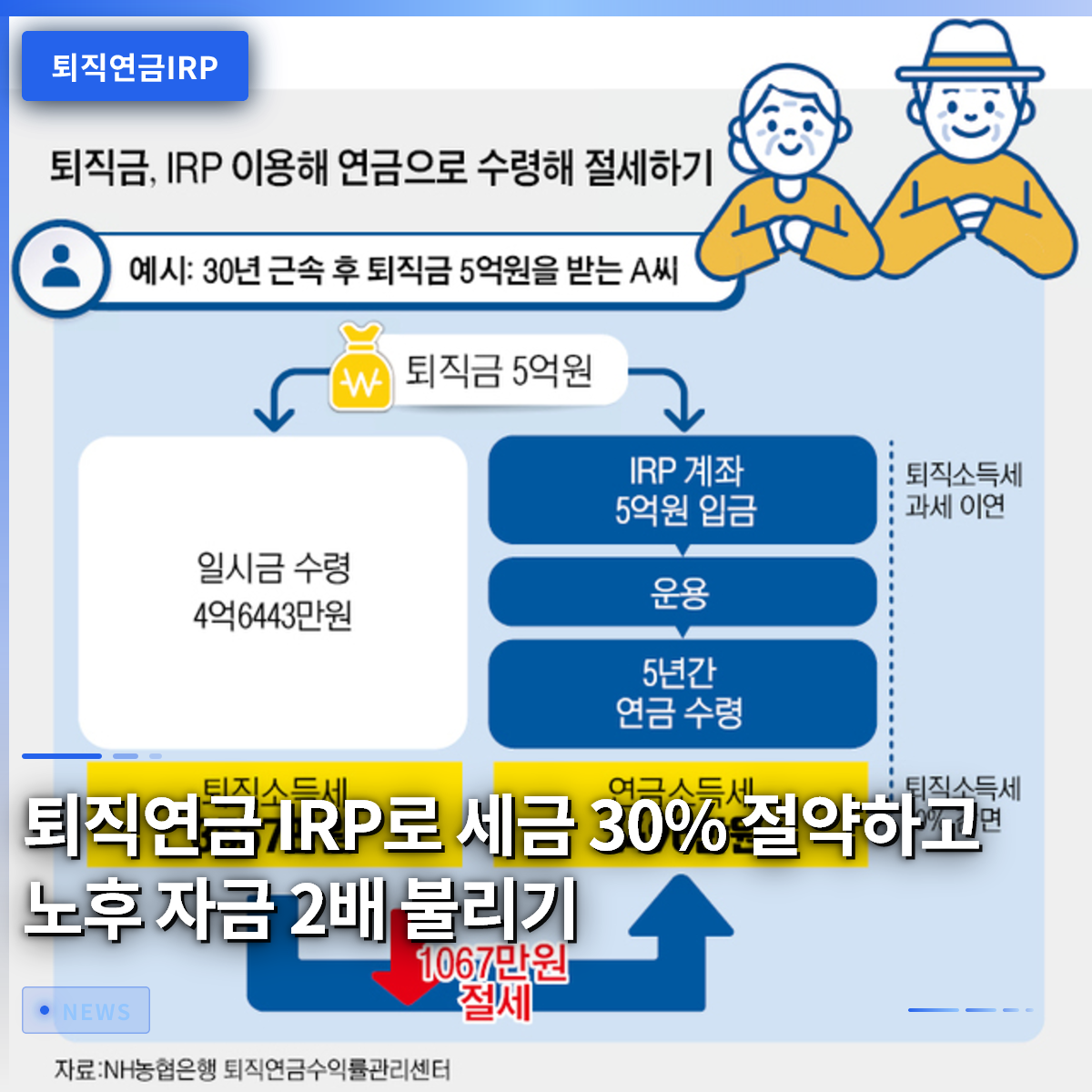
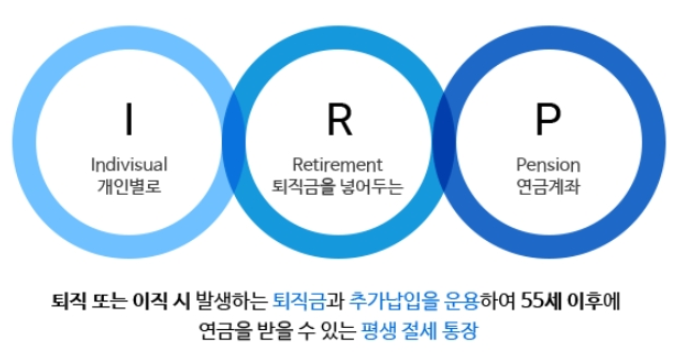
Receiving your severance pay in an IRP account significantly reduces your tax burden. An IRP (Individual Retirement Pension) is a personal retirement pension that allows you to consolidate your severance pay upon job change or retirement to prepare for your own future. Manager Ahn emphasized that you must receive your severance pay in an IRP account to achieve tax savings. Since IRPs allow you to fill the annual tax deduction limit of 9 million KRW, your year-end tax refund amount also increases. Furthermore, utilizing an IRP when converting from a Defined Benefit (DB) plan to a Defined Contribution (DC) plan can also reduce the burden of severance income tax. This article provides a detailed look at tax-saving secrets through IRPs, ETF investment strategies, non-face-to-face account opening, fee savings, and future prospects.
=
Save 30% on Taxes and Double Your Retirement Funds with IRP
1. Why Receiving Severance Pay in an IRP Account is Essential

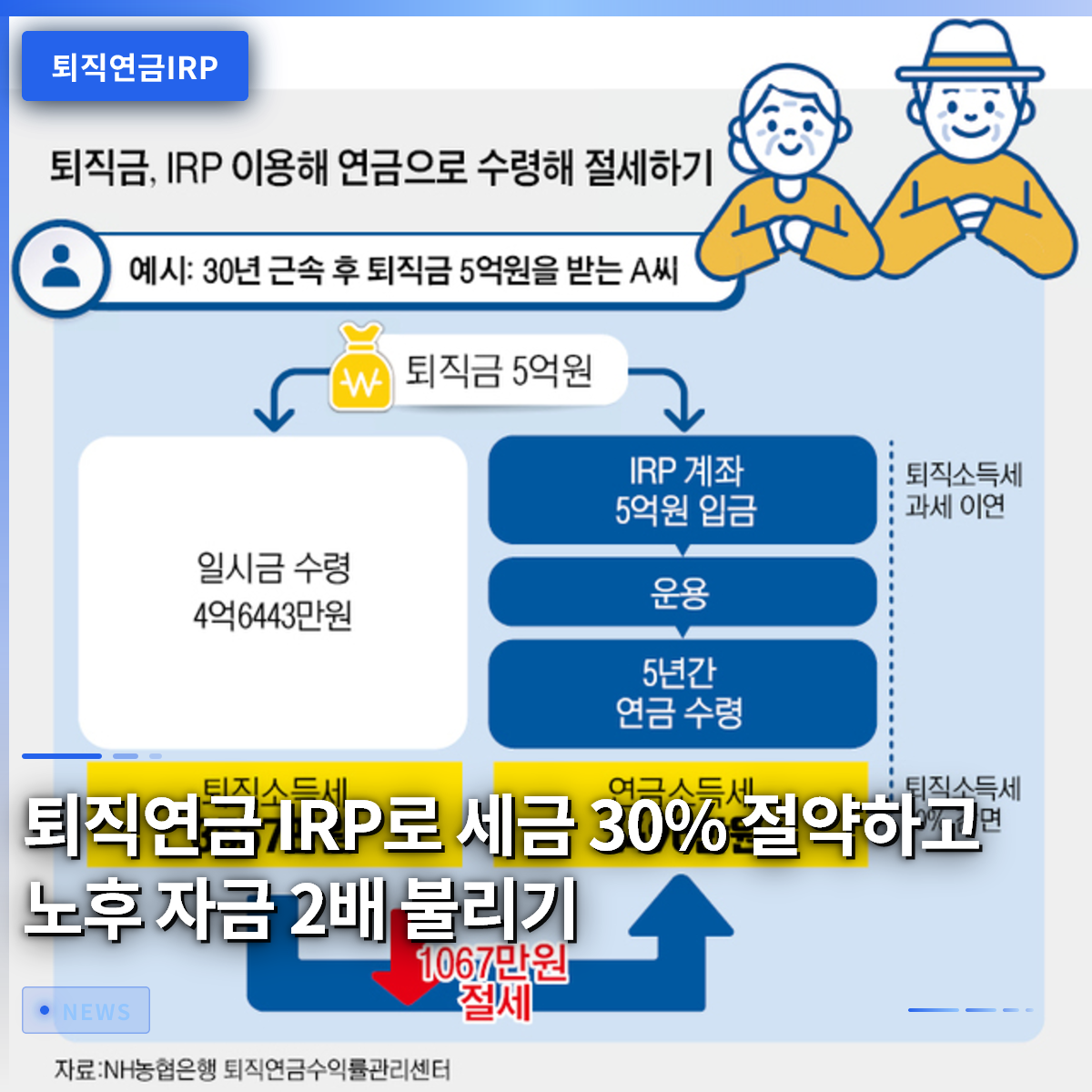
If you receive your severance pay directly into your bank account as cash, you must pay a 16.5% miscellaneous income tax without any tax benefits. In contrast, receiving it in an IRP account allows you to defer severance income tax and spread the payment over time to reduce the burden. Additionally, IRPs offer tax deductions of up to 3.3 million KRW when received as a pension, resulting in significant long-term tax savings. In some cases, making a lump-sum deposit of your severance pay into an IRP can yield interest rates of over 5% annually without losing the principal. At KB Kookmin Bank, a low fee of 0.25% is applied to balances under 5 million KRW even upon early termination. Therefore, the IRP is the most efficient tool for preserving and growing the value of your funds after retirement.
Tax-saving strategies and investment tips using IRPs: Filling the annual IRP limit of 9 million KRW can result in a year-end tax refund of up to 2.265 million KRW. If you receive it as a pension after 5 years of enrollment, you can also receive additional tax reductions. When employees convert from a DC plan, transferring their DB plan severance pay to an IRP allows them to maintain the account without termination fees. Purchasing ETFs within an IRP allows you to maintain a 30% bond and 70% stock allocation to ensure stability. Investing 500,000 KRW monthly for 10 years in an IRP accumulation fund offered by banks can yield an expected return of approximately 45%. In particular, because IRPs offer tax deduction benefits, the total return rate is more than 10% higher than that of general pension savings accounts. Therefore, the IRP is an essential tax-saving item that you must secure.
The IRP is an excellent means of receiving severance pay, allowing you to achieve both tax savings and the formation of retirement funds.
2. IRP Tax Benefits and Tax-Saving Secrets
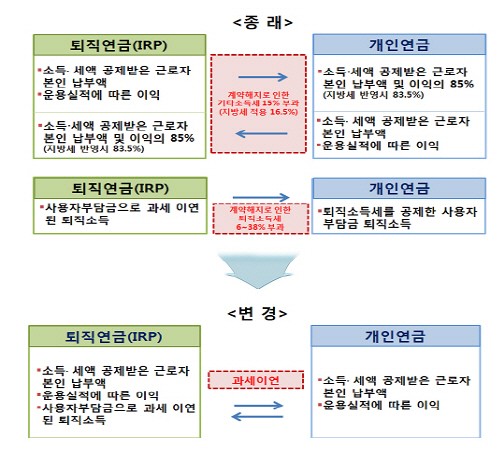
Amounts deposited into an IRP are eligible for a 16.5% tax deduction up to an annual limit of 9 million KRW. For employees with labor income, the deduction limit can be up to 9 million KRW, allowing you to get back 15% of the amount paid. Additionally, investment returns generated within an IRP account are taxed at a dividend tax rate of 15.4%, which is more advantageous than general stock investments. If an employee continues to maintain their IRP after retirement, they can delay the withdrawal timing until age 55, further reducing the tax burden. Moreover, utilizing an IRP when converting from a DB plan to a DC plan allows for staged payment of severance income tax, avoiding the tax burden associated with lump-sum deposits. Furthermore, the IRP serves as a safety net that can fill income gaps during the National Pension enrollment period.
How to maximize returns by including ETFs in your IRP: Investing at least 30% in bond-hybrid ETFs within your IRP account can reduce volatility while achieving returns that exceed the market average. In the second half of 2023, a product called “ACE US S&P 500 US Bond Hybrid 50 Active” was highly popular within IRPs. This product lowered the possibility of principal loss through a balanced portfolio of bonds and stocks. Also, when purchasing equity ETFs within an IRP, you should check the gap between your holding balance and the equity ETF purchase limit in advance. If your balance remains but equity ETF purchases are blocked, consider keeping a small amount of cash assets. This allows you to flexibly adjust your investment allocation within the IRP account. Additionally, check the trading fees when purchasing ETFs in an IRP. Since fees vary by financial institution, non-face-to-face account conversions often result in lower management fees.
IRPs offer excellent tax savings through tax deductions of up to 9 million KRW and low dividend income tax, and returns can be maximized by including ETFs.
3. Ensuring Stability in ETF Investments within IRPs
When investing in ETFs from an IRP account, adhering to the “30% safe asset principle” can lower the volatility of the entire portfolio. Bond-hybrid ETFs, commonly used in retirement pension IRPs, minimize principal loss even during stock market declines. For example, if you deposit 5 million KRW into an IRP and invest 1.5 million KRW in a bond-hybrid ETF, you can maintain stability regardless of market conditions. Also, when purchasing ETFs in an IRP, you should consider the tax benefits at the time of sale and purchase. Since dividend income tax is subject to a 15.4% separate taxation, the longer the holding period, the lower the tax burden. Therefore, even within an IRP, aggressive investors can increase their allocation to equity ETFs, while conservative investors can increase their allocation to bond-hybrid ETFs.
How to handle blocked ETF purchases in IRPs: There are cases where equity ETF purchases are blocked even if there is a remaining balance in the IRP. In such cases, it is helpful to keep a small amount of cash assets within the IRP account. By keeping cash assets, you can secure spare funds for future equity ETF purchases. Additionally, using the non-face-to-face conversion service for your IRP account can lower management fees, reducing investment costs. Employing a diversification strategy to avoid purchase restrictions is another method. By including at least 30% in bonds and maintaining a 70% stock allocation, you can preserve the stability of the entire portfolio.
When investing in ETFs within an IRP, it is effective to adhere to the 30% safe asset rule and employ a strategy of keeping cash assets when purchases are restricted.
4. IRP Transfers, Terminations, and Interim Fund Management Strategies
From 2022 to 2024, a total of 63.8 trillion KRW was transferred to IRPs. However, the termination amount for the same period was 43.4 trillion KRW, resulting in a termination rate of 68.1%, which requires caution. If you make a lump-sum deposit of your severance pay into an IRP, you may have to pay additional taxes upon early termination, so caution is needed. When transferring severance pay to an IRP account after converting from a DB plan, there are no termination fees, so it can be done without burden. Also, while IRPs allow interim withdrawals, you must pay a 16.5% miscellaneous income tax on the withdrawn amount, so early termination should be avoided when using it for long-term funds.
Termination timing and reinvestment timing for efficient IRP management: If the funds in your IRP account are over 5 million KRW and the investment period is more than 5 years, it is more advantageous to consider reinvestment rather than termination. This is because receiving it as a pension offers greater tax benefits. Also, fees are charged when terminating an IRP, so converting to a non-face-to-face account can save on fees. If you need emergency funds, withdrawing a small amount of cash products from within the IRP account is one method. This allows you to secure liquidity without compromising the stability of your overall retirement funds.
A long-term perspective is needed to avoid the high termination rate of IRPs, and pension receipt or reinvestment should be considered over termination.
5. Non-Face-to-Face IRP Account Opening and Fee-Saving Tips
KB Kookmin Bank now allows IRP accounts to be opened via non-face-to-face methods, making it easy for employees to use. Upon non-face-to-face conversion, management fees are lowered, reducing the fee from 0.25% to 0.1% for balances under 5 million KRW. Additionally, the documents required for opening are simplified, allowing you to start an IRP immediately with just an ID and account number. Non-face-to-face account opening allows you to use online convenience services, enabling you to check and transfer IRP funds anytime, anywhere.
Methods and precautions for reducing IRP account management fees: In addition to account management fees, ETF trading fees may occur in IRP accounts. Therefore, it is best to choose a non-face-to-face account that allows you to manage your IRP with minimal fees. Also, be aware that additional taxes may be imposed if you terminate your IRP early. After termination, tax benefits on the principal are also lost, so long-term fund planning is necessary. Finally, setting up automatic transfers in your IRP account is convenient as it can be used for insurance premiums or loan repayments.
Non-face-to-face IRP account opening reduces fee burdens, and long-term fund management can maximize tax benefits.
6. Future Prospects of IRPs and Action Checklist
IRPs have established themselves as essential financial tools for tax benefits and retirement preparation, with integration with digital platforms expected to become more active in the future. With the development of fintech technology, enrollment and management of IRP accounts will become simpler, and customized investment products will diversify. Additionally, as the government plans to expand tax support for retirement pensions, the utility of IRPs will increase further. To prepare retirement funds through IRPs, it is important to formulate a strategy that matches your income and investment style. For example, employees in their 30s and 40s should aim for long-term investment while filling the tax deduction limit, while those in their 50s and older should plan for a stable cash flow through pension receipt.
IRP Action Checklist: Check it out now – Are you receiving a tax deduction for your IRP contributions within the annual limit of 9 million KRW? (If not, consider additional contributions.) – Do safe assets (including bond-hybrid ETFs) in your IRP account account for at least 30% of the total? (If not, adjust your allocation.) – Have you kept a small amount of cash assets in case of restricted ETF purchases in your IRP? (e.g., 1 million KRW.) – Have you converted your IRP account to non-face-to-face to save on management fees? (If not, consider conversion.) – If you need to terminate or make interim withdrawals from your IRP, have you delayed it to reduce the additional tax burden? (Avoid termination unless for emergency funds.) – Are you diversifying your IRP funds according to your pension receipt plan to prepare for income gap periods? (Aim for a return rate of over 5% annually.)
IRPs are essential for tax savings and securing retirement funds, and must be managed consistently through a systematic checklist.