By correctly combining personal pension savings and individual retirement pensions (IRP), you can receive a tax deduction of up to 9 million won during your year-end tax settlement, securing a refund of several hundred thousand won. Many office workers sigh as they see taxes deducted from their monthly salaries, but in reality, not many people actively utilize tax-saving financial products to get their money back. If you have only envied colleagues who receive substantial refunds every year during tax settlement, it is time to start thinking about how to structure these accounts. Rather than simply letting money sit idle in a checking account, you must build a structure that captures both tax benefits and investment returns to achieve true financial success. This article covers everything office workers are most curious about, from calculating the tax deduction limit to the differences between the two accounts and practical methods for allocating funds.
=
How to Maximize Your 9 Million Won Tax Deduction for Personal Pension Savings: Methods and Recommended Strategies
1. Understanding the Basic Concepts of Personal Pension Savings and IRP
Personal pension savings is the most representative financial product that allows individuals to voluntarily enroll to prepare for retirement while enjoying tax benefits. It can be opened through banks, securities firms, or insurance companies. In particular, choosing to invest in funds or exchange-traded funds (ETFs) through a securities firm can yield high long-term asset growth. On the other hand, the Individual Retirement Pension (IRP) is a system that manages employees’ severance pay or additional contributions made by the individual to be used as retirement funds. Although these two products may look similar at first glance, they show clear differences in eligibility, the nature of the funds, and the proportion of assets that can be invested. Therefore, it is far more advantageous to view these two accounts not as separate products, but as one large pocket for retirement preparation.
Organically linking these two accounts creates a system that naturally grows assets and saves taxes, even without complex tax knowledge. For example, setting up automatic transfers for a fixed amount each month helps build the habit of saving money effortlessly. Starting small, with the mindset of saving the cost of a daily coffee, is the key to winning the long-term race.
Personal pension savings and individual retirement pensions are essential financial tools for achieving both retirement preparation and tax savings simultaneously.
2. The Golden Combination to Maximize the 9 Million Won Tax Deduction Limit

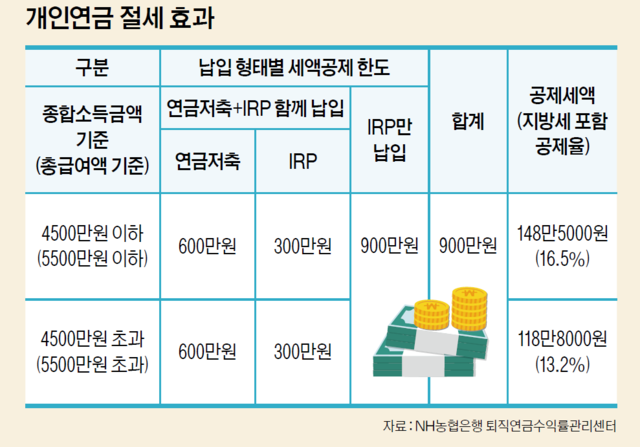
The annual tax deduction limit allows for a maximum deduction of 6 million won if only pension savings are used. By adding an additional 3 million won contribution to an IRP account, you can maximize the tax deduction benefit up to a total of 9 million won across both accounts. If you are an office worker with a total annual income of 55 million won or less, a deduction rate of 16.5% applies, allowing you to receive a surprising refund of up to 1.485 million won. Even if your total income exceeds this amount, you can still enjoy significant tax savings with a 13.2% deduction rate, making it an opportunity office workers cannot afford to miss.
In practice, an ordinary office worker earning 3 million won per month who contributes 500,000 won to pension savings and 250,000 won to an IRP each month will exactly reach the 9 million won limit annually. After consistently contributing for a year, you can directly see the substantial refund deposited into your account during the following year’s tax settlement season. While the monthly outflow may feel burdensome at first, once you experience the tax refund, you may actually feel motivated to increase your contributions.
The core of tax savings is maximizing the annual 9 million won tax deduction limit by combining 6 million won in pension savings and 3 million won in IRP.
3. Differences in Risk Asset Investment Limits and Response Strategies
In a personal pension savings account, you can freely invest 100% of your contributions in risk assets such as equity funds or ETFs. In contrast, an IRP account requires you to mandatorily hold at least 30% in safe assets, limiting risk assets to a maximum of 70%. Due to this regulation, those who prefer aggressive investing tend to favor pension savings accounts over IRPs, which impose more constraints on asset management.
However, you can use this constraint as an opportunity to build a balanced portfolio that enhances the stability of your overall assets. For example, if you want to increase your stock allocation, you can focus on buying aggressive equity products in your pension savings account while placing safe assets like bonds or deposits in your IRP. This approach allows you to accurately match your desired stock-to-bond ratio across both accounts while fully complying with legal regulations.
You should strategically allocate investment proportions between the two accounts, considering the 70% risk asset limit in IRP accounts.
4. How to Link and Utilize Comprehensive Asset Management Accounts (CMA)
The Comprehensive Asset Management Account (CMA) is called an all-purpose account because it allows you to manage various financial products in one place while enjoying tax-exempt benefits. One of its biggest hidden advantages is that when the account matures, you can transfer the funds to a pension account to receive additional tax deduction benefits. Not only does it reduce taxes when you withdraw money, but it also adds tax deductions on the amount contributed to the pension, making this process a must for financial experts.
If the maturity date of your CMA, where you have diligently saved for years, is approaching, try transferring the funds entirely to pension savings or an IRP. Moving a lump sum to a pension account at once provides a dual benefit of significant tax savings and a substantial boost to your retirement funds. If you are an office worker who has been actively investing, it is wise to understand these inter-account transfer paths in advance and execute them in time for the year-end tax settlement.
Transferring matured CMA funds to a pension account allows you to enjoy both additional tax deductions and tax-saving effects.
5. Precautions for Early Termination and Managing Fund Liquidity
Pension products are designed to provide true benefits only when held long-term, so terminating them early can result in a tax bomb. A 16.5% miscellaneous income tax is imposed on the principal for which you received tax deductions and the accumulated earnings, meaning you end up spitting out the taxes you saved all at once. Therefore, never put emergency funds or short-term money that you plan to use in the next few months into a pension account; keep such funds in regular deposits or products that allow free deposits and withdrawals.
You may occasionally see people around you trying to terminate their pensions due to urgent cash needs, which is one of the most foolish actions as it blocks the long-term compound interest effect. If you are in a situation where you inevitably need cash, it is far more advantageous to look into account-secured loans or exceptional withdrawal reasons permitted by law rather than early termination. Since this is money for your retirement, it is most important to maintain the account for a long time with an unwavering mindset.
Early termination requires returning all tax deduction benefits received, so you should only contribute with surplus funds that you can hold long-term.
6. Practical Steps for Successful Retirement Preparation
As retirement approaches, the importance of systematic asset management and tax-saving strategies multiplies, and only those who start preparing early can enjoy a comfortable retirement. Start practicing this method now: set up automatic transfers to your pension savings and IRP accounts on your payday, and live on the remaining amount. Saving is a matter of system rather than willpower, so the automatic transfer structure you set up once should make the money save itself.
No matter how the financial environment changes in the future, pension accounts that guarantee certain tax benefits will remain the most powerful wealth management tool for office workers. Starting today, check your annual income and contribution status, and if you are short of the limit, make additional contributions during the remaining period to definitely reach the 9 million won cap. Small changes in habits will create an asset difference of tens of millions of won in a few years and completely transform the quality of your life after retirement.
You should consistently contribute using an automatic transfer system to build a solid foundation for a prosperous life after retirement.
Frequently Asked Questions
=