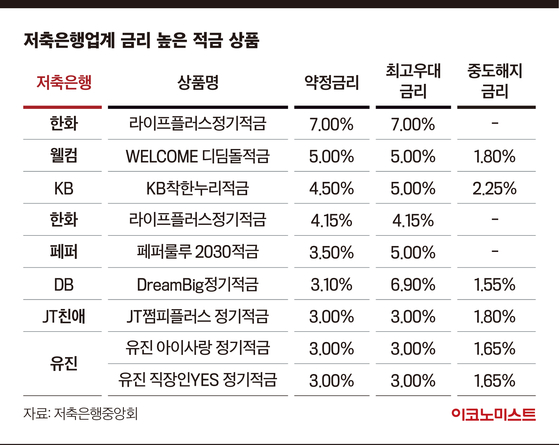
At this point, the most reliable method for asset growth is securing principal plus alpha through high-interest savings bank fixed deposits. As of late September 2026, despite slight adjustments in market interest rates, some savings banks are still offering attractive preferential rates of over 7% annually. In particular, the ‘TOK7 Fixed Deposit’ introduced by Woori Financial Savings Bank is gaining attention as a means to maximize short-term fund management efficiency, offering an annual interest rate of 7% for a 7-month term with a monthly limit of 500,000 won. Additionally, linked savings strategies involving government-supported financial products, such as the Youth Asset Building Account and the Youth Future Fixed Deposit, have become a major topic among individual investors. In this article, we introduce carefully selected active savings bank fixed deposit products that are worth signing up for immediately, reflecting the latest interest rate trends. Furthermore, since it is easy to chase high interest rates alone, we provide a detailed explanation of specific portfolio construction methods to overcome the period of falling interest rates through an appropriate allocation between demand deposits and systematic fixed deposits. We will break down key information along with practical tips to help you maximize your returns without gaps during the remaining few months until the end of the year.
=
September 2026 Savings Bank Fixed Deposit Interest Rate Comparison: A Comprehensive Guide to Key Strategies for Building a Lump Sum by Year-End
1. The Appeal and Realistic Limitations of High-Interest Savings Bank Fixed Deposits
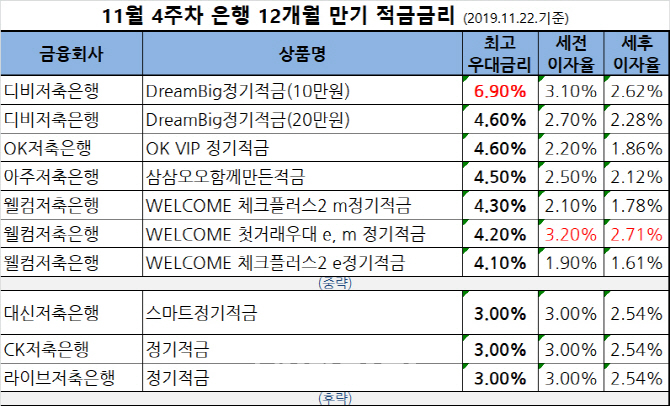
Savings bank deposit and fixed deposit products maintain a clear interest rate advantage over general commercial banks, meaning even small differences can make a significant impact over the long term. Especially during periods of fierce competition for new customers, you can expect high returns exceeding 7% annually if you meet the preferential conditions on top of the base interest. For example, if you save 500,000 won monthly for 7 months, you would earn approximately 240,000 won in interest at a commercial bank’s low rate, whereas a high-interest savings bank product could yield over 250,000 won. The issue is that most high-interest preferential rates require strict conditions, such as ‘non-face-to-face subscription’ or ‘automatic transfer for utility bills.’ Unlike in the past, the majority of products are now launched via mobile apps that do not require branch visits, sparking a race in non-face-to-face account opening speeds. However, a point to note is that for some products, the high interest rate is only applied if the automatic transfer setting is maintained for more than 3 months. Therefore, you must carefully read the terms to avoid actual losses due to early termination conditions or period restrictions that may arise from signing up based solely on the interest rate figure. It is a wise judgment to carefully consider these constraints and sign up based on your lifestyle patterns.
Although savings bank fixed deposits offer attractive high returns, you must verify the conditions for preferential interest rates and early termination regulations to actually maximize your interest earnings.
2. Woori Financial Savings Bank TOK7 Fixed Deposit: An Option for Short-Term Adventurers
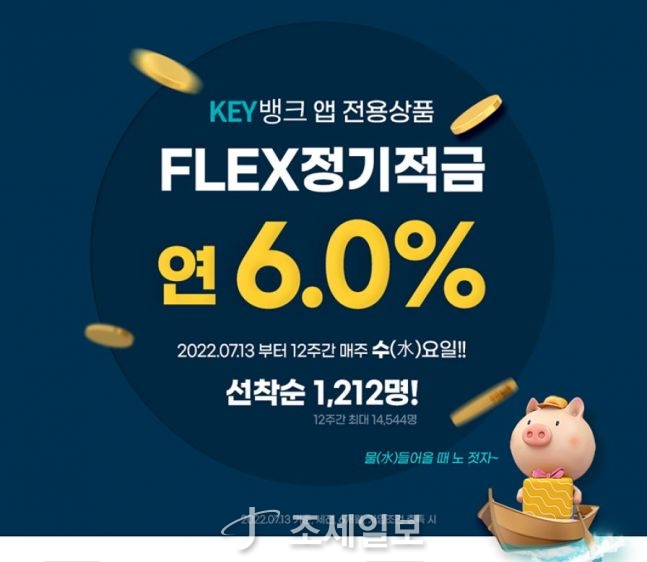
The ‘TOK7 Fixed Deposit’ from Woori Financial Savings Bank, which has recently drawn attention, has emerged as a core strategy for short-term fund management by simultaneously satisfying short maturity and high interest rates. This product offers an aggressive annual interest rate of 7% for a relatively short period of 7 months and sets a monthly contribution limit of 500,000 won, enabling manageable savings. For example, if you are an office worker whose funds are temporarily dispersed due to late marriage or job changes, it is highly effective to channel your idle cash assets into this product during that period. The 7-month period is shorter than the typical 1-year maturity fixed deposit, offering significant flexibility to move funds to their intended purpose or switch to a new high-interest product after the period expires. Notably, this product was launched in connection with the aforementioned ‘Udape’ event, meaning additional marketing benefits or prize drawing opportunities may be provided under specific conditions. To prepare for periods of rapid interest rate fluctuations in the short term, such short-term high-interest fixed deposits serve as the safest support for funds that cannot be locked in for long periods. Therefore, assuming you need to secure liquidity for about 7 months starting after your November payday, we recommend opening the app right now to check the minimum contribution amount.
The Woori Financial Savings Bank TOK7 Fixed Deposit presents an optimized strategy for short-term fund management with its combination of a 7% annual interest rate and a 7-month maturity, making it useful during periods requiring liquidity.
3. Strategic Combination of Youth Future Fixed Deposits and General Savings Bank Fixed Deposits
The strongest strategy for 2026 is to set the government-supported Youth Future Fixed Deposit as the ‘default’ rather than the entirety of your savings, and to layer a general savings bank fixed deposit suitable for your personal capacity on top of it, creating a double safety net. The Youth Future Fixed Deposit has the advantage of maximizing real returns through government contribution funds, but strict barriers exist in the form of contribution limits and eligibility requirements. For example, assuming you can contribute 500,000 won monthly, you could allocate 300,000 won to the Youth Future Fixed Deposit and 200,000 won to a high-interest savings bank fixed deposit. In this case, you enjoy the policy benefits guaranteed by the state while allowing the remaining amount to accumulate rapidly at the point when market interest rates are at their peak. This combination becomes the most realistic alternative for those in their late 20s to early 30s who are looking for successors to the Youth Asset Building Account or existing fixed deposits. General savings bank fixed deposits often offer flexible contribution features, serving as a complement that alleviates the fixed contribution burden of the Youth Future Fixed Deposit. This complex savings strategy lays the foundation for a stable form of asset building that remains unshaken even in an uncertain economic environment.
The optimal structure is a dual approach: fixing the policy benefit of the Youth Future Fixed Deposit as a fixed savings component, while diversifying the remaining surplus funds into general savings bank fixed deposits with high market interest rates.
4. The Necessity of a Short-Term Fixed Deposit Relay Strategy in Preparation for Falling Interest Rates
Between 2025 and 2026, deposit and fixed deposit interest rates are on a trend of being continuously adjusted downward, albeit slightly, depending on the direction of the Bank of Korea’s base interest rate. In this situation, entrusting all your assets to a single long-term 2-3 year fixed deposit could actually result in paying opportunity costs. Instead, we propose a ‘stem replacement strategy’ where you sign up for short-term fixed deposits of 6 months to 1 year, dividing the period, and switch to the savings bank product offering the highest interest rate at the time of maturity. This strategy is an active approach that adjusts the speed of fund management according to market conditions, much like soccer players adjusting their training intensity based on their team doctor’s advice. For example, if a short-term fixed deposit signed up in September matures in March, and interest rates have risen by then, you can immediately move the funds to a new high-interest product. Conversely, if interest rates have fallen, you can maintain the high interest rate of the existing 3-month contract while preparing your next move. This relay method provides room to recover from a single mistake and produces a magical effect of raising the average return rate in the long term.
During periods of high interest rate volatility, a relay strategy of cyclically signing up for short-term fixed deposits of 6 months to 1 year, rather than long-term deposits, is the best solution to minimize opportunity costs.
5. Non-Face-to-Face Channel-Led Subscription Procedures and Practical Contribution Management Tips
We have entered an era where there is no need to visit a branch in person to open a passbook, as most savings banks support non-face-to-face account opening and dedicated fixed deposit subscriptions via smartphone apps. However, since the identity verification process and the linking of transfer accounts via the app may not always be smooth, it is best to schedule this for a leisurely weekend afternoon. In particular, the ‘automatic transfer’ setting should not be the first step of savings; rather, it must be set precisely to match your payday or allowance payment date when funds actually enter the account. Remember that relying on the system rather than the habit of manually depositing money increases the long-term success rate of savings. Additionally, keeping app notifications enabled after subscription helps prevent interest losses due to unnecessary time passing as the maturity date or early termination eligibility date approaches. Since user experience varies greatly between savings bank apps, it is also a good method to refer to detailed reviews or community feedback before signing up to choose the one with the most intuitive interface. This systematic mobile environment setup transforms ordinary daily financial habits into a powerful asset-building engine.
To secure actual interest income, you must meticulously manage notification settings and optimize the timing of automatic transfers during the simple subscription process via non-face-to-face channels.
6. Actions Until the End of 2026 and Directions for Sustainable Asset Management
As of September 30, 2026, the savings behavior over the next 3 months will be a crucial decision point that determines success or failure. Rather than blindly signing up due to being dazzled by interest rate figures, you must choose the optimal fixed deposit product after fully understanding your monthly net income and expense patterns. Just before the end of the year, consumer sentiment tends to revive, leading to significant outflows of liquid funds; therefore, you definitely need a solid foundation of fixed deposit assets to withstand this period. As new products from major companies, including Woori Financial Savings Bank, are scheduled to continue launching, please continuously update and monitor information based on the content introduced today. Do not forget that what distinguishes the pros and cons of financial products is not the product itself, but the diligence and planning of the person managing it. When small amounts of starting capital are repeated and executed consistently, their value expands exponentially, guaranteeing future freedom of choice. We sincerely hope this article serves as a decisive weapon in your interest rate battle, and we encourage you to take the first step by launching the app today.
The top priority is to respond nimbly to the changing interest rate environment ahead of year-end and to establish a sustainable asset base through diligent execution of plans.
Frequently Asked Questions
=