Understanding the correct methods for receiving your retirement pension can save you millions of won in taxes and help secure your post-retirement assets much more effectively. Many employees inadvertently choose a lump sum upon retirement, only to face a significant tax burden and regret their decision later. For instance, Mr. Kim, an office worker in Seoul, received his severance pay in one go and had to swallow his disappointment due to the high tax rates applied. In this article, we will examine the precise differences between Defined Benefit (DB), Defined Contribution (DC), and Individual Retirement Pension (IRP) plans, along with optimal strategies to minimize taxes. This is essential practical information for those approaching retirement or planning a job change. We will break down complex tax laws and application procedures in an easy-to-understand manner, so please read through to the end.
=
2026 Ultimate Guide to Receiving Your Retirement Pension: Lump Sum vs. Annuity Differences and Tax-Saving Tips
1. Understanding the Basic Structure of Retirement Pension Receipt Methods
Before choosing how to receive your retirement pension, it is crucial to accurately understand the nature of the plan you are enrolled in. There are methods where the company manages the severance pay and pays a fixed amount, and methods where individuals manage the funds directly to maximize returns. The plans commonly encountered by employees are broadly divided into Defined Benefit (DB) and Defined Contribution (DC) types, each with distinct pros and cons. In a DB plan, the severance pay is determined based on years of service and average salary, making it more advantageous if your salary increased significantly during your tenure. On the other hand, in a DC plan, the company deposits a fixed amount into your personal account annually, and you directly select financial products to invest in.
If you prefer stability, a DB plan may be suitable, but if you want to actively grow your assets, a DC plan might be a better fit. When changing jobs or retiring, these funds must be transferred to an Individual Retirement Pension (IRP) account to enable normal pension receipt. Failing to understand this process properly can lead to unintended situations where you have to pay taxes prematurely, so caution is required. It is safe to check your account status in advance by visiting a financial institution or using a mobile app.
The asset management method and final receipt amount vary depending on the type of retirement pension plan, so you must first confirm your enrollment type.
2. The Decisive Difference Between Lump Sum and Annuity Receipt
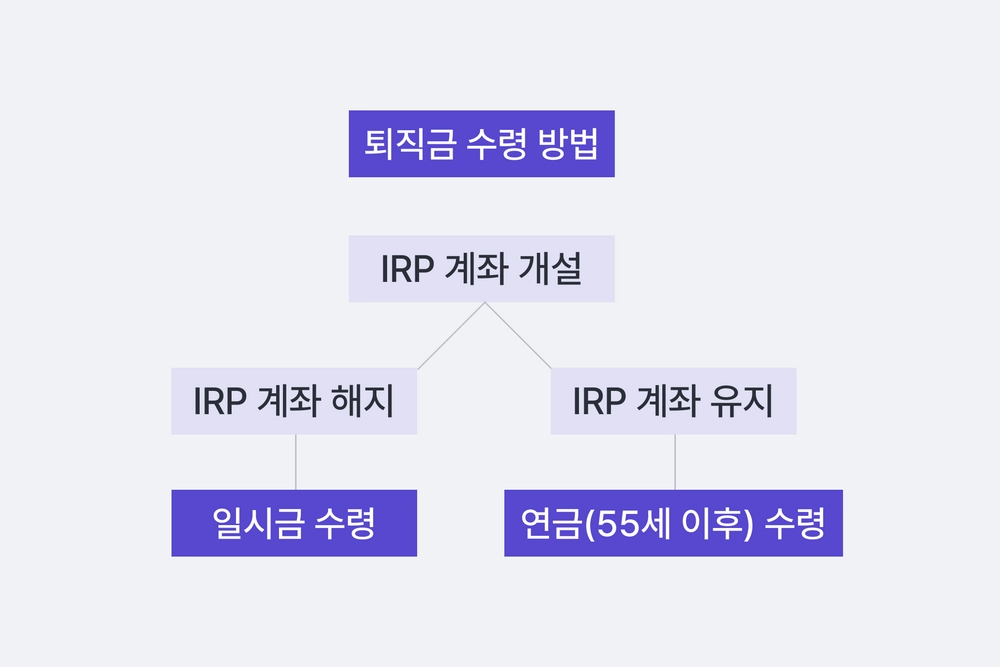
Whether to receive your retirement pension as a lump sum or as a monthly annuity is a core factor determining the scale of your post-retirement funds. Choosing a lump sum simply because you need a large amount of cash immediately can result in a sudden surge in tax burden, as severance income tax is applied all at once to the severance pay accumulated over decades. Conversely, if you receive it in the form of an annuity after the age of 55, a much lower pension income tax rate is applied compared to the interest income tax rate on general financial products. To fully benefit from tax laws, setting the pension receipt period to 10 years or longer is highly advantageous for tax savings.
In reality, you will often hear from those around you that having a steady cash flow coming in monthly after retirement makes managing living expenses much easier. There is also a risk that if you receive a lump sum and impulsively invest it poorly or spend it on unnecessary items, your assets could disappear in an instant. By maintaining an annuity account and continuing to invest in high-quality bonds or funds, you can enjoy the benefit of tax deferral and the effect of compound interest on asset growth. Therefore, unless you are in a special situation where you urgently need a large sum of money, receiving it as an annuity is far wiser for long-term asset management.
Choosing annuity receipt allows you to benefit from a much lower tax rate and tax deferral compared to a lump sum, helping to protect your valuable post-retirement assets.
3. Tax-Saving Strategies Using Individual Retirement Pension (IRP) Accounts

The Individual Retirement Pension (IRP) account is not just a container for holding severance pay but has established itself as an essential tax-saving tool for employees. It is very popular among employees because you can receive tax credit benefits if you contribute up to a certain limit during the annual tax settlement period. For example, by consistently saving within the annual contribution limit, you can enjoy the effect of receiving refunds ranging from hundreds of thousands to over a million won. The profits earned from directly managing various financial products within this account do not require immediate tax payment; they can be deferred until you receive the pension.
The tax deferral effect, which delays tax payment, is a hidden hero that maximizes compound interest over time, significantly increasing the final receipt amount. However, if you cancel the account without thinking just because you urgently need money, you may have to return all the tax benefits you received. Keep in mind that early withdrawal or collateral loans are only possible under exceptional circumstances permitted by law, such as purchasing a house or securing a deposit for a lease. If you make consistent additional contributions regularly, you can directly observe the pension amount you can receive at retirement growing noticeably.
The IRP account is the most powerful tax-saving means that allows you to simultaneously benefit from tax credits and tax deferral.
4. Procedures and Precautions for Applying for Pension Receipt After Age 55
Once you turn 55 and leave your job, you become eligible to formally proceed with the application for receiving your retirement pension as an annuity. In the past, you had to be enrolled for at least 5 years to receive it as an annuity, but accounts where severance pay has been transferred are exempt from this requirement, making it more convenient. Note that there is a regulation regarding the annual receipt limit in the first year of receipt, so you cannot simply withdraw a large amount all at once. If you try to withdraw money exceeding this limit, general miscellaneous income tax will be applied instead of pension income tax, which could actually result in a loss.
The application process can be handled conveniently and non-face-to-face through a smartphone app, or by visiting the branch of the financial company where you have an account. Prepare your ID, a copy of your bankbook, and documents confirming your retirement, and fill out the forms accordingly; payment will be made within a few business days. Since calculating the limit can be complex in the first year of receiving the pension, it is safe to consult with a dedicated asset management staff member. The upper limit of the pension amount you can receive each year varies depending on the account valuation and the year of receipt, so it is necessary to develop the habit of checking it annually.
When receiving a pension after age 55, you must always check the legally prescribed annual receipt limit in the first year and avoid excessive withdrawals.
5. The Default Option System and Wise Asset Management Methods
South Korea’s retirement pension system includes a mechanism where, if the subscriber does not give specific management instructions, the funds are automatically invested in pre-determined products. This is called the Default Option, a very useful system introduced to boost the returns of retirement pensions that are easily left neglected. If employees leave their severance pay only in principal-guaranteed products due to busy schedules, the real value of their assets will decrease as it fails to keep up with inflation. It is advisable to regularly check your portfolio and seek advice through expert seminars, either as you approach retirement or while still employed.
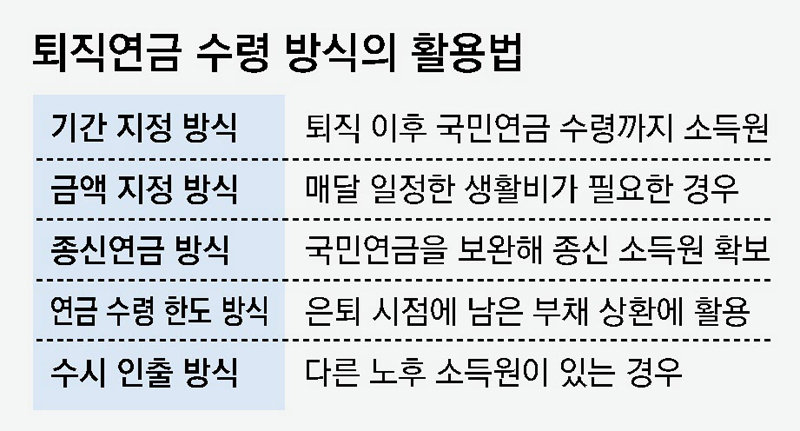
During the period of income gap before receiving the National Pension, you must cover living expenses by appropriately adjusting the monthly payment amount from your retirement pension. The quality of life after retirement changes completely depending on how you allocate your assets, so you must study and take an interest in it yourself. Recently, various financial institutions, including securities firms and banks, provide customized asset management consultations, so it is wise to utilize them actively. Focus on building a balanced portfolio that generates steady returns while minimizing the risk of principal loss, even in complex market conditions.
By utilizing the Default Option and active asset allocation, you can increase the returns of neglected retirement pensions and create a stable post-retirement cash flow.
6. Final Recommendations and Outlook for a Successful Retirement
The method of receiving your retirement pension is not just a technique for receiving money, but the final period of using the assets you have accumulated through a lifetime of work in the most wise manner. As aging becomes more severe in the future, retirement pensions and the National Pension will serve as the two major pillars supporting retirement. Since tax systems can change slightly over time, you must always keep an eye on the latest information and find the method most advantageous to you. Start with the small action of opening your smartphone app right now to check where your retirement pension account is and how much is in it.
Retirement is not the end, but the beginning of a new life, and for those who are prepared, leisurely times that they could not enjoy before are waiting. Imagine receiving a pension like a warm monthly salary while wisely avoiding tax bombs, and start making a plan step by step from now. We sincerely hope that you will share the tax-saving tips you learned today with your acquaintances and achieve a prosperous and happy retirement preparation together.
Thorough prior preparation and choosing the correct receipt method are the keys to completing a comfortable and leisurely retirement life.
Frequently Asked Questions
=