
The government’s ambitious push for a “productive finance” policy is causing significant shock as it is heading in a completely different direction on the ground. The Financial Services Commission (FSC) recently boasted about improved economic indicators, claiming them as evidence that capital is flowing smoothly into the industrial sector. However, a closer look reveals that this “success” stems not from investments in businesses, but from an explosion in stock trading centered on major semiconductor giants. Critics are piling on, arguing that the government is turning a blind eye to the fact that investors are merely passing stocks back and forth, allowing brokerage firms to pocket massive fee revenues. It is hard not to wonder where the original grand goal of diverting vast sums from real estate to productive enterprises has gone. Today, we will examine the uncomfortable truths hidden behind the brokerage firms’ lavish fee bonanza and why the financial authorities’ attitude is problematic.
=
Financial Services Commission’s Reality Blindness: Packaging a Brokerage Fee Bonanza as Productive Finance

1. The Gap Between the FSC’s Self-Praise and Reality

At a recent meeting, the Financial Services Commission emphasized the improvement in Gross Domestic Product (GDP) indicators, self-assessing their policies as successful. Their logic was that because finance supplied money to industry, a virtuous cycle was created where both the real economy and the financial sector grew simultaneously. These announcements make it sound as if the capital flow guided by the government has permeated the manufacturing sector, yielding visible economic results. However, hidden behind the rise in these macroeconomic indicators is a completely different reason that leaves the public bewildered. The definition of “productive finance” that the government has been shouting about and the actual flow of money on the ground are worlds apart. This attitude of the government acts as a factor that undermines confidence in the policy’s effectiveness, drawing widespread criticism. Critics point out that in their haste to package the results, the authorities are ignoring the structural market problems that truly need to be solved. It is time to seriously reflect on who the figures touted by the financial authorities are actually for.
While the FSC packages the improvement in macro indicators as a policy success, the actual flow of funds on the ground is far removed from the policy’s intent.
2. The Brokerage Fee Bonanza Created by the Samsung Electronics and SK Hynix Storm

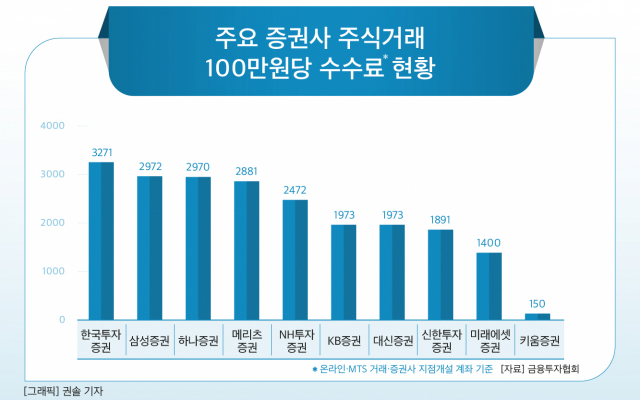
The decisive factor behind the massive profits earned by the domestic financial sector in the first half of this year was the investment frenzy surrounding specific large-cap semiconductor stocks. With stock trading centered on Samsung Electronics and SK Hynix surging, brokerage firms held an unprecedented fee bonanza. In fact, the brokerage fee revenue collected by domestic securities firms skyrocketed by nearly three times in just one year. Consequently, net income, which reflects all other costs and revenues, also recorded an unprecedented astronomical level, bringing smiles to the securities industry. It is true that because the stock market enjoyed such a boom, trading volumes increased, which temporarily contributed to nominal GDP growth. However, this has absolutely nothing to do with companies raising investment funds to build new factories or develop technology. Every time stock ownership changes hands from one investor to another, it is only the brokerage firms’ pockets that get fuller.
The massive net profits of brokerage firms are due to fee income from the surge in large-cap semiconductor stock trading, not from corporate investments.
3. Money That Moved from Real Estate to Stocks but Not to Companies

The core goal of the “productive finance transformation” that the government declared on a large scale last year was to make funds trapped in the real estate market flow into enterprises. To boost the productivity of the South Korean economy, innovative companies with high growth potential must be able to raise funds smoothly. However, the surge in stock trading volume this time did not go into corporate treasuries; it was merely an illusion generated by the process of hands changing between individuals and institutions. The virtuous cycle where money flows into companies to revitalize the real economy was nowhere to be found in this boom. As a result, the vast funds in the market did not head to productive areas but instead created a distorted structure that relies excessively on the volatility of specific large-cap stocks. The policy goal of curbing real estate speculation and boosting corporate investment, which the government had boasted about, lost its power in the face of the market’s immense greed. The harsh reality is that funds are circulating only to be used as tools for short-term profit realization by brokerage firms and some investors.
The surge in stock market trading is not a flow of funds into companies but merely a simple hand-to-hand transfer between investors.
4. Shabby IPO Results and the Broken Ladder of Growth

One of the clearest indicators of whether productive finance is working properly is IPO performance. According to data compiled by the supervisory authority, the scale of new shares raised through IPOs from the beginning of this year has plummeted to half of the level in the same period last year. Because all funds in the market are ruthlessly concentrated on a few large-cap semiconductor stocks, promising growth companies that are just starting out have lost their footing. The channel for companies to raise funds and grow through the securities market has been completely blocked, a dismal situation. In the healthy economic chain from investment to growth, and then to exit and reinvestment, IPOs play a crucial role in exiting investments. If this exit link breaks, reinvestment in the next stage becomes impossible, ultimately draining the vitality of the entire national economy. Due to the government’s policy failure, a paradox is unfolding where innovative companies that should be the future pillars of the economy are suffering from a funding drought.
Due to the concentration on large-cap stocks, IPO results have been halved, collapsing the funding ladder for growth companies.
5. Total Operating Surplus: A Homework Assignment, Not an Achievement
The increase in total operating surplus in the finance and insurance sectors, which the Financial Services Commission proudly touts, is by no means an indicator to celebrate. Instead, it should be regarded as a serious homework assignment that needs to be solved immediately and a warning sign of market distortion. It is disappointing to see the financial authorities, who should be deeply considering and revising policy supplements, instead promoting this as their own achievement. An official later explained that the figure describes the overall economy rather than being a direct result of productive finance. This attitude of changing the story every time a flaw in their own policy is exposed is the main cause of eroding the trust of market participants. The financial authorities, who should accurately diagnose the problem and provide the right prescription, are instead taking a bystander’s stance by ignoring reality. While brokerage firms are fattening their bellies with fees, small and medium-sized enterprises and venture companies that truly need money are bleeding out.
The indicator touted by the FSC is not an achievement but a task that must be solved immediately, yet the authorities are evading responsibility.
6. Government Awakening and Outlook for True Productive Finance

For the South Korean economy to achieve sustainable growth in the future, a major overhaul of the financial authorities’ complacent attitude is inevitable. It is not the time to be intoxicated by the statistical illusion that macroeconomic numbers have improved; we must face the places where real funds are needed. We must prepare practical incentives so that companies can invest freely and achieve innovation, and correct market distortions. Readers, too, must keenly observe the structural contradictions hidden behind the temporary stock market boom visible before your eyes. The financial authorities must now open their eyes wide, listen to the voices from the field, and realize true productive finance. We strongly urge them to stop boasting about hollow indicators, revitalize the IPO market, and make the bold decision to inject vitality into the real economy.
The financial authorities must move beyond statistical illusions and achieve a policy transformation for the substantive activation of corporate investment.
Frequently Asked Questions
=