The most advantageous way to receive your retirement pension is undoubtedly to receive it in installments through a pension account after the age of 55. Many people choose to receive a lump sum when they leave their company, but this leads to a fatal mistake: they end up paying a hefty tax bill ranging from several million to tens of millions of won. In fact, it is easy to find office workers around you who regretted receiving their retirement savings, accumulated over more than 10 years of service, directly into a regular bank account and were hit with a “bomb” of retirement income tax. Experts advise that to prevent financial ruin in old age, one must create a stable lifelong cash flow by combining the National Pension, corporate retirement pensions, and personal pensions. Therefore, we must accurately understand the standard receiving procedures and tax-saving methods that must be followed before the retirement funds reach our hands. From now on, we will carefully examine specific know-how for wisely preserving and growing your retirement funds. By reading this article to the end, you will fully understand how to minimize taxes and securely protect your assets for old age.
=
Retirement Pension Receiving Methods: Tax-Saving Tips and Everything You Need to Know About Receiving Pensions After Age 55
1. Basic Principles of Receiving Retirement Pensions and the Trap of Lump Sums
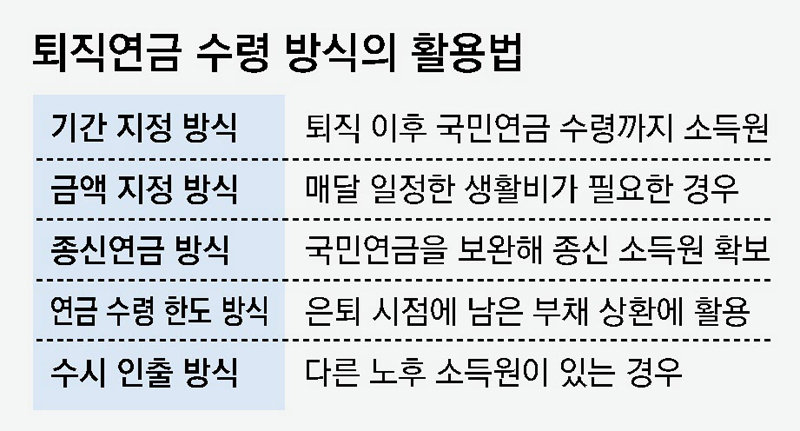
When receiving a retirement pension, you must first transfer the funds to an Individual Retirement Pension (IRP) account before deciding on the form of receipt. If the company directly deposits the retirement pay into the employee’s regular commercial bank account, it is legally treated as a lump-sum receipt, and retirement income tax is immediately imposed. For example, Mr. Kim, an office worker living in Seoul, retired from a company where he had worked for 15 years. Citing an urgent need for cash, he received his retirement pay directly into a regular account. As a result, he suffered the pain of paying hundreds of thousands of won in extra taxes because he failed to fully utilize the retirement income tax deduction benefits. This is a representative case of financial loss that occurs when the standard receiving principles are ignored. Only after the retirement benefits are deposited into an Individual Retirement Pension account are you qualified to choose whether to withdraw them as a lump sum or receive them as a pension in installments. If you rashly close the account and withdraw the funds as a lump sum just because you need a large amount of money immediately, all the tax benefits previously supported by the state will disappear. The biggest difference between receiving retirement pay as a lump sum and receiving it as a pension in installments lies in the type and magnitude of the applicable tax rates. If you withdraw everything at once as a lump sum, the retirement income tax rate is applied as is, resulting in a heavy tax burden on the large sum all at once. On the other hand, if you receive it monthly through a pension account after the age of 55, you can receive a reduction of 30% to 40% on the retirement income tax you would otherwise have to pay. Moreover, if the pension receipt period exceeds 10 years, the reduction rate increases further, becoming a powerful tool to drastically reduce the tax burden. In fact, simulations with 100 million won in retirement savings show that choosing pension receipt can save several million won in taxes. Therefore, unless there are special circumstances, it is far more advantageous to keep money that you do not need immediately locked in the pension account to maximize tax benefits.
Retirement pay must be transferred to an Individual Retirement Pension account, and choosing pension receipt over a lump sum allows for significant tax savings.
2. Complete Guide to Opening and Transferring Individual Retirement Pension Accounts
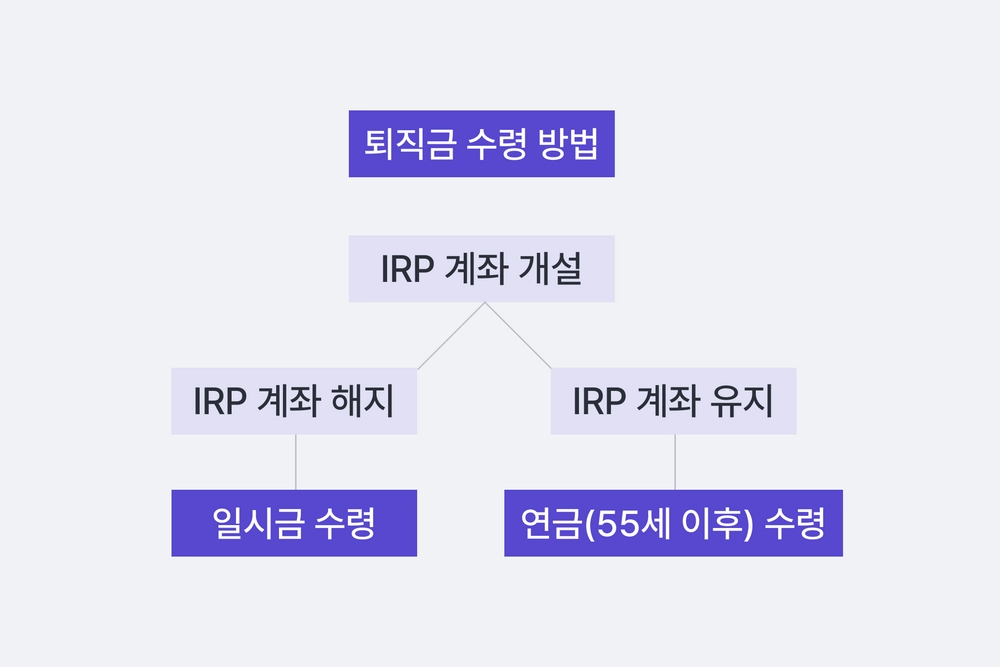
An Individual Retirement Pension account can be easily opened through your financial institution before leaving your company or immediately after retirement. It does not matter whether it is a bank or a securities firm; you can visit the financial company you usually use or create an account non-face-to-face via a smartphone app. Once the account is successfully opened, you must inform the relevant department at your company of your account number to ensure that your retirement benefits are safely deposited into this account. At this stage, it is crucial to thoroughly check the documents in advance and firmly request that the company does not mistakenly transfer the funds to a regular checking account. In reality, many retirees underestimate this procedure and are shocked to find themselves rushing to banks after being hit with a tax bomb. Once the retirement pay has been successfully deposited into the Individual Retirement Pension account, you enter the phase of active asset management and choosing the receipt method. Rather than leaving the money idle in the account, you can grow your assets by investing in deposits, bonds, or performance-linked products. If the subscriber is over the age of 55 and has met the 5-year subscription period requirement, they can proceed with the pension commencement application without delay. The application process is also very simple, allowing you to set up automatic transfers so that living expenses are regularly deposited into your account according to a designated date and cycle. Mr. Park, who retired in Busan, directly set his pension receipt cycle to the end of each month via a securities firm’s mobile app and is comfortably receiving his retirement funds. As shown here, the system is well-established, allowing you to receive pensions safely and transparently with just a few taps on your smartphone screen, without the need for complex document submissions.
Individual Retirement Pension accounts can be easily opened non-face-to-face, and if you are over 55 after retirement, you can easily start receiving your pension via smartphone.
3. Tax-Saving Tips to Avoid a Tax Bomb and the Tax Deferral System
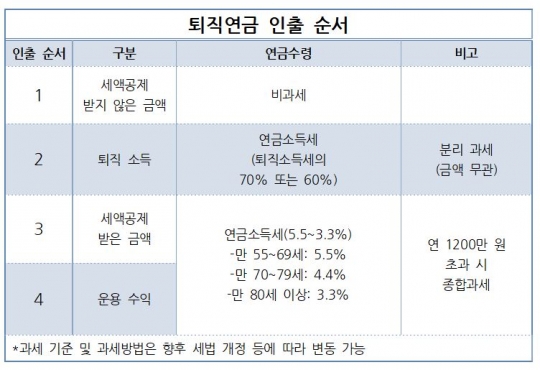
The most critical element in retirement pension receiving methods is undoubtedly the tax-saving technique of how much you can reduce your taxes. The state grants significant tax benefits when employees receive their funds in the form of a pension to help them maintain a stable livelihood after retirement. A representative system for this is tax deferral, a beneficial system that postpones the imposition of retirement income tax at the time of transferring retirement pay to a pension account. Taxes are only paid in installments at a lower tax rate when the pension is actually received after the age of 55, which greatly helps in securing a large sum of funds. For example, if you receive 200 million won in retirement pay as a lump sum, you must pay tens of millions of won in taxes immediately, but if you keep it in a pension account, the tax payment is deferred. The deferred taxes are settled at a pension income tax rate that is much lower than the original amount during the pension receipt period, resulting in a significant increase in actual income. Additionally, if you voluntarily make additional contributions to a pension savings or Individual Retirement Pension account every year, you can also enjoy substantial tax credit benefits during year-end tax settlement. Office workers with total income below a certain standard can receive refunds of hundreds of thousands to over one million won if they consistently contribute up to the limit throughout the year. Mr. Jeong, an office worker, receives a nice refund every year-end tax settlement season thanks to additional contributions to his Individual Retirement Pension, which he gives to his parents as pocket money. You must keep in mind that retirement pensions are not merely savings accounts for accumulating money, but the best legal tax-saving tool permitted by the state.
By utilizing the tax deferral system, you can postpone retirement income tax payment and apply a lower tax rate upon pension receipt, saving a significant amount of tax.
4. Conditions for Receipt After Age 55 and Exceptional Reasons for Early Withdrawal
To formally receive a retirement pension in the form of a pension, you must first meet the basic age requirement of being at least 55 years old. In addition to the age requirement, the subscription period for the relevant retirement pension account must be maintained for at least 5 years to qualify for formal pension receipt. However, life does not always follow the rules, and crisis situations requiring large sums of money may arise suddenly. Fortunately, the law recognizes unavoidable reasons such as the purchase of a home in one’s own name or securing a deposit for a lease for non-homeowners, as well as medical care or treatment for the individual or family members lasting more than 3 months. If you fall under these exceptional early withdrawal reasons, you can withdraw your retirement pension before the age of 55, subject to strict review. In fact, Mr. Lee, who lives in Daegu, was frantic due to his parents’ sudden hospital surgery costs but successfully withdrew his funds early by proving the medical care reason stipulated by law. However, since such early withdrawals deplete valuable assets that are like a lifeline for old age, they should be decided cautiously only in truly unavoidable situations. Additionally, there are exception clauses that allow small-balance accounts to be easily settled without complex procedures even before the age of 55. Nevertheless, breaking into your retirement pension for minor living expense shortages or impulsive consumption is equivalent to voluntarily giving up a stable life in the future. Therefore, no matter the temptation, the firm resolve to remember the original purpose of retirement funds and protect them to the end is most important.
Pension receipt is generally possible only after meeting the age of 55 and a 5-year subscription period, and early withdrawal is allowed only in exceptional cases such as home purchase or medical care.
5. Harmonious Cash Flow Design with National and Personal Pensions
To complete a successful life in old age, you must not rely solely on the retirement pension but harmoniously combine various pension products. As experts unanimously emphasize, the key is to build a sturdy triangular structure consisting of the National Pension, retirement pensions, and personal pensions. First, the National Pension, which is paid by the state for a lifetime, serves as the backbone responsible for a reliable basic living expense, and you may consider delaying the receipt period if necessary. On top of this, the retirement pension, accumulated as a reward for hard work at the workplace, becomes the second pillar, stably supporting living expenses from middle age onwards. Finally, adding personal pension savings prepared voluntarily by the individual completes a perfect lifelong income pipeline where cash flow does not stop even after retirement. Clients who visit recently opened retirement planning specialist lounges in the Chungcheong region are amazed after receiving a one-glance diagnosis of their multiple pension receipt structures. This is because simulating your expected cash flow in advance clearly reveals how much living expense will be lacking each month after retirement. For example, if you need 3 million won in living expenses per month and receive 1.5 million won from the National Pension, you can fill the remaining gap with your retirement pension and personal pension. By coordinating the timing and amount of pension receipts in advance, you can enjoy a leisurely life with hobbies without worrying about money after retirement. Do not think it is too late; it is a good idea to gather all your pension assets in one place and start a comprehensive check-up now.
You must design a stable cash flow structure that never stops for a lifetime by harmoniously combining the National Pension, retirement pension, and personal pension.
6. Certain Investment and Withdrawal Strategies to Prevent Financial Ruin in Old Age
Leaving money idle in a retirement pension account is a dangerous action where the actual asset value is eroded by inflation. If stocks serve as a powerful engine for asset growth, safe bonds play the role of an unshakable anchor, so the two assets must be mixed appropriately. Recently, various products such as personal investment government bonds and guaranteed performance-linked insurance have been launched, allowing retirees to manage their assets without burden. Even retirees who are struggling to find a suitable investment destination can form a customized portfolio suited to their tendencies by receiving expert advice. Customers who are already over 55 need the wisdom to start receiving their pension immediately upon subscription while safely growing their remaining assets. Life after retirement is much longer than one might think, so the skill of withdrawing assets stably in installments until death, rather than using them all at once, is essential. You must maintain a method of consistently withdrawing a fixed amount each month while practicing to flexibly adjust the pension receipt amount according to market conditions. Those who do not be fooled by flashy investment rumors around them but maintain their own pace and quietly protect their retirement assets become the true winners. Starting today, please carefully check the status of your retirement pension account and seriously consider the most advantageous receiving method. Thorough preparation and wise choices will be the only key to making the long golden age of old age the most abundant and happy.
You must prevent financial ruin in old age by mixing stocks and bonds in balance to grow assets and using a strategy of stable, installment withdrawals until death.
Frequently Asked Questions
=