The retirement pension system is an essential financial asset management framework that employees must understand to secure stable funds for their post-retirement life. If you simply leave your monthly pension contributions untouched or overlook them based solely on their name, your real asset value may decline as it fails to keep pace with inflation. It is natural to feel envious when you see colleagues receiving substantial tax refund benefits during the year-end tax settlement or earning decent returns through investment products. However, surprisingly few employees accurately know which type of pension plan they are enrolled in or how their funds are being managed. In this article, we will thoroughly examine the structural differences between Defined Benefit (DB) and Defined Contribution (DC) plans, as well as safe asset management methods that are currently gaining attention. Let us explore specific ways to choose the most advantageous option to protect and grow your valuable retirement assets.
=
A Complete Guide to the Differences Between DB and DC Pension Plans and Switching Strategies
1. The Two Faces of Retirement Pensions: Basic Concepts of DB and DC Plans

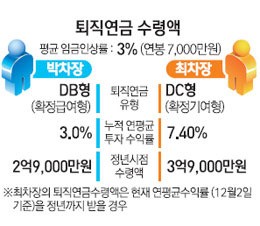
The Defined Benefit (DB) plan is a type of pension where the level of retirement benefits an employee will receive is predetermined. According to consultation materials from the Ministry of Employment and Labor, the statutory minimum retirement benefit for a DB plan is calculated by multiplying the number of years of service by the average wage at the time of retirement divided by 31. In other words, since the company directly manages the pension assets and bears the associated responsibilities, this structure is highly advantageous for employees whose wages consistently rise. On the other hand, the Defined Contribution (DC) plan is a system where the company deposits at least one-twelfth of the employee’s annual total wages into an account in the employee’s name each year. Employees must directly select and manage financial products to grow their accumulated funds, and their final retirement amount is determined by the results of these investments. For example, if an employee named Kim invests in aggressive equity funds or Exchange-Traded Funds (ETFs) in their DC account and achieves high returns, the profits belong entirely to them. Conversely, if the investment fails and results in a loss of principal, the employee must bear that responsibility entirely, requiring a cautious approach. Thus, the biggest difference between these two systems lies in who manages the assets and where the responsibility lies.
DB plans are advantageous during periods of wage growth because the amount received at retirement is fixed, while DC plans allow you to grow your assets based on your own investment performance.
2. Principal and Interest Guaranteed Products Are Not All the Same: How to Choose Deposits Wisely
Many employees choose fixed-term deposits or various principal and interest guaranteed products to manage their retirement pension assets safely. However, just as with general bank deposits, blindly signing up based only on the name can lead to unexpected disadvantages or a failure to fully enjoy interest rate benefits. In addition to fixed-term deposits, various financial products exist under the umbrella of “principal and interest guaranteed,” such as interest-guaranteed insurance, equity-linked bonds (ELBs), government bonds, and issued promissory notes. For instance, some products significantly reduce the agreed interest rate upon early termination, while others guarantee the interest rate at the time of enrollment until maturity, serving as an excellent safe haven in volatile markets. Recently, it has become easier to allocate retirement pension funds to safe government bond products guaranteed by the state, broadening the range of choices. Therefore, rather than simply trusting the label “principal and interest guaranteed,” you should carefully examine the enrollment period, early termination interest rates, and the creditworthiness of the issuing institution for each product. Choosing the optimal product that matches the nature of your assets is the shortcut to securing both the safety and profitability of your retirement funds.
Even for principal and interest guaranteed products, the structure and early termination conditions vary, so you must carefully compare interest rates and maturity conditions before making a selection.
3. Switching My Retirement Pension: Is It Really Okay to Do It Now?

During your working life, you will likely see colleagues moving their retirement pension accounts to better financial institutions or switching products. With emerging securities firms aggressively entering the market by offering lower fees and superior mobile application usability, the demand for switching is steadily increasing. In fact, the market landscape is being rapidly reshaped, with some securities firms recently seeing their pension assets surpass hundreds of billions of won in a short period, attracting many employees. However, you should absolutely avoid moving your valuable pension funds without a plan just because others say it is a good idea. You must first accurately confirm when your current product matures and whether there are any exit fees or losses associated with early termination. Additionally, you should calmly review whether the portfolio diversity and asset management systems of the new financial institution align with your investment style. Moving your account impulsively without thorough prior analysis can lead to the mistake of losing the preferential interest rate benefits you were previously enjoying.
When switching retirement pensions, first check the fee conditions and the maturity status of your existing products, and carefully consider whether the new financial institution suits your investment style.
4. The Flower of Year-End Tax Settlement: Tax-Saving Strategies for Pension Savings Funds and IRP Accounts
Every year during the year-end tax settlement season, employees look forward to and carefully manage the process of securing refunds through tax deductions. Utilizing both pension savings funds and Individual Retirement Pension (IRP) accounts, which are representative tax-saving accounts, allows you to enjoy significant tax benefits within the contribution limits. For example, consistently accumulating a fixed amount each month can significantly reduce your tax burden at year-end, resulting in a tangible increase in your disposable income. While both accounts share the common goal of long-term accumulation for retirement, there are subtle differences in the range of available financial products and specific regulations. Some investors focus on asset growth by constructing portfolios centered on aggressive equity ETFs, while others prefer a safe, bond-centric dividend strategy. It is important to allocate assets in a ratio that suits you to create an environment where you can sleep soundly even in highly volatile markets. To capture both the benefits of tax deductions and investment returns, it is essential to adopt a strategy of maximizing the limits of both accounts.
By appropriately utilizing pension savings funds and IRP accounts, you can achieve both year-end tax deductions and asset growth.
5. How to Construct a Retirement Pension Portfolio Linked to Global Stocks
Recently, many investors are diversifying their retirement pension portfolios by looking beyond the domestic market to global markets, including U.S. stocks. Retirement funds for major pension funds worldwide and overseas employees are also deeply linked to massive global indices and blue-chip stocks to grow their assets. Large-scale global index funds or index products tracking the Nasdaq-100 have already established themselves as a core pillar of the global capital market. An increasing number of employees are actively including these representative global indices or ETFs in their retirement pension accounts to enjoy long-term compound interest effects. For example, practicing diversification by appropriately allocating between safe assets and risky assets can minimize the impact of market crashes. However, emotional selling driven by exchange rate fluctuations or short-term market index declines is the enemy of long-term investing. A strategy of patiently holding global blue-chip assets that steadily rise over the long term in your retirement pension will make your post-retirement life more abundant.
Using ETFs linked to representative global indices in your retirement pension account can help you expect long-term asset growth.
6. How to Use Retirement Pensions for Safe Monthly Dividends and Practical Suggestions
For those approaching retirement or concerned about their post-retirement cash flow, monthly dividend income is an attractive alternative above all else. By utilizing retirement pension or IRP accounts, you can construct a portfolio that receives regular monthly dividends while safely protecting your principal. For example, you can apply a method that appropriately allocates between safe bond assets and assets with high dividend tendencies to lower the risk of loss. Since retirement assets are difficult to recover from even a single failure, strict loss limitation and a principled asset allocation strategy are paramount. Start by opening your HomeTax or financial institution app today to check which type of pension plan you are enrolled in. A small amount of interest and active account management habits will return as a powerful magic that completely changes your retirement account balance in a few years. Take the first step now toward the solid economic freedom befitting the coming era of longevity.
By building safe asset allocation and monthly dividend cash flow through your retirement pension account, you can prepare successfully for retirement.
Frequently Asked Questions
=