
With the U.S. Senate’s procedural vote on the Clarity Act scheduled for the 15th and the Federal Reserve’s interest rate decision looming, the Bitcoin market is showing a clear downward trend. Facing a major event that could completely reshape the virtual asset regulatory framework, investors are pausing their trades and maintaining a wait-and-see stance. I, too, spent last night staring at the charts, wondering when to hit the buy button, only to sigh as prices swung wildly over a single comment from the political sphere. In this article, we will examine the atmosphere of the virtual asset market, which stands at a crossroads of massive institutional change, and look closely at the response strategies we should adopt. Rather than trembling in vague fear, we must calmly grasp the core of the regulatory bill to prevent unproductive losses. Let us analyze the key variables shaking the market, step by step.
=
Analyzing the Impact on the Bitcoin Market Ahead of the Clarity Act Senate Vote

1. Core Regulatory Changes in the Clarity Act
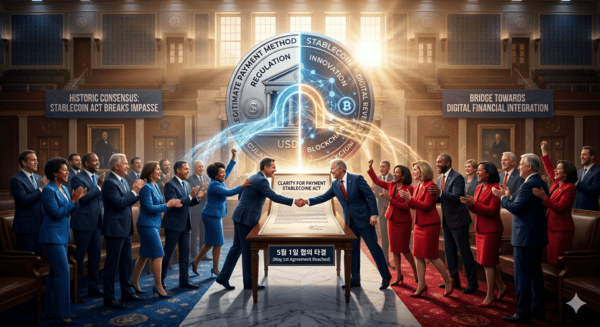
The 600-page draft of the Clarity Act currently under review provides specific guidelines for the entire virtual asset industry, including decentralized finance (DeFi). As an attempt to bridge the massive regulatory gap between the traditional financial sector and the virtual asset market, it focuses on clearly defining the scope of virtual asset-related activities for traditional financial institutions. If this complex regulatory framework is fully established, numerous projects previously left in legal gray areas will have a significantly higher chance of being integrated into the mainstream system. However, this process will demand a very high level of compliance capability from companies, and those unprepared may suffer significant blows. In fact, talking to my coin-investing colleagues, I can easily see them deeply troubled by the dilemma between the long-term benefit of entering the mainstream system and the immediate, stringent conditions. It is crucial to remember that the direction of future capital flows could change entirely depending on how the bill’s detailed provisions are finalized.
The sheer volume of the bill draft is also evidence of its powerful potential impact on the market. Rather than focusing solely on immediate price fluctuations, we should keep a close eye on the fundamental improvement of the ecosystem brought about by this institutional reform.
The Clarity Act is a large-scale attempt to integrate virtual assets into the mainstream system and eliminate the regulatory gap with traditional finance.
2. Why the Passage of the Senate Procedural Vote Is Uncertain
For the Clarity Act to pass the final floor vote, it must secure overwhelming support of at least 60 votes in the Senate, but current political opinions are sharply divided. In particular, the opposition party is demanding stronger bipartisan ethical standards and investor protection measures, making it realistically very difficult for the bill to pass in its original form. I recently watched a broadcast of a U.S. policy debate and observed the tense standoff between political factions; each time the bill’s processing was delayed over a minor condition, I witnessed a flood of disappointment-driven selling. If stringent requirements continue to be added beyond expectations, the shock to the market could be much greater than anticipated. Given the entanglement of political interests, it is difficult to predict the outcome until the day of the vote, and investor anxiety is at its peak.
The process of crossing the threshold of the National Assembly or Parliament is always a series of numerous variables and compromises, so we must abandon the complacent expectation that it will pass in one go. It is essential to monitor political news in real-time and respond flexibly.
Due to political disagreements within the Senate and stringent demands for ethical regulations, the likelihood of the Clarity Act passing in its original form is not high.
3. Realistic Volatility Response Strategies for Investors

Currently, investors are facing the double burden of the Clarity Act’s outcome and the Federal Reserve’s interest rate decision, making it a very painful time to time their trades. If the benchmark interest rate is likely to remain high for an extended period, it will inevitably act as a fatal negative factor for Bitcoin, classified as a risky asset. Conversely, if inflation slows down and expectations for rate cuts revive, the bill’s passage could combine with this to secure strong upward momentum. Therefore, in such a mixed market, it is wise to adopt a strategy of thoroughly diversifying risk by observing market volatility rather than betting all assets in one direction. I, too, am preparing for the coming storm by adjusting my portfolio weights and increasing my cash holdings.
In phases where macroeconomic indicators and legislative news intersect, one must absolutely avoid emotional chasing buys. The patience to calmly observe until the market finds a clear direction is the most powerful weapon.
In a double-burden phase where interest rate policy and regulatory issues overlap, risk management takes precedence over betting on a specific direction.
4. Investor Sentiment Shown by the Fear and Greed Index
The current Fear and Greed Index for the virtual asset market stands at 61, remaining in the “Greed” zone, indicating that investor expectations have not been completely crushed. This metric suggests that the market’s expectations for the bill’s passage are reflected to some extent, but it also serves as a warning that a correction could come at any time. As the index approaches 100, the risk of a sharp price drop caused by a flood of overbought selling triggered by even a small negative news item becomes very high. In fact, countless investors have suffered painful experiences in previous bull markets, buying on news when the Greed Index was high only to see their assets halve in an instant. If objective indicators point to overheating, it is necessary to step back and observe the market with cold, cautious judgment.
Blindly hitting the buy button driven by herd mentality is a shortcut to eroding your account in the long run. Do not ignore the danger signals suggested by the indicators; always cultivate the habit of assuming the worst-case scenario.
Since the Fear and Greed Index remains in the “Greed” stage, one must prepare for the possibility of a sharp price correction due to overbuying.
5. Why Altcoins Are Shaking More Than Bitcoin

The fundamental reason why major altcoins like Ethereum and Ripple are falling much more sharply than Bitcoin is that market funds are concentrating solely on the “blue chip” safe asset. As uncertainty across the entire virtual asset market grows, investors show a clear tendency to sell altcoins and buy Bitcoin to reduce risk. In particular, this Clarity Act is closely linked to the securities classification issues of altcoins in general, so anxiety will not subside until the regulatory scope is clarified. Altcoin investors around me are often so terrified that the survival of their projects has become uncertain that they lose sleep at night. In a situation where it is unclear where the blade of regulation will fall, cautious approaches are required for volatility-sensitive altcoins for the time being.
If the drop in altcoins is excessive compared to the movement of blue chips, it is clear evidence of how much the sentiment of market participants has been suppressed. Efforts to thoroughly verify the fundamentals of individual projects must precede premature bargain hunting.
Altcoins are suffering greater damage than Bitcoin due to regulatory uncertainty and the market’s preference for safe assets.
6. The Importance of Checking Policy Updates and Final Recommendations

Massive regulatory issues like the Clarity Act undergo multiple content changes from the initial draft to the finalization of the revised version, making it crucial to track accurate information in real-time. Relying solely on hearsay from internet communities or blog posts with sensational titles will likely lead to missing detailed content changes and causing trouble. You must definitely develop the habit of directly verifying the bill’s original text and revision records through official congressional websites or reputable economic media. The ability to collect data based on facts, without being swayed by uncertain rumors, is the only way to survive in this highly volatile market. The Bitcoin market will ultimately find its own path, so an attitude of not being overly elated or depressed by immediate price fluctuations is necessary. I sincerely encourage you to become a wise investor who establishes your own solid investment principles and responds calmly according to them.
The massive wave of regulation is a gate that the virtual asset market must inevitably pass through to mature to the next level. Only by closing your ears to the noise of the news and focusing on the essence can you achieve long-term profits.
Checking the latest policy updates through official channels is essential, and investment principles that are not swayed by the news are required.
Frequently Asked Questions
=