Pension savings accounts are the most powerful tax-saving tool, offering tax deductions of up to 9 million won annually during year-end tax settlement. Mr. Kim, an office worker, was disappointed by the smaller-than-expected refund he received last year, but after learning how to use pension accounts to reclaim taxes, he has been consistently depositing money every month. While many people view these accounts simply as savings products for retirement, they are also a core channel for asset management, allowing direct investment in stocks and exchange-traded funds (ETFs). Since these are long-term savings accounts intended to secure stable living expenses in old age, it is crucial to carefully consider the enrollment period and payout age requirements. In this article, we will walk you through the precise tax benefits and asset management strategies for pension savings accounts, tailored for beginners.
=
Tax Deduction Limits for Pension Savings Accounts and Essential Conditions to Check Before Enrolling
1. Everything About Tax Deductions and Contribution Limits for Pension Savings Accounts

Pension savings accounts are eligible for tax deductions on contributions up to 6 million won annually, or up to 9 million won when combined with individual retirement pension (IRP) accounts. If your total annual income is 55 million won or less, you can receive a refund of 16.5% of your contributions; if it exceeds this amount, the refund rate is 13.2%. Mr. Park, a young professional, sets up automatic monthly transfers of 500,000 won to his pension account and enjoys the substantial tax refunds he receives at year-end. Simply maxing out the tax deduction limit can yield a real return rate far higher than bank deposit interest.
Because the tax benefits are so significant, it is not uncommon to see people cutting back on their living expenses to forcefully meet the contribution limit. However, a much wiser approach is to consistently contribute an amount that aligns with your income level and cash flow. The year-end tax settlement refund is like a bonus from the state for office workers who have diligently saved throughout the year, so do not miss this opportunity. Keep in mind that the amounts contributed will be subject to income tax when the pension is eventually received, so you must consider both immediate tax savings and future tax liabilities holistically.
You can receive tax deductions of up to 9 million won annually by combining pension savings and retirement pensions, with refund rates ranging from 13.2% to 16.5% depending on your income bracket.
2. Investment Methods for Simultaneous Retirement Preparation and Asset Growth

A pension savings account is not merely a place to park idle money; it is a comprehensive asset management account that allows investment in various exchange-traded funds (ETFs) and mutual funds listed on the stock market. Recently, it has become possible to freely trade products within the account, including global semiconductor companies leading the AI industry and funds tracking U.S. dividend stock indices. For instance, more office workers are adopting investment strategies that reinvest monthly distributions to maximize the effect of compound interest. By utilizing asset allocation services provided by securities firms, you can adjust your portfolio monthly based on expert advice to pursue stable returns.
Unlike regular stock accounts, taxes on profits generated within a pension account are deferred until the pension is actually received. This tax deferral allows you to fully benefit from compound interest, meaning asset growth is significantly faster in the long term compared to regular accounts. Many parents also open these accounts early to facilitate long-term asset formation for their children, and the difference in investment performance becomes increasingly apparent over time. However, when investing in overseas equity products, you must carefully examine exchange rate risks and fee structures to select stocks that match your investment style.
Pension savings accounts allow investment in domestic and international ETFs and dividend stocks, maximizing compound investment returns through tax deferral.
3. Essential Conditions and Payout Requirements to Verify Before Enrolling
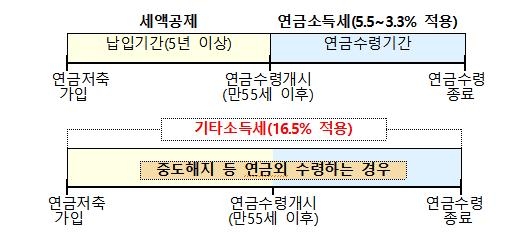
Since pension savings accounts are long-term products designed to secure stable living in old age, strict conditions and penalties apply if you withdraw funds prematurely. To receive funds at the standard pension income tax rate, you must be at least 55 years old and have maintained the account for at least five years. If you fail to meet these conditions and urgently withdraw funds or close the account, you must return all the tax deduction benefits previously received. In fact, Mr. Lee, an office worker, had to close his account midway due to an urgent need for cash and later deeply regretted it after receiving a massive tax bill for miscellaneous income.
Therefore, the principle is to fund your pension account with surplus money that you can lock away for at least 10 years without affecting your daily life. If you find yourself in an unavoidable situation where you need cash, consider utilizing collateral loans within the account or withdrawing only a portion of the funds rather than closing the account entirely. You should develop the habit of frequently checking your enrollment date and expected payout timing via your financial institution’s website or mobile app. As your retirement date approaches, it is essential to engage in retirement planning that calculates whether to extend the payout period or receive a larger lump sum.
You must be at least 55 years old and have a 5-year enrollment period to receive standard pension payouts; early termination results in tax disadvantages.
4. The Decisive Differences Between Pension Savings Insurance and Pension Savings Funds
Pension insurance and pension savings funds, which many people confuse, differ vastly in their tax structures and asset management methods. Insurance products typically involve paying a fixed premium monthly, whereas pension savings funds opened at securities firms allow you to freely buy and sell stocks or ETFs of your choice. In recent years, as the returns on equity assets have significantly outperformed bank deposit rates, there has been a sharp increase in customers preferring investment-type products. Mrs. Choi, a housewife, felt frustrated by the low returns of her previous pension insurance policy and has since transferred her contract to a securities firm account to invest directly in U.S. equity products.
While insurance products offer stability, there is a risk that their real asset value may actually decrease when inflation is taken into account. On the other hand, fund or ETF accounts carry the risk of principal loss depending on market conditions, but they offer the potential for higher long-term asset growth. It is essential to frequently check your contract status and compare returns via the mobile apps of various financial institutions. You should calmly assess whether your investment style leans toward stability or aggressive growth before selecting the appropriate product to avoid regret.
Pension savings insurance is stable but offers lower returns, while pension savings funds allow direct investment, enabling the pursuit of higher long-term returns.
5. Practical Tips for Avoiding Early Termination and Tax Bombs
The biggest enemy when managing a pension savings account is early termination due to unexpected expenses and the resulting heavy tax burden. As mentioned earlier, a high miscellaneous income tax rate of 16.5% is applied upon termination, instantly wiping out the tax-saving benefits accumulated over time. Mr. Kim, an office worker, once closed his account because he needed a large sum of money to move, unaware of the consequences, and was left in despair upon receiving the tax notice. To prevent this, you need the wisdom to maintain a separate emergency fund account and treat your pension account as a sacred, untouchable asset.
If your annual payout amount exceeds a certain threshold at the time of pension receipt, it may become subject to comprehensive income tax, requiring a strategy to spread out the payout timing. It is now standard practice in retirement planning to start receiving the pension in small installments from age 55 to fill the income gap after retirement while minimizing the tax burden. Actively utilizing customer service centers or expert consultation services from financial institutions can greatly help in creating the most advantageous payout schedule for you. Simply understanding and responding to the tax structure can make your post-retirement life much more abundant and comfortable.
A 16.5% miscellaneous income tax is imposed upon early termination, so it is essential to manage emergency funds separately and adopt a strategy to spread out payout timing after retirement.
6. Outlook for Utilizing Pension Savings Accounts for a Successful Retirement
In the future asset management market, how skillfully you handle your pension savings account will be a key factor determining your quality of life after retirement. The government is also gradually expanding benefits to keep pace with the aging population, such as increasing tax deduction limits and allowing the inclusion of a wider variety of financial products. By consistently holding high-quality assets like global semiconductors or dividend stocks in line with the changing investment environment, you can build a solid retirement fund. Small actions, such as opening your securities firm’s app right now to check your contribution limit and reviewing your automatic transfer settings, can change your future.
I recommend that you start today by consistently contributing an appropriate amount to your pension account each month to secure both tax benefits and investment returns. It is most important to establish a long-term investment plan tailored to your income and consumption patterns, rather than being swayed by rumors. If you diligently take one step at a time toward the distant goal of retirement, a day will surely come when you can enjoy life with a smile and leisure. We wish you success in your asset management and hope that you will definitely receive a full tax deduction starting next year based on what you have learned today.
Pension savings accounts are an essential asset management tool in the era of aging; consistent long-term contributions and strategic investment are the keys to success.
Frequently Asked Questions
=